RelayThat Review (2026): DCO Pricing, Limits & Alternatives
Bottom line
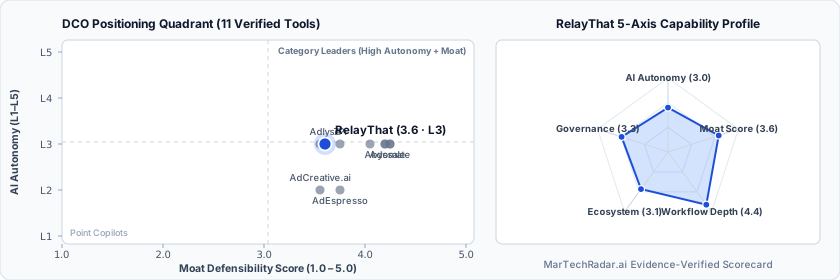
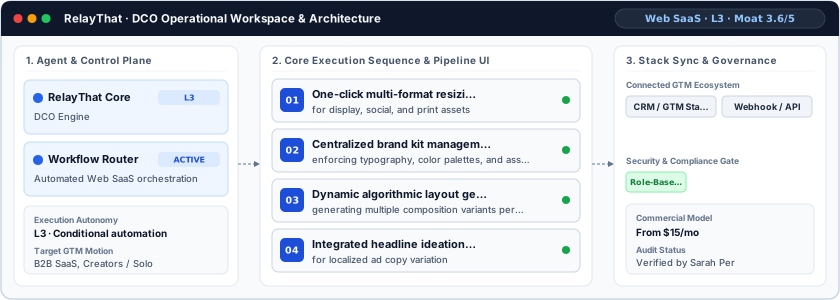
RelayThat is a Web SaaS tool for DCO (Dynamic Creative Optimization / DCO) in AdTech & Paid Media. Pricing: From $15/mo. Best suited to B2B SaaS and Creators / Solo. Editor ratings: AI autonomy L3 (conditional automation); moat score 3.6/5.0 (Proprietary moat). Fact-checked by Sarah Per on Oct 14, 2026.
Algorithmic design automation platform that enforces strict brand governance while generating multi-channel digital ad variants at scale.
RelayThat buyer fit verdict: when to choose vs. when to walk away
Choose RelayThat if (Best Fit)
- Target ICP & Stack Fit: You operate as B2B SaaS and Creators / Solo requiring a Web SaaS deployment for DCO.
- L3 Architecture & Defensibility: Rule-based layout adaptation engine that isolates brand tokens (colors, typography, logos) from layout execution, eliminating manual formatting while maintaining programmatic compliance.
- Commercial Model Fit: Your procurement budget aligns with From $15/mo.
Walk away from RelayThat if (Deal-Breakers)
- Walk away if your workflow requires uncapped enterprise volume on the From $15/mo entry plan without upgrading tiers.
- Walk away if your workflow cannot tolerate layout flexibility boundaries: The strict reliance on algorithmic layout templates prevents granular pixel-level overrides, creating operational friction when bespoke spatial configurations or irregular typography treatments are required.
- Walk away if ad exchange feed integration is a deal-breaker for your team: The platform focuses on static rendering rather than real-time programmatic ad server assembly, requiring manual export or secondary orchestration to connect generated variants directly into active bidding pipes.
RelayThat key facts & scorecard
| Pricing | From $15/moVendor pricing page |
|---|---|
| Free plan | No / not disclosed |
| Delivery | Web SaaS |
| Audience | B2B SaaS, Creators / Solo |
| AI autonomy level | L3 · Conditional automationEditor-verified |
| Moat tier & score | 3.6 / 5.0 · Proprietary moatEditor-verified |
| Funding | Bootstrapped |
| Founders | Craig Carpenter |
| Company size | 2-10 employees |
| Governance & docs | Terms ↗ · Privacy ↗ |
| Headquarters | Boston, MA |
| Founded | 2015 |
| Last verified |
RelayThat pros & cons: strengths vs. operational limitations
Pros: core strengths & capabilities
- One-click multi-format resizing: for display, social, and print assets
- Centralized brand kit management: enforcing typography, color palettes, and asset guidelines
- Dynamic algorithmic layout generator: generating multiple composition variants per asset set
- Integrated headline ideation generator: for localized ad copy variation
Cons: operational limitations & risks
- Layout Flexibility Boundaries: The strict reliance on algorithmic layout templates prevents granular pixel-level overrides, creating operational friction when bespoke spatial configurations or irregular typography treatments are required.
- Ad Exchange Feed Integration: The platform focuses on static rendering rather than real-time programmatic ad server assembly, requiring manual export or secondary orchestration to connect generated variants directly into active bidding pipes.
- Asset Ingestion Throughput: Bulk importing thousands of individualized SKU assets alongside dynamic catalog variables triggers batch processing queues that introduce rendering lag in high-velocity product catalog updates.
RelayThat TCO & deal-breaker stress test
Simulate 12-month stepped TCO, hidden cost multipliers, contract lock-in exposure, and stack failure modes using only facts verified by Sarah Per on · Capture SHA 0993603d.
RelayThat aligns with your 5-seat / $800/mo profile. Review the walk-away triggers and contract levers below before deployment.
| Plan / Tier | Verified Rate | Scale Fit | Scope & Quota Notes |
|---|---|---|---|
| Pro | $15/mo | 1–2 seats | Verified $15/mo tier from vendor pricing schedule. |
| Pro | $25/mo | 5 seats | Verified $25/mo tier from vendor pricing schedule. |
- Moat Score
- 3.6 / 5.0
- AI Autonomy
- L3
- Free Tier / Trial
- None disclosed
Triggered audit signals & failure modes
- Published Self-Serve Entry FloorVerified Pricing Ledger
RelayThat publishes a transparent entry point (From $15/mo) for initial validation before committing.
- Tier Fit for 5-Seat Scale: Pro ($15/mo)Verified Tier Schedule
Verified $15/mo tier from vendor pricing schedule.
- Primary Operational Bottleneck: Layout Flexibility BoundariesAudit by Sarah Per
The strict reliance on algorithmic layout templates prevents granular pixel-level overrides, creating operational friction when bespoke spatial configurations or irregular typography treatments are required.
Hidden TCO Multipliers & Quota Gates
- Per-Seat Linear Scaling: RelayThat prices licenses on a per-user/seat basis (From $15/mo); expanding from 2 to 15+ operators multiplies base recurring spend linearly.
- Profile / Workspace Quota Ceilings: Base tiers cap the number of connected profiles, workspaces, or contact records, forcing tier upgrades before seat limits are reached.
When to Walk Away & Negotiation Levers
- Walk away if your workflow requires uncapped enterprise volume on the From $15/mo entry plan without upgrading tiers.
- Walk away if your workflow cannot tolerate layout flexibility boundaries: The strict reliance on algorithmic layout templates prevents granular pixel-level overrides, creating operational friction when bespoke spatial configurations or irregular typography treatments are required.
- Walk away if ad exchange feed integration is a deal-breaker for your team: The platform focuses on static rendering rather than real-time programmatic ad server assembly, requiring manual export or secondary orchestration to connect generated variants directly into active bidding pipes.
- Validate exact quota thresholds (seats, credits, or API calls) included in RelayThat's From $15/mo tier before converting from monthly to annual billing.
- Require a sandbox proof-of-concept testing layout flexibility boundaries against your live CRM/data schema before annual sign-off.
Ask a custom procurement or TCO stress-test question about RelayThat
Fits within $800/mo budget (From $39/mo)
Offers a free tier (Free plan · $0/mo · Enterprise plan)
RelayThat moat & subtrack positioning
Rule-based layout adaptation engine that isolates brand tokens (colors, typography, logos) from layout execution, eliminating manual formatting while maintaining programmatic compliance.
Editorial review
Fact-checked by Sarah Per (Principal Content Systems & Generative Media Editor) on .
Background
For distributed marketing teams and digital agencies struggling with the operational overhead of repetitive asset production, RelayThat provides an automated creative generation engine. Headquartered in Boston, MA, and founded in 2015, the platform converts brand identity rules into scalable visual assets across display and social channels. The software targets performance marketing leads, digital agency directors, and brand operations teams seeking to produce compliant creative variations without allocating custom manual studio resources.
How RelayThat works
At its architectural core, RelayThat operates a rule-based rendering engine that abstracts visual elements—such as logos, primary hex palettes, typographic hierarchies, and copy—into structured design tokens. Instead of relying on open-ended canvas manipulation, the ingestion pipeline maps these tokens onto pre-validated dynamic layout configurations. Under this execution model, the platform programmatically recalculates visual spacing, contrast ratios, and element alignment across dozens of social and ad specifications simultaneously with its one-click resizing mechanism.
Limitations
Operational considerations and platform boundaries include:
- Layout Flexibility Boundaries: The strict reliance on algorithmic layout templates prevents granular pixel-level overrides, creating operational friction when bespoke spatial configurations or irregular typography treatments are required.
- Ad Exchange Feed Integration: The platform focuses on static rendering rather than real-time programmatic ad server assembly, requiring manual export or secondary orchestration to connect generated variants directly into active bidding pipes.
- Asset Ingestion Throughput: Bulk importing thousands of individualized SKU assets alongside dynamic catalog variables triggers batch processing queues that introduce rendering lag in high-velocity product catalog updates.
RelayThat pricing
RelayThat distributes its software through a transparent per-seat software-as-a-service model. Commercial licensing begins at $15 per month for the Pro tier, which provides core design automation capabilities for individual users. For organizations requiring expanded workspace governance and multi-brand administration, the Pro+ tier is available at $25 per month. Volume enterprise agreements and agency packages are structured via customized procurement channels based on seat count and dedicated brand management requirements.
How RelayThat compares
Within the creative optimization market, RelayThat occupies an operational midpoint between programmatic ad generation platforms like AdCreative.ai and enterprise-scale layout engines like Abyssale or 7Pi. While Abyssale offers direct developer-oriented image generation APIs and AdCreative.ai utilizes scoring models for conversion prediction, RelayThat focuses on deterministic brand consistency for mid-tier marketing teams. It delivers maximum utility for growth marketers and agencies that require rapid multi-format asset generation without the steep technical implementation overhead of fully headless rendering systems.
Frequently asked questions about RelayThat
How much does RelayThat cost and what pricing tiers are available?
Published pricing summary for RelayThat: From $15/mo. A permanent free plan is not disclosed for RelayThat. Verified tier schedule: Pro ($15/mo for 1–2 seats); Pro ($25/mo for 5 seats). RelayThat distributes its software through a transparent per-seat software-as-a-service model. Commercial licensing begins at $15 per month for the Pro tier, which provides core design automation capabilities for individual users.
How does RelayThat work and how autonomous is its AI architecture?
Algorithmic design automation platform that enforces strict brand governance while generating multi-channel digital ad variants at scale. Within DCO (Dynamic Creative Optimization / DCO), MarTechRadar rates its execution architecture at L3 · Conditional automation with a verified Moat Score of 3.6 / 5.0 (Proprietary moat). Rule-based layout adaptation engine that isolates brand tokens (colors, typography, logos) from layout execution, eliminating manual formatting while maintaining programmatic compliance. Corporate profile: Founded by Craig Carpenter, operating at 2-10 employees scale.
What are the main limitations of RelayThat and when should buyers walk away?
Based on our editorial technical audit, key operational considerations and boundaries for RelayThat include: (1) Layout Flexibility Boundaries: The strict reliance on algorithmic layout templates prevents granular pixel-level overrides, creating operational friction when bespoke spatial configurations or irregular typography treatments are required. (2) Ad Exchange Feed Integration: The platform focuses on static rendering rather than real-time programmatic ad server assembly, requiring manual export or secondary orchestration to connect generated variants directly into active bidding pipes. (3) Asset Ingestion Throughput: Bulk importing thousands of individualized SKU assets alongside dynamic catalog variables triggers batch processing queues that introduce rendering lag in high-velocity product catalog updates. Primary procurement walk-away rule: Walk away if your workflow requires uncapped enterprise volume on the From $15/mo entry plan without upgrading tiers.
What integrations, compliance certifications, and contract terms apply to RelayThat?
Key TCO multiplier to watch: Per-Seat Linear Scaling (RelayThat prices licenses on a per-user/seat basis (From $15/mo); expanding from 2 to 15+ operators multiplies base recurring spend linearly.) Before signing a contract, procurement teams should validate exact quota thresholds (seats, credits, or API calls) included in RelayThat's From $15/mo tier before converting from monthly to annual billing.
What are the best RelayThat alternatives and head-to-head competitors in 2026?
Top fact-checked alternatives to RelayThat in DCO (Dynamic Creative Optimization / DCO) include Clippable (Free plan · $0/mo · Enterprise plan), MatchCraft (Free plan · $0/mo · Enterprise plan), ModelRoom (From $39/mo), Socioh (From $3.20/mo). Within the creative optimization market, RelayThat occupies an operational midpoint between programmatic ad generation platforms like AdCreative.ai and enterprise-scale layout engines like Abyssale or 7Pi.
Verified sources & evidence trail
- Official product domain: https://relaythat.com
- Commercial pricing verification: https://www.relaythat.com/pricing
- Verified corporate entity profiles (
sameAs): LinkedIn Company Profile · Crunchbase Entity Record - First-party governance & documentation links: Terms · Privacy
- Editorial audit sign-off: Fact-checked by Sarah Per on under the MarTechRadar Evidence-Ledger Protocol.