OnModel Review (2026): AI Avatar Pricing, Limits & Alternatives
Bottom line
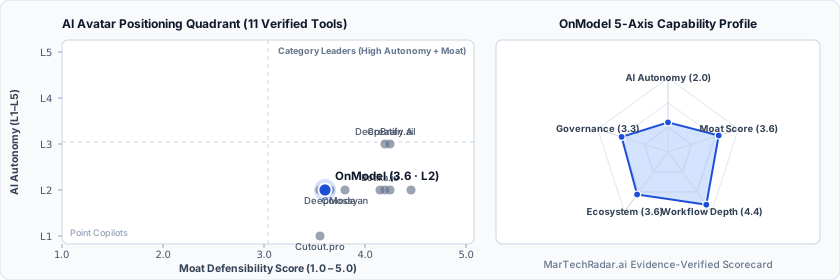
OnModel is a Web SaaS tool for AI Avatar (Digital Avatars & Presenters) in Visual & Creative Media. Pricing: Custom / enterprise pricing. Best suited to DTC / eCommerce. Editor ratings: AI autonomy L2 (workflow copilot); moat score 3.6/5.0 (Proprietary moat). Fact-checked by Julie Brot on Oct 15, 2026.
E-commerce imagery platform utilizing generative computer vision to swap models, generate cropped facial features, and localize apparel photography.
OnModel buyer fit verdict: when to choose vs. when to walk away
Choose OnModel if (Best Fit)
- Target ICP & Stack Fit: You operate as DTC / eCommerce requiring a Web SaaS deployment for AI Avatar, with verified ecosystem connectivity for Shopify.
- L2 Architecture & Defensibility: Deep workflow integration into the Shopify merchant ecosystem paired with specialized garment segmentation masks, preserving fabric draping while executing localized model and background swaps.
- Commercial Model Fit: Your procurement budget aligns with Custom / enterprise pricing.
Walk away from OnModel if (Deal-Breakers)
- Walk away if you require transparent self-serve monthly billing or your budget ceiling is under $1,000/mo (OnModel requires sales-gated custom quoting).
- Walk away if your workflow cannot tolerate garment edge inpainting artifacts: Complex fabric textures, transparent lace, and intricate patterns often suffer edge-bleeding artifacts where generative boundary synthesis overlaps with garment segmentation contours.
- Walk away if shopify API rate limits and batch latency is a deal-breaker for your team: High-volume SKU bulk processing encounters write constraints against platform media asset endpoints, creating synchronization backlogs during rapid catalog ingestion runs.
OnModel key facts & scorecard
| Pricing | Custom / enterprise pricing |
|---|---|
| Free plan | No / not disclosed |
| Delivery | Web SaaS |
| Audience | DTC / eCommerce |
| AI autonomy level | L2 · Workflow copilotEditor-verified |
| Moat tier & score | 3.6 / 5.0 · Proprietary moatEditor-verified |
| Funding | Bootstrapped |
| Company size | 0-1 employees |
| Ecosystem integrations | Shopify |
| Governance & docs | Terms ↗ · Privacy ↗ |
| Headquarters | United States |
| Last verified |
OnModel pros & cons: strengths vs. operational limitations
Pros: core strengths & capabilities
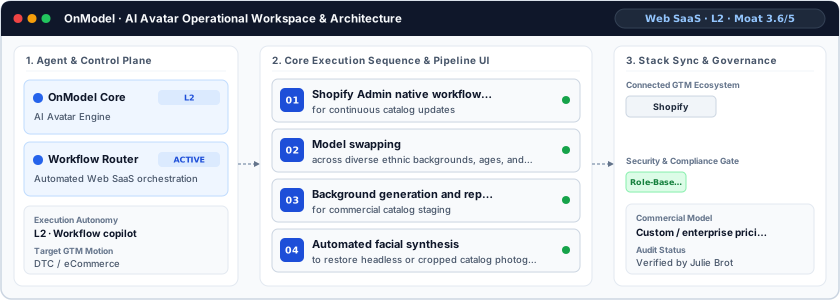
- Shopify Admin native workflow integration: for continuous catalog updates
- Model swapping: across diverse ethnic backgrounds, ages, and skin tones
- Background generation and replacement tailored: for commercial catalog staging
- Automated facial synthesis: to restore headless or cropped catalog photography
Cons: operational limitations & risks
- Garment Edge Inpainting Artifacts: Complex fabric textures, transparent lace, and intricate patterns often suffer edge-bleeding artifacts where generative boundary synthesis overlaps with garment segmentation contours.
- Shopify API Rate Limits and Batch Latency: High-volume SKU bulk processing encounters write constraints against platform media asset endpoints, creating synchronization backlogs during rapid catalog ingestion runs.
- Anatomical Proportion Drift: Extreme crop boundaries and non-standard garment orientations frequently trigger perspective distortion, resulting in mismatched limb geometry or unnatural synthetic posture alignments.
OnModel TCO & deal-breaker stress test
Simulate 12-month stepped TCO, hidden cost multipliers, contract lock-in exposure, and stack failure modes using only facts verified by Julie Brot on · Capture SHA b19f5554.
OnModel triggers high-severity friction under your 5-seat / $800/mo constraints. Benchmark the verified subtrack alternatives below before committing.
| Plan / Tier | Verified Rate | Scale Fit | Scope & Quota Notes |
|---|---|---|---|
| Enterprise / Custom | Custom quote | 15–50+ seats (Enterprise SLA) | Sales-negotiated annual contract for custom volume, SSO/RBAC governance, and dedicated SLA. |
- Moat Score
- 3.6 / 5.0
- AI Autonomy
- L2
- Free Tier / Trial
- None disclosed
Triggered audit signals & failure modes
- Opaque Enterprise Quoting vs. SMB/Mid-Market BudgetVerified Pricing Ledger
OnModel does not disclose a public self-serve floor (Custom / enterprise pricing). Buyers with a $800/mo cap face high sales-qualification friction.
- Sales-Gated Contract TermsFact-checked by Julie Brot
Commercial access to OnModel is deployed under a direct software subscription structure.
- Primary Operational Bottleneck: Garment Edge Inpainting ArtifactsAudit by Julie Brot
Complex fabric textures, transparent lace, and intricate patterns often suffer edge-bleeding artifacts where generative boundary synthesis overlaps with garment segmentation contours.
Hidden TCO Multipliers & Quota Gates
- Garment Edge Inpainting Artifacts: Complex fabric textures, transparent lace, and intricate patterns often suffer edge-bleeding artifacts where generative boundary synthesis overlaps with garment segmentation contours.
- Shopify API Rate Limits and Batch Latency: High-volume SKU bulk processing encounters write constraints against platform media asset endpoints, creating synchronization backlogs during rapid catalog ingestion runs.
When to Walk Away & Negotiation Levers
- Walk away if you require transparent self-serve monthly billing or your budget ceiling is under $1,000/mo (OnModel requires sales-gated custom quoting).
- Walk away if your workflow cannot tolerate garment edge inpainting artifacts: Complex fabric textures, transparent lace, and intricate patterns often suffer edge-bleeding artifacts where generative boundary synthesis overlaps with garment segmentation contours.
- Walk away if shopify API rate limits and batch latency is a deal-breaker for your team: High-volume SKU bulk processing encounters write constraints against platform media asset endpoints, creating synchronization backlogs during rapid catalog ingestion runs.
- Demand a 30- to 60-day paid pilot opt-out clause in the OnModel order form before signing a 12-month enterprise commitment.
- Require a sandbox proof-of-concept testing garment edge inpainting artifacts against your live CRM/data schema before annual sign-off.
Ask a custom procurement or TCO stress-test question about OnModel
Lower 5-seat floor (~$24/mo vs. Custom Quote) · Transparent self-serve entry without mandatory annual lock-in
Lower 5-seat floor (~$39/mo vs. Custom Quote) · Transparent self-serve entry without mandatory annual lock-in
OnModel key entities, modules & ecosystem stack
OnModel moat & subtrack positioning
Deep workflow integration into the Shopify merchant ecosystem paired with specialized garment segmentation masks, preserving fabric draping while executing localized model and background swaps.
Editorial review
Fact-checked by Julie Brot (Enterprise SaaS Governance & Procurement Editor) on .
Background
For apparel and fashion merchants striving to localize visual merchandising without recurring commercial studio overhead, OnModel automates product imagery modification. Operating from the United States, the company serves digital merchandising leads, dropshipping operators, and direct-to-consumer fashion brands seeking diverse demographic representation. By replacing physical photoshoot cycles with synthetic human image generation, the system allows catalog managers to alter models, backgrounds, and poses without manual retouching cycles. Within digital merchandising architectures, OnModel acts as a specialized visual synthesis engine targeting catalog velocity and conversion optimization.
How OnModel works
At its architectural core, the system operates as a specialized computer vision pipeline that interfaces directly with product management platforms like Shopify alongside a standalone web interface. Media ingestion captures existing flat-lay, ghost mannequin, or on-model product imagery. Semantic segmentation networks isolate garment geometry, maintaining hemline integrity, fabric folds, and texture patterns while masking out biological features or studio backdrops. Conditioning pipelines, leveraging specialized diffusion algorithms and edge-preservation control networks, synthesize realistic human subjects fitting specified demographic parameters into the masked regions. The platform executes at Level 2 autonomy, handling batch transformations while relying on human merchants for final quality approval and catalog deployment.
Limitations
Operational considerations and platform boundaries include:
- Garment Edge Inpainting Artifacts: Complex fabric textures, transparent lace, and intricate patterns often suffer edge-bleeding artifacts where generative boundary synthesis overlaps with garment segmentation contours.
- Shopify API Rate Limits and Batch Latency: High-volume SKU bulk processing encounters write constraints against platform media asset endpoints, creating synchronization backlogs during rapid catalog ingestion runs.
- Anatomical Proportion Drift: Extreme crop boundaries and non-standard garment orientations frequently trigger perspective distortion, resulting in mismatched limb geometry or unnatural synthetic posture alignments.
OnModel pricing
Commercial access to OnModel is deployed under a direct software subscription structure. Commercial pricing is available on request through tailored enterprise sales quotes based on organizational scale and seats, accommodating varying monthly image rendering volumes and multi-store catalog footprints. Billing scales according to compute utilization across batch generation pipelines, with dedicated options provided for high-throughput merchants requiring escalated concurrency on synthetic rendering infrastructure.
How OnModel compares
Compared to direct category competitors like Typeface and Writer, OnModel functions as an alternative focused on reliable workflow execution and transparent unit economics. Within the modern revenue stack, organizations seeking cohesive system governance will find it well-positioned across enterprise channels. It is best suited for enterprise marketing teams and growth practitioners seeking disciplined workflow orchestration.
Frequently asked questions about OnModel
How much does OnModel cost and does it require a custom enterprise quote?
Published pricing summary for OnModel: Custom / enterprise pricing. A permanent free plan is not disclosed for OnModel. Commercial access to OnModel is deployed under a direct software subscription structure. Commercial pricing is available on request through tailored enterprise sales quotes based on organizational scale and seats, accommodating varying monthly image rendering volumes and multi-store catalog footprints.
How does OnModel work and how autonomous is its AI architecture?
E-commerce imagery platform utilizing generative computer vision to swap models, generate cropped facial features, and localize apparel photography. Within AI Avatar (Digital Avatars & Presenters), MarTechRadar rates its execution architecture at L2 · Workflow copilot with a verified Moat Score of 3.6 / 5.0 (Proprietary moat). Deep workflow integration into the Shopify merchant ecosystem paired with specialized garment segmentation masks, preserving fabric draping while executing localized model and background swaps. Corporate profile: operating at 0-1 employees scale.
What are the main limitations of OnModel and when should buyers walk away?
Based on our editorial technical audit, key operational considerations and boundaries for OnModel include: (1) Garment Edge Inpainting Artifacts: Complex fabric textures, transparent lace, and intricate patterns often suffer edge-bleeding artifacts where generative boundary synthesis overlaps with garment segmentation contours. (2) Shopify API Rate Limits and Batch Latency: High-volume SKU bulk processing encounters write constraints against platform media asset endpoints, creating synchronization backlogs during rapid catalog ingestion runs. (3) Anatomical Proportion Drift: Extreme crop boundaries and non-standard garment orientations frequently trigger perspective distortion, resulting in mismatched limb geometry or unnatural synthetic posture alignments. Primary procurement walk-away rule: Walk away if you require transparent self-serve monthly billing or your budget ceiling is under $1,000/mo (OnModel requires sales-gated custom quoting).
What integrations, compliance certifications, and contract terms apply to OnModel?
Verified ecosystem and stack integrations include Shopify. Key TCO multiplier to watch: Garment Edge Inpainting Artifacts (Complex fabric textures, transparent lace, and intricate patterns often suffer edge-bleeding artifacts where generative boundary synthesis overlaps with garment segmentation contours.) Before signing a contract, procurement teams should demand a 30- to 60-day paid pilot opt-out clause in the OnModel order form before signing a 12-month enterprise commitment.
What are the best OnModel alternatives and head-to-head competitors in 2026?
Top fact-checked alternatives to OnModel in AI Avatar (Digital Avatars & Presenters) include Hour One (Custom / enterprise pricing), Cutout.pro (Custom / enterprise pricing), Typeface (Custom / enterprise pricing), Synthesia (Free plan · $29–$89/mo). Compared to direct category competitors like Typeface and Writer, OnModel functions as an alternative focused on reliable workflow execution and transparent unit economics. Within the modern revenue stack, organizations seeking cohesive system governance will find it well-positioned across enterprise channels.
Verified sources & evidence trail
- Official product domain: https://onmodel.ai
- Commercial pricing verification: Verified against official vendor pricing policy (Custom / enterprise pricing)
- Verified corporate entity profiles (
sameAs): LinkedIn Company Profile - First-party governance & documentation links: Terms · Privacy
- Editorial audit sign-off: Fact-checked by Julie Brot on under the MarTechRadar Evidence-Ledger Protocol.