Pier39 AI Review (2026): AI SDR Pricing, Limits & Alternatives
Bottom line
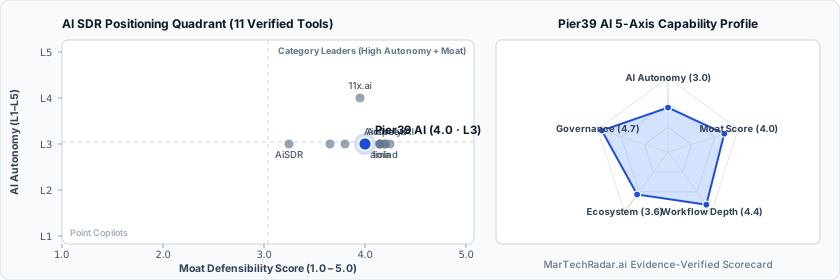
Pier39 AI is a Web SaaS tool for AI SDR (Autonomous B2B Sales Agents & AI BDRs) in AI SDR & Outbound. Pricing: Custom / enterprise pricing. Best suited to B2B Sales Leaders, SDR/BDR Teams and Revenue Operations (RevOps). Editor ratings: AI autonomy L3 (conditional automation); moat score 4.0/5.0 (Proprietary moat). Fact-checked by Julie Brot on Oct 12, 2026.
Autonomous revenue recovery agent navigating e-commerce funnels from pre-checkout cart intervention to post-purchase monetization.
Pier39 AI buyer fit verdict: when to choose vs. when to walk away
Choose Pier39 AI if (Best Fit)
- Target ICP & Stack Fit: You operate as B2B Sales Leaders, SDR/BDR Teams and Revenue Operations (RevOps) requiring a Web SaaS deployment for AI SDR, with verified ecosystem connectivity for Outreach.
- L3 Architecture & Defensibility: Specialized agentic workflow tracking customer purchase states across pre-purchase and post-purchase touchpoints, paired with verified SOC 2 Type II compliance.
- Commercial Model Fit: Your procurement budget aligns with Custom / enterprise pricing.
Walk away from Pier39 AI if (Deal-Breakers)
- Walk away if you require transparent self-serve monthly billing or your budget ceiling is under $1,000/mo (Pier39 AI requires sales-gated custom quoting).
- Walk away if your workflow cannot tolerate checkout session telemetry latency: Agentic triggers depend on low-latency browser event streams, which can misfire or lag when shoppers use aggressive script blockers or operate over degraded network connections.
- Walk away if catalog state synchronization overhead is a deal-breaker for your team: Dynamic inventory shifts require tight real-time bidirectional catalog synchronization, risking hallucinated stock availability or outdated pricing during rapid promotion rotations.
Pier39 AI key facts & scorecard
| Pricing | Custom / enterprise pricing |
|---|---|
| Free plan | No / not disclosed |
| Delivery | Web SaaS |
| Audience | B2B Sales Leaders, SDR/BDR Teams, Revenue Operations (RevOps) |
| AI autonomy level | L3 · Conditional automationEditor-verified |
| Moat tier & score | 4.0 / 5.0 · Proprietary moatEditor-verified |
| Funding | Seed |
| Total funding | $3MBacked by Zero Knowledge, Cadenza Ventures |
| Founders | Ankita Verma, Sanjana Haribhaskaran |
| Company size | 2-10 employees |
| Ecosystem integrations | Outreach |
| Compliance & governance | SOC 2 |
| Governance & docs | System Status ↗ · Privacy ↗ |
| Headquarters | San Francisco, California |
| Founded | 2022 |
| Last verified |
Pier39 AI pros & cons: strengths vs. operational limitations
Pros: core strengths & capabilities
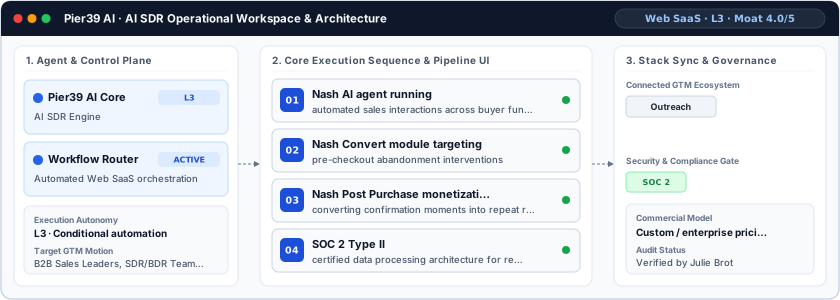
- Nash AI agent running: automated sales interactions across buyer funnels
- Nash Convert module targeting: pre-checkout abandonment interventions
- Nash Post Purchase monetization: converting confirmation moments into repeat revenue
- SOC 2 Type II: certified data processing architecture for retail security
Cons: operational limitations & risks
- Checkout Session Telemetry Latency: Agentic triggers depend on low-latency browser event streams, which can misfire or lag when shoppers use aggressive script blockers or operate over degraded network connections.
- Catalog State Synchronization Overhead: Dynamic inventory shifts require tight real-time bidirectional catalog synchronization, risking hallucinated stock availability or outdated pricing during rapid promotion rotations.
- Post-Purchase Channel Saturation: Aggressive automated secondary offers risk shopper fatigue and checkout attribution skew if post-transaction touchpoints collide with existing transactional receipt logic.
Pier39 AI TCO & deal-breaker stress test
Simulate 12-month stepped TCO, hidden cost multipliers, contract lock-in exposure, and stack failure modes using only facts verified by Julie Brot on · Capture SHA 1b25ddf1.
Pier39 AI triggers high-severity friction under your 5-seat / $800/mo constraints. Benchmark the verified subtrack alternatives below before committing.
| Plan / Tier | Verified Rate | Scale Fit | Scope & Quota Notes |
|---|---|---|---|
| Enterprise / Custom | Custom quote | 15–50+ seats (Enterprise SLA) | Sales-negotiated annual contract for custom volume, SSO/RBAC governance, and dedicated SLA. |
- Moat Score
- 4.0 / 5.0
- AI Autonomy
- L3
- Free Tier / Trial
- None disclosed
Triggered audit signals & failure modes
- Opaque Enterprise Quoting vs. SMB/Mid-Market BudgetVerified Pricing Ledger
Pier39 AI does not disclose a public self-serve floor (Custom / enterprise pricing). Buyers with a $800/mo cap face high sales-qualification friction.
- Sales-Gated Contract TermsFact-checked by Julie Brot
Commercial pricing is available on request through tailored enterprise sales quotes based on organizational scale and seats.
- Primary Operational Bottleneck: Checkout Session Telemetry LatencyAudit by Julie Brot
Agentic triggers depend on low-latency browser event streams, which can misfire or lag when shoppers use aggressive script blockers or operate over degraded network connections.
Hidden TCO Multipliers & Quota Gates
- Checkout Session Telemetry Latency: Agentic triggers depend on low-latency browser event streams, which can misfire or lag when shoppers use aggressive script blockers or operate over degraded network connections.
- Catalog State Synchronization Overhead: Dynamic inventory shifts require tight real-time bidirectional catalog synchronization, risking hallucinated stock availability or outdated pricing during rapid promotion rotations.
When to Walk Away & Negotiation Levers
- Walk away if you require transparent self-serve monthly billing or your budget ceiling is under $1,000/mo (Pier39 AI requires sales-gated custom quoting).
- Walk away if your workflow cannot tolerate checkout session telemetry latency: Agentic triggers depend on low-latency browser event streams, which can misfire or lag when shoppers use aggressive script blockers or operate over degraded network connections.
- Walk away if catalog state synchronization overhead is a deal-breaker for your team: Dynamic inventory shifts require tight real-time bidirectional catalog synchronization, risking hallucinated stock availability or outdated pricing during rapid promotion rotations.
- Demand a 30- to 60-day paid pilot opt-out clause in the Pier39 AI order form before signing a 12-month enterprise commitment.
- Require a sandbox proof-of-concept testing checkout session telemetry latency against your live CRM/data schema before annual sign-off.
Ask a custom procurement or TCO stress-test question about Pier39 AI
Lower 5-seat floor (~$149/mo vs. Custom Quote) · Transparent self-serve entry without mandatory annual lock-in
Verified AI SDR peer (Custom / enterprise pricing · Moat 4.2/5.0)
Pier39 AI key entities, modules & ecosystem stack
Pier39 AI moat & subtrack positioning
Specialized agentic workflow tracking customer purchase states across pre-purchase and post-purchase touchpoints, paired with verified SOC 2 Type II compliance.
Editorial review
Fact-checked by Julie Brot (Enterprise SaaS Governance & Procurement Editor) on .
Background
Established in 2022 in San Francisco, California, Pier39 AI addresses the operational burden of high cart abandonment rates and fragmented post-transaction monetization. Having secured $3M in early-stage financing, the platform is targeted directly at commercial digital marketing directors, e-commerce revenue leaders, and conversion rate optimization specialists. Rather than deploying static email drip sequences or blunt pop-up overlays, Pier39 AI configures proactive agentic interventions that interact with digital shoppers throughout transactional inflection points.
How Pier39 AI works
The platform functions around an autonomous agent runtime designated as Nash, delivering Level 3 operational autonomy across discrete funnel modules. Nash Convert observes in-session telemetry, shopper intent signals, and abandoned checkout paths to deploy real-time objection-handling and personalized conversion prompts before abandonment occurs. Downstream, Nash Post Purchase captures shopper session context on order confirmation surfaces, immediately initiating individualized post-sale cross-sell interactions, while Nash Discover addresses catalog exposure. All telemetry flows across an infrastructure verified under SOC 2 Type II certification to enforce transactional data governance.
Limitations
Operational considerations and platform boundaries include:
- Checkout Session Telemetry Latency: Agentic triggers depend on low-latency browser event streams, which can misfire or lag when shoppers use aggressive script blockers or operate over degraded network connections.
- Catalog State Synchronization Overhead: Dynamic inventory shifts require tight real-time bidirectional catalog synchronization, risking hallucinated stock availability or outdated pricing during rapid promotion rotations.
- Post-Purchase Channel Saturation: Aggressive automated secondary offers risk shopper fatigue and checkout attribution skew if post-transaction touchpoints collide with existing transactional receipt logic.
Pier39 AI pricing
Commercial pricing is available on request through tailored enterprise sales quotes based on organizational scale and seats. Deployments do not expose public self-serve tiers, instead structuring custom agreements around merchant transaction volume, storefront traffic thresholds, and required agent capabilities across the Nash module suite.
How Pier39 AI compares
While horizontal AI BDR vendors such as 11x.ai, 1mind, and Actively AI direct their autonomous agents toward outbound prospecting and outbound pipeline generation, Pier39 AI deliberately focuses inward on consumer transactional funnels. This architectural focus prioritizes direct-to-consumer order flow over outbound enterprise prospecting, making the software suitable for high-volume transactional digital merchants seeking automated funnel recovery rather than B2B outbound cold outreach.
Frequently asked questions about Pier39 AI
How much does Pier39 AI cost and does it require a custom enterprise quote?
Published pricing summary for Pier39 AI: Custom / enterprise pricing. A permanent free plan is not disclosed for Pier39 AI. Commercial pricing is available on request through tailored enterprise sales quotes based on organizational scale and seats.
How does Pier39 AI work and how autonomous is its AI architecture?
Autonomous revenue recovery agent navigating e-commerce funnels from pre-checkout cart intervention to post-purchase monetization. Within AI SDR (Autonomous B2B Sales Agents & AI BDRs), MarTechRadar rates its execution architecture at L3 · Conditional automation with a verified Moat Score of 4.0 / 5.0 (Proprietary moat). Specialized agentic workflow tracking customer purchase states across pre-purchase and post-purchase touchpoints, paired with verified SOC 2 Type II compliance. Corporate profile: Founded by Ankita Verma, Sanjana Haribhaskaran, operating at 2-10 employees scale.
What are the main limitations of Pier39 AI and when should buyers walk away?
Based on our editorial technical audit, key operational considerations and boundaries for Pier39 AI include: (1) Checkout Session Telemetry Latency: Agentic triggers depend on low-latency browser event streams, which can misfire or lag when shoppers use aggressive script blockers or operate over degraded network connections. (2) Catalog State Synchronization Overhead: Dynamic inventory shifts require tight real-time bidirectional catalog synchronization, risking hallucinated stock availability or outdated pricing during rapid promotion rotations. (3) Post-Purchase Channel Saturation: Aggressive automated secondary offers risk shopper fatigue and checkout attribution skew if post-transaction touchpoints collide with existing transactional receipt logic. Primary procurement walk-away rule: Walk away if you require transparent self-serve monthly billing or your budget ceiling is under $1,000/mo (Pier39 AI requires sales-gated custom quoting).
What integrations, compliance certifications, and contract terms apply to Pier39 AI?
Verified ecosystem and stack integrations include Outreach. Documented security and governance attestations include SOC 2. First-party governance and developer endpoints verified on domain include: Status (https://pier39.ai/status). Key TCO multiplier to watch: Checkout Session Telemetry Latency (Agentic triggers depend on low-latency browser event streams, which can misfire or lag when shoppers use aggressive script blockers or operate over degraded network connections.) Before signing a contract, procurement teams should demand a 30- to 60-day paid pilot opt-out clause in the Pier39 AI order form before signing a 12-month enterprise commitment.
What are the best Pier39 AI alternatives and head-to-head competitors in 2026?
Top fact-checked alternatives to Pier39 AI in AI SDR (Autonomous B2B Sales Agents & AI BDRs) include Pocus (Custom / enterprise pricing), Zopto (From $149/mo), Uniti AI (Custom / enterprise pricing), Dreach (Custom / enterprise pricing). While horizontal AI BDR vendors such as 11x.ai, 1mind, and Actively AI direct their autonomous agents toward outbound prospecting and outbound pipeline generation, Pier39 AI deliberately focuses inward on consumer transactional funnels.
Verified sources & evidence trail
- Official product domain: https://pier39.ai
- Commercial pricing verification: Verified against official vendor pricing policy (Custom / enterprise pricing)
- Verified corporate entity profiles (
sameAs): LinkedIn Company Profile · Crunchbase Entity Record - First-party governance & documentation links: System Status · Privacy
- Editorial audit sign-off: Fact-checked by Julie Brot on under the MarTechRadar Evidence-Ledger Protocol.