Pixelcut Review (2026): AI Product Photography Pricing, Limits & Alternatives
Bottom line
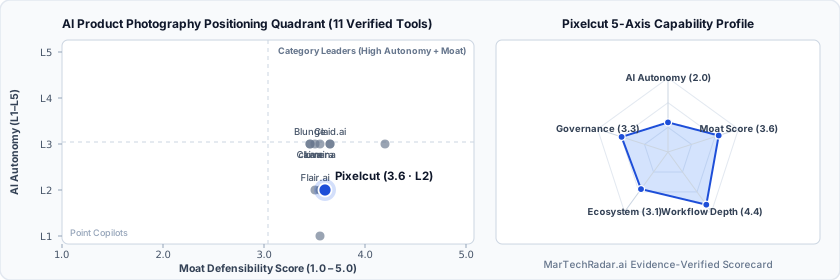
Pixelcut is a Web SaaS tool for AI Product Photography (Product Photography & AI Retouching) in Visual & Creative Media. Pricing: Free plan · $0/mo · Enterprise plan. Best suited to DTC / eCommerce and Creators / Solo. Editor ratings: AI autonomy L2 (workflow copilot); moat score 3.6/5.0 (Proprietary moat). Fact-checked by Julie Brot on Oct 15, 2026.
Mobile-first AI visual editing platform delivering automated background segmentation, generative lifestyle staging, and catalog upscaling for digital.
Pixelcut buyer fit verdict: when to choose vs. when to walk away
Choose Pixelcut if (Best Fit)
- Target ICP & Stack Fit: You operate as DTC / eCommerce and Creators / Solo requiring a Web SaaS deployment for AI Product Photography.
- L2 Architecture & Defensibility: Defensibility centers on high-volume consumer-to-business training feedback loops and optimized client-cloud inference pipelines tailored for low-friction mobile image capture.
- Commercial Model Fit: Your procurement budget aligns with Free plan · $0/mo · Enterprise plan and want a self-serve free tier for zero-cost initial validation.
Walk away from Pixelcut if (Deal-Breakers)
- Walk away if your workflow requires uncapped enterprise volume on the Free plan · $0/mo · Enterprise plan entry plan without upgrading tiers.
- Walk away if your workflow cannot tolerate edge alpha matting on fine transparencies: Segmentation precision degrades on refractive glassware, liquid boundaries, and diffuse fine fibers, requiring manual brush retouching to prevent halo artifacts.
- Walk away if batch inference latency bottlenecks is a deal-breaker for your team: Processing hundreds of SKU assets simultaneously introduces queue latency over mobile networks, impacting bulk publishing pipelines compared to headless APIs.
Pixelcut key facts & scorecard
| Pricing | Free plan · $0/mo · Enterprise planVendor pricing page |
|---|---|
| Free plan | Yes |
| Delivery | Web SaaS |
| Audience | DTC / eCommerce, Creators / Solo |
| AI autonomy level | L2 · Workflow copilotEditor-verified |
| Moat tier & score | 3.6 / 5.0 · Proprietary moatEditor-verified |
| Funding | Venture-backed |
| Founders | Dominique Yahyavi, Prasanth Veerina |
| Company size | 11-50 employees |
| Governance & docs | API & Docs ↗ · Changelog ↗ · Terms ↗ · Privacy ↗ |
| Headquarters | Oakland, California, United States |
| Founded | 2020 |
| Last verified |
Pixelcut pros & cons: strengths vs. operational limitations
Pros: core strengths & capabilities
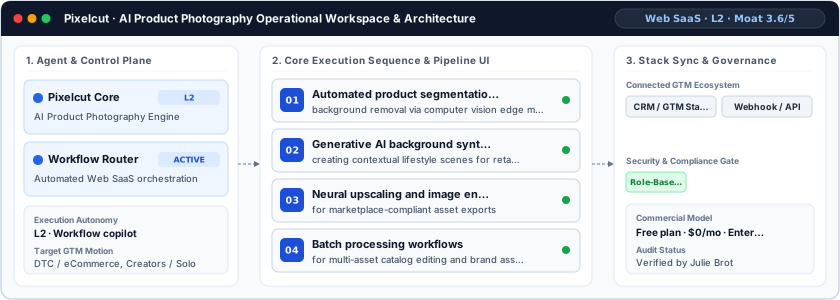
- Automated product segmentation and: background removal via computer vision edge matting
- Generative AI background synthesis: creating contextual lifestyle scenes for retail items
- Neural upscaling and image enhancement: for marketplace-compliant asset exports
- Batch processing workflows: for multi-asset catalog editing and brand asset management
Cons: operational limitations & risks
- Edge Alpha Matting on Fine Transparencies: Segmentation precision degrades on refractive glassware, liquid boundaries, and diffuse fine fibers, requiring manual brush retouching to prevent halo artifacts.
- Batch Inference Latency Bottlenecks: Processing hundreds of SKU assets simultaneously introduces queue latency over mobile networks, impacting bulk publishing pipelines compared to headless APIs.
- Geometric Perspective Distortion: Synthesized generative backgrounds occasionally mismatch the original camera elevation and focal length, generating subtle spatial incongruities between product and plane.
Pixelcut TCO & deal-breaker stress test
Simulate 12-month stepped TCO, hidden cost multipliers, contract lock-in exposure, and stack failure modes using only facts verified by Julie Brot on · Capture SHA 618b7fb5.
Pixelcut is viable for 5 seats, but requires commercial or technical verification on the flagged items below.
| Plan / Tier | Verified Rate | Scale Fit | Scope & Quota Notes |
|---|---|---|---|
| Free / Sandbox | $0 | 1–2 seats (Evaluation) | Entry free tier with capped usage or feature quotas for initial workflow testing. |
| Free | $8/mo | 1–2 seats | per month, billed yearly |
| Free | $10/mo | 5 seats | per month, billed yearly |
| Business | $24/mo | 15 seats | per month, billed yearly |
- Moat Score
- 3.6 / 5.0
- AI Autonomy
- L2
- Free Tier / Trial
- Free plan
Triggered audit signals & failure modes
- Opaque Enterprise Quoting vs. SMB/Mid-Market BudgetVerified Pricing Ledger
Pixelcut does not disclose a public self-serve floor (Free plan · $0/mo · Enterprise plan). Buyers with a $800/mo cap face high sales-qualification friction.
- Published Self-Serve Entry FloorVerified Pricing Ledger
Pixelcut publishes a transparent entry point (Free plan · $0/mo · Enterprise plan) with a free tier for initial validation before committing.
- Tier Fit for 5-Seat Scale: Free ($8/mo)Verified Tier Schedule
per month, billed yearly
- Primary Operational Bottleneck: Edge Alpha Matting on Fine TransparenciesAudit by Julie Brot
Segmentation precision degrades on refractive glassware, liquid boundaries, and diffuse fine fibers, requiring manual brush retouching to prevent halo artifacts.
Hidden TCO Multipliers & Quota Gates
- Annual Billing Headline vs. Monthly Premium: Headline entry rates reflect annual billing commitments (Save 20%); month-to-month flexibility carries a higher effective monthly rate or requires annual prepayment.
- Credit & Usage Burn Multiplier: Automated workflows consume metered credits/usage quotas; multi-step enrichment, voice minutes, or high-frequency agent runs can trigger mid-cycle top-up packs.
When to Walk Away & Negotiation Levers
- Walk away if your workflow requires uncapped enterprise volume on the Free plan · $0/mo · Enterprise plan entry plan without upgrading tiers.
- Walk away if your workflow cannot tolerate edge alpha matting on fine transparencies: Segmentation precision degrades on refractive glassware, liquid boundaries, and diffuse fine fibers, requiring manual brush retouching to prevent halo artifacts.
- Walk away if batch inference latency bottlenecks is a deal-breaker for your team: Processing hundreds of SKU assets simultaneously introduces queue latency over mobile networks, impacting bulk publishing pipelines compared to headless APIs.
- Validate exact quota thresholds (seats, credits, or API calls) included in Pixelcut's Free plan · $0/mo · Enterprise plan tier before converting from monthly to annual billing.
- Require a sandbox proof-of-concept testing edge alpha matting on fine transparencies against your live CRM/data schema before annual sign-off.
Ask a custom procurement or TCO stress-test question about Pixelcut
Lower 5-seat floor (~$8/mo vs. Custom Quote)
Lower 5-seat floor (~$9/mo vs. Custom Quote)
Pixelcut moat & subtrack positioning
Defensibility centers on high-volume consumer-to-business training feedback loops and optimized client-cloud inference pipelines tailored for low-friction mobile image capture.
Editorial review
Fact-checked by Julie Brot (Enterprise SaaS Governance & Procurement Editor) on .
Background
To capture online consumer demand, digital commerce merchants require continuous asset production without studio overhead. Founded in 2020 in Oakland, California, United States, Pixelcut addresses this operational bottleneck by delivering automated product photography workflows for digital storefront operators and marketplace merchants. Operating primarily at an L2 autonomy tier, the platform replaces manual masking routines with neural background isolation and scene synthesis, converting raw mobile snapshots into commercial-ready visual collateral across distributed selling channels.
How Pixelcut works
Under the hood, Pixelcut combines client-side capture frameworks with cloud-hosted neural pipelines. Ingested images pass through semantic segmentation models that isolate foreground product geometry and compute sub-pixel alpha mattes around complex edges. Once extracted, the platform leverages text-guided diffusion models to synthesize contextual lifestyle backgrounds matching specific lighting directions. The pipeline concludes with deep-learning super-resolution algorithms that upscale resolution while eliminating raster compression artifacts prior to catalog export.
Limitations
Operational considerations and platform boundaries include:
- Edge Alpha Matting on Fine Transparencies: Segmentation precision degrades on refractive glassware, liquid boundaries, and diffuse fine fibers, requiring manual brush retouching to prevent halo artifacts.
- Batch Inference Latency Bottlenecks: Processing hundreds of SKU assets simultaneously introduces queue latency over mobile networks, impacting bulk publishing pipelines compared to headless APIs.
- Geometric Perspective Distortion: Synthesized generative backgrounds occasionally mismatch the original camera elevation and focal length, generating subtle spatial incongruities between product and plane.
Pixelcut pricing
Pixelcut provides a tiered commercial licensing model tied to processing volumes and feature access. Entry-level usage is supported through a permanent $0 tier providing baseline background removal. Scaled operations expand into Pro tiers at $10 monthly or $8 per month billed yearly, moving up to Business tiers at $30 monthly or $24 per month billed annually for multi-seat teams requiring 3,600 monthly generative credits, bulk exports, and custom enterprise plans.
How Pixelcut compares
Compared to direct category competitors like Flair.ai and Photoroom, Pixelcut functions as an alternative focused on specialized workflow execution. Within the product photography and retouching landscape, Pixelcut contends with solutions like Blunge, Caimera, and clova. While Blunge targets high-throughput enterprise batch rendering and Clova emphasizes multi-modal studio ecosystems, Pixelcut emphasizes mobile-native accessibility and rapid generative scene composition. It remains ideal for high-velocity DTC merchants, marketplace sellers, and agile digital creative teams seeking fast asset generation without enterprise studio setups.
Frequently asked questions about Pixelcut
How much does Pixelcut cost and what pricing tiers are available?
Published pricing summary for Pixelcut: Free plan · $0/mo · Enterprise plan. Pixelcut includes a free tier or sandbox entry point. Verified tier schedule: Free / Sandbox ($0 for 1–2 seats (Evaluation)); Free ($8/mo for 1–2 seats); Free ($10/mo for 5 seats); Business ($24/mo for 15 seats). Pixelcut provides a tiered commercial licensing model tied to processing volumes and feature access. Entry-level usage is supported through a permanent $0 tier providing baseline background removal.
How does Pixelcut work and how autonomous is its AI architecture?
Mobile-first AI visual editing platform delivering automated background segmentation, generative lifestyle staging, and catalog upscaling for digital. Within AI Product Photography (Product Photography & AI Retouching), MarTechRadar rates its execution architecture at L2 · Workflow copilot with a verified Moat Score of 3.6 / 5.0 (Proprietary moat). Defensibility centers on high-volume consumer-to-business training feedback loops and optimized client-cloud inference pipelines tailored for low-friction mobile image capture. Corporate profile: Founded by Dominique Yahyavi, Prasanth Veerina, operating at 11-50 employees scale.
What are the main limitations of Pixelcut and when should buyers walk away?
Based on our editorial technical audit, key operational considerations and boundaries for Pixelcut include: (1) Edge Alpha Matting on Fine Transparencies: Segmentation precision degrades on refractive glassware, liquid boundaries, and diffuse fine fibers, requiring manual brush retouching to prevent halo artifacts. (2) Batch Inference Latency Bottlenecks: Processing hundreds of SKU assets simultaneously introduces queue latency over mobile networks, impacting bulk publishing pipelines compared to headless APIs. (3) Geometric Perspective Distortion: Synthesized generative backgrounds occasionally mismatch the original camera elevation and focal length, generating subtle spatial incongruities between product and plane. Primary procurement walk-away rule: Walk away if your workflow requires uncapped enterprise volume on the Free plan · $0/mo · Enterprise plan entry plan without upgrading tiers.
What integrations, compliance certifications, and contract terms apply to Pixelcut?
First-party governance and developer endpoints verified on domain include: API Docs (https://www.pixelcut.ai/docs). Key TCO multiplier to watch: Annual Billing Headline vs. Monthly Premium (Headline entry rates reflect annual billing commitments (Save 20%); month-to-month flexibility carries a higher effective monthly rate or requires annual prepayment.) Before signing a contract, procurement teams should validate exact quota thresholds (seats, credits, or API calls) included in Pixelcut's Free plan · $0/mo · Enterprise plan tier before converting from monthly to annual billing.
What are the best Pixelcut alternatives and head-to-head competitors in 2026?
Top fact-checked alternatives to Pixelcut in AI Product Photography (Product Photography & AI Retouching) include Photoroom (Free plan · $7.50–$82.50/mo), Flair.ai (Free plan · $8–$38/mo), Caimera ($15–$117/seat/mo), clova ($23–$95/mo). Compared to direct category competitors like Flair.ai and Photoroom, Pixelcut functions as an alternative focused on specialized workflow execution. Within the product photography and retouching landscape, Pixelcut contends with solutions like Blunge, Caimera, and clova.
Verified sources & evidence trail
- Official product domain: https://pixelcut.ai
- Commercial pricing verification: https://www.pixelcut.ai/pricing
- Verified corporate entity profiles (
sameAs): LinkedIn Company Profile · Crunchbase Entity Record - First-party governance & documentation links: API & Docs · Changelog · Terms · Privacy
- Editorial audit sign-off: Fact-checked by Julie Brot on under the MarTechRadar Evidence-Ledger Protocol.