Proton.ai Review (2026): AI SDR Pricing, Limits & Alternatives
Bottom line
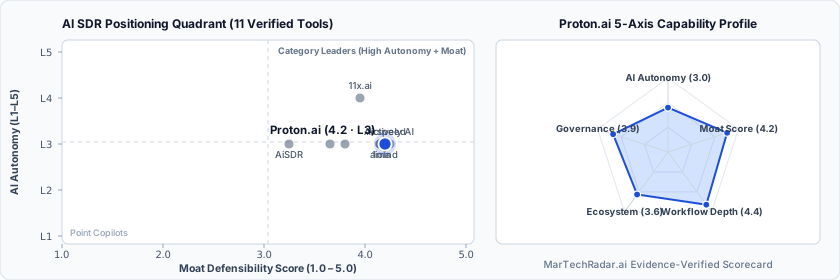
Proton.ai is a Web SaaS tool for AI SDR (Autonomous B2B Sales Agents & AI BDRs) in AI SDR & Outbound. Pricing: Custom / enterprise pricing. Best suited to B2B Sales Leaders, SDR/BDR Teams and Revenue Operations (RevOps). Editor ratings: AI autonomy L3 (conditional automation); moat score 4.2/5.0 (Proprietary moat). Fact-checked by Tim Fenolz on Oct 12, 2026.
AI-powered sales platform built for distributors that ingests ERP and catalog data to automate reorder tracking, whitespace cross-selling, and quote creation.
Proton.ai buyer fit verdict: when to choose vs. when to walk away
Choose Proton.ai if (Best Fit)
- Target ICP & Stack Fit: You operate as B2B Sales Leaders, SDR/BDR Teams and Revenue Operations (RevOps) requiring a Web SaaS deployment for AI SDR, with verified ecosystem connectivity for Outreach.
- L3 Architecture & Defensibility: Proprietary wholesale transaction models mapped against high-SKU distribution catalogs, deep two-way ERP integrations, and historical distributor buying patterns.
- Commercial Model Fit: Your procurement budget aligns with Custom / enterprise pricing.
Walk away from Proton.ai if (Deal-Breakers)
- Walk away if you require transparent self-serve monthly billing or your budget ceiling is under $1,000/mo (Proton.ai requires sales-gated custom quoting).
- Walk away if your workflow cannot tolerate ERP integration fragility: Data synchronization depends heavily on customized distributor database schemas, requiring frequent pipeline remediation when legacy ERP line-item mappings change.
- Walk away if catalog cleansing overhead is a deal-breaker for your team: Whitespace prediction accuracy drops when product catalogs contain duplicate SKUs, missing descriptions, or unstandardized unit-of-measure attributes.
Proton.ai key facts & scorecard
| Pricing | Custom / enterprise pricing |
|---|---|
| Free plan | No / not disclosed |
| Delivery | Web SaaS |
| Audience | B2B Sales Leaders, SDR/BDR Teams, Revenue Operations (RevOps) |
| AI autonomy level | L3 · Conditional automationEditor-verified |
| Moat tier & score | 4.2 / 5.0 · Proprietary moatEditor-verified |
| Funding | Series A |
| Total funding | $20MBacked by Battery Ventures, Abstract |
| Founders | Benjamin Cohen |
| Company size | 51-200 employees |
| Ecosystem integrations | Outreach |
| Governance & docs | Trust & Security ↗ · System Status ↗ · Terms ↗ · Privacy ↗ |
| Headquarters | Cambridge, Massachusetts |
| Founded | 2018 |
| Last verified |
Proton.ai pros & cons: strengths vs. operational limitations
Pros: core strengths & capabilities
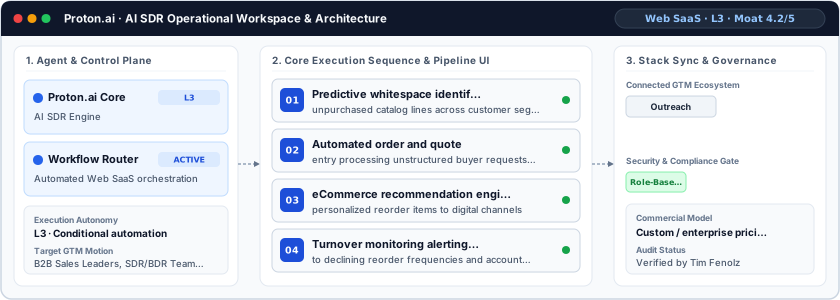
- Predictive whitespace identification exposing: unpurchased catalog lines across customer segments
- Automated order and quote: entry processing unstructured buyer requests into ERP line items
- eCommerce recommendation engine surfacing: personalized reorder items to digital channels
- Turnover monitoring alerting inside reps: to declining reorder frequencies and account attrition
Cons: operational limitations & risks
- ERP Integration Fragility: Data synchronization depends heavily on customized distributor database schemas, requiring frequent pipeline remediation when legacy ERP line-item mappings change.
- Catalog Cleansing Overhead: Whitespace prediction accuracy drops when product catalogs contain duplicate SKUs, missing descriptions, or unstandardized unit-of-measure attributes.
- Cold Account Latency: The algorithmic models require substantial historical transaction logs, rendering predictive cross-sell recommendations ineffective for net-new accounts without purchase history.
Proton.ai TCO & deal-breaker stress test
Simulate 12-month stepped TCO, hidden cost multipliers, contract lock-in exposure, and stack failure modes using only facts verified by Tim Fenolz on · Capture SHA 60ca7873.
Proton.ai triggers high-severity friction under your 5-seat / $800/mo constraints. Benchmark the verified subtrack alternatives below before committing.
| Plan / Tier | Verified Rate | Scale Fit | Scope & Quota Notes |
|---|---|---|---|
| Enterprise / Custom | Custom quote | 15–50+ seats (Enterprise SLA) | Sales-negotiated annual contract for custom volume, SSO/RBAC governance, and dedicated SLA. |
- Moat Score
- 4.2 / 5.0
- AI Autonomy
- L3
- Free Tier / Trial
- None disclosed
Triggered audit signals & failure modes
- Opaque Enterprise Quoting vs. SMB/Mid-Market BudgetVerified Pricing Ledger
Proton.ai does not disclose a public self-serve floor (Custom / enterprise pricing). Buyers with a $800/mo cap face high sales-qualification friction.
- Sales-Gated Contract TermsFact-checked by Tim Fenolz
Commercial pricing is available on request through tailored enterprise sales quotes based on organizational scale, active ERP integrations, and assigned sales seats.
- Primary Operational Bottleneck: ERP Integration FragilityAudit by Tim Fenolz
Data synchronization depends heavily on customized distributor database schemas, requiring frequent pipeline remediation when legacy ERP line-item mappings change.
Hidden TCO Multipliers & Quota Gates
- ERP Integration Fragility: Data synchronization depends heavily on customized distributor database schemas, requiring frequent pipeline remediation when legacy ERP line-item mappings change.
- Catalog Cleansing Overhead: Whitespace prediction accuracy drops when product catalogs contain duplicate SKUs, missing descriptions, or unstandardized unit-of-measure attributes.
When to Walk Away & Negotiation Levers
- Walk away if you require transparent self-serve monthly billing or your budget ceiling is under $1,000/mo (Proton.ai requires sales-gated custom quoting).
- Walk away if your workflow cannot tolerate ERP integration fragility: Data synchronization depends heavily on customized distributor database schemas, requiring frequent pipeline remediation when legacy ERP line-item mappings change.
- Walk away if catalog cleansing overhead is a deal-breaker for your team: Whitespace prediction accuracy drops when product catalogs contain duplicate SKUs, missing descriptions, or unstandardized unit-of-measure attributes.
- Demand a 30- to 60-day paid pilot opt-out clause in the Proton.ai order form before signing a 12-month enterprise commitment.
- Require a sandbox proof-of-concept testing ERP integration fragility against your live CRM/data schema before annual sign-off.
Ask a custom procurement or TCO stress-test question about Proton.ai
Lower 5-seat floor (~$56/mo vs. Custom Quote) · Transparent self-serve entry without mandatory annual lock-in
Offers a free tier (Free plan · $0/mo · Enterprise plan) · Transparent self-serve entry without mandatory annual lock-in
Proton.ai key entities, modules & ecosystem stack
Proton.ai moat & subtrack positioning
Proprietary wholesale transaction models mapped against high-SKU distribution catalogs, deep two-way ERP integrations, and historical distributor buying patterns.
Editorial review
Fact-checked by Tim Fenolz (Lead AdTech, Programmatic & Attribution Analyst) on .
Background
For wholesale distribution operations burdened by multi-thousand SKU catalogs and complex order frequencies, Proton.ai provides an industry-specific sales intelligence platform that systematically surfaces whitespace cross-sell opportunities. Established in 2018 in Cambridge, Massachusetts, the company has raised $20M in venture funding to automate revenue workflows for branch managers, outside sales reps, and customer service teams. Rather than treating accounts as generic pipelines, the system aligns sales prompts directly with historical line-item reorder cadences.
How Proton.ai works
At an architectural level, Proton.ai connects directly into distribution ERP environments such as Epicor, Infor, and SAP to continuously ingest historical transactions, pricing tiers, and inventory states. Its machine learning pipeline executes collaborative filtering and churn prediction against invoice logs to pinpoint lapsed purchase cycles and unpenetrated product categories. The technical engine synthesizes prioritized outreach targets and prepares draft quote entries directly from unstructured customer requests, leaving execution verification to the distribution representative.
Limitations
Operational considerations and platform boundaries include:
- ERP Integration Fragility: Data synchronization depends heavily on customized distributor database schemas, requiring frequent pipeline remediation when legacy ERP line-item mappings change.
- Catalog Cleansing Overhead: Whitespace prediction accuracy drops when product catalogs contain duplicate SKUs, missing descriptions, or unstandardized unit-of-measure attributes.
- Cold Account Latency: The algorithmic models require substantial historical transaction logs, rendering predictive cross-sell recommendations ineffective for net-new accounts without purchase history.
Proton.ai pricing
Commercial pricing is available on request through tailored enterprise sales quotes based on organizational scale, active ERP integrations, and assigned sales seats. Contracts are structured around recurring annual commitments that include core data ingestion pipeline setup, custom catalog normalization, and assigned technical account management. Additional modules covering digital storefront recommendations or automated quote extraction scale according to transactional transaction volume.
How Proton.ai compares
Unlike horizontal outbound systems such as 11x.ai, 1mind, or Actively AI—which focus primarily on top-of-funnel cold email prospecting and autonomous meeting scheduling—Proton.ai is purpose-built for high-frequency catalog replenishment and expansion. While horizontal agents prioritize outbound messaging delivery, Proton.ai focuses on mining internal transaction telemetry to protect distributor wallet share. It is optimized for middle-market to enterprise distributors managing dense inventories rather than software companies running outbound outbound SDR cadences.
Direct competitors & market radar
Top algorithmic competitors based on category positioning, capability overlap, and ICP alignment.
Frequently asked questions about Proton.ai
How much does Proton.ai cost and does it require a custom enterprise quote?
Published pricing summary for Proton.ai: Custom / enterprise pricing. A permanent free plan is not disclosed for Proton.ai. Commercial pricing is available on request through tailored enterprise sales quotes based on organizational scale, active ERP integrations, and assigned sales seats.
How does Proton.ai work and how autonomous is its AI architecture?
AI-powered sales platform built for distributors that ingests ERP and catalog data to automate reorder tracking, whitespace cross-selling, and quote creation. Within AI SDR (Autonomous B2B Sales Agents & AI BDRs), MarTechRadar rates its execution architecture at L3 · Conditional automation with a verified Moat Score of 4.2 / 5.0 (Proprietary moat). Proprietary wholesale transaction models mapped against high-SKU distribution catalogs, deep two-way ERP integrations, and historical distributor buying patterns. Corporate profile: Founded by Benjamin Cohen, operating at 51-200 employees scale.
What are the main limitations of Proton.ai and when should buyers walk away?
Based on our editorial technical audit, key operational considerations and boundaries for Proton.ai include: (1) ERP Integration Fragility: Data synchronization depends heavily on customized distributor database schemas, requiring frequent pipeline remediation when legacy ERP line-item mappings change. (2) Catalog Cleansing Overhead: Whitespace prediction accuracy drops when product catalogs contain duplicate SKUs, missing descriptions, or unstandardized unit-of-measure attributes. (3) Cold Account Latency: The algorithmic models require substantial historical transaction logs, rendering predictive cross-sell recommendations ineffective for net-new accounts without purchase history. Primary procurement walk-away rule: Walk away if you require transparent self-serve monthly billing or your budget ceiling is under $1,000/mo (Proton.ai requires sales-gated custom quoting).
What integrations, compliance certifications, and contract terms apply to Proton.ai?
Verified ecosystem and stack integrations include Outreach. First-party governance and developer endpoints verified on domain include: Trust/Security (https://trust.proton.ai), Status (https://status.proton.ai). Key TCO multiplier to watch: ERP Integration Fragility (Data synchronization depends heavily on customized distributor database schemas, requiring frequent pipeline remediation when legacy ERP line-item mappings change.) Before signing a contract, procurement teams should demand a 30- to 60-day paid pilot opt-out clause in the Proton.ai order form before signing a 12-month enterprise commitment.
What are the best Proton.ai alternatives and head-to-head competitors in 2026?
Top fact-checked alternatives to Proton.ai in AI SDR (Autonomous B2B Sales Agents & AI BDRs) include PUNKU (Free plan · $0/mo · Enterprise plan), Pocus (Custom / enterprise pricing), PhantomBuster (From $56/mo), Pepper (Custom / enterprise pricing). Unlike horizontal outbound systems such as 11x.ai, 1mind, or Actively AI—which focus primarily on top-of-funnel cold email prospecting and autonomous meeting scheduling—Proton.ai is purpose-built for high-frequency catalog replenishment and expansion.
Verified sources & evidence trail
- Official product domain: https://www.proton.ai
- Commercial pricing verification: Verified against official vendor pricing policy (Custom / enterprise pricing)
- Verified corporate entity profiles (
sameAs): LinkedIn Company Profile · Crunchbase Entity Record - First-party governance & documentation links: Trust & Security · System Status · Terms · Privacy
- Editorial audit sign-off: Fact-checked by Tim Fenolz on under the MarTechRadar Evidence-Ledger Protocol.