Rejourney Review (2026): ChatGPT for Marketing Pricing, Limits & Alternatives
Bottom line
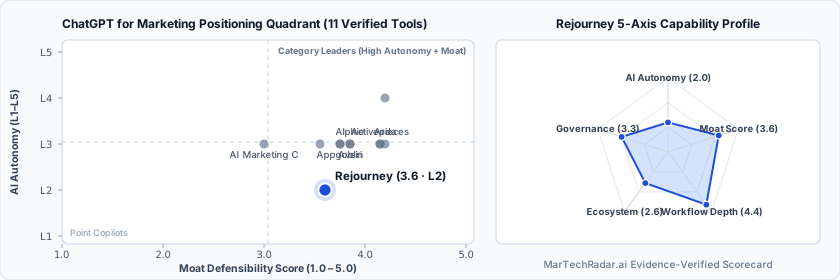
Rejourney is a Web SaaS tool for ChatGPT for Marketing (Open-Source Marketing Agents & Prompts) in Agent & Marketing Ops. Pricing: Custom / enterprise pricing. Best suited to B2B SaaS. Editor ratings: AI autonomy L2 (workflow copilot); moat score 3.6/5.0 (Proprietary moat). Fact-checked by Tim Fenolz on Oct 16, 2026.
Open-source marketing agent framework designed to orchestrate structured customer journey automations and programmatic prompt workflows across distributed.
Rejourney buyer fit verdict: when to choose vs. when to walk away
Choose Rejourney if (Best Fit)
- Target ICP & Stack Fit: You operate as B2B SaaS requiring a Web SaaS deployment for ChatGPT for Marketing.
- L2 Architecture & Defensibility: Rejourney relies on open architecture modularity and prompt workflow orchestration, though enterprise defensibility depends on proprietary execution runtime and data integration governance.
- Commercial Model Fit: Your procurement budget aligns with Custom / enterprise pricing.
Walk away from Rejourney if (Deal-Breakers)
- Walk away if you require transparent self-serve monthly billing or your budget ceiling is under $1,000/mo (Rejourney requires sales-gated custom quoting).
- Walk away if your workflow cannot tolerate LLM latency overhead: Real-time trigger throughput suffers when external inference endpoints introduce response delays during sudden traffic bursts, creating delivery lags for immediate user alerts.
- Walk away if schema drift risk is a deal-breaker for your team: Upstream customer data changes frequently invalidate prompt token contexts, requiring manual engineering oversight to update payload mappings and prevent malformed agent completions.
Rejourney key facts & scorecard
| Pricing | Custom / enterprise pricing |
|---|---|
| Free plan | No / not disclosed |
| Delivery | Web SaaS |
| Audience | B2B SaaS |
| AI autonomy level | L2 · Workflow copilotEditor-verified |
| Moat tier & score | 3.6 / 5.0 · Proprietary moatEditor-verified |
| Funding | Venture-backed |
| Headquarters | United States |
| Last verified |
Rejourney pros & cons: strengths vs. operational limitations
Pros: core strengths & capabilities
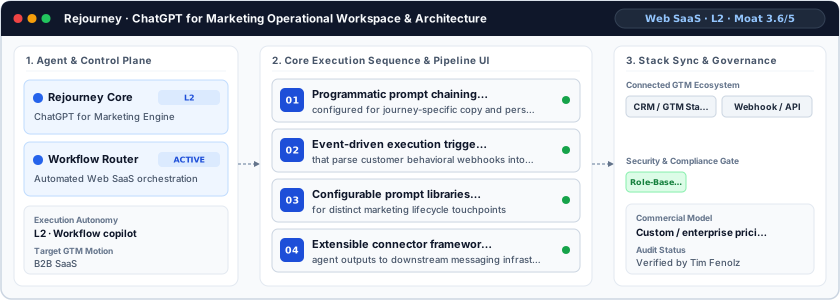
- Programmatic prompt chaining engines: configured for journey-specific copy and persona generation
- Event-driven execution triggers: that parse customer behavioral webhooks into agent prompts
- Configurable prompt libraries versioned: for distinct marketing lifecycle touchpoints
- Extensible connector framework linking: agent outputs to downstream messaging infrastructure
Cons: operational limitations & risks
- LLM Latency Overhead: Real-time trigger throughput suffers when external inference endpoints introduce response delays during sudden traffic bursts, creating delivery lags for immediate user alerts.
- Schema Drift Risk: Upstream customer data changes frequently invalidate prompt token contexts, requiring manual engineering oversight to update payload mappings and prevent malformed agent completions.
- State Management Limits: Maintaining coherent multi-step journey state across prolonged user sessions demands custom external database stores, as native orchestration memory remains session-bound.
Rejourney TCO & deal-breaker stress test
Simulate 12-month stepped TCO, hidden cost multipliers, contract lock-in exposure, and stack failure modes using only facts verified by Tim Fenolz on .
Rejourney triggers high-severity friction under your 5-seat / $800/mo constraints. Benchmark the verified subtrack alternatives below before committing.
| Plan / Tier | Verified Rate | Scale Fit | Scope & Quota Notes |
|---|---|---|---|
| Enterprise / Custom | Custom quote | 15–50+ seats (Enterprise SLA) | Sales-negotiated annual contract for custom volume, SSO/RBAC governance, and dedicated SLA. |
- Moat Score
- 3.6 / 5.0
- AI Autonomy
- L2
- Free Tier / Trial
- None disclosed
Triggered audit signals & failure modes
- Opaque Enterprise Quoting vs. SMB/Mid-Market BudgetVerified Pricing Ledger
Rejourney does not disclose a public self-serve floor (Custom / enterprise pricing). Buyers with a $800/mo cap face high sales-qualification friction.
- Sales-Gated Contract TermsFact-checked by Tim Fenolz
Commercial access for Rejourney is provided via custom enterprise agreements tailored to organizational deployment requirements and supported operational scale.
- Primary Operational Bottleneck: LLM Latency OverheadAudit by Tim Fenolz
Real-time trigger throughput suffers when external inference endpoints introduce response delays during sudden traffic bursts, creating delivery lags for immediate user alerts.
Hidden TCO Multipliers & Quota Gates
- Credit & Usage Burn Multiplier: Automated workflows consume metered credits/usage quotas; multi-step enrichment, voice minutes, or high-frequency agent runs can trigger mid-cycle top-up packs.
- LLM Latency Overhead: Real-time trigger throughput suffers when external inference endpoints introduce response delays during sudden traffic bursts, creating delivery lags for immediate user alerts.
- Schema Drift Risk: Upstream customer data changes frequently invalidate prompt token contexts, requiring manual engineering oversight to update payload mappings and prevent malformed agent completions.
When to Walk Away & Negotiation Levers
- Walk away if you require transparent self-serve monthly billing or your budget ceiling is under $1,000/mo (Rejourney requires sales-gated custom quoting).
- Walk away if your workflow cannot tolerate LLM latency overhead: Real-time trigger throughput suffers when external inference endpoints introduce response delays during sudden traffic bursts, creating delivery lags for immediate user alerts.
- Walk away if schema drift risk is a deal-breaker for your team: Upstream customer data changes frequently invalidate prompt token contexts, requiring manual engineering oversight to update payload mappings and prevent malformed agent completions.
- Demand a 30- to 60-day paid pilot opt-out clause in the Rejourney order form before signing a 12-month enterprise commitment.
- Require a sandbox proof-of-concept testing LLM latency overhead against your live CRM/data schema before annual sign-off.
Ask a custom procurement or TCO stress-test question about Rejourney
Lower 5-seat floor (~$99/mo vs. Custom Quote) · Transparent self-serve entry without mandatory annual lock-in
Lower 5-seat floor (~$99/mo vs. Custom Quote) · Transparent self-serve entry without mandatory annual lock-in
Rejourney moat & subtrack positioning
Rejourney relies on open architecture modularity and prompt workflow orchestration, though enterprise defensibility depends on proprietary execution runtime and data integration governance.
Editorial review
Fact-checked by Tim Fenolz (Lead AdTech, Programmatic & Attribution Analyst) on .
Background
Rejourney, based in the United States, addresses the growing operational demand for automated prompt chains and modular agent orchestration across lifecycle marketing pipelines. Built for marketing engineers, growth technical leads, and lifecycle automation teams, the software shifts workflow creation away from hardcoded messaging templates toward programmable agent systems. Operating within open-source marketing agents and prompt frameworks, Rejourney enables development teams to construct dynamic customer touchpoints without locking their messaging logic into closed software-as-a-service silos.
How Rejourney works
Architecturally, Rejourney operates as an L2 autonomous orchestration layer that ingests user event telemetry through standard webhooks and API payloads. The incoming event context is passed into a prompt-construction pipeline, where variables are mapped to localized agent tasks such as behavioral email drafting, re-engagement message tailoring, or content variant synthesis. The execution harness routes prompt assemblies to connected large language model endpoints, verifies the structured outputs against predefined schema constraints, and transmits the resulting payloads directly to downstream messaging endpoints or customer data platforms.
Limitations
Operational considerations and platform boundaries include:
- LLM Latency Overhead: Real-time trigger throughput suffers when external inference endpoints introduce response delays during sudden traffic bursts, creating delivery lags for immediate user alerts.
- Schema Drift Risk: Upstream customer data changes frequently invalidate prompt token contexts, requiring manual engineering oversight to update payload mappings and prevent malformed agent completions.
- State Management Limits: Maintaining coherent multi-step journey state across prolonged user sessions demands custom external database stores, as native orchestration memory remains session-bound.
Rejourney pricing
Commercial access for Rejourney is provided via custom enterprise agreements tailored to organizational deployment requirements and supported operational scale. Prospective enterprise clients must contact the sales team directly to receive a customized quote based on expected transaction volumes, infrastructure management tiers, and service-level requirements, without standard entry-level digital pricing tiers. Pricing is available on request through tailored enterprise sales quotes, with custom enterprise tiers, subscription plans, and seat licenses structured around organizational scale and monthly workflow volume.
How Rejourney compares
Within the agentic automation market, Rejourney competes against specialized frameworks like Alphie, Appgoblin, and Arda. While Appgoblin prioritizes rapid mobile application campaign triggers and Alphie emphasizes conversational customer interaction flows, Rejourney differentiates itself on flexible customer journey logic and modular prompt chaining. It suits mid-market to enterprise technology organizations that prioritize programmatic control over their marketing automation stack over prepackaged software interfaces. It is best suited for enterprise marketing teams and growth practitioners seeking disciplined workflow orchestration.
Frequently asked questions about Rejourney
How much does Rejourney cost and does it require a custom enterprise quote?
Published pricing summary for Rejourney: Custom / enterprise pricing. A permanent free plan is not disclosed for Rejourney. Commercial access for Rejourney is provided via custom enterprise agreements tailored to organizational deployment requirements and supported operational scale.
How does Rejourney work and how autonomous is its AI architecture?
Open-source marketing agent framework designed to orchestrate structured customer journey automations and programmatic prompt workflows across distributed. Within ChatGPT for Marketing (Open-Source Marketing Agents & Prompts), MarTechRadar rates its execution architecture at L2 · Workflow copilot with a verified Moat Score of 3.6 / 5.0 (Proprietary moat). Rejourney relies on open architecture modularity and prompt workflow orchestration, though enterprise defensibility depends on proprietary execution runtime and data integration governance.
What are the main limitations of Rejourney and when should buyers walk away?
Based on our editorial technical audit, key operational considerations and boundaries for Rejourney include: (1) LLM Latency Overhead: Real-time trigger throughput suffers when external inference endpoints introduce response delays during sudden traffic bursts, creating delivery lags for immediate user alerts. (2) Schema Drift Risk: Upstream customer data changes frequently invalidate prompt token contexts, requiring manual engineering oversight to update payload mappings and prevent malformed agent completions. (3) State Management Limits: Maintaining coherent multi-step journey state across prolonged user sessions demands custom external database stores, as native orchestration memory remains session-bound. Primary procurement walk-away rule: Walk away if you require transparent self-serve monthly billing or your budget ceiling is under $1,000/mo (Rejourney requires sales-gated custom quoting).
What integrations, compliance certifications, and contract terms apply to Rejourney?
Key TCO multiplier to watch: Credit & Usage Burn Multiplier (Automated workflows consume metered credits/usage quotas; multi-step enrichment, voice minutes, or high-frequency agent runs can trigger mid-cycle top-up packs.) Before signing a contract, procurement teams should demand a 30- to 60-day paid pilot opt-out clause in the Rejourney order form before signing a 12-month enterprise commitment.
What are the best Rejourney alternatives and head-to-head competitors in 2026?
Top fact-checked alternatives to Rejourney in ChatGPT for Marketing (Open-Source Marketing Agents & Prompts) include HelloDeck (Custom / enterprise pricing), Korosta (Custom / enterprise pricing), PromptBase (Custom / enterprise pricing), TaskingAI (Custom / enterprise pricing). Within the agentic automation market, Rejourney competes against specialized frameworks like Alphie, Appgoblin, and Arda.
Verified sources & evidence trail
- Official product domain: https://rejourney.co/demo/leaks
- Commercial pricing verification: Verified against official vendor pricing policy (Custom / enterprise pricing)
- Editorial audit sign-off: Fact-checked by Tim Fenolz on under the MarTechRadar Evidence-Ledger Protocol.