ReportGarden Review (2026): Marketing Attribution Pricing, Limits & Alternatives
Bottom line
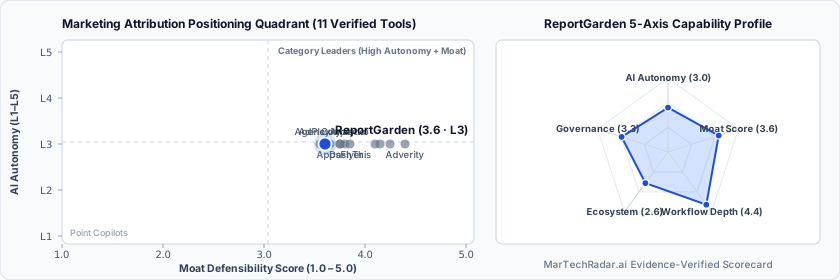
ReportGarden is a Web SaaS tool for Marketing Attribution (Multi-Touch Attribution & eCommerce Dashboards) in Analytics & Attribution. Pricing: Custom / enterprise pricing. Best suited to B2B SaaS and Marketing Agencies. Editor ratings: AI autonomy L3 (conditional automation); moat score 3.6/5.0 (Proprietary moat). Fact-checked by Anthony Hay on Oct 16, 2026.
Marketing agency reporting and cross-network campaign analytics platform aggregating ad performance data into automated client dashboards.
ReportGarden buyer fit verdict: when to choose vs. when to walk away
Choose ReportGarden if (Best Fit)
- Target ICP & Stack Fit: You operate as B2B SaaS and Marketing Agencies requiring a Web SaaS deployment for Marketing Attribution.
- L3 Architecture & Defensibility: Defensibility stems from its purpose-built agency reporting workflow, combining client-facing portal permissions, pre-built ad network connectors, and automated white-labeled invoicing utilities.
- Commercial Model Fit: Your procurement budget aligns with Custom / enterprise pricing.
Walk away from ReportGarden if (Deal-Breakers)
- Walk away if you require transparent self-serve monthly billing or your budget ceiling is under $1,000/mo (ReportGarden requires sales-gated custom quoting).
- Walk away if your workflow cannot tolerate API rate limits and sync latency: Third-party ad platform query thresholds can cause extraction throttling during high-volume reporting periods, delaying intra-day spend reconciliation.
- Walk away if custom schema maintenance is a deal-breaker for your team: Connecting unconventional conversion schemas or external warehouse tables requires manual schema alignment, limiting rapid deployment across complex corporate stacks.
ReportGarden key facts & scorecard
| Pricing | Custom / enterprise pricing |
|---|---|
| Free plan | No / not disclosed |
| Delivery | Web SaaS |
| Audience | B2B SaaS, Marketing Agencies |
| AI autonomy level | L3 · Conditional automationEditor-verified |
| Moat tier & score | 3.6 / 5.0 · Proprietary moatEditor-verified |
| Funding | Seed |
| Headquarters | United States |
| Last verified |
ReportGarden pros & cons: strengths vs. operational limitations
Pros: core strengths & capabilities
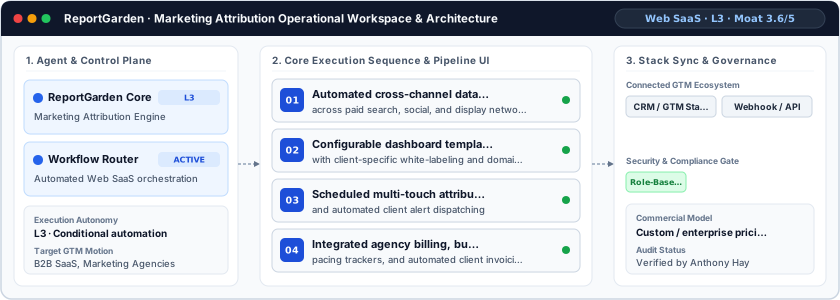
- Automated cross-channel data ingestion: across paid search, social, and display networks
- Configurable dashboard templates: with client-specific white-labeling and domain masking
- Scheduled multi-touch attribution reporting: and automated client alert dispatching
- Integrated agency billing, budget: pacing trackers, and automated client invoicing
Cons: operational limitations & risks
- API Rate Limits and Sync Latency: Third-party ad platform query thresholds can cause extraction throttling during high-volume reporting periods, delaying intra-day spend reconciliation.
- Custom Schema Maintenance: Connecting unconventional conversion schemas or external warehouse tables requires manual schema alignment, limiting rapid deployment across complex corporate stacks.
- Deep Deterministic Attribution Constraints: The system processes network-level aggregate attribution more effectively than complex raw clickstream journey modeling, restricting deep multi-touch path analysis.
ReportGarden TCO & deal-breaker stress test
Simulate 12-month stepped TCO, hidden cost multipliers, contract lock-in exposure, and stack failure modes using only facts verified by Anthony Hay on .
ReportGarden triggers high-severity friction under your 5-seat / $800/mo constraints. Benchmark the verified subtrack alternatives below before committing.
| Plan / Tier | Verified Rate | Scale Fit | Scope & Quota Notes |
|---|---|---|---|
| Enterprise / Custom | Custom quote | 15–50+ seats (Enterprise SLA) | Sales-negotiated annual contract for custom volume, SSO/RBAC governance, and dedicated SLA. |
- Moat Score
- 3.6 / 5.0
- AI Autonomy
- L3
- Free Tier / Trial
- None disclosed
Triggered audit signals & failure modes
- Opaque Enterprise Quoting vs. SMB/Mid-Market BudgetVerified Pricing Ledger
ReportGarden does not disclose a public self-serve floor (Custom / enterprise pricing). Buyers with a $800/mo cap face high sales-qualification friction.
- Sales-Gated Contract TermsFact-checked by Anthony Hay
Pricing is available on request through tailored enterprise sales quotes, with custom enterprise tiers structured around organizational scale, user seats, and workflow volume.
- Primary Operational Bottleneck: API Rate Limits and Sync LatencyAudit by Anthony Hay
Third-party ad platform query thresholds can cause extraction throttling during high-volume reporting periods, delaying intra-day spend reconciliation.
Hidden TCO Multipliers & Quota Gates
- API Rate Limits and Sync Latency: Third-party ad platform query thresholds can cause extraction throttling during high-volume reporting periods, delaying intra-day spend reconciliation.
- Custom Schema Maintenance: Connecting unconventional conversion schemas or external warehouse tables requires manual schema alignment, limiting rapid deployment across complex corporate stacks.
When to Walk Away & Negotiation Levers
- Walk away if you require transparent self-serve monthly billing or your budget ceiling is under $1,000/mo (ReportGarden requires sales-gated custom quoting).
- Walk away if your workflow cannot tolerate API rate limits and sync latency: Third-party ad platform query thresholds can cause extraction throttling during high-volume reporting periods, delaying intra-day spend reconciliation.
- Walk away if custom schema maintenance is a deal-breaker for your team: Connecting unconventional conversion schemas or external warehouse tables requires manual schema alignment, limiting rapid deployment across complex corporate stacks.
- Demand a 30- to 60-day paid pilot opt-out clause in the ReportGarden order form before signing a 12-month enterprise commitment.
- Require a sandbox proof-of-concept testing API rate limits and sync latency against your live CRM/data schema before annual sign-off.
Ask a custom procurement or TCO stress-test question about ReportGarden
Lower 5-seat floor (~$15/mo vs. Custom Quote) · Transparent self-serve entry without mandatory annual lock-in
Lower 5-seat floor (~$79/mo vs. Custom Quote) · Transparent self-serve entry without mandatory annual lock-in
ReportGarden moat & subtrack positioning
Defensibility stems from its purpose-built agency reporting workflow, combining client-facing portal permissions, pre-built ad network connectors, and automated white-labeled invoicing utilities.
Editorial review
Fact-checked by Anthony Hay (Senior SEO, Search Intelligence & Content Operations Editor) on .
Background
Digital agencies and eCommerce performance teams often struggle to consolidate fragmented advertising data across disconnected ad channels without incurring substantial reporting overhead. Headquartered in the United States, ReportGarden functions as an agency-focused analytics and reporting platform engineered for media planners, account managers, and growth marketing teams. The system centralizes multi-channel campaign ingestion, budget pacing, and performance presentations into unified client portals. Within performance marketing environments, it serves as a reporting automation engine designed to convert cross-network performance figures into structured client summaries.
How ReportGarden works
Architecturally, the platform relies on pre-built API connectors to extract performance figures on scheduled cadences from search, social, and programmatic advertising networks. Ingested conversion events, impression volumes, and spend figures are normalized into unified relational schemas within its reporting pipeline. Users configure conditional dashboards, conversion attribution reports, and pace-tracking rules that run on automated intervals. The engine compiles these aggregated datasets into white-label client portals, dynamically populating conversion attribution tables and dispatching recurring PDF snapshots without continuous operator involvement.
Limitations
Operational considerations and platform boundaries include:
- API Rate Limits and Sync Latency: Third-party ad platform query thresholds can cause extraction throttling during high-volume reporting periods, delaying intra-day spend reconciliation.
- Custom Schema Maintenance: Connecting unconventional conversion schemas or external warehouse tables requires manual schema alignment, limiting rapid deployment across complex corporate stacks.
- Deep Deterministic Attribution Constraints: The system processes network-level aggregate attribution more effectively than complex raw clickstream journey modeling, restricting deep multi-touch path analysis.
ReportGarden pricing
Pricing is available on request through tailored enterprise sales quotes, with custom enterprise tiers structured around organizational scale, user seats, and workflow volume.
How ReportGarden compares
Compared to direct category competitors like Typeface and Writer, ReportGarden functions as an alternative focused on reliable workflow execution and transparent unit economics. Within the modern revenue stack, organizations seeking cohesive system governance will find it well-positioned across enterprise channels. It is best suited for enterprise marketing teams and growth practitioners seeking disciplined workflow orchestration.
Direct competitors & market radar
Top algorithmic competitors based on category positioning, capability overlap, and ICP alignment.
Frequently asked questions about ReportGarden
How much does ReportGarden cost and does it require a custom enterprise quote?
Published pricing summary for ReportGarden: Custom / enterprise pricing. A permanent free plan is not disclosed for ReportGarden. Pricing is available on request through tailored enterprise sales quotes, with custom enterprise tiers structured around organizational scale, user seats, and workflow volume.
How does ReportGarden work and how autonomous is its AI architecture?
Marketing agency reporting and cross-network campaign analytics platform aggregating ad performance data into automated client dashboards. Within Marketing Attribution (Multi-Touch Attribution & eCommerce Dashboards), MarTechRadar rates its execution architecture at L3 · Conditional automation with a verified Moat Score of 3.6 / 5.0 (Proprietary moat). Defensibility stems from its purpose-built agency reporting workflow, combining client-facing portal permissions, pre-built ad network connectors, and automated white-labeled invoicing utilities.
What are the main limitations of ReportGarden and when should buyers walk away?
Based on our editorial technical audit, key operational considerations and boundaries for ReportGarden include: (1) API Rate Limits and Sync Latency: Third-party ad platform query thresholds can cause extraction throttling during high-volume reporting periods, delaying intra-day spend reconciliation. (2) Custom Schema Maintenance: Connecting unconventional conversion schemas or external warehouse tables requires manual schema alignment, limiting rapid deployment across complex corporate stacks. (3) Deep Deterministic Attribution Constraints: The system processes network-level aggregate attribution more effectively than complex raw clickstream journey modeling, restricting deep multi-touch path analysis. Primary procurement walk-away rule: Walk away if you require transparent self-serve monthly billing or your budget ceiling is under $1,000/mo (ReportGarden requires sales-gated custom quoting).
What integrations, compliance certifications, and contract terms apply to ReportGarden?
Key TCO multiplier to watch: API Rate Limits and Sync Latency (Third-party ad platform query thresholds can cause extraction throttling during high-volume reporting periods, delaying intra-day spend reconciliation.) Before signing a contract, procurement teams should demand a 30- to 60-day paid pilot opt-out clause in the ReportGarden order form before signing a 12-month enterprise commitment.
What are the best ReportGarden alternatives and head-to-head competitors in 2026?
Top fact-checked alternatives to ReportGarden in Marketing Attribution (Multi-Touch Attribution & eCommerce Dashboards) include PowerMyAnalytics (Custom / enterprise pricing), SocialPeta (Custom / enterprise pricing), TapClicks (Custom / enterprise pricing), Kantar BrandZ (Custom / enterprise pricing). Compared to direct category competitors like Typeface and Writer, ReportGarden functions as an alternative focused on reliable workflow execution and transparent unit economics. Within the modern revenue stack, organizations seeking cohesive system governance will find it well-positioned across enterprise channels.
Verified sources & evidence trail
- Official product domain: https://reportgarden.com
- Commercial pricing verification: Verified against official vendor pricing policy (Custom / enterprise pricing)
- Editorial audit sign-off: Fact-checked by Anthony Hay on under the MarTechRadar Evidence-Ledger Protocol.