Roger Review (2026): ChatGPT for Marketing Pricing, Limits & Alternatives
Bottom line
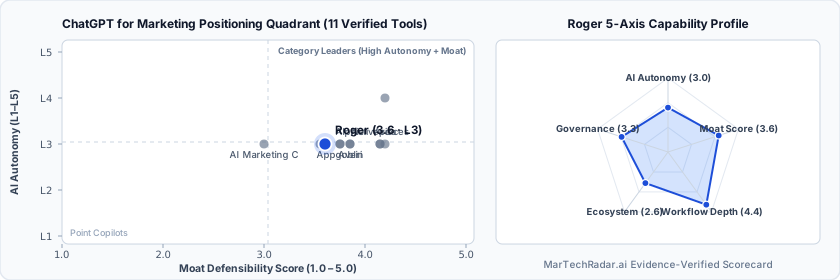
Roger is a Web SaaS tool for ChatGPT for Marketing (Open-Source Marketing Agents & Prompts) in Agent & Marketing Ops. Pricing: Custom / enterprise pricing. Best suited to B2B SaaS. Editor ratings: AI autonomy L3 (conditional automation); moat score 3.6/5.0 (Proprietary moat). Fact-checked by Tim Fenolz on Oct 16, 2026.
Open-source autonomous marketing agent framework orchestrating multi-step campaign execution, prompt chaining, and tool calling for growth engineering teams.
Roger buyer fit verdict: when to choose vs. when to walk away
Choose Roger if (Best Fit)
- Target ICP & Stack Fit: You operate as B2B SaaS requiring a Web SaaS deployment for ChatGPT for Marketing.
- L3 Architecture & Defensibility: Roger derives its defensibility from modular agent architectures and extensible prompt-chaining libraries designed specifically for go-to-market workflows, though it faces commoditization risks common to open-source agent runtimes without dedicated managed infrastructure.
- Commercial Model Fit: Your procurement budget aligns with Custom / enterprise pricing.
Walk away from Roger if (Deal-Breakers)
- Walk away if you require transparent self-serve monthly billing or your budget ceiling is under $1,000/mo (Roger requires sales-gated custom quoting).
- Walk away if your workflow cannot tolerate context window drift: Extended multi-step agent loops risk non-deterministic hallucination or parameter drift when chaining long-context inputs across sequential marketing actions without human-in-the-loop checkpoints.
- Walk away if API rate throttling is a deal-breaker for your team: Unconstrained recursive tool execution rapidly exhausts rate limits across external ad platform interfaces and downstream messaging gateways during high-volume data-enrichment sweeps.
Roger key facts & scorecard
| Pricing | Custom / enterprise pricing |
|---|---|
| Free plan | No / not disclosed |
| Delivery | Web SaaS |
| Audience | B2B SaaS |
| AI autonomy level | L3 · Conditional automationEditor-verified |
| Moat tier & score | 3.6 / 5.0 · Proprietary moatEditor-verified |
| Funding | Open source |
| Headquarters | United States |
| Last verified |
Roger pros & cons: strengths vs. operational limitations
Pros: core strengths & capabilities
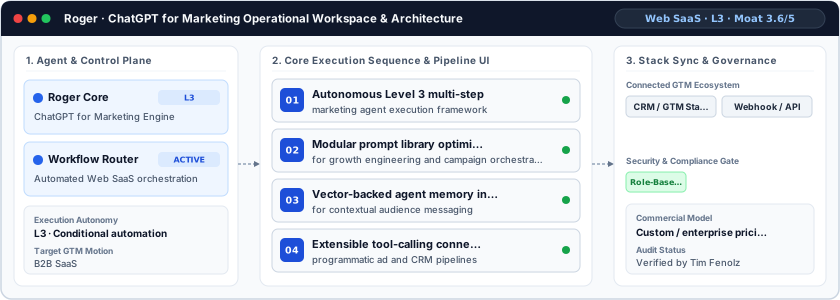
- Autonomous Level 3 multi-step: marketing agent execution framework
- Modular prompt library optimized: for growth engineering and campaign orchestration
- Vector-backed agent memory integration: for contextual audience messaging
- Extensible tool-calling connectors linking: programmatic ad and CRM pipelines
Cons: operational limitations & risks
- Context Window Drift: Extended multi-step agent loops risk non-deterministic hallucination or parameter drift when chaining long-context inputs across sequential marketing actions without human-in-the-loop checkpoints.
- API Rate Throttling: Unconstrained recursive tool execution rapidly exhausts rate limits across external ad platform interfaces and downstream messaging gateways during high-volume data-enrichment sweeps.
- Schema Maintenance Overhead: Self-hosted deployments require ongoing manual maintenance to update prompt bindings and API connectors whenever third-party martech endpoints revise their data schemas.
Roger TCO & deal-breaker stress test
Simulate 12-month stepped TCO, hidden cost multipliers, contract lock-in exposure, and stack failure modes using only facts verified by Tim Fenolz on .
Roger triggers high-severity friction under your 5-seat / $800/mo constraints. Benchmark the verified subtrack alternatives below before committing.
| Plan / Tier | Verified Rate | Scale Fit | Scope & Quota Notes |
|---|---|---|---|
| Enterprise / Custom | Custom quote | 15–50+ seats (Enterprise SLA) | Sales-negotiated annual contract for custom volume, SSO/RBAC governance, and dedicated SLA. |
- Moat Score
- 3.6 / 5.0
- AI Autonomy
- L3
- Free Tier / Trial
- None disclosed
Triggered audit signals & failure modes
- Opaque Enterprise Quoting vs. SMB/Mid-Market BudgetVerified Pricing Ledger
Roger does not disclose a public self-serve floor (Custom / enterprise pricing). Buyers with a $800/mo cap face high sales-qualification friction.
- Sales-Gated Contract TermsFact-checked by Tim Fenolz
Commercial pricing is available on request through tailored enterprise sales quotes based on organizational scale and seats.
- Primary Operational Bottleneck: Context Window DriftAudit by Tim Fenolz
Extended multi-step agent loops risk non-deterministic hallucination or parameter drift when chaining long-context inputs across sequential marketing actions without human-in-the-loop checkpoints.
Hidden TCO Multipliers & Quota Gates
- Context Window Drift: Extended multi-step agent loops risk non-deterministic hallucination or parameter drift when chaining long-context inputs across sequential marketing actions without human-in-the-loop checkpoints.
- API Rate Throttling: Unconstrained recursive tool execution rapidly exhausts rate limits across external ad platform interfaces and downstream messaging gateways during high-volume data-enrichment sweeps.
When to Walk Away & Negotiation Levers
- Walk away if you require transparent self-serve monthly billing or your budget ceiling is under $1,000/mo (Roger requires sales-gated custom quoting).
- Walk away if your workflow cannot tolerate context window drift: Extended multi-step agent loops risk non-deterministic hallucination or parameter drift when chaining long-context inputs across sequential marketing actions without human-in-the-loop checkpoints.
- Walk away if API rate throttling is a deal-breaker for your team: Unconstrained recursive tool execution rapidly exhausts rate limits across external ad platform interfaces and downstream messaging gateways during high-volume data-enrichment sweeps.
- Demand a 30- to 60-day paid pilot opt-out clause in the Roger order form before signing a 12-month enterprise commitment.
- Require a sandbox proof-of-concept testing context window drift against your live CRM/data schema before annual sign-off.
Ask a custom procurement or TCO stress-test question about Roger
Lower 5-seat floor (~$99/mo vs. Custom Quote) · Transparent self-serve entry without mandatory annual lock-in
Lower 5-seat floor (~$99/mo vs. Custom Quote) · Transparent self-serve entry without mandatory annual lock-in
Roger moat & subtrack positioning
Roger derives its defensibility from modular agent architectures and extensible prompt-chaining libraries designed specifically for go-to-market workflows, though it faces commoditization risks common to open-source agent runtimes without dedicated managed infrastructure.
Editorial review
Fact-checked by Tim Fenolz (Lead AdTech, Programmatic & Attribution Analyst) on .
Background
Architectured as an open-source agent runtime based in the United States, Roger addresses the structural fragility of rigid automation scripts in growth engineering. Engineered specifically for technical marketers, revenue operations engineers, and AI developers, the framework structures non-deterministic campaign generation into predictable execution graphs. Rather than relying on closed-box SaaS logic, Roger establishes a code-first foundation for teams constructing autonomous outbound sequences, content adaptation engines, and algorithmic conversion loops directly within their owned data environments.
How Roger works
Under the hood, Roger executes at Level 3 conditional autonomy by deploying multi-agent state machines coordinated through declarative prompt templates and tool-calling interfaces. The ingestion engine pulls unstructured audience signals, product documentation, and campaign logs into vector memory stores to ground contextual generation. Downstream, individual specialized agents manage sub-tasks—such as audience cohort identification, message variant synthesis, and performance evaluation—passing intermediary outputs across verified schemas before hitting external CRM or communication endpoints.
Limitations
Operational considerations and platform boundaries include:
- Context Window Drift: Extended multi-step agent loops risk non-deterministic hallucination or parameter drift when chaining long-context inputs across sequential marketing actions without human-in-the-loop checkpoints.
- API Rate Throttling: Unconstrained recursive tool execution rapidly exhausts rate limits across external ad platform interfaces and downstream messaging gateways during high-volume data-enrichment sweeps.
- Schema Maintenance Overhead: Self-hosted deployments require ongoing manual maintenance to update prompt bindings and API connectors whenever third-party martech endpoints revise their data schemas.
Roger pricing
Commercial pricing is available on request through tailored enterprise sales quotes based on organizational scale and seats. While core runtime components align with an open-source model, commercial arrangements cover dedicated enterprise hosting, governance tooling, priority support agreements, and customized orchestration connectors.
How Roger compares
Within the open-source agent landscape, Roger competes against frameworks like Alphie, Appgoblin, and Arda. While Appgoblin emphasizes app-store intelligence and Alphie focuses on modular conversational flows, Roger prioritizes horizontal marketing orchestration and multi-agent coordination. Arda targets developer-centric workflow primitives, making Roger the preferred architecture for technical growth engineers who require production-ready prompt scaffolding without constructing agent state management entirely from scratch. It is best suited for enterprise marketing teams and growth practitioners seeking disciplined workflow orchestration.
Frequently asked questions about Roger
How much does Roger cost and does it require a custom enterprise quote?
Published pricing summary for Roger: Custom / enterprise pricing. A permanent free plan is not disclosed for Roger. Commercial pricing is available on request through tailored enterprise sales quotes based on organizational scale and seats.
How does Roger work and how autonomous is its AI architecture?
Open-source autonomous marketing agent framework orchestrating multi-step campaign execution, prompt chaining, and tool calling for growth engineering teams. Within ChatGPT for Marketing (Open-Source Marketing Agents & Prompts), MarTechRadar rates its execution architecture at L3 · Conditional automation with a verified Moat Score of 3.6 / 5.0 (Proprietary moat). Roger derives its defensibility from modular agent architectures and extensible prompt-chaining libraries designed specifically for go-to-market workflows, though it faces commoditization risks common to open-source agent runtimes without dedicated managed infrastructure.
What are the main limitations of Roger and when should buyers walk away?
Based on our editorial technical audit, key operational considerations and boundaries for Roger include: (1) Context Window Drift: Extended multi-step agent loops risk non-deterministic hallucination or parameter drift when chaining long-context inputs across sequential marketing actions without human-in-the-loop checkpoints. (2) API Rate Throttling: Unconstrained recursive tool execution rapidly exhausts rate limits across external ad platform interfaces and downstream messaging gateways during high-volume data-enrichment sweeps. (3) Schema Maintenance Overhead: Self-hosted deployments require ongoing manual maintenance to update prompt bindings and API connectors whenever third-party martech endpoints revise their data schemas. Primary procurement walk-away rule: Walk away if you require transparent self-serve monthly billing or your budget ceiling is under $1,000/mo (Roger requires sales-gated custom quoting).
What integrations, compliance certifications, and contract terms apply to Roger?
Key TCO multiplier to watch: Context Window Drift (Extended multi-step agent loops risk non-deterministic hallucination or parameter drift when chaining long-context inputs across sequential marketing actions without human-in-the-loop checkpoints.) Before signing a contract, procurement teams should demand a 30- to 60-day paid pilot opt-out clause in the Roger order form before signing a 12-month enterprise commitment.
What are the best Roger alternatives and head-to-head competitors in 2026?
Top fact-checked alternatives to Roger in ChatGPT for Marketing (Open-Source Marketing Agents & Prompts) include Revliu (Custom / enterprise pricing), SendRoq (Custom / enterprise pricing), Seylo (Custom / enterprise pricing), SiteTell (Custom / enterprise pricing). Within the open-source agent landscape, Roger competes against frameworks like Alphie, Appgoblin, and Arda. While Appgoblin emphasizes app-store intelligence and Alphie focuses on modular conversational flows, Roger prioritizes horizontal marketing orchestration and multi-agent coordination.
Verified sources & evidence trail
- Official product domain: https://useroger.io
- Commercial pricing verification: Verified against official vendor pricing policy (Custom / enterprise pricing)
- Editorial audit sign-off: Fact-checked by Tim Fenolz on under the MarTechRadar Evidence-Ledger Protocol.