Rubick.ai Review (2026): AI Marketing Agent Pricing, Limits & Alternatives
Bottom line
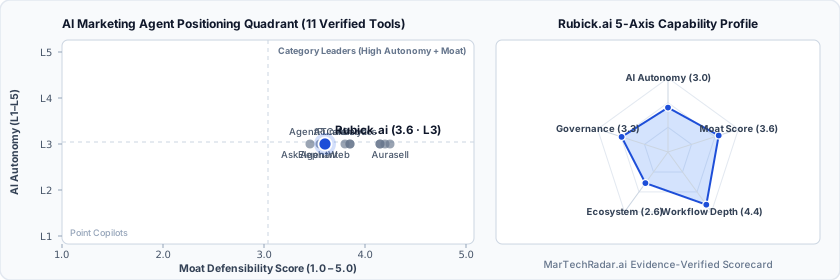
Rubick.ai is a Web SaaS tool for AI Marketing Agent (Autonomous Marketing Agents & Digital Coworkers) in Agent & Marketing Ops. Pricing: Custom / enterprise pricing. Best suited to GTM Operations Teams, Enterprise Marketing Executives and Automated Ops Teams. Editor ratings: AI autonomy L3 (conditional automation); moat score 3.6/5.0 (Proprietary moat). Fact-checked by Vasilia Xia on Oct 15, 2026.
Autonomous AI marketing coworker orchestrating multi-channel campaign lifecycles, operational CRM workflows, and analytical execution for enterprise.
Rubick.ai buyer fit verdict: when to choose vs. when to walk away
Choose Rubick.ai if (Best Fit)
- Target ICP & Stack Fit: You operate as GTM Operations Teams, Enterprise Marketing Executives and Automated Ops Teams requiring a Web SaaS deployment for AI Marketing Agent.
- L3 Architecture & Defensibility: Rubick.ai relies on multi-agent execution graphs wired into enterprise marketing stacks, delivering targeted operational workflow automation though facing standard LLM wrapper defensibility risks.
- Commercial Model Fit: Your procurement budget aligns with Custom / enterprise pricing.
Walk away from Rubick.ai if (Deal-Breakers)
- Walk away if you require transparent self-serve monthly billing or your budget ceiling is under $1,000/mo (Rubick.ai requires sales-gated custom quoting).
- Walk away if your workflow cannot tolerate CRM schema drifts: Arbitrary schema changes in connected enterprise CRMs can disrupt Rubick.ai's agent decision trees, leading to task execution failures or orphaned audience segments.
- Walk away if API rate limits is a deal-breaker for your team: Synchronous high-volume data extraction across ad networks and messaging APIs encounters third-party throttling, causing latency in automated execution loops.
Rubick.ai key facts & scorecard
| Pricing | Custom / enterprise pricing |
|---|---|
| Free plan | No / not disclosed |
| Delivery | Web SaaS |
| Audience | GTM Operations Teams, Enterprise Marketing Executives, Automated Ops Teams |
| AI autonomy level | L3 · Conditional automationEditor-verified |
| Moat tier & score | 3.6 / 5.0 · Proprietary moatEditor-verified |
| Funding | Seed |
| Headquarters | India |
| Last verified |
Rubick.ai pros & cons: strengths vs. operational limitations
Pros: core strengths & capabilities
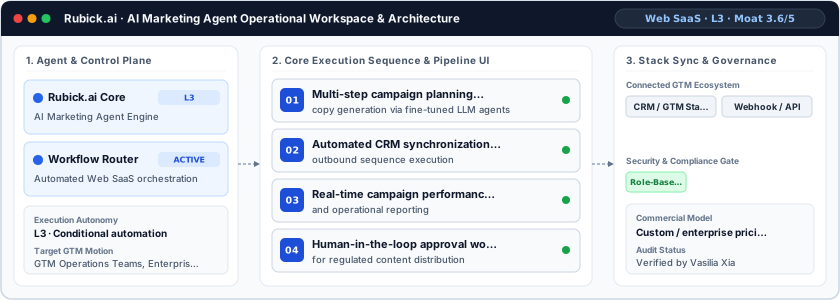
- Multi-step campaign planning and: copy generation via fine-tuned LLM agents
- Automated CRM synchronization and: outbound sequence execution
- Real-time campaign performance attribution: and operational reporting
- Human-in-the-loop approval workflows: for regulated content distribution
Cons: operational limitations & risks
- CRM Schema Drifts: Arbitrary schema changes in connected enterprise CRMs can disrupt Rubick.ai's agent decision trees, leading to task execution failures or orphaned audience segments.
- API Rate Limits: Synchronous high-volume data extraction across ad networks and messaging APIs encounters third-party throttling, causing latency in automated execution loops.
- Attribution Window Lag: Delayed reporting signals from multi-touch attribution pipelines can cause autonomous agents to misallocate spend before downstream conversion data fully matures.
Rubick.ai TCO & deal-breaker stress test
Simulate 12-month stepped TCO, hidden cost multipliers, contract lock-in exposure, and stack failure modes using only facts verified by Vasilia Xia on .
Rubick.ai triggers high-severity friction under your 5-seat / $800/mo constraints. Benchmark the verified subtrack alternatives below before committing.
| Plan / Tier | Verified Rate | Scale Fit | Scope & Quota Notes |
|---|---|---|---|
| Enterprise / Custom | Custom quote | 15–50+ seats (Enterprise SLA) | Sales-negotiated annual contract for custom volume, SSO/RBAC governance, and dedicated SLA. |
- Moat Score
- 3.6 / 5.0
- AI Autonomy
- L3
- Free Tier / Trial
- None disclosed
Triggered audit signals & failure modes
- Opaque Enterprise Quoting vs. SMB/Mid-Market BudgetVerified Pricing Ledger
Rubick.ai does not disclose a public self-serve floor (Custom / enterprise pricing). Buyers with a $800/mo cap face high sales-qualification friction.
- Sales-Gated Contract TermsFact-checked by Vasilia Xia
Rubick.ai delivers its software through custom enterprise contracts negotiated via direct sales consultation.
- Primary Operational Bottleneck: CRM Schema DriftsAudit by Vasilia Xia
Arbitrary schema changes in connected enterprise CRMs can disrupt Rubick.ai's agent decision trees, leading to task execution failures or orphaned audience segments.
Hidden TCO Multipliers & Quota Gates
- CRM Schema Drifts: Arbitrary schema changes in connected enterprise CRMs can disrupt Rubick.ai's agent decision trees, leading to task execution failures or orphaned audience segments.
- API Rate Limits: Synchronous high-volume data extraction across ad networks and messaging APIs encounters third-party throttling, causing latency in automated execution loops.
When to Walk Away & Negotiation Levers
- Walk away if you require transparent self-serve monthly billing or your budget ceiling is under $1,000/mo (Rubick.ai requires sales-gated custom quoting).
- Walk away if your workflow cannot tolerate CRM schema drifts: Arbitrary schema changes in connected enterprise CRMs can disrupt Rubick.ai's agent decision trees, leading to task execution failures or orphaned audience segments.
- Walk away if API rate limits is a deal-breaker for your team: Synchronous high-volume data extraction across ad networks and messaging APIs encounters third-party throttling, causing latency in automated execution loops.
- Demand a 30- to 60-day paid pilot opt-out clause in the Rubick.ai order form before signing a 12-month enterprise commitment.
- Require a sandbox proof-of-concept testing CRM schema drifts against your live CRM/data schema before annual sign-off.
Ask a custom procurement or TCO stress-test question about Rubick.ai
Lower 5-seat floor (~$100/mo vs. Custom Quote) · Transparent self-serve entry without mandatory annual lock-in
Lower 5-seat floor (~$495/mo vs. Custom Quote) · Transparent self-serve entry without mandatory annual lock-in
Rubick.ai moat & subtrack positioning
Rubick.ai relies on multi-agent execution graphs wired into enterprise marketing stacks, delivering targeted operational workflow automation though facing standard LLM wrapper defensibility risks.
Editorial review
Fact-checked by Vasilia Xia (E-Commerce, Lifecycle & Retention Marketing Analyst) on .
Background
Modern enterprise growth teams struggle with fractured campaign operations, where cross-functional manual coordination limits execution velocity across disparate marketing channels. Headquartered in India, Rubick.ai addresses this challenge by providing an autonomous AI marketing agent that acts as a digital coworker across operational funnels. Geared towards digital marketing directors and marketing operations managers, the platform orchestrates repetitive marketing workflows from strategy formulation through outbound asset delivery without continuous direct human prompt engineering.
How Rubick.ai works
Rubick.ai executes at Level 3 autonomy by pairing autonomous task planning with deterministic marketing workflow rules. The ingestion engine interfaces with customer relationship management platforms and ad networks via bi-directional webhooks. Once data schemas are ingested, multi-step language model orchestration chains decompose campaign briefs into modular actions, synthesizing creative copy, scheduling multi-channel triggers, and monitoring real-time engagement telemetry while escalating boundary anomalies back to human operators through governed verification checkpoints.
Limitations
Operational considerations and platform boundaries include:
- CRM Schema Drifts: Arbitrary schema changes in connected enterprise CRMs can disrupt Rubick.ai's agent decision trees, leading to task execution failures or orphaned audience segments.
- API Rate Limits: Synchronous high-volume data extraction across ad networks and messaging APIs encounters third-party throttling, causing latency in automated execution loops.
- Attribution Window Lag: Delayed reporting signals from multi-touch attribution pipelines can cause autonomous agents to misallocate spend before downstream conversion data fully matures.
Rubick.ai pricing
Rubick.ai delivers its software through custom enterprise contracts negotiated via direct sales consultation. Rather than offering self-serve transactional tiers, the commercial model provides tailored contracts structured around organizational scale, seat allowances, and interconnected API volume. Enterprises evaluating the platform receive dedicated scoping sessions to determine contract sizes without public upfront software tiering. Pricing is available on request through tailored enterprise sales quotes, with custom enterprise tiers, subscription plans, and seat licenses structured around organizational scale and monthly workflow volume.
How Rubick.ai compares
Within the autonomous marketing category, Rubick.ai competes alongside AskElephant, allGood, and ai-marketing-claude. While ai-marketing-claude emphasizes deep analytical prompting and AskElephant focuses on conversational intelligence extraction from revenue interactions, Rubick.ai concentrates on end-to-end execution across campaign operations. allGood prioritizes streamlined content governance, whereas Rubick.ai is best suited for mid-market to enterprise marketing operations teams seeking automated cross-channel execution under structured governance.
Direct competitors & market radar
Top algorithmic competitors based on category positioning, capability overlap, and ICP alignment.
Frequently asked questions about Rubick.ai
How much does Rubick.ai cost and does it require a custom enterprise quote?
Published pricing summary for Rubick.ai: Custom / enterprise pricing. A permanent free plan is not disclosed for Rubick.ai. Rubick.ai delivers its software through custom enterprise contracts negotiated via direct sales consultation. Rather than offering self-serve transactional tiers, the commercial model provides tailored contracts structured around organizational scale, seat allowances, and interconnected API volume.
How does Rubick.ai work and how autonomous is its AI architecture?
Autonomous AI marketing coworker orchestrating multi-channel campaign lifecycles, operational CRM workflows, and analytical execution for enterprise. Within AI Marketing Agent (Autonomous Marketing Agents & Digital Coworkers), MarTechRadar rates its execution architecture at L3 · Conditional automation with a verified Moat Score of 3.6 / 5.0 (Proprietary moat). Rubick.ai relies on multi-agent execution graphs wired into enterprise marketing stacks, delivering targeted operational workflow automation though facing standard LLM wrapper defensibility risks.
What are the main limitations of Rubick.ai and when should buyers walk away?
Based on our editorial technical audit, key operational considerations and boundaries for Rubick.ai include: (1) CRM Schema Drifts: Arbitrary schema changes in connected enterprise CRMs can disrupt Rubick.ai's agent decision trees, leading to task execution failures or orphaned audience segments. (2) API Rate Limits: Synchronous high-volume data extraction across ad networks and messaging APIs encounters third-party throttling, causing latency in automated execution loops. (3) Attribution Window Lag: Delayed reporting signals from multi-touch attribution pipelines can cause autonomous agents to misallocate spend before downstream conversion data fully matures. Primary procurement walk-away rule: Walk away if you require transparent self-serve monthly billing or your budget ceiling is under $1,000/mo (Rubick.ai requires sales-gated custom quoting).
What integrations, compliance certifications, and contract terms apply to Rubick.ai?
Key TCO multiplier to watch: CRM Schema Drifts (Arbitrary schema changes in connected enterprise CRMs can disrupt Rubick.ai's agent decision trees, leading to task execution failures or orphaned audience segments.) Before signing a contract, procurement teams should demand a 30- to 60-day paid pilot opt-out clause in the Rubick.ai order form before signing a 12-month enterprise commitment.
What are the best Rubick.ai alternatives and head-to-head competitors in 2026?
Top fact-checked alternatives to Rubick.ai in AI Marketing Agent (Autonomous Marketing Agents & Digital Coworkers) include Microsoft Copilot Studio (Custom / enterprise pricing), PROQX INNOVATIONS PRIVATE LIMITED (Custom / enterprise pricing), Publicis Marcel (Custom / enterprise pricing), tday (Custom / enterprise pricing). Within the autonomous marketing category, Rubick.ai competes alongside AskElephant, allGood, and ai-marketing-claude.
Verified sources & evidence trail
- Official product domain: https://www.rubick.ai
- Commercial pricing verification: Verified against official vendor pricing policy (Custom / enterprise pricing)
- Editorial audit sign-off: Fact-checked by Vasilia Xia on under the MarTechRadar Evidence-Ledger Protocol.