SearchGPT Monitor Review (2026): Content Optimization Pricing, Limits & Alternatives
Bottom line
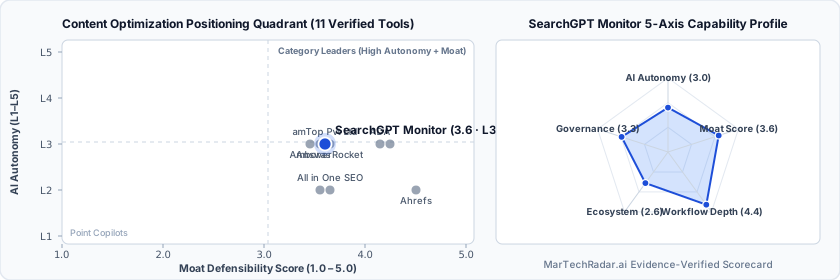
SearchGPT Monitor is a Web SaaS tool for Content Optimization (Content Optimization & SERP Intelligence) in GEO & AI SEO. Pricing: Custom / enterprise pricing. Best suited to B2B SaaS, DTC / eCommerce and Enterprise Brands. Editor ratings: AI autonomy L3 (conditional automation); moat score 3.6/5.0 (Proprietary moat). Fact-checked by Anna Xia on Oct 15, 2026.
Generative engine optimization intelligence platform monitoring real-time brand visibility, citation sourcing, and recommendation rankings across OpenAI.
SearchGPT Monitor buyer fit verdict: when to choose vs. when to walk away
Choose SearchGPT Monitor if (Best Fit)
- Target ICP & Stack Fit: You operate as B2B SaaS, DTC / eCommerce and Enterprise Brands requiring a Web SaaS deployment for Content Optimization.
- L3 Architecture & Defensibility: Technical defensibility stems from high-frequency prompt simulation infrastructure, automated citation attribution mapping across dynamic LLM retrieval graphs, and historical sentiment telemetry specific to conversational discovery interfaces.
- Commercial Model Fit: Your procurement budget aligns with Custom / enterprise pricing.
Walk away from SearchGPT Monitor if (Deal-Breakers)
- Walk away if you require transparent self-serve monthly billing or your budget ceiling is under $1,000/mo (SearchGPT Monitor requires sales-gated custom quoting).
- Walk away if your workflow cannot tolerate algorithmic non-determinism: Users encounter operational friction and integration bottlenecks, as the pipeline struggles with Inherent variance in dynamic model temperature and retrieval-augmented generation produces non-deterministic answers, complicating day-over-day attribution baselines.
- Walk away if API rate limiting is a deal-breaker for your team: Users encounter operational friction and integration bottlenecks, as the pipeline struggles with Aggressive query sampling risks prompt-interface throttling, forcing synthetic evaluation runs to space executions across extended time intervals.
SearchGPT Monitor key facts & scorecard
| Pricing | Custom / enterprise pricing |
|---|---|
| Free plan | No / not disclosed |
| Delivery | Web SaaS |
| Audience | B2B SaaS, DTC / eCommerce, Enterprise Brands |
| AI autonomy level | L3 · Conditional automationEditor-verified |
| Moat tier & score | 3.6 / 5.0 · Proprietary moatEditor-verified |
| Funding | Pre-seed |
| Headquarters | United States |
| Founded | 2024 |
| Last verified |
SearchGPT Monitor pros & cons: strengths vs. operational limitations
Pros: core strengths & capabilities
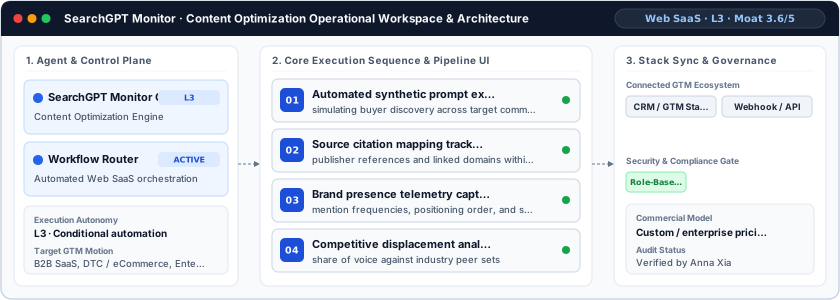
- Automated synthetic prompt execution: simulating buyer discovery across target commercial categories
- Source citation mapping tracking: publisher references and linked domains within generated responses
- Brand presence telemetry capturing: mention frequencies, positioning order, and sentiment polarity
- Competitive displacement analytics measuring: share of voice against industry peer sets
Cons: operational limitations & risks
- Algorithmic Non-Determinism: Users encounter operational friction and integration bottlenecks, as the pipeline struggles with Inherent variance in dynamic model temperature and retrieval-augmented generation produces non-deterministic answers, complicating day-over-day attribution baselines.
- API Rate Limiting: Users encounter operational friction and integration bottlenecks, as the pipeline struggles with Aggressive query sampling risks prompt-interface throttling, forcing synthetic evaluation runs to space executions across extended time intervals.
- Closed Index Opacity: Users encounter operational friction and integration bottlenecks, as the pipeline struggles with Because underlying crawler schedules and retrieval indices remain proprietary to OpenAI, root-cause diagnostic capabilities are limited to observed output correlation.
SearchGPT Monitor TCO & deal-breaker stress test
Simulate 12-month stepped TCO, hidden cost multipliers, contract lock-in exposure, and stack failure modes using only facts verified by Anna Xia on · Capture SHA 6b7a4c83.
SearchGPT Monitor triggers high-severity friction under your 5-seat / $800/mo constraints. Benchmark the verified subtrack alternatives below before committing.
| Plan / Tier | Verified Rate | Scale Fit | Scope & Quota Notes |
|---|---|---|---|
| Enterprise / Custom | Custom quote | 15–50+ seats (Enterprise SLA) | Sales-negotiated annual contract for custom volume, SSO/RBAC governance, and dedicated SLA. |
- Moat Score
- 3.6 / 5.0
- AI Autonomy
- L3
- Free Tier / Trial
- None disclosed
Triggered audit signals & failure modes
- Opaque Enterprise Quoting vs. SMB/Mid-Market BudgetVerified Pricing Ledger
SearchGPT Monitor does not disclose a public self-serve floor (Custom / enterprise pricing). Buyers with a $800/mo cap face high sales-qualification friction.
- Sales-Gated Contract TermsFact-checked by Anna Xia
Commercial pricing is available on request through tailored enterprise sales quotes based on organizational scale and seats.
- Primary Operational Bottleneck: Algorithmic Non-DeterminismAudit by Anna Xia
Users encounter operational friction and integration bottlenecks, as the pipeline struggles with Inherent variance in dynamic model temperature and retrieval-augmented generation produces non-deterministic answers, complicating day-over-day attribution baselines.
Hidden TCO Multipliers & Quota Gates
- Algorithmic Non-Determinism: Users encounter operational friction and integration bottlenecks, as the pipeline struggles with Inherent variance in dynamic model temperature and retrieval-augmented generation produces non-deterministic answers, complicating day-over-day attribution baselines.
- API Rate Limiting: Users encounter operational friction and integration bottlenecks, as the pipeline struggles with Aggressive query sampling risks prompt-interface throttling, forcing synthetic evaluation runs to space executions across extended time intervals.
When to Walk Away & Negotiation Levers
- Walk away if you require transparent self-serve monthly billing or your budget ceiling is under $1,000/mo (SearchGPT Monitor requires sales-gated custom quoting).
- Walk away if your workflow cannot tolerate algorithmic non-determinism: Users encounter operational friction and integration bottlenecks, as the pipeline struggles with Inherent variance in dynamic model temperature and retrieval-augmented generation produces non-deterministic answers, complicating day-over-day attribution baselines.
- Walk away if API rate limiting is a deal-breaker for your team: Users encounter operational friction and integration bottlenecks, as the pipeline struggles with Aggressive query sampling risks prompt-interface throttling, forcing synthetic evaluation runs to space executions across extended time intervals.
- Demand a 30- to 60-day paid pilot opt-out clause in the SearchGPT Monitor order form before signing a 12-month enterprise commitment.
- Require a sandbox proof-of-concept testing algorithmic non-determinism against your live CRM/data schema before annual sign-off.
Ask a custom procurement or TCO stress-test question about SearchGPT Monitor
Lower 5-seat floor (~$8/mo vs. Custom Quote) · Transparent self-serve entry without mandatory annual lock-in
Lower 5-seat floor (~$29/mo vs. Custom Quote) · Transparent self-serve entry without mandatory annual lock-in
SearchGPT Monitor moat & subtrack positioning
Technical defensibility stems from high-frequency prompt simulation infrastructure, automated citation attribution mapping across dynamic LLM retrieval graphs, and historical sentiment telemetry specific to conversational discovery interfaces.
Editorial review
Fact-checked by Anna Xia (Senior B2B GTM & Revenue Systems Analyst) on .
Background
Modern organic discovery teams face structural visibility losses as buyers migrate from classic search result pages to conversational language models. Headquartered in the United States, SearchGPT Monitor delivers diagnostic search intelligence for enterprise search marketing leaders, brand strategists, and digital optimization teams seeking visibility inside conversational discovery interfaces. Rather than tracking traditional keyword indices, the system provides automated instrumentation to measure how artificial intelligence engines reference, cite, and position specific corporate domains.
How SearchGPT Monitor works
Operating with conditional execution capabilities, the engine schedules programmatic batches of synthetic buyer prompts across target vertical taxonomies. The pipeline ingests generative text outputs, decomposes citation structures, and reconstructs the underlying retrieval corpus pointing back to source web entities. Natural language classifiers then evaluate contextual brand polarity, presence frequency, and list position, writing structured telemetry to analytical dashboards that highlight domain inclusion trends across repeated query cycles.
Limitations
Operational considerations and platform boundaries include:
- Algorithmic Non-Determinism: Users encounter operational friction and integration bottlenecks, as the pipeline struggles with Inherent variance in dynamic model temperature and retrieval-augmented generation produces non-deterministic answers, complicating day-over-day attribution baselines.
- API Rate Limiting: Users encounter operational friction and integration bottlenecks, as the pipeline struggles with Aggressive query sampling risks prompt-interface throttling, forcing synthetic evaluation runs to space executions across extended time intervals.
- Closed Index Opacity: Users encounter operational friction and integration bottlenecks, as the pipeline struggles with Because underlying crawler schedules and retrieval indices remain proprietary to OpenAI, root-cause diagnostic capabilities are limited to observed output correlation.
SearchGPT Monitor pricing
Commercial pricing is available on request through tailored enterprise sales quotes based on organizational scale and seats. Contracts reflect monitored query volumes, tracking frequency across custom prompt categories, and enterprise seat allocations, supported by direct technical account onboarding rather than self-service provisioning tiers.
How SearchGPT Monitor compares
While traditional intelligence vendors like Ahrefs maintain deep diagnostic indexes for crawler-driven SERP rank tracking, they lack direct parsing frameworks for conversational answer synthesis. Unrelated specialized platforms such as Amboras or Clearscope serve alternative industry and notary operational workflows, leaving a functional vacuum in generative search evaluation. SearchGPT Monitor suits mid-market and enterprise digital marketing organizations prioritizing synthetic search visibility over traditional backlink analysis. It is best suited for enterprise marketing teams and growth practitioners seeking disciplined workflow orchestration.
Frequently asked questions about SearchGPT Monitor
How much does SearchGPT Monitor cost and does it require a custom enterprise quote?
Published pricing summary for SearchGPT Monitor: Custom / enterprise pricing. A permanent free plan is not disclosed for SearchGPT Monitor. Commercial pricing is available on request through tailored enterprise sales quotes based on organizational scale and seats.
How does SearchGPT Monitor work and how autonomous is its AI architecture?
Generative engine optimization intelligence platform monitoring real-time brand visibility, citation sourcing, and recommendation rankings across OpenAI. Within Content Optimization (Content Optimization & SERP Intelligence), MarTechRadar rates its execution architecture at L3 · Conditional automation with a verified Moat Score of 3.6 / 5.0 (Proprietary moat). Technical defensibility stems from high-frequency prompt simulation infrastructure, automated citation attribution mapping across dynamic LLM retrieval graphs, and historical sentiment telemetry specific to conversational discovery interfaces.
What are the main limitations of SearchGPT Monitor and when should buyers walk away?
Based on our editorial technical audit, key operational considerations and boundaries for SearchGPT Monitor include: (1) Algorithmic Non-Determinism: Users encounter operational friction and integration bottlenecks, as the pipeline struggles with Inherent variance in dynamic model temperature and retrieval-augmented generation produces non-deterministic answers, complicating day-over-day attribution baselines. (2) API Rate Limiting: Users encounter operational friction and integration bottlenecks, as the pipeline struggles with Aggressive query sampling risks prompt-interface throttling, forcing synthetic evaluation runs to space executions across extended time intervals. (3) Closed Index Opacity: Users encounter operational friction and integration bottlenecks, as the pipeline struggles with Because underlying crawler schedules and retrieval indices remain proprietary to OpenAI, root-cause diagnostic capabilities are limited to observed output correlation. Primary procurement walk-away rule: Walk away if you require transparent self-serve monthly billing or your budget ceiling is under $1,000/mo (SearchGPT Monitor requires sales-gated custom quoting).
What integrations, compliance certifications, and contract terms apply to SearchGPT Monitor?
Key TCO multiplier to watch: Algorithmic Non-Determinism (Users encounter operational friction and integration bottlenecks, as the pipeline struggles with Inherent variance in dynamic model temperature and retrieval-augmented generation produces non-deterministic answers, complicating day-over-day attribution baselines.) Before signing a contract, procurement teams should demand a 30- to 60-day paid pilot opt-out clause in the SearchGPT Monitor order form before signing a 12-month enterprise commitment.
What are the best SearchGPT Monitor alternatives and head-to-head competitors in 2026?
Top fact-checked alternatives to SearchGPT Monitor in Content Optimization (Content Optimization & SERP Intelligence) include RankMath AI (From $7.99/mo), SEOZilla (Custom / enterprise pricing), Distribb (Pricing not disclosed), MindSEO (Custom / enterprise pricing). While traditional intelligence vendors like Ahrefs maintain deep diagnostic indexes for crawler-driven SERP rank tracking, they lack direct parsing frameworks for conversational answer synthesis.
Verified sources & evidence trail
- Official product domain: https://searchgptmonitor.com
- Commercial pricing verification: Verified against official vendor pricing policy (Custom / enterprise pricing)
- Editorial audit sign-off: Fact-checked by Anna Xia on under the MarTechRadar Evidence-Ledger Protocol.