Shape.io Review (2026): AI PPC Pricing, Limits & Alternatives
Bottom line
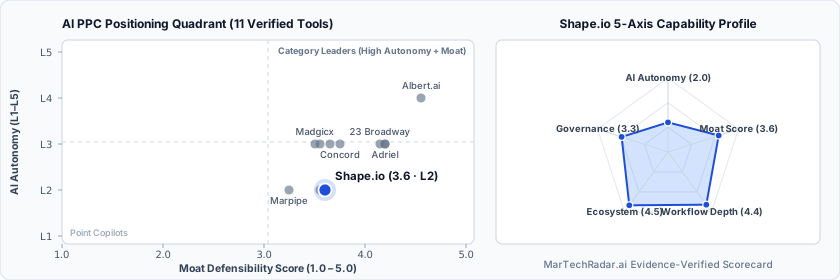
Shape.io is a Web SaaS tool for AI PPC (Autonomous Bidding & Budget Management) in AdTech & Paid Media. Pricing: Custom / enterprise pricing. Best suited to B2B SaaS and Marketing Agencies. Editor ratings: AI autonomy L2 (workflow copilot); moat score 3.6/5.0 (Proprietary moat). Fact-checked by Vasilia Xia on Oct 14, 2026.
Shape.io is an ad spend management and pacing automation platform that consolidates multi-network PPC budgets into unified pools with automated controls.
Shape.io buyer fit verdict: when to choose vs. when to walk away
Choose Shape.io if (Best Fit)
- Target ICP & Stack Fit: You operate as B2B SaaS and Marketing Agencies requiring a Web SaaS deployment for AI PPC, with verified ecosystem connectivity for LinkedIn, Google Ads, Meta Ads.
- L2 Architecture & Defensibility: Shape.io's defensibility stems from its cross-channel budget pooling architecture and deep ad network API integrations, coupled with data warehousing synchronization via its Data Cloud export pipeline.
- Commercial Model Fit: Your procurement budget aligns with Custom / enterprise pricing.
Walk away from Shape.io if (Deal-Breakers)
- Walk away if you require transparent self-serve monthly billing or your budget ceiling is under $1,000/mo (Shape.io requires sales-gated custom quoting).
- Walk away if your workflow cannot tolerate API rate limits and sync latency: Third-party ad network API refresh cycles can delay intra-day spend tracking by several hours, exposing high-velocity ad campaigns to pacing drift before defensive budget rules trigger.
- Walk away if attribution window lag is a deal-breaker for your team: The pacing engine recalculates spend pacing independently of delayed conversion attribution windows, risking false-positive alerts or premature budget throttles on channels with prolonged consideration cycles.
Shape.io key facts & scorecard
| Pricing | Custom / enterprise pricing |
|---|---|
| Free plan | No / not disclosed |
| Delivery | Web SaaS |
| Audience | B2B SaaS, Marketing Agencies |
| AI autonomy level | L2 · Workflow copilotEditor-verified |
| Moat tier & score | 3.6 / 5.0 · Proprietary moatEditor-verified |
| Funding | AcquiredAcquired by NinjaCat |
| Founders | Chris Vlessis, David Teofilovic, Feng Liu, Jon Davis |
| Company size | 1-10 employees |
| Ecosystem integrations | LinkedIn, Google Ads, Meta Ads |
| Governance & docs | Trust & Security ↗ · Terms ↗ · Privacy ↗ |
| Headquarters | 228 Park Ave S, Suite 57506, New York, 10003, US |
| Founded | 2012 |
| Last verified |
Shape.io pros & cons: strengths vs. operational limitations
Pros: core strengths & capabilities
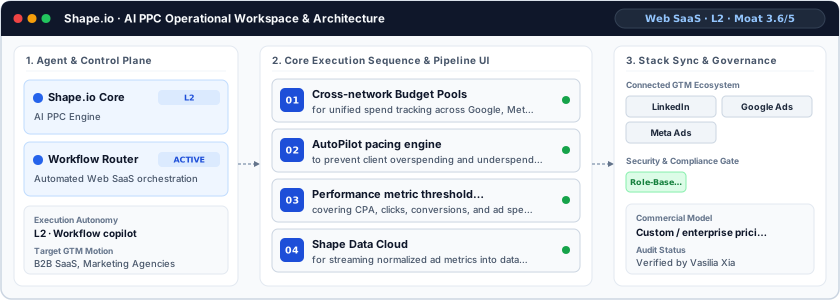
- Cross-network Budget Pools: for unified spend tracking across Google, Meta, Microsoft, and LinkedIn
- AutoPilot pacing engine: to prevent client overspending and underspending
- Performance metric threshold alerting: covering CPA, clicks, conversions, and ad spend
- Shape Data Cloud: for streaming normalized ad metrics into data warehouses
Cons: operational limitations & risks
- API Rate Limits and Sync Latency: Third-party ad network API refresh cycles can delay intra-day spend tracking by several hours, exposing high-velocity ad campaigns to pacing drift before defensive budget rules trigger.
- Attribution Window Lag: The pacing engine recalculates spend pacing independently of delayed conversion attribution windows, risking false-positive alerts or premature budget throttles on channels with prolonged consideration cycles.
- Bid Strategy Conflicts: External daily budget overrides can destabilize automated platform bid strategies, such as Google's Target CPA or Smart Bidding, by continually triggering bid learning phases.
Shape.io TCO & deal-breaker stress test
Simulate 12-month stepped TCO, hidden cost multipliers, contract lock-in exposure, and stack failure modes using only facts verified by Vasilia Xia on · Capture SHA e0236da2.
Shape.io triggers high-severity friction under your 5-seat / $800/mo constraints. Benchmark the verified subtrack alternatives below before committing.
| Plan / Tier | Verified Rate | Scale Fit | Scope & Quota Notes |
|---|---|---|---|
| Enterprise / Custom | Custom quote | 15–50+ seats (Enterprise SLA) | Sales-negotiated annual contract for custom volume, SSO/RBAC governance, and dedicated SLA. |
- Moat Score
- 3.6 / 5.0
- AI Autonomy
- L2
- Free Tier / Trial
- None disclosed
Triggered audit signals & failure modes
- Opaque Enterprise Quoting vs. SMB/Mid-Market BudgetVerified Pricing Ledger
Shape.io does not disclose a public self-serve floor (Custom / enterprise pricing). Buyers with a $800/mo cap face high sales-qualification friction.
- Sales-Gated Contract TermsFact-checked by Vasilia Xia
Shape.io licenses its technology through custom enterprise pricing available on request via sales consultation. Commercial agreements are structured around managed advertising spend volume, tracked ad accounts, and operational seat requirements.
- Primary Operational Bottleneck: API Rate Limits and Sync LatencyAudit by Vasilia Xia
Third-party ad network API refresh cycles can delay intra-day spend tracking by several hours, exposing high-velocity ad campaigns to pacing drift before defensive budget rules trigger.
Hidden TCO Multipliers & Quota Gates
- API Rate Limits and Sync Latency: Third-party ad network API refresh cycles can delay intra-day spend tracking by several hours, exposing high-velocity ad campaigns to pacing drift before defensive budget rules trigger.
- Attribution Window Lag: The pacing engine recalculates spend pacing independently of delayed conversion attribution windows, risking false-positive alerts or premature budget throttles on channels with prolonged consideration cycles.
When to Walk Away & Negotiation Levers
- Walk away if you require transparent self-serve monthly billing or your budget ceiling is under $1,000/mo (Shape.io requires sales-gated custom quoting).
- Walk away if your workflow cannot tolerate API rate limits and sync latency: Third-party ad network API refresh cycles can delay intra-day spend tracking by several hours, exposing high-velocity ad campaigns to pacing drift before defensive budget rules trigger.
- Walk away if attribution window lag is a deal-breaker for your team: The pacing engine recalculates spend pacing independently of delayed conversion attribution windows, risking false-positive alerts or premature budget throttles on channels with prolonged consideration cycles.
- Demand a 30- to 60-day paid pilot opt-out clause in the Shape.io order form before signing a 12-month enterprise commitment.
- Require a sandbox proof-of-concept testing API rate limits and sync latency against your live CRM/data schema before annual sign-off.
Ask a custom procurement or TCO stress-test question about Shape.io
Lower 5-seat floor (~$500/mo vs. Custom Quote) · Transparent self-serve entry without mandatory annual lock-in
Lower 5-seat floor (~$49/mo vs. Custom Quote) · Transparent self-serve entry without mandatory annual lock-in
Shape.io key entities, modules & ecosystem stack
Shape.io moat & subtrack positioning
Shape.io's defensibility stems from its cross-channel budget pooling architecture and deep ad network API integrations, coupled with data warehousing synchronization via its Data Cloud export pipeline.
Editorial review
Fact-checked by Vasilia Xia (E-Commerce, Lifecycle & Retention Marketing Analyst) on .
Background
Eliminating manual budget tracking across fragmented ad channels is the central mandate of Shape.io. Established in 2012 and headquartered in New York, the company was acquired by NinjaCat to bolster enterprise cross-network campaign governance. The software is engineered for PPC directors, performance media leads, and digital agency operators who manage multi-client paid media portfolios. Within modern media buying stacks, Shape.io occupies the autonomous pacing layer, standardizing spend ingestion across disparate paid channels to mitigate human execution risk.
How Shape.io works
Operating as a Level 2 autonomous budget management platform, Shape.io pulls performance and billing telemetry via direct API connections to ad networks including Google Ads, Meta Ads, and Microsoft Advertising. The core data pipeline ingests cost metrics at scheduled intervals, normalizing disparate currency and delivery structures into centralized Budget Pools. The AutoPilot pacing engine tracks current spend against target run rates, calculating projected end-of-cycle spend using historical pacing curves. When pacing models project an overspend, the system issues API mutations to adjust daily caps or pause ad sets automatically.
Limitations
Operational considerations and platform boundaries include:
- API Rate Limits and Sync Latency: Third-party ad network API refresh cycles can delay intra-day spend tracking by several hours, exposing high-velocity ad campaigns to pacing drift before defensive budget rules trigger.
- Attribution Window Lag: The pacing engine recalculates spend pacing independently of delayed conversion attribution windows, risking false-positive alerts or premature budget throttles on channels with prolonged consideration cycles.
- Bid Strategy Conflicts: External daily budget overrides can destabilize automated platform bid strategies, such as Google's Target CPA or Smart Bidding, by continually triggering bid learning phases.
Shape.io pricing
Shape.io licenses its technology through custom enterprise pricing available on request via sales consultation. Commercial agreements are structured around managed advertising spend volume, tracked ad accounts, and operational seat requirements. Enterprise tiers provide access to the Shape Data Cloud, specialized network connector sync frequencies, and direct technical implementation support.
How Shape.io compares
Compared to autonomous media-buying platforms like Albert.ai, which controls creative selection and keyword bidding, Shape.io restricts its scope to spend governance and budget pacing. Adriel focuses on cross-channel BI visualization and creative dashboards, whereas Shape.io emphasizes automated execution via write-back APIs. Relative to 23 Broadway's custom attribution pipelines, Shape.io prioritizes standardized pacing operations across standard ad networks, serving digital agencies and multi-account marketing teams requiring strict financial spend controls.
Frequently asked questions about Shape.io
How much does Shape.io cost and does it require a custom enterprise quote?
Published pricing summary for Shape.io: Custom / enterprise pricing. A permanent free plan is not disclosed for Shape.io. Shape.io licenses its technology through custom enterprise pricing available on request via sales consultation. Commercial agreements are structured around managed advertising spend volume, tracked ad accounts, and operational seat requirements.
How does Shape.io work and how autonomous is its AI architecture?
Shape.io is an ad spend management and pacing automation platform that consolidates multi-network PPC budgets into unified pools with automated controls. Within AI PPC (Autonomous Bidding & Budget Management), MarTechRadar rates its execution architecture at L2 · Workflow copilot with a verified Moat Score of 3.6 / 5.0 (Proprietary moat). Shape.io's defensibility stems from its cross-channel budget pooling architecture and deep ad network API integrations, coupled with data warehousing synchronization via its Data Cloud export pipeline. Corporate profile: Founded by Chris Vlessis, David Teofilovic, Feng Liu, Jon Davis, operating at 1-10 employees scale, acquired by NinjaCat.
What are the main limitations of Shape.io and when should buyers walk away?
Based on our editorial technical audit, key operational considerations and boundaries for Shape.io include: (1) API Rate Limits and Sync Latency: Third-party ad network API refresh cycles can delay intra-day spend tracking by several hours, exposing high-velocity ad campaigns to pacing drift before defensive budget rules trigger. (2) Attribution Window Lag: The pacing engine recalculates spend pacing independently of delayed conversion attribution windows, risking false-positive alerts or premature budget throttles on channels with prolonged consideration cycles. (3) Bid Strategy Conflicts: External daily budget overrides can destabilize automated platform bid strategies, such as Google's Target CPA or Smart Bidding, by continually triggering bid learning phases. Primary procurement walk-away rule: Walk away if you require transparent self-serve monthly billing or your budget ceiling is under $1,000/mo (Shape.io requires sales-gated custom quoting).
What integrations, compliance certifications, and contract terms apply to Shape.io?
Verified ecosystem and stack integrations include LinkedIn, Google Ads, Meta Ads. First-party governance and developer endpoints verified on domain include: Trust/Security (https://policies.ninjacat.io/compliance/gdpr-statement). Key TCO multiplier to watch: API Rate Limits and Sync Latency (Third-party ad network API refresh cycles can delay intra-day spend tracking by several hours, exposing high-velocity ad campaigns to pacing drift before defensive budget rules trigger.) Before signing a contract, procurement teams should demand a 30- to 60-day paid pilot opt-out clause in the Shape.io order form before signing a 12-month enterprise commitment.
What are the best Shape.io alternatives and head-to-head competitors in 2026?
Top fact-checked alternatives to Shape.io in AI PPC (Autonomous Bidding & Budget Management) include Uplane (Custom / enterprise pricing), 23 Broadway (Custom / enterprise pricing), Nanigans (Custom / enterprise pricing), paretos (Custom / enterprise pricing). Compared to autonomous media-buying platforms like Albert.ai, which controls creative selection and keyword bidding, Shape.io restricts its scope to spend governance and budget pacing.
Verified sources & evidence trail
- Official product domain: https://shape.io
- Commercial pricing verification: Verified against official vendor pricing policy (Custom / enterprise pricing)
- Verified corporate entity profiles (
sameAs): LinkedIn Company Profile · Crunchbase Entity Record - First-party governance & documentation links: Trust & Security · Terms · Privacy
- Editorial audit sign-off: Fact-checked by Vasilia Xia on under the MarTechRadar Evidence-Ledger Protocol.