Singular AI Review (2026): Marketing Mix Modeling Pricing, Limits & Alternatives
Bottom line
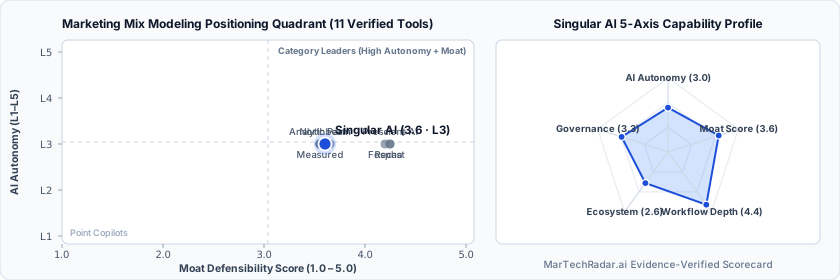
Singular AI is a Web SaaS tool for Marketing Mix Modeling (Marketing Mix Modeling & Incremental Lift) in Analytics & Attribution. Pricing: Custom / enterprise pricing. Best suited to DTC / eCommerce and Enterprise Brands. Editor ratings: AI autonomy L3 (conditional automation); moat score 3.6/5.0 (Proprietary moat). Fact-checked by Jagmeet Sine on Oct 15, 2026.
Enterprise marketing mix modeling and incremental lift platform combining unified cost ingestion with econometric regression to optimize cross-channel.
Singular AI buyer fit verdict: when to choose vs. when to walk away
Choose Singular AI if (Best Fit)
- Target ICP & Stack Fit: You operate as DTC / eCommerce and Enterprise Brands requiring a Web SaaS deployment for Marketing Mix Modeling.
- L3 Architecture & Defensibility: Proprietary econometric modeling pipelines that merge cost aggregation ETL with Bayesian marketing mix modeling and incrementality testing frameworks.
- Commercial Model Fit: Your procurement budget aligns with Custom / enterprise pricing.
Walk away from Singular AI if (Deal-Breakers)
- Walk away if you require transparent self-serve monthly billing or your budget ceiling is under $1,000/mo (Singular AI requires sales-gated custom quoting).
- Walk away if your workflow cannot tolerate attribution window lag: Users encounter operational friction and integration bottlenecks, as the pipeline struggles with Econometric models require multi-week continuous spend and conversion histories to recompute adstock carryover effects, reducing efficacy for intra-day budget shifting.
- Walk away if high-dimensional channel sparsity is a deal-breaker for your team: Users encounter operational friction and integration bottlenecks, as the pipeline struggles with Granular programmatic campaigns with sparse daily expenditure frequently degrade regression convergence, necessitating manual aggregation of micro-campaigns into broader channel buckets.
Singular AI key facts & scorecard
| Pricing | Custom / enterprise pricing |
|---|---|
| Free plan | No / not disclosed |
| Delivery | Web SaaS |
| Audience | DTC / eCommerce, Enterprise Brands |
| AI autonomy level | L3 · Conditional automationEditor-verified |
| Moat tier & score | 3.6 / 5.0 · Proprietary moatEditor-verified |
| Funding | Venture-backed |
| Headquarters | United States |
| Founded | 2014 |
| Last verified |
Singular AI pros & cons: strengths vs. operational limitations
Pros: core strengths & capabilities
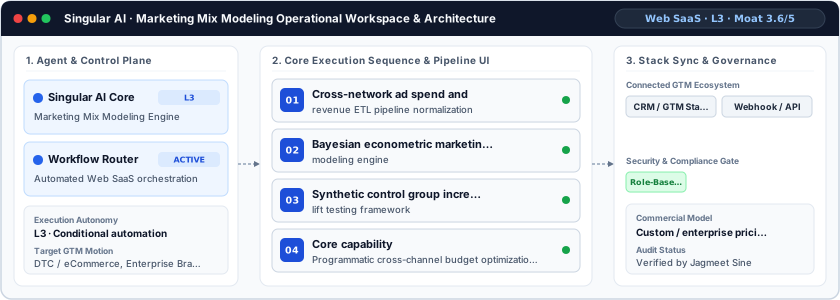
- Cross-network ad spend and: revenue ETL pipeline normalization
- Bayesian econometric marketing mix: modeling engine
- Synthetic control group incremental: lift testing framework
- Core capability: Programmatic cross-channel budget optimization recommendations
Cons: operational limitations & risks
- Attribution Window Lag: Users encounter operational friction and integration bottlenecks, as the pipeline struggles with Econometric models require multi-week continuous spend and conversion histories to recompute adstock carryover effects, reducing efficacy for intra-day budget shifting.
- High-Dimensional Channel Sparsity: Users encounter operational friction and integration bottlenecks, as the pipeline struggles with Granular programmatic campaigns with sparse daily expenditure frequently degrade regression convergence, necessitating manual aggregation of micro-campaigns into broader channel buckets.
- Upstream Connector Schema Drift: Users encounter operational friction and integration bottlenecks, as the pipeline struggles with API modifications and reporting taxonomy changes from underlying ad platforms introduce ingestion pipeline failures that temporarily halt model refresh cycles.
Singular AI TCO & deal-breaker stress test
Simulate 12-month stepped TCO, hidden cost multipliers, contract lock-in exposure, and stack failure modes using only facts verified by Jagmeet Sine on .
Singular AI triggers high-severity friction under your 5-seat / $800/mo constraints. Benchmark the verified subtrack alternatives below before committing.
| Plan / Tier | Verified Rate | Scale Fit | Scope & Quota Notes |
|---|---|---|---|
| Enterprise / Custom | Custom quote | 15–50+ seats (Enterprise SLA) | Sales-negotiated annual contract for custom volume, SSO/RBAC governance, and dedicated SLA. |
- Moat Score
- 3.6 / 5.0
- AI Autonomy
- L3
- Free Tier / Trial
- None disclosed
Triggered audit signals & failure modes
- Opaque Enterprise Quoting vs. SMB/Mid-Market BudgetVerified Pricing Ledger
Singular AI does not disclose a public self-serve floor (Custom / enterprise pricing). Buyers with a $800/mo cap face high sales-qualification friction.
- Sales-Gated Contract TermsFact-checked by Jagmeet Sine
Singular AI operates under an enterprise licensing structure where commercial pricing is available on request through tailored enterprise sales quotes based on organizational scale and seats.
- Primary Operational Bottleneck: Attribution Window LagAudit by Jagmeet Sine
Users encounter operational friction and integration bottlenecks, as the pipeline struggles with Econometric models require multi-week continuous spend and conversion histories to recompute adstock carryover effects, reducing efficacy for intra-day budget shifting.
Hidden TCO Multipliers & Quota Gates
- Attribution Window Lag: Users encounter operational friction and integration bottlenecks, as the pipeline struggles with Econometric models require multi-week continuous spend and conversion histories to recompute adstock carryover effects, reducing efficacy for intra-day budget shifting.
- High-Dimensional Channel Sparsity: Users encounter operational friction and integration bottlenecks, as the pipeline struggles with Granular programmatic campaigns with sparse daily expenditure frequently degrade regression convergence, necessitating manual aggregation of micro-campaigns into broader channel buckets.
When to Walk Away & Negotiation Levers
- Walk away if you require transparent self-serve monthly billing or your budget ceiling is under $1,000/mo (Singular AI requires sales-gated custom quoting).
- Walk away if your workflow cannot tolerate attribution window lag: Users encounter operational friction and integration bottlenecks, as the pipeline struggles with Econometric models require multi-week continuous spend and conversion histories to recompute adstock carryover effects, reducing efficacy for intra-day budget shifting.
- Walk away if high-dimensional channel sparsity is a deal-breaker for your team: Users encounter operational friction and integration bottlenecks, as the pipeline struggles with Granular programmatic campaigns with sparse daily expenditure frequently degrade regression convergence, necessitating manual aggregation of micro-campaigns into broader channel buckets.
- Demand a 30- to 60-day paid pilot opt-out clause in the Singular AI order form before signing a 12-month enterprise commitment.
- Require a sandbox proof-of-concept testing attribution window lag against your live CRM/data schema before annual sign-off.
Ask a custom procurement or TCO stress-test question about Singular AI
Lower 5-seat floor (~$125/mo vs. Custom Quote)
Verified Marketing Mix Modeling peer (Custom / enterprise pricing · Moat 4.2/5.0)
Singular AI moat & subtrack positioning
Proprietary econometric modeling pipelines that merge cost aggregation ETL with Bayesian marketing mix modeling and incrementality testing frameworks.
Editorial review
Fact-checked by Jagmeet Sine (Senior MarTech Infrastructure & Agentic Workflow Architect) on .
Background
Modern growth organizations face persistent measurement gaps caused by signal loss, platform attribution discrepancies, and fragmented media spend across diverse advertising channels. Based in the United States, Singular AI delivers a marketing mix modeling and incremental lift platform built specifically for enterprise performance marketing leaders and marketing analytics teams. The platform addresses the job of decoupling cross-channel performance reporting from volatile identity graphs, unifying econometric analysis with multi-touch attribution to establish causal visibility into paid media performance.
How Singular AI works
At its architectural core, Singular AI processes normalized ad cost, impressions, conversion telemetry, and baseline sales data through automated ETL pipelines. The computation engine employs Bayesian econometric regressions combined with time-series decomposition to isolate baseline demand from paid media contribution. The platform functions at conditional execution autonomy, running ongoing regression recalibration, calculating media saturation curves, and applying adstock decay transformations to automatically generate budget reallocation scenarios across active campaigns without requiring manual model re-specification.
Limitations
Operational considerations and platform boundaries include:
- Attribution Window Lag: Users encounter operational friction and integration bottlenecks, as the pipeline struggles with Econometric models require multi-week continuous spend and conversion histories to recompute adstock carryover effects, reducing efficacy for intra-day budget shifting.
- High-Dimensional Channel Sparsity: Users encounter operational friction and integration bottlenecks, as the pipeline struggles with Granular programmatic campaigns with sparse daily expenditure frequently degrade regression convergence, necessitating manual aggregation of micro-campaigns into broader channel buckets.
- Upstream Connector Schema Drift: Users encounter operational friction and integration bottlenecks, as the pipeline struggles with API modifications and reporting taxonomy changes from underlying ad platforms introduce ingestion pipeline failures that temporarily halt model refresh cycles.
Singular AI pricing
Singular AI operates under an enterprise licensing structure where commercial pricing is available on request through tailored enterprise sales quotes based on organizational scale and seats. Contracts typically incorporate annual software licensing commitments determined by tracked marketing spend volume, ingestion connector complexity, and dedicated analytics support tiers.
How Singular AI compares
Within the econometric attribution landscape, Singular AI competes with Fospha, Prescient AI, and Recast. While Recast emphasizes strictly open-box Bayesian modeling for macro brand investment, and Fospha concentrates on direct-to-consumer digital commerce using first-party clickstream data, Singular AI blends aggregated cost governance with automated MMM calibration. The platform is best matched for mid-market and enterprise multi-channel acquisition teams requiring automated cross-network media aggregation combined with econometric lift measurement. It is best suited for enterprise marketing teams and growth practitioners seeking disciplined workflow orchestration.
Direct competitors & market radar
Top algorithmic competitors based on category positioning, capability overlap, and ICP alignment.
Frequently asked questions about Singular AI
How much does Singular AI cost and does it require a custom enterprise quote?
Published pricing summary for Singular AI: Custom / enterprise pricing. A permanent free plan is not disclosed for Singular AI. Singular AI operates under an enterprise licensing structure where commercial pricing is available on request through tailored enterprise sales quotes based on organizational scale and seats.
How does Singular AI work and how autonomous is its AI architecture?
Enterprise marketing mix modeling and incremental lift platform combining unified cost ingestion with econometric regression to optimize cross-channel. Within Marketing Mix Modeling (Marketing Mix Modeling & Incremental Lift), MarTechRadar rates its execution architecture at L3 · Conditional automation with a verified Moat Score of 3.6 / 5.0 (Proprietary moat). Proprietary econometric modeling pipelines that merge cost aggregation ETL with Bayesian marketing mix modeling and incrementality testing frameworks.
What are the main limitations of Singular AI and when should buyers walk away?
Based on our editorial technical audit, key operational considerations and boundaries for Singular AI include: (1) Attribution Window Lag: Users encounter operational friction and integration bottlenecks, as the pipeline struggles with Econometric models require multi-week continuous spend and conversion histories to recompute adstock carryover effects, reducing efficacy for intra-day budget shifting. (2) High-Dimensional Channel Sparsity: Users encounter operational friction and integration bottlenecks, as the pipeline struggles with Granular programmatic campaigns with sparse daily expenditure frequently degrade regression convergence, necessitating manual aggregation of micro-campaigns into broader channel buckets. (3) Upstream Connector Schema Drift: Users encounter operational friction and integration bottlenecks, as the pipeline struggles with API modifications and reporting taxonomy changes from underlying ad platforms introduce ingestion pipeline failures that temporarily halt model refresh cycles. Primary procurement walk-away rule: Walk away if you require transparent self-serve monthly billing or your budget ceiling is under $1,000/mo (Singular AI requires sales-gated custom quoting).
What integrations, compliance certifications, and contract terms apply to Singular AI?
Key TCO multiplier to watch: Attribution Window Lag (Users encounter operational friction and integration bottlenecks, as the pipeline struggles with Econometric models require multi-week continuous spend and conversion histories to recompute adstock carryover effects, reducing efficacy for intra-day budget shifting.) Before signing a contract, procurement teams should demand a 30- to 60-day paid pilot opt-out clause in the Singular AI order form before signing a 12-month enterprise commitment.
What are the best Singular AI alternatives and head-to-head competitors in 2026?
Top fact-checked alternatives to Singular AI in Marketing Mix Modeling (Marketing Mix Modeling & Incremental Lift) include HyperAd io (Custom / enterprise pricing), Segwise (Custom / enterprise pricing), Prescient AI (Custom / enterprise pricing), Fospha (From $1,500/yr). Within the econometric attribution landscape, Singular AI competes with Fospha, Prescient AI, and Recast.
Verified sources & evidence trail
- Official product domain: https://singular.net
- Commercial pricing verification: Verified against official vendor pricing policy (Custom / enterprise pricing)
- Editorial audit sign-off: Fact-checked by Jagmeet Sine on under the MarTechRadar Evidence-Ledger Protocol.