StackAdapt Review (2026): AI Programmatic Advertising Pricing, Limits & Alternatives
Bottom line
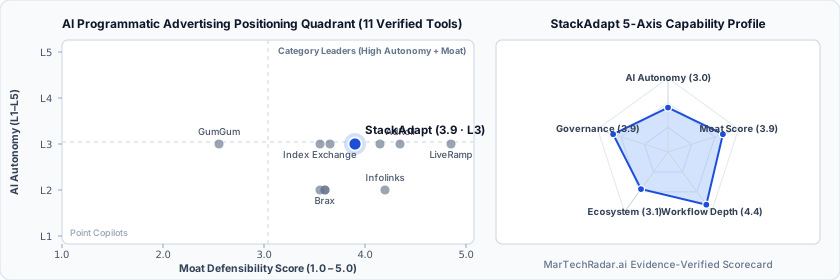
StackAdapt is a SaaS Platform tool for AI Programmatic Advertising (Programmatic DSP/SSP & Contextual AdTech) in AdTech & Paid Media. Pricing: Pricing not disclosed. Best suited to B2B Marketing & GTM Teams. Editor ratings: AI autonomy L3 (conditional automation); moat score 3.9/5.0 (Proprietary moat). Fact-checked by Jiacky Lee on Oct 18, 2026.
AI-powered multi-channel programmatic advertising DSP for planning, executing, and optimizing CTV, display, native, audio, and DOOH campaigns.
StackAdapt buyer fit verdict: when to choose vs. when to walk away
Choose StackAdapt if (Best Fit)
- Target ICP & Stack Fit: You operate as B2B Marketing & GTM Teams requiring a SaaS Platform deployment for AI Programmatic Advertising.
- L3 Architecture & Defensibility: StackAdapt establishes a high technological and scale moat through its real-time programmatic bidding engine executing 465B decisions per second, Ivy Studio conversational AI planner, and omnichannel inventory reach.
- Commercial Model Fit: Your procurement budget aligns with Pricing not disclosed.
Walk away from StackAdapt if (Deal-Breakers)
- Walk away if you require transparent self-serve monthly billing or your budget ceiling is under $1,000/mo (StackAdapt requires sales-gated custom quoting).
- Walk away if your workflow cannot tolerate programmatic media spend barrier: Because real-time bidding algorithms require statistically significant impression and conversion volume to exit exploration phases, smaller advertisers with limited monthly media budgets often struggle to generate enough auction feedback for multi-channel optimization.
- Walk away if cross-channel attribution bottleneck is a deal-breaker for your team: Measuring incremental lift across non-clickable upper-funnel channels such as Connected TV, audio, and digital out-of-home alongside lower-funnel native and display ads introduces attribution complexity when household graph coverage is incomplete.
StackAdapt key facts & scorecard
| Pricing | Pricing not disclosed |
|---|---|
| Free plan | No / not disclosed |
| Delivery | SaaS Platform |
| Audience | B2B Marketing & GTM Teams |
| AI autonomy level | L3 · Conditional automationEditor-verified |
| Moat tier & score | 3.9 / 5.0 · Proprietary moatEditor-verified |
| Funding | Undisclosed |
| Total funding | $536.6MBacked by Intrepid Growth Partners, Summit Partners, MaRS Investment Accelerator Fund, Teachers’ Venture Growth, Plaza Ventures |
| Founders | Vitaly Pecherskiy, Yang Han |
| Company size | 1,001-5,000 employees |
| Headquarters | Toronto, Ontario, Canada |
| Founded | 2014 |
| Last verified |
StackAdapt pros & cons: strengths vs. operational limitations
Pros: core strengths & capabilities
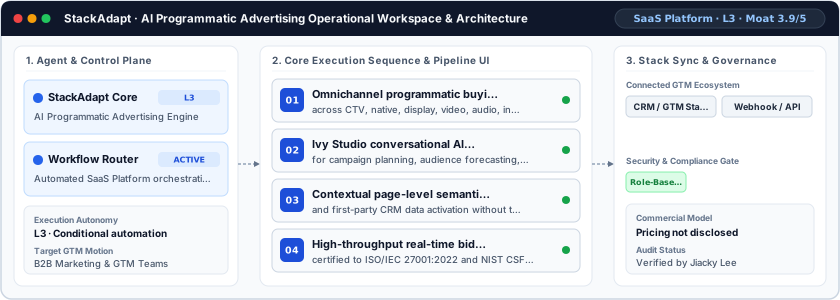
- Omnichannel programmatic buying: across CTV, native, display, video, audio, in-game, and DOOH
- Ivy Studio conversational AI hub: for campaign planning, audience forecasting, and automated optimization
- Contextual page-level semantic targeting: and first-party CRM data activation without third-party cookies
- High-throughput real-time bidding architecture: certified to ISO/IEC 27001:2022 and NIST CSF standards
Cons: operational limitations & risks
- Programmatic Media Spend Barrier: Because real-time bidding algorithms require statistically significant impression and conversion volume to exit exploration phases, smaller advertisers with limited monthly media budgets often struggle to generate enough auction feedback for multi-channel optimization.
- Cross-Channel Attribution Bottleneck: Measuring incremental lift across non-clickable upper-funnel channels such as Connected TV, audio, and digital out-of-home alongside lower-funnel native and display ads introduces attribution complexity when household graph coverage is incomplete.
- Platform Workflow Learning Curve: Configuring supply-path filters, custom contextual phrase taxonomies, pixel conversion hierarchies, and bid-shading thresholds requires experienced programmatic traders rather than generalist marketers.
StackAdapt TCO & deal-breaker stress test
Simulate 12-month stepped TCO, hidden cost multipliers, contract lock-in exposure, and stack failure modes using only facts verified by Jiacky Lee on · Capture SHA 36017276.
StackAdapt triggers high-severity friction under your 5-seat / $800/mo constraints. Benchmark the verified subtrack alternatives below before committing.
| Plan / Tier | Verified Rate | Scale Fit | Scope & Quota Notes |
|---|---|---|---|
| Enterprise / Custom | Custom quote | 15–50+ seats (Enterprise SLA) | Sales-negotiated annual contract for custom volume, SSO/RBAC governance, and dedicated SLA. |
- Moat Score
- 3.9 / 5.0
- AI Autonomy
- L3
- Free Tier / Trial
- None disclosed
Triggered audit signals & failure modes
- Opaque Enterprise Quoting vs. SMB/Mid-Market BudgetVerified Pricing Ledger
StackAdapt does not disclose a public self-serve floor (Pricing not disclosed). Buyers with a $800/mo cap face high sales-qualification friction.
- Sales-Gated Contract TermsFact-checked by Jiacky Lee
StackAdapt operates on a custom, tiered enterprise commercial model with pricing available on request through its sales organization.
- Primary Operational Bottleneck: Programmatic Media Spend BarrierAudit by Jiacky Lee
Because real-time bidding algorithms require statistically significant impression and conversion volume to exit exploration phases, smaller advertisers with limited monthly media budgets often struggle to generate enough auction feedback for multi-channel optimization.
Hidden TCO Multipliers & Quota Gates
- Programmatic Media Spend Barrier: Because real-time bidding algorithms require statistically significant impression and conversion volume to exit exploration phases, smaller advertisers with limited monthly media budgets often struggle to generate enough auction feedback for multi-channel optimization.
- Cross-Channel Attribution Bottleneck: Measuring incremental lift across non-clickable upper-funnel channels such as Connected TV, audio, and digital out-of-home alongside lower-funnel native and display ads introduces attribution complexity when household graph coverage is incomplete.
When to Walk Away & Negotiation Levers
- Walk away if you require transparent self-serve monthly billing or your budget ceiling is under $1,000/mo (StackAdapt requires sales-gated custom quoting).
- Walk away if your workflow cannot tolerate programmatic media spend barrier: Because real-time bidding algorithms require statistically significant impression and conversion volume to exit exploration phases, smaller advertisers with limited monthly media budgets often struggle to generate enough auction feedback for multi-channel optimization.
- Walk away if cross-channel attribution bottleneck is a deal-breaker for your team: Measuring incremental lift across non-clickable upper-funnel channels such as Connected TV, audio, and digital out-of-home alongside lower-funnel native and display ads introduces attribution complexity when household graph coverage is incomplete.
- Demand a 30- to 60-day paid pilot opt-out clause in the StackAdapt order form before signing a 12-month enterprise commitment.
- Require a sandbox proof-of-concept testing programmatic media spend barrier against your live CRM/data schema before annual sign-off.
Ask a custom procurement or TCO stress-test question about StackAdapt
Lower 5-seat floor (~$36/mo vs. Custom Quote) · Transparent self-serve entry without mandatory annual lock-in
Verified AI Programmatic Advertising peer (Pricing not disclosed · Moat 3.5/5.0)
StackAdapt moat & subtrack positioning
StackAdapt establishes a high technological and scale moat through its real-time programmatic bidding engine executing 465B decisions per second, Ivy Studio conversational AI planner, and omnichannel inventory reach.
Editorial review
Fact-checked by Jiacky Lee (Managing Editor, AI Autonomy & Moat Methodology) on .
Background
Founded in 2014 by Vitaly Pecherskiy and Yang Han and headquartered in Toronto, Ontario, Canada, StackAdapt (stackadapt.com) is an AI-powered multi-channel programmatic advertising demand-side platform (DSP) built for performance agencies and enterprise brand media buyers. Operating with a team of 1,001-5,000 employees and backed by $536.6M in Private Equity funding from Intrepid Growth Partners, Summit Partners, MaRS Investment Accelerator Fund, Teachers’ Venture Growth, and Plaza Ventures, the company enables marketers to plan, buy, and measure programmatic inventory across Connected TV (CTV), native, display, video, audio, in-game, and digital out-of-home (DOOH) channels. Rather than forcing media traders to manage disconnected channel-specific buying consoles or rely solely on third-party cookie segments that degrade in privacy-restricted environments, StackAdapt combines contextual page-level intelligence, first-party CRM activation, and automated bid shading inside a unified execution environment.
How StackAdapt works
StackAdapt operates at Level 3 autonomy through its proprietary bidding infrastructure and the Ivy Studio AI advertising hub. At the auction layer, StackAdapt's machine learning models evaluate supply-path signals, contextual page semantics, device telemetry, and historical conversion propensity to execute up to 465 billion real-time optimization decisions per second across global ad exchanges. Through Ivy Studio, media planners interact with a conversational-to-workflow AI assistant that translates campaign briefs into cross-channel budget allocations, audience reach forecasts, and automated bid strategies. Its contextual targeting engine parses live publisher content in real time to match ads with high-intent editorial environments without relying on persistent user identifiers, while the StackAdapt API and enterprise security controls—aligned with ISO/IEC 27001:2022 and the NIST Cybersecurity Framework (CSF)—support custom reporting and data room integrations.
Limitations
Operational limitations and technical trade-offs include:
- Programmatic Media Spend Barrier: Because real-time bidding algorithms require statistically significant impression and conversion volume to exit exploration phases, smaller advertisers with limited monthly media budgets often struggle to generate enough auction feedback for multi-channel optimization.
- Cross-Channel Attribution Bottleneck: Measuring incremental lift across non-clickable upper-funnel channels such as Connected TV, audio, and digital out-of-home alongside lower-funnel native and display ads introduces attribution complexity when household graph coverage is incomplete.
- Platform Workflow Learning Curve: Configuring supply-path filters, custom contextual phrase taxonomies, pixel conversion hierarchies, and bid-shading thresholds requires experienced programmatic traders rather than generalist marketers.
StackAdapt pricing
StackAdapt operates on a custom, tiered enterprise commercial model with pricing available on request through its sales organization. The platform structures customer access across five service tiers—Basic (Digital Basic), Grow (Bronze), Scale (Silver), Accelerate (Gold), and Enterprise (Platinum)—scaling creative studio support, data activation capabilities, account management resources, and API access based on programmatic media spend commitments. Prospective agencies and brand advertisers must request a demo and scope campaign volume to receive contract terms and platform fee schedules.
How StackAdapt compares
Within the Programmatic DSP/SSP & Contextual AdTech category, StackAdapt competes against enterprise demand-side platforms such as The Trade Desk, DV360, and Quantcast. Versus legacy enterprise DSPs that often impose rigid minimum spend commitments and complex seat onboarding designed exclusively for holding-company agencies, StackAdapt differentiates itself through its native ad roots, self-serve workflow agility, and the Ivy Studio conversational planning interface. Compared to single-channel native or contextual networks, StackAdapt offers full omnichannel execution spanning CTV, audio, in-game, DOOH, and B2B ABM targeting within a single programmatic console.
Frequently asked questions about StackAdapt
How much does StackAdapt cost and does it require a custom enterprise quote?
Published pricing summary for StackAdapt: Pricing not disclosed. A permanent free plan is not disclosed for StackAdapt. StackAdapt operates on a custom, tiered enterprise commercial model with pricing available on request through its sales organization.
How does StackAdapt work and how autonomous is its AI architecture?
AI-powered multi-channel programmatic advertising DSP for planning, executing, and optimizing CTV, display, native, audio, and DOOH campaigns. Within AI Programmatic Advertising (Programmatic DSP/SSP & Contextual AdTech), MarTechRadar rates its execution architecture at L3 · Conditional automation with a verified Moat Score of 3.9 / 5.0 (Proprietary moat). StackAdapt establishes a high technological and scale moat through its real-time programmatic bidding engine executing 465B decisions per second, Ivy Studio conversational AI planner, and omnichannel inventory reach. Corporate profile: Founded by Vitaly Pecherskiy, Yang Han, operating at 1,001-5,000 employees scale.
What are the main limitations of StackAdapt and when should buyers walk away?
Based on our editorial technical audit, key operational considerations and boundaries for StackAdapt include: (1) Programmatic Media Spend Barrier: Because real-time bidding algorithms require statistically significant impression and conversion volume to exit exploration phases, smaller advertisers with limited monthly media budgets often struggle to generate enough auction feedback for multi-channel optimization. (2) Cross-Channel Attribution Bottleneck: Measuring incremental lift across non-clickable upper-funnel channels such as Connected TV, audio, and digital out-of-home alongside lower-funnel native and display ads introduces attribution complexity when household graph coverage is incomplete. (3) Platform Workflow Learning Curve: Configuring supply-path filters, custom contextual phrase taxonomies, pixel conversion hierarchies, and bid-shading thresholds requires experienced programmatic traders rather than generalist marketers. Primary procurement walk-away rule: Walk away if you require transparent self-serve monthly billing or your budget ceiling is under $1,000/mo (StackAdapt requires sales-gated custom quoting).
What integrations, compliance certifications, and contract terms apply to StackAdapt?
Key TCO multiplier to watch: Programmatic Media Spend Barrier (Because real-time bidding algorithms require statistically significant impression and conversion volume to exit exploration phases, smaller advertisers with limited monthly media budgets often struggle to generate enough auction feedback for multi-channel optimization.) Before signing a contract, procurement teams should demand a 30- to 60-day paid pilot opt-out clause in the StackAdapt order form before signing a 12-month enterprise commitment.
What are the best StackAdapt alternatives and head-to-head competitors in 2026?
Top fact-checked alternatives to StackAdapt in AI Programmatic Advertising (Programmatic DSP/SSP & Contextual AdTech) include Imprezia (Pricing not disclosed), Seedtag (Custom / enterprise pricing), Madgicx (From $49/mo), Skai (From $0/mo). Within the Programmatic DSP/SSP & Contextual AdTech category, StackAdapt competes against enterprise demand-side platforms such as The Trade Desk, DV360, and Quantcast.
Verified sources & evidence trail
- Official product domain: https://stackadapt.com
- Commercial pricing verification: Verified against official vendor pricing policy (Pricing not disclosed)
- Verified corporate entity profiles (
sameAs): LinkedIn Company Profile · Crunchbase Entity Record - Editorial audit sign-off: Fact-checked by Jiacky Lee on under the MarTechRadar Evidence-Ledger Protocol.