StartupsOnX Review (2026): ChatGPT for Marketing Pricing, Limits & Alternatives
Bottom line
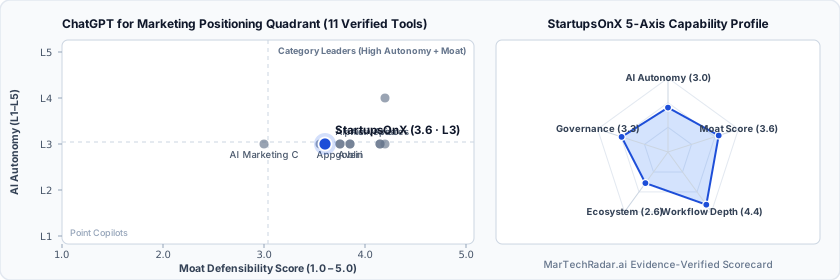
StartupsOnX is a Web SaaS tool for ChatGPT for Marketing (Open-Source Marketing Agents & Prompts) in Agent & Marketing Ops. Pricing: Custom / enterprise pricing. Best suited to B2B SaaS. Editor ratings: AI autonomy L3 (conditional automation); moat score 3.6/5.0 (Proprietary moat). Fact-checked by Tim Fenolz on Oct 16, 2026.
Curated catalog and registry system indexing open-source marketing agents, autonomous execution templates, and production prompts for technical marketing.
StartupsOnX buyer fit verdict: when to choose vs. when to walk away
Choose StartupsOnX if (Best Fit)
- Target ICP & Stack Fit: You operate as B2B SaaS requiring a Web SaaS deployment for ChatGPT for Marketing.
- L3 Architecture & Defensibility: Defensibility centers on taxonomy depth, prompt version indexing, and developer community contribution loops rather than closed-source proprietary foundational weights.
- Commercial Model Fit: Your procurement budget aligns with Custom / enterprise pricing.
Walk away from StartupsOnX if (Deal-Breakers)
- Walk away if you require transparent self-serve monthly billing or your budget ceiling is under $1,000/mo (StartupsOnX requires sales-gated custom quoting).
- Walk away if your workflow cannot tolerate repository drift vulnerability: Users encounter operational friction and integration bottlenecks, as the pipeline struggles with Upstream maintainers routinely refactor prompt syntax or deprecate tooling interfaces, which breaks linked deployment templates without active registry verification.
- Walk away if zero native sandbox execution is a deal-breaker for your team: Users encounter operational friction and integration bottlenecks, as the pipeline struggles with The directory provides discovery and structural profiling rather than managed container execution, forcing engineering teams to provision internal sandboxes to test agent safety.
StartupsOnX key facts & scorecard
| Pricing | Custom / enterprise pricing |
|---|---|
| Free plan | No / not disclosed |
| Delivery | Web SaaS |
| Audience | B2B SaaS |
| AI autonomy level | L3 · Conditional automationEditor-verified |
| Moat tier & score | 3.6 / 5.0 · Proprietary moatEditor-verified |
| Funding | Venture-backed |
| Headquarters | United States |
| Last verified |
StartupsOnX pros & cons: strengths vs. operational limitations
Pros: core strengths & capabilities
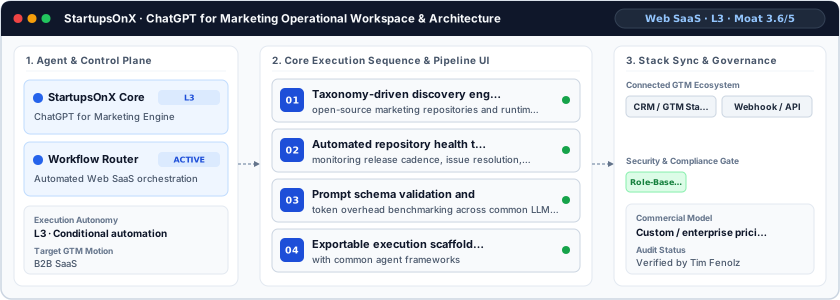
- Taxonomy-driven discovery engine categorizing: open-source marketing repositories and runtime prompts
- Automated repository health tracking: monitoring release cadence, issue resolution, and license compliance
- Prompt schema validation and: token overhead benchmarking across common LLM backends
- Exportable execution scaffolds compatible: with common agent frameworks
Cons: operational limitations & risks
- Repository Drift Vulnerability: Users encounter operational friction and integration bottlenecks, as the pipeline struggles with Upstream maintainers routinely refactor prompt syntax or deprecate tooling interfaces, which breaks linked deployment templates without active registry verification.
- Zero Native Sandbox Execution: Users encounter operational friction and integration bottlenecks, as the pipeline struggles with The directory provides discovery and structural profiling rather than managed container execution, forcing engineering teams to provision internal sandboxes to test agent safety.
- Prompt Token Volatility: Users encounter operational friction and integration bottlenecks, as the pipeline struggles with Referenced third-party prompts lack dynamic runtime token-usage controls, exposing production orchestrations to unbounded model inference costs if implemented directly.
StartupsOnX TCO & deal-breaker stress test
Simulate 12-month stepped TCO, hidden cost multipliers, contract lock-in exposure, and stack failure modes using only facts verified by Tim Fenolz on .
StartupsOnX triggers high-severity friction under your 5-seat / $800/mo constraints. Benchmark the verified subtrack alternatives below before committing.
| Plan / Tier | Verified Rate | Scale Fit | Scope & Quota Notes |
|---|---|---|---|
| Enterprise / Custom | Custom quote | 15–50+ seats (Enterprise SLA) | Sales-negotiated annual contract for custom volume, SSO/RBAC governance, and dedicated SLA. |
- Moat Score
- 3.6 / 5.0
- AI Autonomy
- L3
- Free Tier / Trial
- None disclosed
Triggered audit signals & failure modes
- Opaque Enterprise Quoting vs. SMB/Mid-Market BudgetVerified Pricing Ledger
StartupsOnX does not disclose a public self-serve floor (Custom / enterprise pricing). Buyers with a $800/mo cap face high sales-qualification friction.
- Sales-Gated Contract TermsFact-checked by Tim Fenolz
Commercial pricing is available on request through tailored enterprise sales quotes based on organizational scale and seats.
- Primary Operational Bottleneck: Repository Drift VulnerabilityAudit by Tim Fenolz
Users encounter operational friction and integration bottlenecks, as the pipeline struggles with Upstream maintainers routinely refactor prompt syntax or deprecate tooling interfaces, which breaks linked deployment templates without active registry verification.
Hidden TCO Multipliers & Quota Gates
- Credit & Usage Burn Multiplier: Automated workflows consume metered credits/usage quotas; multi-step enrichment, voice minutes, or high-frequency agent runs can trigger mid-cycle top-up packs.
- Repository Drift Vulnerability: Users encounter operational friction and integration bottlenecks, as the pipeline struggles with Upstream maintainers routinely refactor prompt syntax or deprecate tooling interfaces, which breaks linked deployment templates without active registry verification.
- Zero Native Sandbox Execution: Users encounter operational friction and integration bottlenecks, as the pipeline struggles with The directory provides discovery and structural profiling rather than managed container execution, forcing engineering teams to provision internal sandboxes to test agent safety.
When to Walk Away & Negotiation Levers
- Walk away if you require transparent self-serve monthly billing or your budget ceiling is under $1,000/mo (StartupsOnX requires sales-gated custom quoting).
- Walk away if your workflow cannot tolerate repository drift vulnerability: Users encounter operational friction and integration bottlenecks, as the pipeline struggles with Upstream maintainers routinely refactor prompt syntax or deprecate tooling interfaces, which breaks linked deployment templates without active registry verification.
- Walk away if zero native sandbox execution is a deal-breaker for your team: Users encounter operational friction and integration bottlenecks, as the pipeline struggles with The directory provides discovery and structural profiling rather than managed container execution, forcing engineering teams to provision internal sandboxes to test agent safety.
- Demand a 30- to 60-day paid pilot opt-out clause in the StartupsOnX order form before signing a 12-month enterprise commitment.
- Require a sandbox proof-of-concept testing repository drift vulnerability against your live CRM/data schema before annual sign-off.
Ask a custom procurement or TCO stress-test question about StartupsOnX
Lower 5-seat floor (~$300/mo vs. Custom Quote)
Lower 5-seat floor (~$99/mo vs. Custom Quote) · Transparent self-serve entry without mandatory annual lock-in
StartupsOnX moat & subtrack positioning
Defensibility centers on taxonomy depth, prompt version indexing, and developer community contribution loops rather than closed-source proprietary foundational weights.
Editorial review
Fact-checked by Tim Fenolz (Lead AdTech, Programmatic & Attribution Analyst) on .
Background
Marketing engineers and autonomous growth teams often struggle with the fragmented landscape of community-maintained AI repositories and unverified LLM prompts. Headquartered in the United States, StartupsOnX functions as an operational registry designed to discover, categorize, and validate open-source marketing agents and prompt configurations. Built for technical marketing architects and demand automation engineers, the platform structures scattered codebases into structured directories. It solves the critical workflow hurdle of finding production-ready marketing automation primitives without auditing hundreds of disconnected software repositories.
How StartupsOnX works
The platform operates as a centralized ingestion engine that systematically pulls repository metadata, prompt structures, and dependency graphs from public code repositories. It indexes operational components—such as automated copywriting loops, scraping agents, and programmatic enrichment recipes—using structured relational schemas and semantic retrieval embeddings. Automated workers inspect agent architectures, tagging target execution environments, required API integrations, and model parameters. By structuring disparate developer contributions into uniform, queryable interfaces, teams evaluate autonomy routines and integration requirements before deploying agent code into internal orchestration runtimes.
Limitations
Operational considerations and platform boundaries include:
- Repository Drift Vulnerability: Users encounter operational friction and integration bottlenecks, as the pipeline struggles with Upstream maintainers routinely refactor prompt syntax or deprecate tooling interfaces, which breaks linked deployment templates without active registry verification.
- Zero Native Sandbox Execution: Users encounter operational friction and integration bottlenecks, as the pipeline struggles with The directory provides discovery and structural profiling rather than managed container execution, forcing engineering teams to provision internal sandboxes to test agent safety.
- Prompt Token Volatility: Users encounter operational friction and integration bottlenecks, as the pipeline struggles with Referenced third-party prompts lack dynamic runtime token-usage controls, exposing production orchestrations to unbounded model inference costs if implemented directly.
StartupsOnX pricing
Commercial pricing is available on request through tailored enterprise sales quotes based on organizational scale and seats. Organizations engaging with the catalog operate under direct enterprise agreements covering team seats, private prompt taxonomy indexing, and custom governance reviews. Standard software packaging omits public self-serve tiers, directing procurement through high-touch architectural sales channels.
How StartupsOnX compares
Within the open-source marketing agent registry category, the platform competes alongside discovery systems like Alphie, Appgoblin, and Arda. While Alphie emphasizes autonomous execution workflows and Arda focuses on broader algorithmic marketing infrastructure, StartupsOnX differentiates through hyper-focused prompt taxonomy and codebase vetting. Appgoblin concentrates primarily on application telemetry, whereas this catalog targets agent maintainability. The platform serves mid-market to enterprise technology organizations prioritizing self-hosted, open-source AI pipelines over closed multi-tenant commercial suites. It is best suited for enterprise marketing teams and growth practitioners seeking disciplined workflow orchestration.
Frequently asked questions about StartupsOnX
How much does StartupsOnX cost and does it require a custom enterprise quote?
Published pricing summary for StartupsOnX: Custom / enterprise pricing. A permanent free plan is not disclosed for StartupsOnX. Commercial pricing is available on request through tailored enterprise sales quotes based on organizational scale and seats. Organizations engaging with the catalog operate under direct enterprise agreements covering team seats, private prompt taxonomy indexing, and custom governance reviews.
How does StartupsOnX work and how autonomous is its AI architecture?
Curated catalog and registry system indexing open-source marketing agents, autonomous execution templates, and production prompts for technical marketing. Within ChatGPT for Marketing (Open-Source Marketing Agents & Prompts), MarTechRadar rates its execution architecture at L3 · Conditional automation with a verified Moat Score of 3.6 / 5.0 (Proprietary moat). Defensibility centers on taxonomy depth, prompt version indexing, and developer community contribution loops rather than closed-source proprietary foundational weights.
What are the main limitations of StartupsOnX and when should buyers walk away?
Based on our editorial technical audit, key operational considerations and boundaries for StartupsOnX include: (1) Repository Drift Vulnerability: Users encounter operational friction and integration bottlenecks, as the pipeline struggles with Upstream maintainers routinely refactor prompt syntax or deprecate tooling interfaces, which breaks linked deployment templates without active registry verification. (2) Zero Native Sandbox Execution: Users encounter operational friction and integration bottlenecks, as the pipeline struggles with The directory provides discovery and structural profiling rather than managed container execution, forcing engineering teams to provision internal sandboxes to test agent safety. (3) Prompt Token Volatility: Users encounter operational friction and integration bottlenecks, as the pipeline struggles with Referenced third-party prompts lack dynamic runtime token-usage controls, exposing production orchestrations to unbounded model inference costs if implemented directly. Primary procurement walk-away rule: Walk away if you require transparent self-serve monthly billing or your budget ceiling is under $1,000/mo (StartupsOnX requires sales-gated custom quoting).
What integrations, compliance certifications, and contract terms apply to StartupsOnX?
Key TCO multiplier to watch: Credit & Usage Burn Multiplier (Automated workflows consume metered credits/usage quotas; multi-step enrichment, voice minutes, or high-frequency agent runs can trigger mid-cycle top-up packs.) Before signing a contract, procurement teams should demand a 30- to 60-day paid pilot opt-out clause in the StartupsOnX order form before signing a 12-month enterprise commitment.
What are the best StartupsOnX alternatives and head-to-head competitors in 2026?
Top fact-checked alternatives to StartupsOnX in ChatGPT for Marketing (Open-Source Marketing Agents & Prompts) include Zero ($60–$77/seat/mo), SendRoq (Custom / enterprise pricing), Seylo (Custom / enterprise pricing), SiteTell (Custom / enterprise pricing). Within the open-source marketing agent registry category, the platform competes alongside discovery systems like Alphie, Appgoblin, and Arda.
Verified sources & evidence trail
- Official product domain: https://www.startupsonx.com/
- Commercial pricing verification: Verified against official vendor pricing policy (Custom / enterprise pricing)
- Editorial audit sign-off: Fact-checked by Tim Fenolz on under the MarTechRadar Evidence-Ledger Protocol.