Teads Review (2026): AI Programmatic Advertising Pricing, Limits & Alternatives
Bottom line
Teads is a Web SaaS tool for AI Programmatic Advertising (Programmatic DSP/SSP & Contextual AdTech) in AdTech & Paid Media. Pricing: Custom / enterprise pricing. Best suited to DTC / eCommerce and Enterprise Brands. Editor ratings: AI autonomy L2 (workflow copilot); moat score 4.2/5.0 (Proprietary moat). Fact-checked by Jagmeet Sine on Oct 12, 2026.
Omnichannel programmatic monetization and contextual advertising platform providing outstream video and dynamic display inventory across premium editorial.
Teads buyer fit verdict: when to choose vs. when to walk away
Choose Teads if (Best Fit)
- Target ICP & Stack Fit: You operate as DTC / eCommerce and Enterprise Brands requiring a Web SaaS deployment for AI Programmatic Advertising.
- L2 Architecture & Defensibility: High moat sustained by direct SDK and header tag integrations across primary-tier publisher networks, proprietary outstream video ad formats, and deep contextual semantic classification models operating independent of third-party cookies.
- Commercial Model Fit: Your procurement budget aligns with Custom / enterprise pricing.
Walk away from Teads if (Deal-Breakers)
- Walk away if you require transparent self-serve monthly billing or your budget ceiling is under $1,000/mo (Teads requires sales-gated custom quoting).
- Walk away if your workflow cannot tolerate inventory supply constraints: Delivery volumes are strictly tied to publisher editorial quality, restricting non-text and non-premium inventory scale compared to open web programmatic networks.
- Walk away if creative asset latency is a deal-breaker for your team: High-fidelity video rendering requires robust client-side bandwidth, occasionally causing layout shifts or latency drops on mobile web connections.
Teads key facts & scorecard
| Pricing | Custom / enterprise pricing |
|---|---|
| Free plan | No / not disclosed |
| Delivery | Web SaaS |
| Audience | DTC / eCommerce, Enterprise Brands |
| AI autonomy level | L2 · Workflow copilotEditor-verified |
| Moat tier & score | 4.2 / 5.0 · Proprietary moatEditor-verified |
| Funding | AcquiredAcquired by Outbrain |
| Total funding | $123.3MBacked by Altice |
| Founders | Andrea Febbraio, Bertrand Quesada, Frederic Montagnon, Gilles Moncaubeig |
| Company size | 1,001-5,000 employees |
| Governance & docs | Trust & Security ↗ · Terms ↗ |
| Headquarters | New York, NY |
| Founded | 2006 |
| Last verified |
Teads pros & cons: strengths vs. operational limitations
Pros: core strengths & capabilities
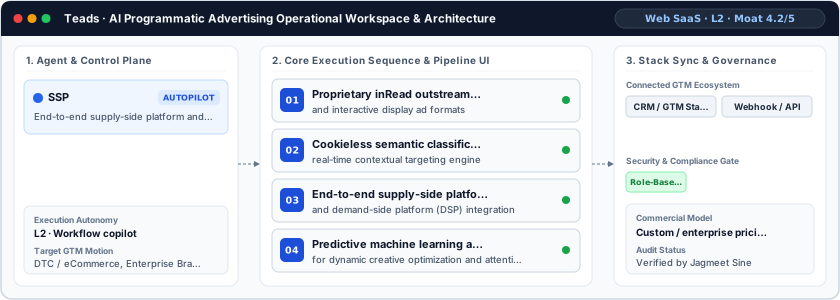
- Proprietary inRead outstream video: and interactive display ad formats
- Cookieless semantic classification and: real-time contextual targeting engine
- End-to-end supply-side platform (SSP): and demand-side platform (DSP) integration
- Predictive machine learning algorithms: for dynamic creative optimization and attention metrics
Cons: operational limitations & risks
- Inventory Supply Constraints: Delivery volumes are strictly tied to publisher editorial quality, restricting non-text and non-premium inventory scale compared to open web programmatic networks.
- Creative Asset Latency: High-fidelity video rendering requires robust client-side bandwidth, occasionally causing layout shifts or latency drops on mobile web connections.
- Outstream Viewport Sensitivity: Attribution and viewability metrics decline sharply if end-users rapidly scroll past article viewports before the edge video container completes initialization.
Teads TCO & deal-breaker stress test
Simulate 12-month stepped TCO, hidden cost multipliers, contract lock-in exposure, and stack failure modes using only facts verified by Jagmeet Sine on · Capture SHA b19798ff.
Teads triggers high-severity friction under your 5-seat / $800/mo constraints. Benchmark the verified subtrack alternatives below before committing.
| Plan / Tier | Verified Rate | Scale Fit | Scope & Quota Notes |
|---|---|---|---|
| Enterprise / Custom | Custom quote | 15–50+ seats (Enterprise SLA) | Sales-negotiated annual contract for custom volume, SSO/RBAC governance, and dedicated SLA. |
- Moat Score
- 4.2 / 5.0
- AI Autonomy
- L2
- Free Tier / Trial
- None disclosed
Triggered audit signals & failure modes
- Opaque Enterprise Quoting vs. SMB/Mid-Market BudgetVerified Pricing Ledger
Teads does not disclose a public self-serve floor (Custom / enterprise pricing). Buyers with a $800/mo cap face high sales-qualification friction.
- Sales-Gated Contract TermsFact-checked by Jagmeet Sine
Commercial pricing is available on request through tailored enterprise sales quotes based on organizational scale and seats.
- Primary Operational Bottleneck: Inventory Supply ConstraintsAudit by Jagmeet Sine
Delivery volumes are strictly tied to publisher editorial quality, restricting non-text and non-premium inventory scale compared to open web programmatic networks.
Hidden TCO Multipliers & Quota Gates
- Inventory Supply Constraints: Delivery volumes are strictly tied to publisher editorial quality, restricting non-text and non-premium inventory scale compared to open web programmatic networks.
- Creative Asset Latency: High-fidelity video rendering requires robust client-side bandwidth, occasionally causing layout shifts or latency drops on mobile web connections.
When to Walk Away & Negotiation Levers
- Walk away if you require transparent self-serve monthly billing or your budget ceiling is under $1,000/mo (Teads requires sales-gated custom quoting).
- Walk away if your workflow cannot tolerate inventory supply constraints: Delivery volumes are strictly tied to publisher editorial quality, restricting non-text and non-premium inventory scale compared to open web programmatic networks.
- Walk away if creative asset latency is a deal-breaker for your team: High-fidelity video rendering requires robust client-side bandwidth, occasionally causing layout shifts or latency drops on mobile web connections.
- Demand a 30- to 60-day paid pilot opt-out clause in the Teads order form before signing a 12-month enterprise commitment.
- Require a sandbox proof-of-concept testing inventory supply constraints against your live CRM/data schema before annual sign-off.
Ask a custom procurement or TCO stress-test question about Teads
Lower 5-seat floor (~$36/mo vs. Custom Quote) · Transparent self-serve entry without mandatory annual lock-in
Verified AI Programmatic Advertising peer (Custom / enterprise pricing · Moat 4.9/5.0)
Teads key entities, modules & ecosystem stack
End-to-end supply-side platform and demand-side platform (DSP) integration
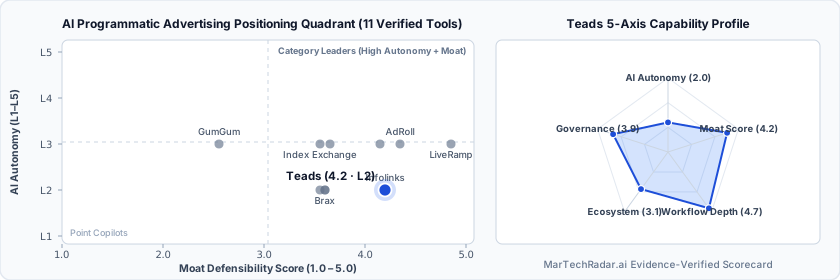
Teads moat & subtrack positioning
High moat sustained by direct SDK and header tag integrations across primary-tier publisher networks, proprietary outstream video ad formats, and deep contextual semantic classification models operating independent of third-party cookies.
Editorial review
Fact-checked by Jagmeet Sine (Senior MarTech Infrastructure & Agentic Workflow Architect) on .
Background
Capitalized by $123.3M in venture funding prior to its structured acquisition agreement with Outbrain, Teads was established in 2006 and maintains headquarters in New York, NY. The platform pioneered outstream video advertising, injecting interactive media units directly into editorial copy rather than relying on legacy pre-roll streams. Positioned as an omnichannel programmatic SSP and DSP engine, it serves media agencies, enterprise advertisers, and premium digital publishers requiring viewable, brand-safe inventory outside closed social environments.
How Teads works
Architecturally, the platform functions at Level 2 autonomy by pairing dynamic creative rendering with algorithmic bid routing. Publisher-side client wrappers inspect DOM elements to deploy proprietary inRead units when an article viewport crosses predefined scroll thresholds. Concurrently, natural language processing pipelines scrape and evaluate page semantics to build cookieless contextual signals. The internal exchange executes predictive auction algorithms against programmatic demand sources, balancing impression yield, viewability tracking, and user attention signals without external cookie dependencies.
Limitations
Operational considerations and platform boundaries include:
- Inventory Supply Constraints: Delivery volumes are strictly tied to publisher editorial quality, restricting non-text and non-premium inventory scale compared to open web programmatic networks.
- Creative Asset Latency: High-fidelity video rendering requires robust client-side bandwidth, occasionally causing layout shifts or latency drops on mobile web connections.
- Outstream Viewport Sensitivity: Attribution and viewability metrics decline sharply if end-users rapidly scroll past article viewports before the edge video container completes initialization.
Teads pricing
Commercial pricing is available on request through tailored enterprise sales quotes based on organizational scale and seats. The platform monetizes primarily via programmatic media spend commitments, dynamic CPM models, and custom revenue-share agreements negotiated directly with digital publishing partners.
How Teads compares
Within programmatic adtech, Teads competes directly with GumGum, AdRoll, and LiveRamp. While GumGum focuses intensely on computer vision across imagery, Teads differentiates through its deeply integrated outstream video ecosystem and direct publisher SDK footprints. Unlike AdRoll, which targets mid-market ecommerce performance retargeting, and LiveRamp, which operates as an identity resolution infrastructure layer, Teads provides an end-to-end programmatic media and creative delivery environment designed specifically for enterprise brands prioritizing viewability and premium contextual environments.
Direct competitors & market radar
Top algorithmic competitors based on category positioning, capability overlap, and ICP alignment.
Frequently asked questions about Teads
How much does Teads cost and does it require a custom enterprise quote?
Published pricing summary for Teads: Custom / enterprise pricing. A permanent free plan is not disclosed for Teads. Commercial pricing is available on request through tailored enterprise sales quotes based on organizational scale and seats. The platform monetizes primarily via programmatic media spend commitments, dynamic CPM models, and custom revenue-share agreements negotiated directly with digital publishing partners.
How does Teads work and how autonomous is its AI architecture?
Omnichannel programmatic monetization and contextual advertising platform providing outstream video and dynamic display inventory across premium editorial. Within AI Programmatic Advertising (Programmatic DSP/SSP & Contextual AdTech), MarTechRadar rates its execution architecture at L2 · Workflow copilot with a verified Moat Score of 4.2 / 5.0 (Proprietary moat). High moat sustained by direct SDK and header tag integrations across primary-tier publisher networks, proprietary outstream video ad formats, and deep contextual semantic classification models operating independent of third-party cookies. Corporate profile: Founded by Andrea Febbraio, Bertrand Quesada, Frederic Montagnon, Gilles Moncaubeig, operating at 1,001-5,000 employees scale, acquired by Outbrain.
What are the main limitations of Teads and when should buyers walk away?
Based on our editorial technical audit, key operational considerations and boundaries for Teads include: (1) Inventory Supply Constraints: Delivery volumes are strictly tied to publisher editorial quality, restricting non-text and non-premium inventory scale compared to open web programmatic networks. (2) Creative Asset Latency: High-fidelity video rendering requires robust client-side bandwidth, occasionally causing layout shifts or latency drops on mobile web connections. (3) Outstream Viewport Sensitivity: Attribution and viewability metrics decline sharply if end-users rapidly scroll past article viewports before the edge video container completes initialization. Primary procurement walk-away rule: Walk away if you require transparent self-serve monthly billing or your budget ceiling is under $1,000/mo (Teads requires sales-gated custom quoting).
What integrations, compliance certifications, and contract terms apply to Teads?
First-party governance and developer endpoints verified on domain include: Trust/Security (https://www.teads.com/security). Key TCO multiplier to watch: Inventory Supply Constraints (Delivery volumes are strictly tied to publisher editorial quality, restricting non-text and non-premium inventory scale compared to open web programmatic networks.) Before signing a contract, procurement teams should demand a 30- to 60-day paid pilot opt-out clause in the Teads order form before signing a 12-month enterprise commitment.
What are the best Teads alternatives and head-to-head competitors in 2026?
Top fact-checked alternatives to Teads in AI Programmatic Advertising (Programmatic DSP/SSP & Contextual AdTech) include GumGum (Custom / enterprise pricing), PubMatic Convert (Custom / enterprise pricing), The Trade Desk Kokai (Custom / enterprise pricing), Taboola (Custom / enterprise pricing). Within programmatic adtech, Teads competes directly with GumGum, AdRoll, and LiveRamp. While GumGum focuses intensely on computer vision across imagery, Teads differentiates through its deeply integrated outstream video ecosystem and direct publisher SDK footprints.
Verified sources & evidence trail
- Official product domain: https://teads.com
- Commercial pricing verification: Verified against official vendor pricing policy (Custom / enterprise pricing)
- Verified corporate entity profiles (
sameAs): LinkedIn Company Profile · Crunchbase Entity Record - First-party governance & documentation links: Trust & Security · Terms
- Editorial audit sign-off: Fact-checked by Jagmeet Sine on under the MarTechRadar Evidence-Ledger Protocol.