The AI Reputation Manager Review (2026): ChatGPT for Marketing Pricing, Limits & Alternatives
Bottom line
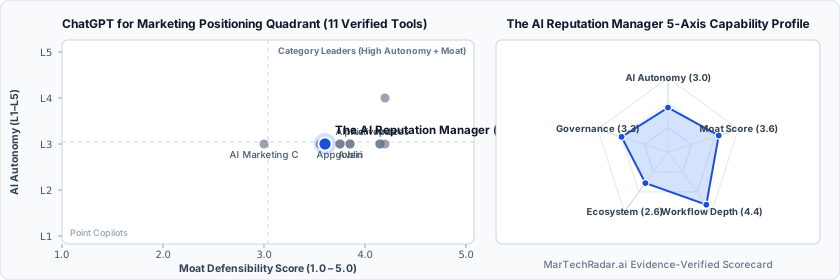
The AI Reputation Manager is a Web SaaS tool for ChatGPT for Marketing (Open-Source Marketing Agents & Prompts) in Agent & Marketing Ops. Pricing: Custom / enterprise pricing. Best suited to B2B SaaS. Editor ratings: AI autonomy L3 (conditional automation); moat score 3.6/5.0 (Proprietary moat). Fact-checked by Julie Brot on Oct 16, 2026.
Open-source agentic reputation orchestration system that monitors brand sentiment, drafts contextual review responses, and automates public review.
The AI Reputation Manager buyer fit verdict: when to choose vs. when to walk away
Choose The AI Reputation Manager if (Best Fit)
- Target ICP & Stack Fit: You operate as B2B SaaS requiring a Web SaaS deployment for ChatGPT for Marketing.
- L3 Architecture & Defensibility: Defensibility rests on open-source agent runtime flexibility, customizable sentiment analysis heuristics, and extensible orchestration wrappers for local or self-hosted deployment models.
- Commercial Model Fit: Your procurement budget aligns with Custom / enterprise pricing.
Walk away from The AI Reputation Manager if (Deal-Breakers)
- Walk away if you require transparent self-serve monthly billing or your budget ceiling is under $1,000/mo (The AI Reputation Manager requires sales-gated custom quoting).
- Walk away if your workflow cannot tolerate platform API rate limits and scraping churn: Review syndication endpoints frequently change HTML structure or enforce aggressive throttling, risking intermittent pipeline drops without active connector maintenance.
- Walk away if nuance detection failure modes is a deal-breaker for your team: Sarcasm, vernacular sarcasm, and subtle multi-sentence grievances can evade deterministic sentiment classifiers, generating inappropriate automated response drafts.
The AI Reputation Manager key facts & scorecard
| Pricing | Custom / enterprise pricing |
|---|---|
| Free plan | No / not disclosed |
| Delivery | Web SaaS |
| Audience | B2B SaaS |
| AI autonomy level | L3 · Conditional automationEditor-verified |
| Moat tier & score | 3.6 / 5.0 · Proprietary moatEditor-verified |
| Funding | Venture-backed |
| Headquarters | United States |
| Last verified |
The AI Reputation Manager pros & cons: strengths vs. operational limitations
Pros: core strengths & capabilities
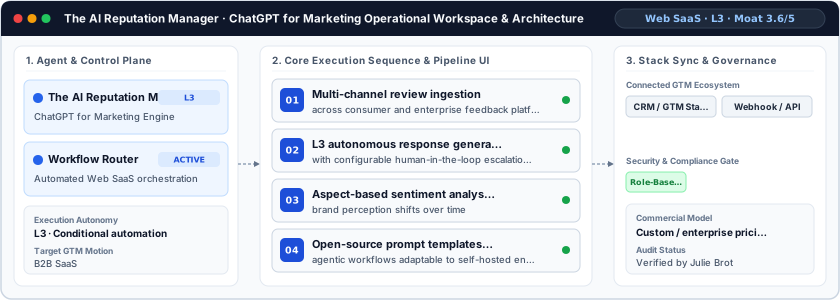
- Multi-channel review ingestion: across consumer and enterprise feedback platforms
- L3 autonomous response generation: with configurable human-in-the-loop escalation rules
- Aspect-based sentiment analysis tracking: brand perception shifts over time
- Open-source prompt templates and: agentic workflows adaptable to self-hosted environments
Cons: operational limitations & risks
- Platform API rate limits and scraping churn: Review syndication endpoints frequently change HTML structure or enforce aggressive throttling, risking intermittent pipeline drops without active connector maintenance.
- Nuance detection failure modes: Sarcasm, vernacular sarcasm, and subtle multi-sentence grievances can evade deterministic sentiment classifiers, generating inappropriate automated response drafts.
- Self-hosted orchestration overhead: Managing open-source agent deployments requires dedicated infrastructure provisioning for message brokers, LLM inference endpoints, and stateful database persistence.
The AI Reputation Manager TCO & deal-breaker stress test
Simulate 12-month stepped TCO, hidden cost multipliers, contract lock-in exposure, and stack failure modes using only facts verified by Julie Brot on .
The AI Reputation Manager triggers high-severity friction under your 5-seat / $800/mo constraints. Benchmark the verified subtrack alternatives below before committing.
| Plan / Tier | Verified Rate | Scale Fit | Scope & Quota Notes |
|---|---|---|---|
| Enterprise / Custom | Custom quote | 15–50+ seats (Enterprise SLA) | Sales-negotiated annual contract for custom volume, SSO/RBAC governance, and dedicated SLA. |
- Moat Score
- 3.6 / 5.0
- AI Autonomy
- L3
- Free Tier / Trial
- None disclosed
Triggered audit signals & failure modes
- Opaque Enterprise Quoting vs. SMB/Mid-Market BudgetVerified Pricing Ledger
The AI Reputation Manager does not disclose a public self-serve floor (Custom / enterprise pricing). Buyers with a $800/mo cap face high sales-qualification friction.
- Sales-Gated Contract TermsFact-checked by Julie Brot
Commercial procurement is structured entirely through custom enterprise tiers.
- Primary Operational Bottleneck: Platform API rate limits and scraping churnAudit by Julie Brot
Review syndication endpoints frequently change HTML structure or enforce aggressive throttling, risking intermittent pipeline drops without active connector maintenance.
Hidden TCO Multipliers & Quota Gates
- Platform API rate limits and scraping churn: Review syndication endpoints frequently change HTML structure or enforce aggressive throttling, risking intermittent pipeline drops without active connector maintenance.
- Nuance detection failure modes: Sarcasm, vernacular sarcasm, and subtle multi-sentence grievances can evade deterministic sentiment classifiers, generating inappropriate automated response drafts.
When to Walk Away & Negotiation Levers
- Walk away if you require transparent self-serve monthly billing or your budget ceiling is under $1,000/mo (The AI Reputation Manager requires sales-gated custom quoting).
- Walk away if your workflow cannot tolerate platform API rate limits and scraping churn: Review syndication endpoints frequently change HTML structure or enforce aggressive throttling, risking intermittent pipeline drops without active connector maintenance.
- Walk away if nuance detection failure modes is a deal-breaker for your team: Sarcasm, vernacular sarcasm, and subtle multi-sentence grievances can evade deterministic sentiment classifiers, generating inappropriate automated response drafts.
- Demand a 30- to 60-day paid pilot opt-out clause in the The AI Reputation Manager order form before signing a 12-month enterprise commitment.
- Require a sandbox proof-of-concept testing platform API rate limits and scraping churn against your live CRM/data schema before annual sign-off.
Ask a custom procurement or TCO stress-test question about The AI Reputation Manager
Lower 5-seat floor (~$99/mo vs. Custom Quote) · Transparent self-serve entry without mandatory annual lock-in
Lower 5-seat floor (~$99/mo vs. Custom Quote) · Transparent self-serve entry without mandatory annual lock-in
The AI Reputation Manager moat & subtrack positioning
Defensibility rests on open-source agent runtime flexibility, customizable sentiment analysis heuristics, and extensible orchestration wrappers for local or self-hosted deployment models.
Editorial review
Fact-checked by Julie Brot (Enterprise SaaS Governance & Procurement Editor) on .
Background
Operating out of the United States, The AI Reputation Manager functions as an open-source agent framework engineered to solve continuous brand sentiment triage and review remediation. Targeted at growth engineers, communications teams, and technical marketers, the system replaces manual customer feedback monitoring with autonomous agent pipelines. By bridging open-source marketing agent runtimes with multi-channel feedback monitoring, the platform addresses the operational friction of tracking, categorizing, and responding to distributed online sentiment across public review channels.
How The AI Reputation Manager works
Architecturally, the platform functions at Level 3 autonomy by executing multi-step monitor-and-respond loops. Ingestion workers query review network endpoints, forums, and directory APIs, passing raw text into parsing layers that conduct aspect-based sentiment classification. Candidate evaluations are then fed into prompting agents that generate context-aware response drafts tailored to specific brand guidelines. The engine automatically publishes low-risk neutral-to-positive interactions while routing anomalous, critical, or legally sensitive reviews into triage queues for human authorization.
Limitations
Operational considerations and platform boundaries include:
- Platform API rate limits and scraping churn: Review syndication endpoints frequently change HTML structure or enforce aggressive throttling, risking intermittent pipeline drops without active connector maintenance.
- Nuance detection failure modes: Sarcasm, vernacular sarcasm, and subtle multi-sentence grievances can evade deterministic sentiment classifiers, generating inappropriate automated response drafts.
- Self-hosted orchestration overhead: Managing open-source agent deployments requires dedicated infrastructure provisioning for message brokers, LLM inference endpoints, and stateful database persistence.
The AI Reputation Manager pricing
Commercial procurement is structured entirely through custom enterprise tiers. The vendor does not publish fixed off-the-shelf software tiers, requiring enterprise buyers to contact sales for tailored quotes based on organizational deployment scale, managed hosting requirements, and seat counts. Pricing is available on request through tailored enterprise sales quotes, with custom enterprise tiers, subscription plans, and seat licenses structured around organizational scale and monthly workflow volume.
How The AI Reputation Manager compares
Compared to direct category competitors like Typeface and Writer, The AI Reputation Manager functions as an alternative focused on reliable workflow execution and transparent unit economics. Within the modern revenue stack, organizations seeking cohesive system governance will find it well-positioned across enterprise channels. It is best suited for enterprise marketing teams and growth practitioners seeking disciplined workflow orchestration.
Frequently asked questions about The AI Reputation Manager
How much does The AI Reputation Manager cost and does it require a custom enterprise quote?
Published pricing summary for The AI Reputation Manager: Custom / enterprise pricing. A permanent free plan is not disclosed for The AI Reputation Manager. Commercial procurement is structured entirely through custom enterprise tiers. The vendor does not publish fixed off-the-shelf software tiers, requiring enterprise buyers to contact sales for tailored quotes based on organizational deployment scale, managed hosting requirements, and seat counts.
How does The AI Reputation Manager work and how autonomous is its AI architecture?
Open-source agentic reputation orchestration system that monitors brand sentiment, drafts contextual review responses, and automates public review. Within ChatGPT for Marketing (Open-Source Marketing Agents & Prompts), MarTechRadar rates its execution architecture at L3 · Conditional automation with a verified Moat Score of 3.6 / 5.0 (Proprietary moat). Defensibility rests on open-source agent runtime flexibility, customizable sentiment analysis heuristics, and extensible orchestration wrappers for local or self-hosted deployment models.
What are the main limitations of The AI Reputation Manager and when should buyers walk away?
Based on our editorial technical audit, key operational considerations and boundaries for The AI Reputation Manager include: (1) Platform API rate limits and scraping churn: Review syndication endpoints frequently change HTML structure or enforce aggressive throttling, risking intermittent pipeline drops without active connector maintenance. (2) Nuance detection failure modes: Sarcasm, vernacular sarcasm, and subtle multi-sentence grievances can evade deterministic sentiment classifiers, generating inappropriate automated response drafts. (3) Self-hosted orchestration overhead: Managing open-source agent deployments requires dedicated infrastructure provisioning for message brokers, LLM inference endpoints, and stateful database persistence. Primary procurement walk-away rule: Walk away if you require transparent self-serve monthly billing or your budget ceiling is under $1,000/mo (The AI Reputation Manager requires sales-gated custom quoting).
What integrations, compliance certifications, and contract terms apply to The AI Reputation Manager?
Key TCO multiplier to watch: Platform API rate limits and scraping churn (Review syndication endpoints frequently change HTML structure or enforce aggressive throttling, risking intermittent pipeline drops without active connector maintenance.) Before signing a contract, procurement teams should demand a 30- to 60-day paid pilot opt-out clause in the The AI Reputation Manager order form before signing a 12-month enterprise commitment.
What are the best The AI Reputation Manager alternatives and head-to-head competitors in 2026?
Top fact-checked alternatives to The AI Reputation Manager in ChatGPT for Marketing (Open-Source Marketing Agents & Prompts) include Suede Creator Skills (Custom / enterprise pricing), SupplyVision (Custom / enterprise pricing), TabX (Custom / enterprise pricing), ThunderPhone v2 (Custom / enterprise pricing). Compared to direct category competitors like Typeface and Writer, The AI Reputation Manager functions as an alternative focused on reliable workflow execution and transparent unit economics.
Verified sources & evidence trail
- Official product domain: https://moregoodreviews.com/ai
- Commercial pricing verification: Verified against official vendor pricing policy (Custom / enterprise pricing)
- Editorial audit sign-off: Fact-checked by Julie Brot on under the MarTechRadar Evidence-Ledger Protocol.