TopicRank Review (2026): Content Optimization Pricing, Limits & Alternatives
Bottom line
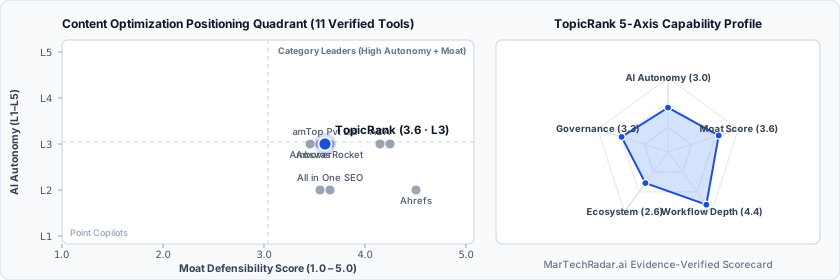
TopicRank is a Web SaaS tool for Content Optimization (Content Optimization & SERP Intelligence) in GEO & AI SEO. Pricing: Custom / enterprise pricing. Best suited to B2B SaaS. Editor ratings: AI autonomy L3 (conditional automation); moat score 3.6/5.0 (Proprietary moat). Fact-checked by Anna Xia on Oct 15, 2026.
Automated topical authority and SERP intelligence software that clusters keyword datasets into structured content silos and internal linking blueprints.
TopicRank buyer fit verdict: when to choose vs. when to walk away
Choose TopicRank if (Best Fit)
- Target ICP & Stack Fit: You operate as B2B SaaS requiring a Web SaaS deployment for Content Optimization.
- L3 Architecture & Defensibility: TopicRank builds defensibility through automated semantic clustering algorithms and structured pillar-cluster relationship mapping, converting flat keyword lists into search-engine-aligned internal link architectures.
- Commercial Model Fit: Your procurement budget aligns with Custom / enterprise pricing.
Walk away from TopicRank if (Deal-Breakers)
- Walk away if you require transparent self-serve monthly billing or your budget ceiling is under $1,000/mo (TopicRank requires sales-gated custom quoting).
- Walk away if your workflow cannot tolerate corpus ingestion scale: The semantic clustering engine experiences significant computational latency and memory consumption spikes when processing uncurated keyword datasets exceeding tens of thousands of rows simultaneously.
- Walk away if dynamic SERP volatility is a deal-breaker for your team: Topic clustering relies on static search snapshots, requiring periodic manual batch re-clustering to capture shifts in search intent or newly emerging semantic entity associations.
TopicRank key facts & scorecard
| Pricing | Custom / enterprise pricing |
|---|---|
| Free plan | No / not disclosed |
| Delivery | Web SaaS |
| Audience | B2B SaaS |
| AI autonomy level | L3 · Conditional automationEditor-verified |
| Moat tier & score | 3.6 / 5.0 · Proprietary moatEditor-verified |
| Funding | Bootstrapped |
| Headquarters | United States |
| Last verified |
TopicRank pros & cons: strengths vs. operational limitations
Pros: core strengths & capabilities
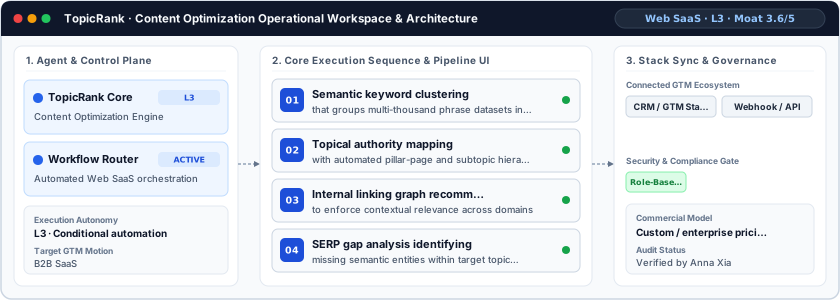
- Semantic keyword clustering: that groups multi-thousand phrase datasets into thematic silos
- Topical authority mapping: with automated pillar-page and subtopic hierarchy generation
- Internal linking graph recommendations: to enforce contextual relevance across domains
- SERP gap analysis identifying: missing semantic entities within target topic clusters
Cons: operational limitations & risks
- Corpus Ingestion Scale: The semantic clustering engine experiences significant computational latency and memory consumption spikes when processing uncurated keyword datasets exceeding tens of thousands of rows simultaneously.
- Dynamic SERP Volatility: Topic clustering relies on static search snapshots, requiring periodic manual batch re-clustering to capture shifts in search intent or newly emerging semantic entity associations.
- CMS Integration Overhead: The platform lacks native automated bidirectional synchronization with headless enterprise content management systems, necessitating manual internal link deployment and page schema validation.
TopicRank TCO & deal-breaker stress test
Simulate 12-month stepped TCO, hidden cost multipliers, contract lock-in exposure, and stack failure modes using only facts verified by Anna Xia on · Capture SHA 6a35b3ee.
TopicRank triggers high-severity friction under your 5-seat / $800/mo constraints. Benchmark the verified subtrack alternatives below before committing.
| Plan / Tier | Verified Rate | Scale Fit | Scope & Quota Notes |
|---|---|---|---|
| Enterprise / Custom | Custom quote | 15–50+ seats (Enterprise SLA) | Sales-negotiated annual contract for custom volume, SSO/RBAC governance, and dedicated SLA. |
- Moat Score
- 3.6 / 5.0
- AI Autonomy
- L3
- Free Tier / Trial
- None disclosed
Triggered audit signals & failure modes
- Opaque Enterprise Quoting vs. SMB/Mid-Market BudgetVerified Pricing Ledger
TopicRank does not disclose a public self-serve floor (Custom / enterprise pricing). Buyers with a $800/mo cap face high sales-qualification friction.
- Sales-Gated Contract TermsFact-checked by Anna Xia
Commercial pricing for TopicRank is available on request through tailored enterprise sales quotes based on organizational scale and seats. Contracts are scoped around domain volume, keyword tracking quotas, and required cluster generation throughput.
- Primary Operational Bottleneck: Corpus Ingestion ScaleAudit by Anna Xia
The semantic clustering engine experiences significant computational latency and memory consumption spikes when processing uncurated keyword datasets exceeding tens of thousands of rows simultaneously.
Hidden TCO Multipliers & Quota Gates
- Corpus Ingestion Scale: The semantic clustering engine experiences significant computational latency and memory consumption spikes when processing uncurated keyword datasets exceeding tens of thousands of rows simultaneously.
- Dynamic SERP Volatility: Topic clustering relies on static search snapshots, requiring periodic manual batch re-clustering to capture shifts in search intent or newly emerging semantic entity associations.
When to Walk Away & Negotiation Levers
- Walk away if you require transparent self-serve monthly billing or your budget ceiling is under $1,000/mo (TopicRank requires sales-gated custom quoting).
- Walk away if your workflow cannot tolerate corpus ingestion scale: The semantic clustering engine experiences significant computational latency and memory consumption spikes when processing uncurated keyword datasets exceeding tens of thousands of rows simultaneously.
- Walk away if dynamic SERP volatility is a deal-breaker for your team: Topic clustering relies on static search snapshots, requiring periodic manual batch re-clustering to capture shifts in search intent or newly emerging semantic entity associations.
- Demand a 30- to 60-day paid pilot opt-out clause in the TopicRank order form before signing a 12-month enterprise commitment.
- Require a sandbox proof-of-concept testing corpus ingestion scale against your live CRM/data schema before annual sign-off.
Ask a custom procurement or TCO stress-test question about TopicRank
Lower 5-seat floor (~$29/mo vs. Custom Quote) · Transparent self-serve entry without mandatory annual lock-in
Lower 5-seat floor (~$50/mo vs. Custom Quote) · Transparent self-serve entry without mandatory annual lock-in
TopicRank moat & subtrack positioning
TopicRank builds defensibility through automated semantic clustering algorithms and structured pillar-cluster relationship mapping, converting flat keyword lists into search-engine-aligned internal link architectures.
Editorial review
Fact-checked by Anna Xia (Senior B2B GTM & Revenue Systems Analyst) on .
Background
Architected to replace manual keyword grouping with semantic entity structuring, TopicRank operates as a content planning engine headquartered in the United States. Designed primarily for enterprise content strategists, SEO directors, and organic growth teams, the platform addresses structural deficiencies in high-volume editorial production. Rather than targeting isolated search queries, TopicRank organizes digital publishing initiatives around unified topic authority models that reflect search engine entity indexing paradigms.
How TopicRank works
At its architectural core, TopicRank ingests bulk keyword corpora and processes them through semantic natural language processing pipelines. The system applies vector embeddings and hierarchical clustering algorithms to calculate semantic distances between queries, categorizing related terms into cohesive topic silos. The pipeline maps central pillar topics to secondary supporting pages and derives directed internal linking blueprints, delivering structural content recommendations that minimize manual editorial taxonomy planning.
Limitations
Operational considerations and platform boundaries include:
- Corpus Ingestion Scale: The semantic clustering engine experiences significant computational latency and memory consumption spikes when processing uncurated keyword datasets exceeding tens of thousands of rows simultaneously.
- Dynamic SERP Volatility: Topic clustering relies on static search snapshots, requiring periodic manual batch re-clustering to capture shifts in search intent or newly emerging semantic entity associations.
- CMS Integration Overhead: The platform lacks native automated bidirectional synchronization with headless enterprise content management systems, necessitating manual internal link deployment and page schema validation.
TopicRank pricing
Commercial pricing for TopicRank is available on request through tailored enterprise sales quotes based on organizational scale and seats. Contracts are scoped around domain volume, keyword tracking quotas, and required cluster generation throughput. Prospective buyers must engage with the vendor sales team directly to evaluate customized enterprise tier packages, data ingestion requirements, and annual contract commitments.
How TopicRank compares
Within the search intelligence landscape, TopicRank competes against broad-spectrum SEO suites like Ahrefs as well as niche taxonomy tools like Amboras. While Ahrefs provides comprehensive backlink graphs and exploratory index tracking, it relies on manual user workflows to construct multi-tier pillar hierarchies. TopicRank specializes entirely in semantic cluster generation, making it best suited for mid-market and enterprise editorial organizations focused on systematic domain authority development.
Frequently asked questions about TopicRank
How much does TopicRank cost and does it require a custom enterprise quote?
Published pricing summary for TopicRank: Custom / enterprise pricing. A permanent free plan is not disclosed for TopicRank. Commercial pricing for TopicRank is available on request through tailored enterprise sales quotes based on organizational scale and seats. Contracts are scoped around domain volume, keyword tracking quotas, and required cluster generation throughput.
How does TopicRank work and how autonomous is its AI architecture?
Automated topical authority and SERP intelligence software that clusters keyword datasets into structured content silos and internal linking blueprints. Within Content Optimization (Content Optimization & SERP Intelligence), MarTechRadar rates its execution architecture at L3 · Conditional automation with a verified Moat Score of 3.6 / 5.0 (Proprietary moat). TopicRank builds defensibility through automated semantic clustering algorithms and structured pillar-cluster relationship mapping, converting flat keyword lists into search-engine-aligned internal link architectures.
What are the main limitations of TopicRank and when should buyers walk away?
Based on our editorial technical audit, key operational considerations and boundaries for TopicRank include: (1) Corpus Ingestion Scale: The semantic clustering engine experiences significant computational latency and memory consumption spikes when processing uncurated keyword datasets exceeding tens of thousands of rows simultaneously. (2) Dynamic SERP Volatility: Topic clustering relies on static search snapshots, requiring periodic manual batch re-clustering to capture shifts in search intent or newly emerging semantic entity associations. (3) CMS Integration Overhead: The platform lacks native automated bidirectional synchronization with headless enterprise content management systems, necessitating manual internal link deployment and page schema validation. Primary procurement walk-away rule: Walk away if you require transparent self-serve monthly billing or your budget ceiling is under $1,000/mo (TopicRank requires sales-gated custom quoting).
What integrations, compliance certifications, and contract terms apply to TopicRank?
Key TCO multiplier to watch: Corpus Ingestion Scale (The semantic clustering engine experiences significant computational latency and memory consumption spikes when processing uncurated keyword datasets exceeding tens of thousands of rows simultaneously.) Before signing a contract, procurement teams should demand a 30- to 60-day paid pilot opt-out clause in the TopicRank order form before signing a 12-month enterprise commitment.
What are the best TopicRank alternatives and head-to-head competitors in 2026?
Top fact-checked alternatives to TopicRank in Content Optimization (Content Optimization & SERP Intelligence) include RankerFox (Custom / enterprise pricing), SearchGPT Monitor (Custom / enterprise pricing), Ahrefs ($29–$1,499/mo), Peec AI (From $95/mo · Enterprise plan). Within the search intelligence landscape, TopicRank competes against broad-spectrum SEO suites like Ahrefs as well as niche taxonomy tools like Amboras. While Ahrefs provides comprehensive backlink graphs and exploratory index tracking, it relies on manual user workflows to construct multi-tier pillar hierarchies.
Verified sources & evidence trail
- Official product domain: https://topicrank.ai
- Commercial pricing verification: Verified against official vendor pricing policy (Custom / enterprise pricing)
- Editorial audit sign-off: Fact-checked by Anna Xia on under the MarTechRadar Evidence-Ledger Protocol.