WordLift Review (2026): Technical SEO Pricing, Limits & Alternatives
Bottom line
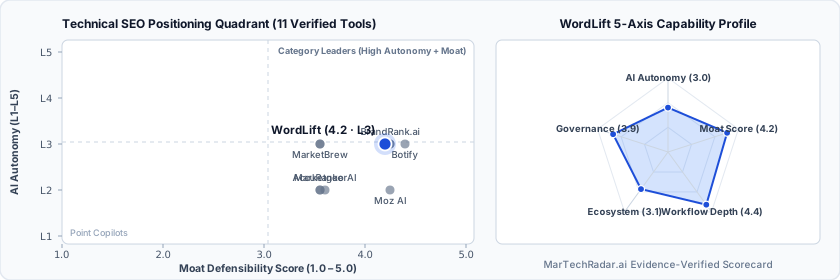
WordLift is a Web SaaS tool for Technical SEO (Technical SEO Auditing & Indexing) in GEO & AI SEO. Pricing: From $799/yr. Best suited to B2B SaaS, DTC / eCommerce and Enterprise Brands. Editor ratings: AI autonomy L3 (conditional automation); moat score 4.2/5.0 (Proprietary moat). Fact-checked by Anna Xia on Oct 15, 2026.
WordLift automates technical SEO and semantic markup by converting unstructured CMS content into dynamic knowledge graphs and machine-readable JSON-LD.
WordLift buyer fit verdict: when to choose vs. when to walk away
Choose WordLift if (Best Fit)
- Target ICP & Stack Fit: You operate as B2B SaaS, DTC / eCommerce and Enterprise Brands requiring a Web SaaS deployment for Technical SEO.
- L3 Architecture & Defensibility: WordLift establishes its technical moat through automated entity resolution linked to open knowledge bases (Wikidata), creating custom semantic web ontologies that search engine crawlers consume directly.
- Commercial Model Fit: Your procurement budget aligns with From $799/yr.
Walk away from WordLift if (Deal-Breakers)
- Walk away if your team is at early validation stage with a <$250/mo tool budget (WordLift starts at From $799/yr before seat or usage expansion).
- Walk away if your workflow cannot tolerate ontology disambiguation: Entity extraction models occasionally misclassify niche industry jargon, requiring manual taxonomy curation and continuous validation of linked entity nodes.
- Walk away if CMS pipeline coupling is a deal-breaker for your team: Integration with headless architectures requires custom webhook and API orchestrations, increasing deployment overhead compared to simple tag-manager injections.
WordLift key facts & scorecard
| Pricing | From $799/yrVendor pricing page |
|---|---|
| Free plan | No / not disclosed |
| Delivery | Web SaaS |
| Audience | B2B SaaS, DTC / eCommerce, Enterprise Brands |
| AI autonomy level | L3 · Conditional automationEditor-verified |
| Moat tier & score | 4.2 / 5.0 · Proprietary moatEditor-verified |
| Funding | Seed |
| Total funding | €1.2M |
| Founders | Andrea Volpini, David Riccitelli |
| Company size | 11-50 employees |
| Governance & docs | API & Docs ↗ · Terms ↗ · Privacy ↗ |
| Headquarters | Roma |
| Founded | 2017 |
| Last verified |
WordLift pros & cons: strengths vs. operational limitations
Pros: core strengths & capabilities
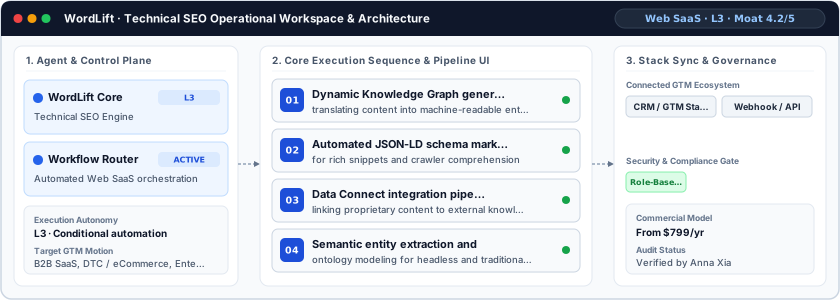
- Dynamic Knowledge Graph generation: translating content into machine-readable entity networks
- Automated JSON-LD schema markup optimization: for rich snippets and crawler comprehension
- Data Connect integration pipeline: linking proprietary content to external knowledge bases
- Semantic entity extraction and: ontology modeling for headless and traditional CMS setups
Cons: operational limitations & risks
- Ontology Disambiguation: Entity extraction models occasionally misclassify niche industry jargon, requiring manual taxonomy curation and continuous validation of linked entity nodes.
- CMS Pipeline Coupling: Integration with headless architectures requires custom webhook and API orchestrations, increasing deployment overhead compared to simple tag-manager injections.
- Graph Maintenance Overhead: Large catalogs risk schema bloat and latency if dynamic graph synchronization loops are not throttled against core publishing database updates.
WordLift TCO & deal-breaker stress test
Simulate 12-month stepped TCO, hidden cost multipliers, contract lock-in exposure, and stack failure modes using only facts verified by Anna Xia on · Capture SHA d408a45f.
WordLift is viable for 5 seats, but requires commercial or technical verification on the flagged items below.
| Plan / Tier | Verified Rate | Scale Fit | Scope & Quota Notes |
|---|---|---|---|
| Entry / Starter | $799/yr | 1–2 seats | Verified $799/yr published rate on vendor pricing schedule. |
- Moat Score
- 4.2 / 5.0
- AI Autonomy
- L3
- Free Tier / Trial
- None disclosed
Triggered audit signals & failure modes
- Annual Contract Lock-in Risk DetectedFact-checked by Anna Xia
Commercial access operates on an annual subscription framework starting from $799 per year for standard site packages.
- Primary Operational Bottleneck: Ontology DisambiguationAudit by Anna Xia
Entity extraction models occasionally misclassify niche industry jargon, requiring manual taxonomy curation and continuous validation of linked entity nodes.
Hidden TCO Multipliers & Quota Gates
- Annual Billing Headline vs. Monthly Premium: Headline entry rates reflect annual billing commitments (Save 20%); month-to-month flexibility carries a higher effective monthly rate or requires annual prepayment.
- Credit & Usage Burn Multiplier: Automated workflows consume metered credits/usage quotas; multi-step enrichment, voice minutes, or high-frequency agent runs can trigger mid-cycle top-up packs.
When to Walk Away & Negotiation Levers
- Walk away if your team is at early validation stage with a <$250/mo tool budget (WordLift starts at From $799/yr before seat or usage expansion).
- Walk away if your workflow cannot tolerate ontology disambiguation: Entity extraction models occasionally misclassify niche industry jargon, requiring manual taxonomy curation and continuous validation of linked entity nodes.
- Walk away if CMS pipeline coupling is a deal-breaker for your team: Integration with headless architectures requires custom webhook and API orchestrations, increasing deployment overhead compared to simple tag-manager injections.
- Negotiate price-lock protection on additional seats and overage credits above the From $799/yr entry tier.
- Require a sandbox proof-of-concept testing ontology disambiguation against your live CRM/data schema before annual sign-off.
Ask a custom procurement or TCO stress-test question about WordLift
Lower 5-seat floor (~$8/mo vs. $799 / yr upfront) · Transparent self-serve entry without mandatory annual lock-in
Fits within $800/mo budget (From $224/mo) · Transparent self-serve entry without mandatory annual lock-in
WordLift moat & subtrack positioning
WordLift establishes its technical moat through automated entity resolution linked to open knowledge bases (Wikidata), creating custom semantic web ontologies that search engine crawlers consume directly.
Editorial review
Fact-checked by Anna Xia (Senior B2B GTM & Revenue Systems Analyst) on .
Background
Architectured around semantic web principles, WordLift was founded in 2017 in Roma with €1.2M in backing to automate the construction of structured metadata for web properties. The platform targets enterprise technical SEO directors and content operations teams seeking to convert unstructured editorial and product content into machine-readable formats. Rather than treating indexing as simple crawling verification, WordLift acts as a real-time semantic publishing engine that builds structured knowledge repositories directly within the publishing pipeline.
How WordLift works
At an L3 autonomy level, WordLift operates as an intelligent semantic middleware layer embedded into CMS platforms and headless data streams. The system deploys natural language processing pipelines to perform named-entity recognition across editorial bodies, cross-referencing extracted subjects with external ontologies such as Wikidata. It then structures this linked information into a proprietary Dynamic Knowledge Graph, injecting validated JSON-LD schema markup directly into page templates to streamline search engine parsing and entity disambiguation.
Limitations
Operational considerations and platform boundaries include:
- Ontology Disambiguation: Entity extraction models occasionally misclassify niche industry jargon, requiring manual taxonomy curation and continuous validation of linked entity nodes.
- CMS Pipeline Coupling: Integration with headless architectures requires custom webhook and API orchestrations, increasing deployment overhead compared to simple tag-manager injections.
- Graph Maintenance Overhead: Large catalogs risk schema bloat and latency if dynamic graph synchronization loops are not throttled against core publishing database updates.
WordLift pricing
Commercial access operates on an annual subscription framework starting from $799 per year for standard site packages. Higher tiers scale based on domain volume, total indexed entity count, dynamic knowledge graph capacity, and API transaction quotas for decoupled enterprise CMS environments.
How WordLift compares
Compared to direct category competitors like Profound and Peec AI, WordLift functions as an alternative focused on specialized workflow execution. Unlike diagnostic crawlers like Botify, Screaming Frog SEO, and Sitebulb that audit existing technical defects post-rendering, WordLift actively synthesizes and injects semantic infrastructure at the CMS layer. This runtime data modeling approach benefits enterprise e-commerce platforms and multi-author publications prioritizing continuous search-engine entity resolution over manual audit remediation. It is best suited for enterprise marketing teams and growth practitioners seeking disciplined workflow orchestration.
Direct competitors & market radar
Top algorithmic competitors based on category positioning, capability overlap, and ICP alignment.
Frequently asked questions about WordLift
How much does WordLift cost and what pricing tiers are available?
Published pricing summary for WordLift: From $799/yr. A permanent free plan is not disclosed for WordLift. Commercial access operates on an annual subscription framework starting from $799 per year for standard site packages. Higher tiers scale based on domain volume, total indexed entity count, dynamic knowledge graph capacity, and API transaction quotas for decoupled enterprise CMS environments.
How does WordLift work and how autonomous is its AI architecture?
WordLift automates technical SEO and semantic markup by converting unstructured CMS content into dynamic knowledge graphs and machine-readable JSON-LD. Within Technical SEO (Technical SEO Auditing & Indexing), MarTechRadar rates its execution architecture at L3 · Conditional automation with a verified Moat Score of 4.2 / 5.0 (Proprietary moat). WordLift establishes its technical moat through automated entity resolution linked to open knowledge bases (Wikidata), creating custom semantic web ontologies that search engine crawlers consume directly. Corporate profile: Founded by Andrea Volpini, David Riccitelli, operating at 11-50 employees scale.
What are the main limitations of WordLift and when should buyers walk away?
Based on our editorial technical audit, key operational considerations and boundaries for WordLift include: (1) Ontology Disambiguation: Entity extraction models occasionally misclassify niche industry jargon, requiring manual taxonomy curation and continuous validation of linked entity nodes. (2) CMS Pipeline Coupling: Integration with headless architectures requires custom webhook and API orchestrations, increasing deployment overhead compared to simple tag-manager injections. (3) Graph Maintenance Overhead: Large catalogs risk schema bloat and latency if dynamic graph synchronization loops are not throttled against core publishing database updates. Primary procurement walk-away rule: Walk away if your team is at early validation stage with a <$250/mo tool budget (WordLift starts at From $799/yr before seat or usage expansion).
What integrations, compliance certifications, and contract terms apply to WordLift?
First-party governance and developer endpoints verified on domain include: API Docs (https://docs.wordlift.io). Key TCO multiplier to watch: Annual Billing Headline vs. Monthly Premium (Headline entry rates reflect annual billing commitments (Save 20%); month-to-month flexibility carries a higher effective monthly rate or requires annual prepayment.) Before signing a contract, procurement teams should negotiate price-lock protection on additional seats and overage credits above the From $799/yr entry tier.
What are the best WordLift alternatives and head-to-head competitors in 2026?
Top fact-checked alternatives to WordLift in Technical SEO (Technical SEO Auditing & Indexing) include RankMath AI (From $7.99/mo), Schema App (Custom / enterprise pricing), Yoast AI (Custom / enterprise pricing), Screaming Frog SEO (Free plan · £169–£199/yr). Compared to direct category competitors like Profound and Peec AI, WordLift functions as an alternative focused on specialized workflow execution.
Verified sources & evidence trail
- Official product domain: https://wordlift.io
- Commercial pricing verification: https://wordlift.io/pricing/?currency=EUR
- Verified corporate entity profiles (
sameAs): LinkedIn Company Profile · Crunchbase Entity Record - First-party governance & documentation links: API & Docs · Terms · Privacy
- Editorial audit sign-off: Fact-checked by Anna Xia on under the MarTechRadar Evidence-Ledger Protocol.