Zalster Review (2026): AI PPC Pricing, Limits & Alternatives
Bottom line
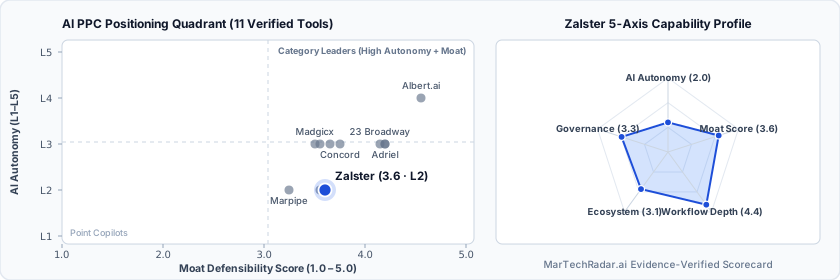
Zalster is a Web SaaS tool for AI PPC (Autonomous Bidding & Budget Management) in AdTech & Paid Media. Pricing: Custom / enterprise pricing. Best suited to DTC / eCommerce. Editor ratings: AI autonomy L2 (workflow copilot); moat score 3.6/5.0 (Proprietary moat). Fact-checked by Anna Xia on Oct 14, 2026.
Algorithmic ad management and budget optimization engine automating paid social campaign pacing, multivariate split testing, and bid adjustments.
Zalster buyer fit verdict: when to choose vs. when to walk away
Choose Zalster if (Best Fit)
- Target ICP & Stack Fit: You operate as DTC / eCommerce requiring a Web SaaS deployment for AI PPC.
- L2 Architecture & Defensibility: Historical rule-based optimization heuristics and early Meta Marketing API integrations, augmented by localized hybrid service delivery across Nordic digital commerce hubs.
- Commercial Model Fit: Your procurement budget aligns with Custom / enterprise pricing.
Walk away from Zalster if (Deal-Breakers)
- Walk away if you require transparent self-serve monthly billing or your budget ceiling is under $1,000/mo (Zalster requires sales-gated custom quoting).
- Walk away if your workflow cannot tolerate API rate limits and sync latency: Frequent batch updates across high-volume accounts risk hitting upstream ad network API rate boundaries, causing delays in real-time budget adjustments during intra-day auction spikes.
- Walk away if attribution window lag is a deal-breaker for your team: Delayed conversion signals resulting from platform privacy frameworks (such as SKAdNetwork) degrade heuristic optimization accuracy, potentially pausing campaigns that generate delayed conversions.
Zalster key facts & scorecard
| Pricing | Custom / enterprise pricing |
|---|---|
| Free plan | No / not disclosed |
| Delivery | Web SaaS |
| Audience | DTC / eCommerce |
| AI autonomy level | L2 · Workflow copilotEditor-verified |
| Moat tier & score | 3.6 / 5.0 · Proprietary moatEditor-verified |
| Funding | Acquired |
| Founders | Albin Stööp, Antonios Kioksoglou, Nathanael Andersson |
| Company size | 11-50 employees |
| Headquarters | Inom Vallgraven, Vastra Gotaland County |
| Founded | 2015 |
| Last verified |
Zalster pros & cons: strengths vs. operational limitations
Pros: core strengths & capabilities
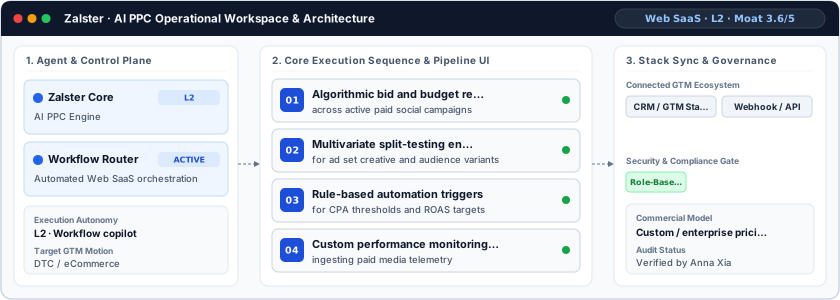
- Algorithmic bid and budget reallocation: across active paid social campaigns
- Multivariate split-testing engine: for ad set creative and audience variants
- Rule-based automation triggers: for CPA thresholds and ROAS targets
- Custom performance monitoring dashboards: ingesting paid media telemetry
Cons: operational limitations & risks
- API Rate Limits and Sync Latency: Frequent batch updates across high-volume accounts risk hitting upstream ad network API rate boundaries, causing delays in real-time budget adjustments during intra-day auction spikes.
- Attribution Window Lag: Delayed conversion signals resulting from platform privacy frameworks (such as SKAdNetwork) degrade heuristic optimization accuracy, potentially pausing campaigns that generate delayed conversions.
- Rule Governance Maintenance: Automated rule sets require ongoing calibration across diverse creative cycles; unmaintained heuristic bounds risk erratic budget cycling across low-confidence multivariate testing branches.
Zalster TCO & deal-breaker stress test
Simulate 12-month stepped TCO, hidden cost multipliers, contract lock-in exposure, and stack failure modes using only facts verified by Anna Xia on · Capture SHA 408cd883.
Zalster triggers high-severity friction under your 5-seat / $800/mo constraints. Benchmark the verified subtrack alternatives below before committing.
| Plan / Tier | Verified Rate | Scale Fit | Scope & Quota Notes |
|---|---|---|---|
| Enterprise / Custom | Custom quote | 15–50+ seats (Enterprise SLA) | Sales-negotiated annual contract for custom volume, SSO/RBAC governance, and dedicated SLA. |
- Moat Score
- 3.6 / 5.0
- AI Autonomy
- L2
- Free Tier / Trial
- None disclosed
Triggered audit signals & failure modes
- Opaque Enterprise Quoting vs. SMB/Mid-Market BudgetVerified Pricing Ledger
Zalster does not disclose a public self-serve floor (Custom / enterprise pricing). Buyers with a $800/mo cap face high sales-qualification friction.
- Sales-Gated Contract TermsFact-checked by Anna Xia
Commercial access to the platform is structured through tailored enterprise contracts. Rather than publishing fixed transactional tiers, commercial pricing is available on request through tailored enterprise sales quotes based on organizational scale and seats.
- Primary Operational Bottleneck: API Rate Limits and Sync LatencyAudit by Anna Xia
Frequent batch updates across high-volume accounts risk hitting upstream ad network API rate boundaries, causing delays in real-time budget adjustments during intra-day auction spikes.
Hidden TCO Multipliers & Quota Gates
- API Rate Limits and Sync Latency: Frequent batch updates across high-volume accounts risk hitting upstream ad network API rate boundaries, causing delays in real-time budget adjustments during intra-day auction spikes.
- Attribution Window Lag: Delayed conversion signals resulting from platform privacy frameworks (such as SKAdNetwork) degrade heuristic optimization accuracy, potentially pausing campaigns that generate delayed conversions.
When to Walk Away & Negotiation Levers
- Walk away if you require transparent self-serve monthly billing or your budget ceiling is under $1,000/mo (Zalster requires sales-gated custom quoting).
- Walk away if your workflow cannot tolerate API rate limits and sync latency: Frequent batch updates across high-volume accounts risk hitting upstream ad network API rate boundaries, causing delays in real-time budget adjustments during intra-day auction spikes.
- Walk away if attribution window lag is a deal-breaker for your team: Delayed conversion signals resulting from platform privacy frameworks (such as SKAdNetwork) degrade heuristic optimization accuracy, potentially pausing campaigns that generate delayed conversions.
- Demand a 30- to 60-day paid pilot opt-out clause in the Zalster order form before signing a 12-month enterprise commitment.
- Require a sandbox proof-of-concept testing API rate limits and sync latency against your live CRM/data schema before annual sign-off.
Ask a custom procurement or TCO stress-test question about Zalster
Lower 5-seat floor (~$500/mo vs. Custom Quote) · Transparent self-serve entry without mandatory annual lock-in
Lower 5-seat floor (~$49/mo vs. Custom Quote) · Transparent self-serve entry without mandatory annual lock-in
Zalster moat & subtrack positioning
Historical rule-based optimization heuristics and early Meta Marketing API integrations, augmented by localized hybrid service delivery across Nordic digital commerce hubs.
Editorial review
Fact-checked by Anna Xia (Senior B2B GTM & Revenue Systems Analyst) on .
Background
Architectured as a performance optimization suite bridging algorithmic automation with media operations, Zalster was founded in 2015 in Inom Vallgraven, Vastra Gotaland County. The software targets performance marketing heads, e-commerce growth operators, and paid social practitioners seeking systematic capital allocation across paid channels. Rather than relying on manual adjustments, the platform coordinates programmatic rules and split-testing pipelines to protect operational margins.
How Zalster works
At its operational foundation, the platform operates at Level 2 autonomy by establishing direct API connections with external social platforms, primarily the Meta Marketing API. Zalster ingests real-time campaign performance telemetry, tracking metrics such as cost-per-acquisition, return on ad spend, and conversion events. Heuristic decision models continuously evaluate these data streams against user-defined guardrails. When performance anomalies or target thresholds are detected, the system executes automated budget reallocations across ad sets, pauses decaying creatives, and scales top-performing audience variants without human intervention.
Limitations
Operational considerations and platform boundaries include:
- API Rate Limits and Sync Latency: Frequent batch updates across high-volume accounts risk hitting upstream ad network API rate boundaries, causing delays in real-time budget adjustments during intra-day auction spikes.
- Attribution Window Lag: Delayed conversion signals resulting from platform privacy frameworks (such as SKAdNetwork) degrade heuristic optimization accuracy, potentially pausing campaigns that generate delayed conversions.
- Rule Governance Maintenance: Automated rule sets require ongoing calibration across diverse creative cycles; unmaintained heuristic bounds risk erratic budget cycling across low-confidence multivariate testing branches.
Zalster pricing
Commercial access to the platform is structured through tailored enterprise contracts. Rather than publishing fixed transactional tiers, commercial pricing is available on request through tailored enterprise sales quotes based on organizational scale and seats. Deployments typically reflect managed ad spend thresholds, integrated connector limits, and organizational governance requirements, accompanied by custom onboarding options.
How Zalster compares
Within algorithmic budget management, Zalster contends with platforms like Albert.ai, 23 Broadway, and Adriel. Albert.ai emphasizes multi-channel autonomous execution using predictive neural models, whereas Adriel focuses on cross-network dashboard aggregation with user-driven rule triggers. 23 Broadway targets performance-focused media buying with deep funnel automation. Zalster differentiates by maintaining tight heuristic controls specifically tailored for direct-to-consumer digital commerce brands requiring disciplined algorithmic guardrails.
Frequently asked questions about Zalster
How much does Zalster cost and does it require a custom enterprise quote?
Published pricing summary for Zalster: Custom / enterprise pricing. A permanent free plan is not disclosed for Zalster. Commercial access to the platform is structured through tailored enterprise contracts. Rather than publishing fixed transactional tiers, commercial pricing is available on request through tailored enterprise sales quotes based on organizational scale and seats.
How does Zalster work and how autonomous is its AI architecture?
Algorithmic ad management and budget optimization engine automating paid social campaign pacing, multivariate split testing, and bid adjustments. Within AI PPC (Autonomous Bidding & Budget Management), MarTechRadar rates its execution architecture at L2 · Workflow copilot with a verified Moat Score of 3.6 / 5.0 (Proprietary moat). Historical rule-based optimization heuristics and early Meta Marketing API integrations, augmented by localized hybrid service delivery across Nordic digital commerce hubs. Corporate profile: Founded by Albin Stööp, Antonios Kioksoglou, Nathanael Andersson, operating at 11-50 employees scale.
What are the main limitations of Zalster and when should buyers walk away?
Based on our editorial technical audit, key operational considerations and boundaries for Zalster include: (1) API Rate Limits and Sync Latency: Frequent batch updates across high-volume accounts risk hitting upstream ad network API rate boundaries, causing delays in real-time budget adjustments during intra-day auction spikes. (2) Attribution Window Lag: Delayed conversion signals resulting from platform privacy frameworks (such as SKAdNetwork) degrade heuristic optimization accuracy, potentially pausing campaigns that generate delayed conversions. (3) Rule Governance Maintenance: Automated rule sets require ongoing calibration across diverse creative cycles; unmaintained heuristic bounds risk erratic budget cycling across low-confidence multivariate testing branches. Primary procurement walk-away rule: Walk away if you require transparent self-serve monthly billing or your budget ceiling is under $1,000/mo (Zalster requires sales-gated custom quoting).
What integrations, compliance certifications, and contract terms apply to Zalster?
Key TCO multiplier to watch: API Rate Limits and Sync Latency (Frequent batch updates across high-volume accounts risk hitting upstream ad network API rate boundaries, causing delays in real-time budget adjustments during intra-day auction spikes.) Before signing a contract, procurement teams should demand a 30- to 60-day paid pilot opt-out clause in the Zalster order form before signing a 12-month enterprise commitment.
What are the best Zalster alternatives and head-to-head competitors in 2026?
Top fact-checked alternatives to Zalster in AI PPC (Autonomous Bidding & Budget Management) include Nanigans (Custom / enterprise pricing), paretos (Custom / enterprise pricing), Shape.io (Custom / enterprise pricing), Veriad (Pricing not disclosed). Within algorithmic budget management, Zalster contends with platforms like Albert.ai, 23 Broadway, and Adriel.
Verified sources & evidence trail
- Official product domain: https://zalster.com
- Commercial pricing verification: Verified against official vendor pricing policy (Custom / enterprise pricing)
- Verified corporate entity profiles (
sameAs): LinkedIn Company Profile · Crunchbase Entity Record - Editorial audit sign-off: Fact-checked by Anna Xia on under the MarTechRadar Evidence-Ledger Protocol.