Campaigner Review (2026): Email Marketing Pricing, Limits & Alternatives
Bottom line
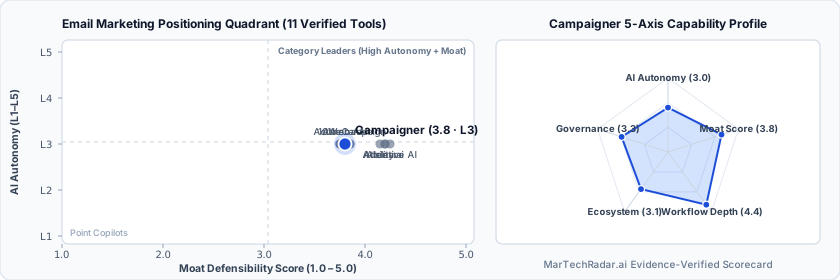
Campaigner is a Web SaaS tool for Email Marketing (AI Email Marketing & Lifecycle Journeys) in Lifecycle & CDP. Pricing: From $14/mo. Best suited to DTC / eCommerce and Enterprise Brands. Editor ratings: AI autonomy L3 (conditional automation); moat score 3.8/5.0 (Proprietary moat). Fact-checked by Anthony Hay on Oct 12, 2026.
Cloud-based email marketing and workflow automation suite offering deliverability protection, demographic audience insights, and multi-channel campaign.
Campaigner buyer fit verdict: when to choose vs. when to walk away
Choose Campaigner if (Best Fit)
- Target ICP & Stack Fit: You operate as DTC / eCommerce and Enterprise Brands requiring a Web SaaS deployment for Email Marketing.
- L3 Architecture & Defensibility: Proprietary Reputation Defender list monitoring algorithms coupled with legacy MTA relay relationships and granular demographic targeting data.
- Commercial Model Fit: Your procurement budget aligns with From $14/mo.
Walk away from Campaigner if (Deal-Breakers)
- Walk away if your workflow requires uncapped enterprise volume on the From $14/mo entry plan without upgrading tiers.
- Walk away if your workflow cannot tolerate audience enrichment coverage: Third-party demographic enrichment for homeowner and marital status records is predominantly North American, creating sparse profile coverage for international subscriber databases.
- Walk away if webhook latency under load is a deal-breaker for your team: High-concurrency webhook ingestion can encounter processing queues during burst promotional events, introducing slight delays into transactional sequence handoffs.
Campaigner key facts & scorecard
| Pricing | From $14/moVendor pricing page |
|---|---|
| Free plan | No / not disclosed |
| Delivery | Web SaaS |
| Audience | DTC / eCommerce, Enterprise Brands |
| AI autonomy level | L3 · Conditional automationEditor-verified |
| Moat tier & score | 3.8 / 5.0 · Proprietary moatEditor-verified |
| Funding | Public company |
| Company size | 51-200 employees |
| Governance & docs | Trust & Security ↗ · System Status ↗ · Privacy ↗ |
| Headquarters | Ottawa, Ontario |
| Founded | 1999 |
| Last verified |
Campaigner pros & cons: strengths vs. operational limitations
Pros: core strengths & capabilities
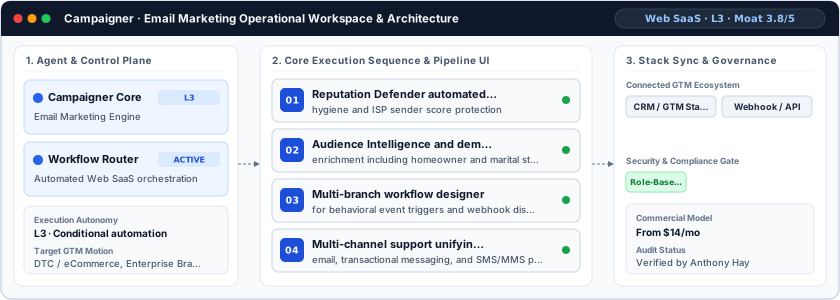
- Reputation Defender automated list: hygiene and ISP sender score protection
- Audience Intelligence and demographic: enrichment including homeowner and marital status data
- Multi-branch workflow designer: for behavioral event triggers and webhook dispatch
- Multi-channel support unifying promotional: email, transactional messaging, and SMS/MMS pipelines
Cons: operational limitations & risks
- Audience Enrichment Coverage: Third-party demographic enrichment for homeowner and marital status records is predominantly North American, creating sparse profile coverage for international subscriber databases.
- Webhook Latency Under Load: High-concurrency webhook ingestion can encounter processing queues during burst promotional events, introducing slight delays into transactional sequence handoffs.
- Relational Data Modeling: The internal data model relies primarily on flat list attributes rather than complex multi-table relational schemas, requiring ETL preparation for nested catalog data.
Campaigner TCO & deal-breaker stress test
Simulate 12-month stepped TCO, hidden cost multipliers, contract lock-in exposure, and stack failure modes using only facts verified by Anthony Hay on · Capture SHA 25e01918.
Campaigner aligns with your 5-seat / $800/mo profile. Review the walk-away triggers and contract levers below before deployment.
| Plan / Tier | Verified Rate | Scale Fit | Scope & Quota Notes |
|---|---|---|---|
| Essentials | $14/mo | 1–2 seats | Verified $14/mo tier from vendor pricing schedule. |
| Free | $35/mo | 5 seats | Verified $35/mo tier from vendor pricing schedule. |
- Moat Score
- 3.8 / 5.0
- AI Autonomy
- L3
- Free Tier / Trial
- None disclosed
Triggered audit signals & failure modes
- Published Self-Serve Entry FloorVerified Pricing Ledger
Campaigner publishes a transparent entry point (From $14/mo) for initial validation before committing.
- Tier Fit for 5-Seat Scale: Free ($35/mo)Verified Tier Schedule
Verified $35/mo tier from vendor pricing schedule.
- Primary Operational Bottleneck: Audience Enrichment CoverageAudit by Anthony Hay
Third-party demographic enrichment for homeowner and marital status records is predominantly North American, creating sparse profile coverage for international subscriber databases.
Hidden TCO Multipliers & Quota Gates
- Profile / Workspace Quota Ceilings: Base tiers cap the number of connected profiles, workspaces, or contact records, forcing tier upgrades before seat limits are reached.
- Enterprise Governance & Add-On Gating: Advanced capabilities such as Single Sign-On (SSO), custom role permissions, or specialized analytics modules are gated behind upper tiers or paid add-ons.
When to Walk Away & Negotiation Levers
- Walk away if your workflow requires uncapped enterprise volume on the From $14/mo entry plan without upgrading tiers.
- Walk away if your workflow cannot tolerate audience enrichment coverage: Third-party demographic enrichment for homeowner and marital status records is predominantly North American, creating sparse profile coverage for international subscriber databases.
- Walk away if webhook latency under load is a deal-breaker for your team: High-concurrency webhook ingestion can encounter processing queues during burst promotional events, introducing slight delays into transactional sequence handoffs.
- Validate exact quota thresholds (seats, credits, or API calls) included in Campaigner's From $14/mo tier before converting from monthly to annual billing.
- Require a sandbox proof-of-concept testing audience enrichment coverage against your live CRM/data schema before annual sign-off.
Ask a custom procurement or TCO stress-test question about Campaigner
Lower 5-seat floor (~$15/mo vs. $35 / mo)
Verified Email Marketing peer (Custom / enterprise pricing · Moat 4.2/5.0)
Campaigner moat & subtrack positioning
Proprietary Reputation Defender list monitoring algorithms coupled with legacy MTA relay relationships and granular demographic targeting data.
Editorial review
Fact-checked by Anthony Hay (Senior SEO, Search Intelligence & Content Operations Editor) on .
Background
Established in 1999 in Ottawa, Ontario, Campaigner operates as an email marketing and lifecycle automation platform within enterprise messaging ecosystems. Engineered for digital marketing managers, retention teams, and mid-market commercial publishers, the service provides advanced campaign orchestration without requiring complex enterprise suite footprints. Positioned in the AI Email Marketing and Lifecycle Journeys category, it centralizes list hygiene, demographic profiling, and high-volume dispatch.
How Campaigner works
Campaigner combines a visual event-triggered workflow engine with high-throughput cloud SMTP relay infrastructure. Ingestion pipelines ingest subscriber interactions, e-commerce purchases, and REST API webhooks to drive conditional routing through L3 autonomous messaging branches. The stack integrates proprietary Reputation Defender algorithms to evaluate contact hygiene before dispatch, alongside an Audience Intelligence engine that enriches customer schemas with demographic attributes such as marital status and homeownership.
Limitations
Operational considerations and platform boundaries include:
- Audience Enrichment Coverage: Third-party demographic enrichment for homeowner and marital status records is predominantly North American, creating sparse profile coverage for international subscriber databases.
- Webhook Latency Under Load: High-concurrency webhook ingestion can encounter processing queues during burst promotional events, introducing slight delays into transactional sequence handoffs.
- Relational Data Modeling: The internal data model relies primarily on flat list attributes rather than complex multi-table relational schemas, requiring ETL preparation for nested catalog data.
Campaigner pricing
Campaigner operates on a tiered monthly subscription based on subscriber volume and platform capabilities. Pricing begins from $14/month for the Essentials tier supporting baseline automations. The Advanced tier is priced at $35/month, unlocking expanded multi-channel routing, advanced automation branching, and extended testing modules. High-volume senders requiring custom sending pools, dedicated account management, or bespoke API throughput negotiate custom enterprise contracts through direct sales engagements.
How Campaigner compares
Within the lifecycle journey sector, Campaigner benchmarks against platforms like Ability.ai, AB Tasty, and 10Web AI. Unlike AB Tasty, which concentrates primarily on client-side visual testing and personalization, Campaigner focuses on message dispatch governance and inbox placement. While Ability.ai emphasizes algorithmic campaign synthesis, Campaigner prioritizes deterministic deliverability protocols and outbound multi-channel pipelines. The platform fits mid-market commerce teams needing dependable inbox delivery and enriched audience data without enterprise overhead.
Frequently asked questions about Campaigner
How much does Campaigner cost and what pricing tiers are available?
Published pricing summary for Campaigner: From $14/mo. A permanent free plan is not disclosed for Campaigner. Verified tier schedule: Essentials ($14/mo for 1–2 seats); Free ($35/mo for 5 seats). Campaigner operates on a tiered monthly subscription based on subscriber volume and platform capabilities. Pricing begins from $14/month for the Essentials tier supporting baseline automations.
How does Campaigner work and how autonomous is its AI architecture?
Cloud-based email marketing and workflow automation suite offering deliverability protection, demographic audience insights, and multi-channel campaign. Within Email Marketing (AI Email Marketing & Lifecycle Journeys), MarTechRadar rates its execution architecture at L3 · Conditional automation with a verified Moat Score of 3.8 / 5.0 (Proprietary moat). Proprietary Reputation Defender list monitoring algorithms coupled with legacy MTA relay relationships and granular demographic targeting data. Corporate profile: operating at 51-200 employees scale.
What are the main limitations of Campaigner and when should buyers walk away?
Based on our editorial technical audit, key operational considerations and boundaries for Campaigner include: (1) Audience Enrichment Coverage: Third-party demographic enrichment for homeowner and marital status records is predominantly North American, creating sparse profile coverage for international subscriber databases. (2) Webhook Latency Under Load: High-concurrency webhook ingestion can encounter processing queues during burst promotional events, introducing slight delays into transactional sequence handoffs. (3) Relational Data Modeling: The internal data model relies primarily on flat list attributes rather than complex multi-table relational schemas, requiring ETL preparation for nested catalog data. Primary procurement walk-away rule: Walk away if your workflow requires uncapped enterprise volume on the From $14/mo entry plan without upgrading tiers.
What integrations, compliance certifications, and contract terms apply to Campaigner?
First-party governance and developer endpoints verified on domain include: Trust/Security (https://www.campaigner.com/trust-center), Status (https://status.campaigner.com). Key TCO multiplier to watch: Profile / Workspace Quota Ceilings (Base tiers cap the number of connected profiles, workspaces, or contact records, forcing tier upgrades before seat limits are reached.) Before signing a contract, procurement teams should validate exact quota thresholds (seats, credits, or API calls) included in Campaigner's From $14/mo tier before converting from monthly to annual billing.
What are the best Campaigner alternatives and head-to-head competitors in 2026?
Top fact-checked alternatives to Campaigner in Email Marketing (AI Email Marketing & Lifecycle Journeys) include AB Tasty (Custom / enterprise pricing), 10Web AI (Custom / enterprise pricing), Blee (Custom / enterprise pricing), brand.ai (Custom / enterprise pricing). Within the lifecycle journey sector, Campaigner benchmarks against platforms like Ability.ai, AB Tasty, and 10Web AI. Unlike AB Tasty, which concentrates primarily on client-side visual testing and personalization, Campaigner focuses on message dispatch governance and inbox placement.
Verified sources & evidence trail
- Official product domain: https://campaigner.com
- Commercial pricing verification: https://www.campaigner.com/pricing/?utm_content=p2k
- Verified corporate entity profiles (
sameAs): LinkedIn Company Profile - First-party governance & documentation links: Trust & Security · System Status · Privacy
- Editorial audit sign-off: Fact-checked by Anthony Hay on under the MarTechRadar Evidence-Ledger Protocol.