Cluster Review (2026): AI SDR Pricing, Limits & Alternatives
Bottom line
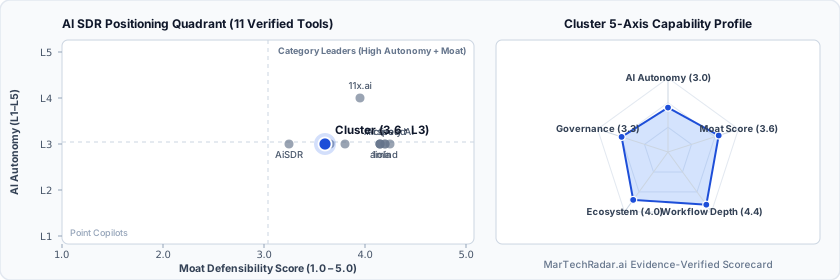
Cluster is a Web SaaS tool for AI SDR (Autonomous B2B Sales Agents & AI BDRs) in AI SDR & Outbound. Pricing: Custom / enterprise pricing. Best suited to B2B Sales Leaders, SDR/BDR Teams and Revenue Operations (RevOps). Editor ratings: AI autonomy L3 (conditional automation); moat score 3.6/5.0 (Proprietary moat). Fact-checked by Jagmeet Sine on Oct 14, 2026.
Go-to-market infrastructure platform providing autonomous sales agents with aggregated access to 50+ data providers and real-time buyer intent signals.
Cluster buyer fit verdict: when to choose vs. when to walk away
Choose Cluster if (Best Fit)
- Target ICP & Stack Fit: You operate as B2B Sales Leaders, SDR/BDR Teams and Revenue Operations (RevOps) requiring a Web SaaS deployment for AI SDR, with verified ecosystem connectivity for Salesforce, Outreach.
- L3 Architecture & Defensibility: Consolidated aggregation layer that normalizes schemas across 50+ distinct sales intelligence and hiring data sources into a low-latency execution layer for agentic prospecting workflows.
- Commercial Model Fit: Your procurement budget aligns with Custom / enterprise pricing.
Walk away from Cluster if (Deal-Breakers)
- Walk away if you require transparent self-serve monthly billing or your budget ceiling is under $1,000/mo (Cluster requires sales-gated custom quoting).
- Walk away if your workflow cannot tolerate upstream schema volatility: Aggregating 50+ external data providers exposes execution pipelines to sudden vendor API alterations and field-mapping drift that require ongoing administrative revalidation.
- Walk away if signal latency & false positives is a deal-breaker for your team: Public job listing updates and corporate triggers can suffer from indexing delays or generate low-relevance intent signals that trigger misdirected outbound outreach.
Cluster key facts & scorecard
| Pricing | Custom / enterprise pricing |
|---|---|
| Free plan | No / not disclosed |
| Delivery | Web SaaS |
| Audience | B2B Sales Leaders, SDR/BDR Teams, Revenue Operations (RevOps) |
| AI autonomy level | L3 · Conditional automationEditor-verified |
| Moat tier & score | 3.6 / 5.0 · Proprietary moatEditor-verified |
| Funding | Pre-seed |
| Company size | 2-10 employees |
| Ecosystem integrations | Salesforce, Outreach |
| Governance & docs | Terms ↗ · Privacy ↗ |
| Headquarters | New York, NY |
| Founded | 2026 |
| Last verified |
Cluster pros & cons: strengths vs. operational limitations
Pros: core strengths & capabilities
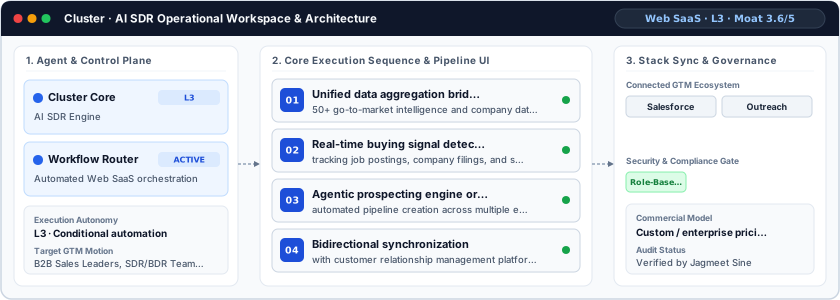
- Unified data aggregation bridging: 50+ go-to-market intelligence and company data providers
- Real-time buying signal detection: tracking job postings, company filings, and social activity
- Agentic prospecting engine orchestrating: automated pipeline creation across multiple endpoints
- Bidirectional synchronization: with customer relationship management platforms including Salesforce
Cons: operational limitations & risks
- Upstream Schema Volatility: Aggregating 50+ external data providers exposes execution pipelines to sudden vendor API alterations and field-mapping drift that require ongoing administrative revalidation.
- Signal Latency & False Positives: Public job listing updates and corporate triggers can suffer from indexing delays or generate low-relevance intent signals that trigger misdirected outbound outreach.
- Outbound Channel Rate Throttling: Operating high-velocity agentic outbound workflows across external mailboxes and social networks risks platform-level domain burning without strict send-volume throttling policies.
Cluster TCO & deal-breaker stress test
Simulate 12-month stepped TCO, hidden cost multipliers, contract lock-in exposure, and stack failure modes using only facts verified by Jagmeet Sine on · Capture SHA 9b617505.
Cluster triggers high-severity friction under your 5-seat / $800/mo constraints. Benchmark the verified subtrack alternatives below before committing.
| Plan / Tier | Verified Rate | Scale Fit | Scope & Quota Notes |
|---|---|---|---|
| Enterprise / Custom | Custom quote | 15–50+ seats (Enterprise SLA) | Sales-negotiated annual contract for custom volume, SSO/RBAC governance, and dedicated SLA. |
- Moat Score
- 3.6 / 5.0
- AI Autonomy
- L3
- Free Tier / Trial
- None disclosed
Triggered audit signals & failure modes
- Opaque Enterprise Quoting vs. SMB/Mid-Market BudgetVerified Pricing Ledger
Cluster does not disclose a public self-serve floor (Custom / enterprise pricing). Buyers with a $800/mo cap face high sales-qualification friction.
- Sales-Gated Contract TermsFact-checked by Jagmeet Sine
Commercial procurement for Cluster operates under custom enterprise pricing models accessible by consulting the vendor sales team.
- Primary Operational Bottleneck: Upstream Schema VolatilityAudit by Jagmeet Sine
Aggregating 50+ external data providers exposes execution pipelines to sudden vendor API alterations and field-mapping drift that require ongoing administrative revalidation.
Hidden TCO Multipliers & Quota Gates
- Credit & Usage Burn Multiplier: Automated workflows consume metered credits/usage quotas; multi-step enrichment, voice minutes, or high-frequency agent runs can trigger mid-cycle top-up packs.
- Upstream Schema Volatility: Aggregating 50+ external data providers exposes execution pipelines to sudden vendor API alterations and field-mapping drift that require ongoing administrative revalidation.
- Signal Latency & False Positives: Public job listing updates and corporate triggers can suffer from indexing delays or generate low-relevance intent signals that trigger misdirected outbound outreach.
When to Walk Away & Negotiation Levers
- Walk away if you require transparent self-serve monthly billing or your budget ceiling is under $1,000/mo (Cluster requires sales-gated custom quoting).
- Walk away if your workflow cannot tolerate upstream schema volatility: Aggregating 50+ external data providers exposes execution pipelines to sudden vendor API alterations and field-mapping drift that require ongoing administrative revalidation.
- Walk away if signal latency & false positives is a deal-breaker for your team: Public job listing updates and corporate triggers can suffer from indexing delays or generate low-relevance intent signals that trigger misdirected outbound outreach.
- Demand a 30- to 60-day paid pilot opt-out clause in the Cluster order form before signing a 12-month enterprise commitment.
- Require a sandbox proof-of-concept testing upstream schema volatility against your live CRM/data schema before annual sign-off.
Ask a custom procurement or TCO stress-test question about Cluster
Lower 5-seat floor (~$125/mo vs. Custom Quote) · Transparent self-serve entry without mandatory annual lock-in
Verified AI SDR peer (Custom / enterprise pricing · Moat 4.3/5.0)
Cluster key entities, modules & ecosystem stack
Cluster moat & subtrack positioning
Consolidated aggregation layer that normalizes schemas across 50+ distinct sales intelligence and hiring data sources into a low-latency execution layer for agentic prospecting workflows.
Editorial review
Fact-checked by Jagmeet Sine (Senior MarTech Infrastructure & Agentic Workflow Architect) on .
Background
Architected as a dedicated execution layer for autonomous pipeline generation, Cluster decouples agent logic from fragmented data vendors. Established in 2026 in New York, NY, the platform targets enterprise revenue operations leaders and sales development heads who need to supply artificial intelligence sales agents with high-integrity data. Rather than requiring teams to stitch together disjointed enrichment APIs, the system provides a unified interface connecting agent decision loops to real-time company signals and prospect communication channels.
How Cluster works
Cluster operates as an asynchronous coordination engine that continuously ingests account signals from sources like Greenhouse job boards, Crunchbase records, and social updates. When a target trigger fires, the internal scheduler passes account metadata through a normalized multi-vendor enrichment waterfall. The engine parses the resulting profile data, matches decision-maker personas, and directs automated prospecting agents to construct personalized outreach sequences across email and social channels while maintaining bidirectional sync with systems like Salesforce.
Limitations
Operational considerations and platform boundaries include:
- Upstream Schema Volatility: Aggregating 50+ external data providers exposes execution pipelines to sudden vendor API alterations and field-mapping drift that require ongoing administrative revalidation.
- Signal Latency & False Positives: Public job listing updates and corporate triggers can suffer from indexing delays or generate low-relevance intent signals that trigger misdirected outbound outreach.
- Outbound Channel Rate Throttling: Operating high-velocity agentic outbound workflows across external mailboxes and social networks risks platform-level domain burning without strict send-volume throttling policies.
Cluster pricing
Commercial procurement for Cluster operates under custom enterprise pricing models accessible by consulting the vendor sales team. Contract commitments are structured via tailored commercial agreements aligned with organizational seat counts, connected agent instances, and data consumption volume across the underlying integration network.Prospective customers can evaluate platform mechanics through structured pilot arrangements prior to committing to long-term commercial software agreements.
How Cluster compares
In contrast to end-to-end synthetic worker solutions like 11x.ai or structured virtual representative tooling such as 1mind and Actively AI, Cluster focuses on providing the underlying data aggregation and trigger infrastructure rather than functioning merely as an out-of-the-box digital persona. This architecture fits mid-market and enterprise organizations running custom agent workflows that demand deep data federation across multiple intelligence providers over rigid, turn-key automation apps.
Frequently asked questions about Cluster
How much does Cluster cost and does it require a custom enterprise quote?
Published pricing summary for Cluster: Custom / enterprise pricing. A permanent free plan is not disclosed for Cluster. Commercial procurement for Cluster operates under custom enterprise pricing models accessible by consulting the vendor sales team.
How does Cluster work and how autonomous is its AI architecture?
Go-to-market infrastructure platform providing autonomous sales agents with aggregated access to 50+ data providers and real-time buyer intent signals. Within AI SDR (Autonomous B2B Sales Agents & AI BDRs), MarTechRadar rates its execution architecture at L3 · Conditional automation with a verified Moat Score of 3.6 / 5.0 (Proprietary moat). Consolidated aggregation layer that normalizes schemas across 50+ distinct sales intelligence and hiring data sources into a low-latency execution layer for agentic prospecting workflows. Corporate profile: operating at 2-10 employees scale.
What are the main limitations of Cluster and when should buyers walk away?
Based on our editorial technical audit, key operational considerations and boundaries for Cluster include: (1) Upstream Schema Volatility: Aggregating 50+ external data providers exposes execution pipelines to sudden vendor API alterations and field-mapping drift that require ongoing administrative revalidation. (2) Signal Latency & False Positives: Public job listing updates and corporate triggers can suffer from indexing delays or generate low-relevance intent signals that trigger misdirected outbound outreach. (3) Outbound Channel Rate Throttling: Operating high-velocity agentic outbound workflows across external mailboxes and social networks risks platform-level domain burning without strict send-volume throttling policies. Primary procurement walk-away rule: Walk away if you require transparent self-serve monthly billing or your budget ceiling is under $1,000/mo (Cluster requires sales-gated custom quoting).
What integrations, compliance certifications, and contract terms apply to Cluster?
Verified ecosystem and stack integrations include Salesforce, Outreach. Key TCO multiplier to watch: Credit & Usage Burn Multiplier (Automated workflows consume metered credits/usage quotas; multi-step enrichment, voice minutes, or high-frequency agent runs can trigger mid-cycle top-up packs.) Before signing a contract, procurement teams should demand a 30- to 60-day paid pilot opt-out clause in the Cluster order form before signing a 12-month enterprise commitment.
What are the best Cluster alternatives and head-to-head competitors in 2026?
Top fact-checked alternatives to Cluster in AI SDR (Autonomous B2B Sales Agents & AI BDRs) include Coffee (From $25/seat/mo · Enterprise plan), Confido (Custom / enterprise pricing), Chert (Custom / enterprise pricing), Gravitas.io (Custom / enterprise pricing). In contrast to end-to-end synthetic worker solutions like 11x.ai or structured virtual representative tooling such as 1mind and Actively AI, Cluster focuses on providing the underlying data aggregation and trigger infrastructure rather than functioning merely as an out-of-the-box digital persona.
Verified sources & evidence trail
- Official product domain: https://getcluster.ai
- Commercial pricing verification: Verified against official vendor pricing policy (Custom / enterprise pricing)
- Verified corporate entity profiles (
sameAs): LinkedIn Company Profile · Crunchbase Entity Record - First-party governance & documentation links: Terms · Privacy
- Editorial audit sign-off: Fact-checked by Jagmeet Sine on under the MarTechRadar Evidence-Ledger Protocol.