CommerceIQ Review (2026): Product Feed Management Pricing, Limits & Alternatives
Bottom line
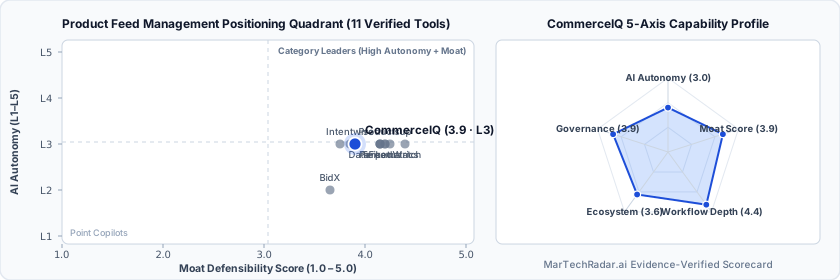
CommerceIQ is a SaaS Platform tool for Product Feed Management (Retail Media & Product Feed Management) in AdTech & Paid Media. Pricing: Pricing not disclosed. Best suited to B2B Marketing & GTM Teams. Editor ratings: AI autonomy L3 (conditional automation); moat score 3.9/5.0 (Proprietary moat). Fact-checked by Jiacky Lee on Oct 18, 2026.
AI-powered retail operating platform uniting retail media bid automation, digital shelf analytics, and omnichannel content optimization.
CommerceIQ buyer fit verdict: when to choose vs. when to walk away
Choose CommerceIQ if (Best Fit)
- Target ICP & Stack Fit: You operate as B2B Marketing & GTM Teams requiring a SaaS Platform deployment for Product Feed Management, with verified ecosystem connectivity for Shopify.
- L3 Architecture & Defensibility: CommerceIQ commands a deep enterprise moat through its Ally AI agentic retail operating architecture that connects digital shelf telemetry, supply chain stock depth, and automated retail media bidding across 1,450+ retailers.
- Commercial Model Fit: Your procurement budget aligns with Pricing not disclosed.
Walk away from CommerceIQ if (Deal-Breakers)
- Walk away if you require transparent self-serve monthly billing or your budget ceiling is under $1,000/mo (CommerceIQ requires sales-gated custom quoting).
- Walk away if your workflow cannot tolerate enterprise brand minimum barrier: CommerceIQ is engineered for large multi-brand CPG manufacturers managing complex retail operations across Amazon Vendor Central, Walmart Luminate, and global grocers, making it overly heavy and cost-prohibitive for small direct-to-consumer (DTC) Shopify merchants.
- Walk away if retailer API latency bottleneck is a deal-breaker for your team: While Amazon and Walmart provide granular real-time advertising and inventory APIs, regional grocery and international retail media networks often exhibit delayed reporting or restricted bid-automation endpoints, limiting autonomous execution speed on secondary channels.
CommerceIQ key facts & scorecard
| Pricing | Pricing not disclosed |
|---|---|
| Free plan | No / not disclosed |
| Delivery | SaaS Platform |
| Audience | B2B Marketing & GTM Teams |
| AI autonomy level | L3 · Conditional automationEditor-verified |
| Moat tier & score | 3.9 / 5.0 · Proprietary moatEditor-verified |
| Funding | Series C+ |
| Total funding | $195.5MBacked by Insight Partners, Madrona, SoftBank Vision Fund, Shasta Ventures, Trinity Ventures |
| Founders | Guru Hariharan |
| Company size | 201-500 employees |
| Ecosystem integrations | Shopify |
| Governance & docs | Privacy ↗ |
| Headquarters | Mountain View, California, United States |
| Founded | 2012 |
| Last verified |
CommerceIQ pros & cons: strengths vs. operational limitations
Pros: core strengths & capabilities
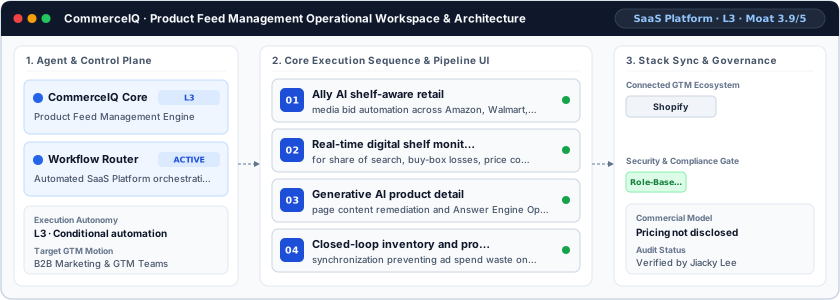
- Ally AI shelf-aware retail: media bid automation across Amazon, Walmart, Instacart, Best Buy, and Criteo
- Real-time digital shelf monitoring: for share of search, buy-box losses, price competitiveness, and SKU suppression
- Generative AI product detail: page content remediation and Answer Engine Optimization (AEO) readiness audits
- Closed-loop inventory and profitability: synchronization preventing ad spend waste on out-of-stock SKUs
Cons: operational limitations & risks
- Enterprise Brand Minimum Barrier: CommerceIQ is engineered for large multi-brand CPG manufacturers managing complex retail operations across Amazon Vendor Central, Walmart Luminate, and global grocers, making it overly heavy and cost-prohibitive for small direct-to-consumer (DTC) Shopify merchants.
- Retailer API Latency Bottleneck: While Amazon and Walmart provide granular real-time advertising and inventory APIs, regional grocery and international retail media networks often exhibit delayed reporting or restricted bid-automation endpoints, limiting autonomous execution speed on secondary channels.
- Cross-Functional Governance Learning Curve: Because Ally AI links retail media budgets directly to supply chain forecasting and digital shelf merchandising, organizations must align historically separate e-commerce sales, supply chain, and paid media teams around shared KPIs.
CommerceIQ TCO & deal-breaker stress test
Simulate 12-month stepped TCO, hidden cost multipliers, contract lock-in exposure, and stack failure modes using only facts verified by Jiacky Lee on · Capture SHA 90535b31.
CommerceIQ triggers high-severity friction under your 5-seat / $800/mo constraints. Benchmark the verified subtrack alternatives below before committing.
| Plan / Tier | Verified Rate | Scale Fit | Scope & Quota Notes |
|---|---|---|---|
| Enterprise / Custom | Custom quote | 15–50+ seats (Enterprise SLA) | Sales-negotiated annual contract for custom volume, SSO/RBAC governance, and dedicated SLA. |
- Moat Score
- 3.9 / 5.0
- AI Autonomy
- L3
- Free Tier / Trial
- None disclosed
Triggered audit signals & failure modes
- Opaque Enterprise Quoting vs. SMB/Mid-Market BudgetVerified Pricing Ledger
CommerceIQ does not disclose a public self-serve floor (Pricing not disclosed). Buyers with a $800/mo cap face high sales-qualification friction.
- Sales-Gated Contract TermsFact-checked by Jiacky Lee
CommerceIQ operates exclusively on a custom enterprise subscription model with pricing available on request.
- Primary Operational Bottleneck: Enterprise Brand Minimum BarrierAudit by Jiacky Lee
CommerceIQ is engineered for large multi-brand CPG manufacturers managing complex retail operations across Amazon Vendor Central, Walmart Luminate, and global grocers, making it overly heavy and cost-prohibitive for small direct-to-consumer (DTC) Shopify merchants.
Hidden TCO Multipliers & Quota Gates
- Enterprise Brand Minimum Barrier: CommerceIQ is engineered for large multi-brand CPG manufacturers managing complex retail operations across Amazon Vendor Central, Walmart Luminate, and global grocers, making it overly heavy and cost-prohibitive for small direct-to-consumer (DTC) Shopify merchants.
- Retailer API Latency Bottleneck: While Amazon and Walmart provide granular real-time advertising and inventory APIs, regional grocery and international retail media networks often exhibit delayed reporting or restricted bid-automation endpoints, limiting autonomous execution speed on secondary channels.
When to Walk Away & Negotiation Levers
- Walk away if you require transparent self-serve monthly billing or your budget ceiling is under $1,000/mo (CommerceIQ requires sales-gated custom quoting).
- Walk away if your workflow cannot tolerate enterprise brand minimum barrier: CommerceIQ is engineered for large multi-brand CPG manufacturers managing complex retail operations across Amazon Vendor Central, Walmart Luminate, and global grocers, making it overly heavy and cost-prohibitive for small direct-to-consumer (DTC) Shopify merchants.
- Walk away if retailer API latency bottleneck is a deal-breaker for your team: While Amazon and Walmart provide granular real-time advertising and inventory APIs, regional grocery and international retail media networks often exhibit delayed reporting or restricted bid-automation endpoints, limiting autonomous execution speed on secondary channels.
- Demand a 30- to 60-day paid pilot opt-out clause in the CommerceIQ order form before signing a 12-month enterprise commitment.
- Require a sandbox proof-of-concept testing enterprise brand minimum barrier against your live CRM/data schema before annual sign-off.
Ask a custom procurement or TCO stress-test question about CommerceIQ
Lower 5-seat floor (~$64/mo vs. Custom Quote) · Transparent self-serve entry without mandatory annual lock-in
Lower 5-seat floor (~$695/mo vs. Custom Quote) · Transparent self-serve entry without mandatory annual lock-in
CommerceIQ key entities, modules & ecosystem stack
CommerceIQ moat & subtrack positioning
CommerceIQ commands a deep enterprise moat through its Ally AI agentic retail operating architecture that connects digital shelf telemetry, supply chain stock depth, and automated retail media bidding across 1,450+ retailers.
Editorial review
Fact-checked by Jiacky Lee (Managing Editor, AI Autonomy & Moat Methodology) on .
Background
Founded in 2012 by Guru Hariharan and headquartered in Mountain View, California, United States, CommerceIQ (commerceiq.ai) is an enterprise AI retail operating platform designed for global consumer packaged goods (CPG) and consumer brand manufacturers. Operating with a team of 201-500 employees and backed by $195.5M in Series D funding from Insight Partners, Madrona, SoftBank Vision Fund, Shasta Ventures, and Trinity Ventures, the company unifies retail media management, digital shelf analytics, and supply chain intelligence across more than 1,450 global online retailers. Rather than managing paid retail media bids in a silo while inventory stockouts, buy-box losses, or suppressed product detail pages quietly erode return on ad spend (ROAS), CommerceIQ connects inventory health, shelf visibility, and algorithmic bidding inside a single closed-loop system.
How CommerceIQ works
CommerceIQ operates at Level 3 autonomy through its Ally AI agentic architecture, which orchestrates data across retail media networks, digital shelf telemetry, and sales operations. The platform continuously monitors SKU-level stock availability, share of search, price competitiveness, review sentiment, and content compliance across major marketplaces and omnichannel retailers including Amazon, Walmart, Instacart, Best Buy, and Criteo-powered networks. When Ally AI detects an imminent out-of-stock event or buy-box suppression, it automatically throttles sponsored product bids for the affected SKU and reallocates ad budget toward high-margin, in-stock substitutes with strong conversion velocity. Simultaneously, its generative content optimization module audits product detail pages for Answer Engine Optimization (AEO) readiness and retailer style-guide compliance, generating localized copy and attribute updates to recover lost organic and paid shelf share.
Limitations
Operational limitations and technical trade-offs include:
- Enterprise Brand Minimum Barrier: CommerceIQ is engineered for large multi-brand CPG manufacturers managing complex retail operations across Amazon Vendor Central, Walmart Luminate, and global grocers, making it overly heavy and cost-prohibitive for small direct-to-consumer (DTC) Shopify merchants.
- Retailer API Latency Bottleneck: While Amazon and Walmart provide granular real-time advertising and inventory APIs, regional grocery and international retail media networks often exhibit delayed reporting or restricted bid-automation endpoints, limiting autonomous execution speed on secondary channels.
- Cross-Functional Governance Learning Curve: Because Ally AI links retail media budgets directly to supply chain forecasting and digital shelf merchandising, organizations must align historically separate e-commerce sales, supply chain, and paid media teams around shared KPIs.
CommerceIQ pricing
CommerceIQ operates exclusively on a custom enterprise subscription model with pricing available on request. Contracts are tailored to a manufacturer's gross merchandise value (GMV) tracked on the platform, total managed retail media spend, number of active retail banners and countries monitored, and selected modular suites (Retail Media Management, Digital Shelf Analytics, and Sales & Operations). Prospective enterprise brands engage CommerceIQ's commercial team for a custom diagnostic audit and annual licensing proposal.
How CommerceIQ compares
Within the Retail Media & Product Feed Management category, CommerceIQ competes against enterprise retail media and omnichannel commerce platforms such as Pacvue, Skai, and Flywheel Digital. Versus standalone retail media bid managers that optimize ad campaigns solely on click and conversion signals without visibility into wholesale inventory or supply chain constraints, CommerceIQ differentiates itself through its shelf-aware Ally AI architecture that synchronizes ad bidding with real-time stock depth, buy-box ownership, and profitability metrics. Compared to traditional syndication-only tools, CommerceIQ delivers closed-loop execution spanning content remediation, digital shelf monitoring, and automated media buying across 1,450+ retail channels.
Frequently asked questions about CommerceIQ
How much does CommerceIQ cost and does it require a custom enterprise quote?
Published pricing summary for CommerceIQ: Pricing not disclosed. A permanent free plan is not disclosed for CommerceIQ. CommerceIQ operates exclusively on a custom enterprise subscription model with pricing available on request.
How does CommerceIQ work and how autonomous is its AI architecture?
AI-powered retail operating platform uniting retail media bid automation, digital shelf analytics, and omnichannel content optimization. Within Product Feed Management (Retail Media & Product Feed Management), MarTechRadar rates its execution architecture at L3 · Conditional automation with a verified Moat Score of 3.9 / 5.0 (Proprietary moat). CommerceIQ commands a deep enterprise moat through its Ally AI agentic retail operating architecture that connects digital shelf telemetry, supply chain stock depth, and automated retail media bidding across 1,450+ retailers. Corporate profile: Founded by Guru Hariharan, operating at 201-500 employees scale.
What are the main limitations of CommerceIQ and when should buyers walk away?
Based on our editorial technical audit, key operational considerations and boundaries for CommerceIQ include: (1) Enterprise Brand Minimum Barrier: CommerceIQ is engineered for large multi-brand CPG manufacturers managing complex retail operations across Amazon Vendor Central, Walmart Luminate, and global grocers, making it overly heavy and cost-prohibitive for small direct-to-consumer (DTC) Shopify merchants. (2) Retailer API Latency Bottleneck: While Amazon and Walmart provide granular real-time advertising and inventory APIs, regional grocery and international retail media networks often exhibit delayed reporting or restricted bid-automation endpoints, limiting autonomous execution speed on secondary channels. (3) Cross-Functional Governance Learning Curve: Because Ally AI links retail media budgets directly to supply chain forecasting and digital shelf merchandising, organizations must align historically separate e-commerce sales, supply chain, and paid media teams around shared KPIs. Primary procurement walk-away rule: Walk away if you require transparent self-serve monthly billing or your budget ceiling is under $1,000/mo (CommerceIQ requires sales-gated custom quoting).
What integrations, compliance certifications, and contract terms apply to CommerceIQ?
Verified ecosystem and stack integrations include Shopify. Key TCO multiplier to watch: Enterprise Brand Minimum Barrier (CommerceIQ is engineered for large multi-brand CPG manufacturers managing complex retail operations across Amazon Vendor Central, Walmart Luminate, and global grocers, making it overly heavy and cost-prohibitive for small direct-to-consumer (DTC) Shopify merchants.) Before signing a contract, procurement teams should demand a 30- to 60-day paid pilot opt-out clause in the CommerceIQ order form before signing a 12-month enterprise commitment.
What are the best CommerceIQ alternatives and head-to-head competitors in 2026?
Top fact-checked alternatives to CommerceIQ in Product Feed Management (Retail Media & Product Feed Management) include Pacvue (Custom / enterprise pricing), Flywheel Digital (Pricing not disclosed), Shopsense (Custom / enterprise pricing), Channel3 (Pricing not disclosed). Within the Retail Media & Product Feed Management category, CommerceIQ competes against enterprise retail media and omnichannel commerce platforms such as Pacvue, Skai, and Flywheel Digital.
Verified sources & evidence trail
- Official product domain: https://commerceiq.ai
- Commercial pricing verification: Verified against official vendor pricing policy (Pricing not disclosed)
- Verified corporate entity profiles (
sameAs): LinkedIn Company Profile · Crunchbase Entity Record - First-party governance & documentation links: Privacy
- Editorial audit sign-off: Fact-checked by Jiacky Lee on under the MarTechRadar Evidence-Ledger Protocol.