Datanyze Review (2026): Sales Intelligence Pricing, Limits & Alternatives
Bottom line
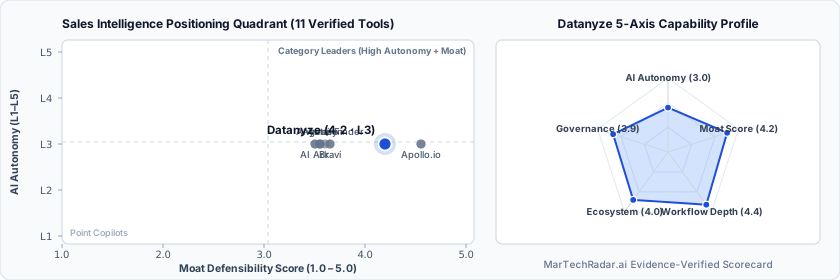
Datanyze is a Web SaaS tool for Sales Intelligence (Lead Enrichment & Waterfall Orchestration) in AI SDR & Outbound. Pricing: Free plan · $0/mo · Enterprise plan. Best suited to B2B SaaS. Editor ratings: AI autonomy L3 (conditional automation); moat score 4.2/5.0 (Proprietary moat). Fact-checked by Anthony Hay on Oct 14, 2026.
Datanyze provides technographic data and B2B contact enrichment via a lightweight browser extension and prospecting interface backed by ZoomInfo data assets.
Datanyze buyer fit verdict: when to choose vs. when to walk away
Choose Datanyze if (Best Fit)
- Target ICP & Stack Fit: You operate as B2B SaaS requiring a Web SaaS deployment for Sales Intelligence, with verified ecosystem connectivity for Apollo.io, LinkedIn.
- L3 Architecture & Defensibility: Datanyze leverages historical technographic detection IP and ZoomInfo's underlying data graph, offering an entry-level ingestion layer for sales development representatives seeking direct contact details.
- Commercial Model Fit: Your procurement budget aligns with Free plan · $0/mo · Enterprise plan and want a self-serve free tier for zero-cost initial validation.
Walk away from Datanyze if (Deal-Breakers)
- Walk away if your workflow requires uncapped enterprise volume on the Free plan · $0/mo · Enterprise plan entry plan without upgrading tiers.
- Walk away if your workflow cannot tolerate waterfall orchestration depth: The system lacks native multi-provider fallback cascading, leaving contact discovery dependent entirely on its internal database index without secondary vendor enrichment routing.
- Walk away if dom volatility is a deal-breaker for your team: Browser-based extraction mechanics face operational fragility whenever target web platforms adjust their frontend CSS classes or implement anti-scraping rate thresholds.
Datanyze key facts & scorecard
| Pricing | Free plan · $0/mo · Enterprise planVendor pricing page |
|---|---|
| Free plan | Yes |
| Delivery | Web SaaS |
| Audience | B2B SaaS |
| AI autonomy level | L3 · Conditional automationEditor-verified |
| Moat tier & score | 4.2 / 5.0 · Proprietary moatEditor-verified |
| Funding | AcquiredAcquired by ZoomInfo |
| Total funding | $1.8M |
| Founders | Ben Sardella, Ilya Semin |
| Company size | 11-50 employees |
| Ecosystem integrations | Apollo.io, LinkedIn |
| Headquarters | Durham, North Carolina |
| Founded | 2012 |
| Last verified |
Datanyze pros & cons: strengths vs. operational limitations
Pros: core strengths & capabilities
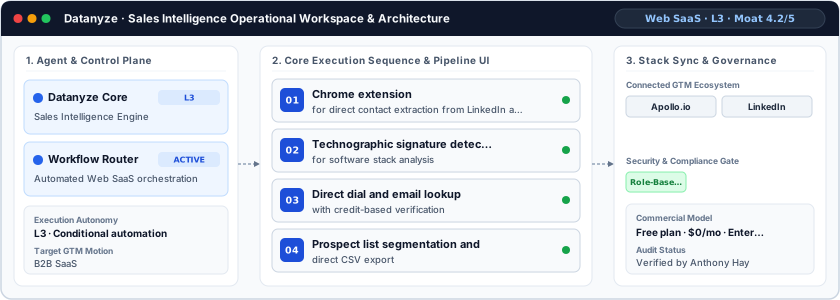
- Chrome extension: for direct contact extraction from LinkedIn and corporate websites
- Technographic signature detection: for software stack analysis
- Direct dial and email lookup: with credit-based verification
- Prospect list segmentation and: direct CSV export
Cons: operational limitations & risks
- Waterfall orchestration depth: The system lacks native multi-provider fallback cascading, leaving contact discovery dependent entirely on its internal database index without secondary vendor enrichment routing.
- DOM volatility: Browser-based extraction mechanics face operational fragility whenever target web platforms adjust their frontend CSS classes or implement anti-scraping rate thresholds.
- Pipeline synchronization: Native CRM synchronization capabilities remain rudimentary, lacking complex bidirectional schema mappings or programmatic deduplication triggers for high-volume enterprise pipelines.
Datanyze TCO & deal-breaker stress test
Simulate 12-month stepped TCO, hidden cost multipliers, contract lock-in exposure, and stack failure modes using only facts verified by Anthony Hay on · Capture SHA 99eaec22.
Datanyze is viable for 5 seats, but requires commercial or technical verification on the flagged items below.
| Plan / Tier | Verified Rate | Scale Fit | Scope & Quota Notes |
|---|---|---|---|
| Free / Sandbox | $0 | 1–2 seats (Evaluation) | Entry free tier with capped usage or feature quotas for initial workflow testing. |
| Entry / Starter | $0.24/mo | 1–2 seats | Verified $0.24/mo published rate on vendor pricing schedule. |
| Growth / Professional | $0.26/mo | 5 seats | Verified $0.26/mo published rate on vendor pricing schedule. |
| Scale / Advanced | $1/mo | 15 seats | Verified $1/mo published rate on vendor pricing schedule. |
- Moat Score
- 4.2 / 5.0
- AI Autonomy
- L3
- Free Tier / Trial
- Free plan
Triggered audit signals & failure modes
- Opaque Enterprise Quoting vs. SMB/Mid-Market BudgetVerified Pricing Ledger
Datanyze does not disclose a public self-serve floor (Free plan · $0/mo · Enterprise plan). Buyers with a $800/mo cap face high sales-qualification friction.
- Published Self-Serve Entry FloorVerified Pricing Ledger
Datanyze publishes a transparent entry point (Free plan · $0/mo · Enterprise plan) with a free tier for initial validation before committing.
- Tier Fit for 5-Seat Scale: Entry / Starter ($0.24/mo)Verified Tier Schedule
Verified $0.24/mo published rate on vendor pricing schedule.
- Primary Operational Bottleneck: Waterfall orchestration depthAudit by Anthony Hay
The system lacks native multi-provider fallback cascading, leaving contact discovery dependent entirely on its internal database index without secondary vendor enrichment routing.
Hidden TCO Multipliers & Quota Gates
- Annual Billing Headline vs. Monthly Premium: Headline entry rates reflect annual billing commitments; month-to-month flexibility carries a higher effective monthly rate or requires annual prepayment.
- Credit & Usage Burn Multiplier: Automated workflows consume metered credits/usage quotas; multi-step enrichment, voice minutes, or high-frequency agent runs can trigger mid-cycle top-up packs.
When to Walk Away & Negotiation Levers
- Walk away if your workflow requires uncapped enterprise volume on the Free plan · $0/mo · Enterprise plan entry plan without upgrading tiers.
- Walk away if your workflow cannot tolerate waterfall orchestration depth: The system lacks native multi-provider fallback cascading, leaving contact discovery dependent entirely on its internal database index without secondary vendor enrichment routing.
- Walk away if dom volatility is a deal-breaker for your team: Browser-based extraction mechanics face operational fragility whenever target web platforms adjust their frontend CSS classes or implement anti-scraping rate thresholds.
- Validate exact quota thresholds (seats, credits, or API calls) included in Datanyze's Free plan · $0/mo · Enterprise plan tier before converting from monthly to annual billing.
- Require a sandbox proof-of-concept testing waterfall orchestration depth against your live CRM/data schema before annual sign-off.
Ask a custom procurement or TCO stress-test question about Datanyze
Lower 5-seat floor (~$50/mo vs. Custom Quote)
Lower 5-seat floor (~$245/mo vs. Custom Quote)
Datanyze key entities, modules & ecosystem stack
Datanyze moat & subtrack positioning
Datanyze leverages historical technographic detection IP and ZoomInfo's underlying data graph, offering an entry-level ingestion layer for sales development representatives seeking direct contact details.
Editorial review
Fact-checked by Anthony Hay (Senior SEO, Search Intelligence & Content Operations Editor) on .
Background
Established through $1.8M in early capital prior to its acquisition by ZoomInfo, Datanyze operates from Durham, North Carolina, having been founded in 2012. Originally recognized for pioneering technographic web scraping, the platform functions today as an accessible prospecting and contact-sourcing engine. Its architecture caters primarily to individual sales development representatives, recruitment specialists, and small business operators who require verified direct dials and email addresses without deploying full-scale enterprise data orchestration stacks.
How Datanyze works
Datanyze functions at an L3 autonomy tier by pairing client-side DOM inspection through a Google Chrome extension with centralized cloud database queries. When an operator inspects a target profile on professional networks or company domains, the extension extracts metadata signatures, passing identifiers to Datanyze's resolution backend. This service queries cached entity records to return direct telephone lines, corporate email addresses, and active company technographics, decrementing user balances via an automated credit reconciliation ledger.
Limitations
Operational considerations and platform boundaries include:
- Waterfall orchestration depth: The system lacks native multi-provider fallback cascading, leaving contact discovery dependent entirely on its internal database index without secondary vendor enrichment routing.
- DOM volatility: Browser-based extraction mechanics face operational fragility whenever target web platforms adjust their frontend CSS classes or implement anti-scraping rate thresholds.
- Pipeline synchronization: Native CRM synchronization capabilities remain rudimentary, lacking complex bidirectional schema mappings or programmatic deduplication triggers for high-volume enterprise pipelines.
Datanyze pricing
Commercial access operates on a self-serve credit model centered around a free tier structured at $0 for initial evaluation credits. Scaled usage steps into paid monthly allocations, including Nyze Pro tiers priced at $21 per month and $39 per month when billed annually, which offer unit economics of approximately $0.26 and $0.24 per credit respectively. High-volume teams negotiate custom enterprise agreements for broader credit allowances.
How Datanyze compares
Datanyze focuses on single-operator prospecting, diverging technically from Apollo.io, Clay, and AI Ark. Apollo.io integrates dialers and sequences into a unified engagement suite, while Clay provides complex multi-provider waterfall orchestration across dozens of enrichment APIs. AI Ark centers around autonomous account sourcing models. Datanyze suits lean outbound teams needing fast, low-overhead contact lookups directly within the browser rather than intricate programmatic workflow graphs.
Frequently asked questions about Datanyze
How much does Datanyze cost and what pricing tiers are available?
Published pricing summary for Datanyze: Free plan · $0/mo · Enterprise plan. Datanyze includes a free tier or sandbox entry point. Verified tier schedule: Free / Sandbox ($0 for 1–2 seats (Evaluation)); Entry / Starter ($0.24/mo for 1–2 seats); Growth / Professional ($0.26/mo for 5 seats); Scale / Advanced ($1/mo for 15 seats). Commercial access operates on a self-serve credit model centered around a free tier structured at $0 for initial evaluation credits.
How does Datanyze work and how autonomous is its AI architecture?
Datanyze provides technographic data and B2B contact enrichment via a lightweight browser extension and prospecting interface backed by ZoomInfo data assets. Within Sales Intelligence (Lead Enrichment & Waterfall Orchestration), MarTechRadar rates its execution architecture at L3 · Conditional automation with a verified Moat Score of 4.2 / 5.0 (Proprietary moat). Datanyze leverages historical technographic detection IP and ZoomInfo's underlying data graph, offering an entry-level ingestion layer for sales development representatives seeking direct contact details. Corporate profile: Founded by Ben Sardella, Ilya Semin, operating at 11-50 employees scale, acquired by ZoomInfo.
What are the main limitations of Datanyze and when should buyers walk away?
Based on our editorial technical audit, key operational considerations and boundaries for Datanyze include: (1) Waterfall orchestration depth: The system lacks native multi-provider fallback cascading, leaving contact discovery dependent entirely on its internal database index without secondary vendor enrichment routing. (2) DOM volatility: Browser-based extraction mechanics face operational fragility whenever target web platforms adjust their frontend CSS classes or implement anti-scraping rate thresholds. (3) Pipeline synchronization: Native CRM synchronization capabilities remain rudimentary, lacking complex bidirectional schema mappings or programmatic deduplication triggers for high-volume enterprise pipelines. Primary procurement walk-away rule: Walk away if your workflow requires uncapped enterprise volume on the Free plan · $0/mo · Enterprise plan entry plan without upgrading tiers.
What integrations, compliance certifications, and contract terms apply to Datanyze?
Verified ecosystem and stack integrations include Apollo.io, LinkedIn. Key TCO multiplier to watch: Annual Billing Headline vs. Monthly Premium (Headline entry rates reflect annual billing commitments; month-to-month flexibility carries a higher effective monthly rate or requires annual prepayment.) Before signing a contract, procurement teams should validate exact quota thresholds (seats, credits, or API calls) included in Datanyze's Free plan · $0/mo · Enterprise plan tier before converting from monthly to annual billing.
What are the best Datanyze alternatives and head-to-head competitors in 2026?
Top fact-checked alternatives to Datanyze in Sales Intelligence (Lead Enrichment & Waterfall Orchestration) include Revspot (Custom / enterprise pricing), Bravi (Custom / enterprise pricing), Fello (From $50/mo), FINNY (Free plan · $0/mo · Enterprise plan). Datanyze focuses on single-operator prospecting, diverging technically from Apollo.io, Clay, and AI Ark. Apollo.io integrates dialers and sequences into a unified engagement suite, while Clay provides complex multi-provider waterfall orchestration across dozens of enrichment APIs.
Verified sources & evidence trail
- Official product domain: https://datanyze.com
- Commercial pricing verification: https://www.datanyze.com/pricing
- Verified corporate entity profiles (
sameAs): LinkedIn Company Profile · Crunchbase Entity Record - Editorial audit sign-off: Fact-checked by Anthony Hay on under the MarTechRadar Evidence-Ledger Protocol.