Dealfront Review (2026): ABM Pricing, Limits & Alternatives
Bottom line
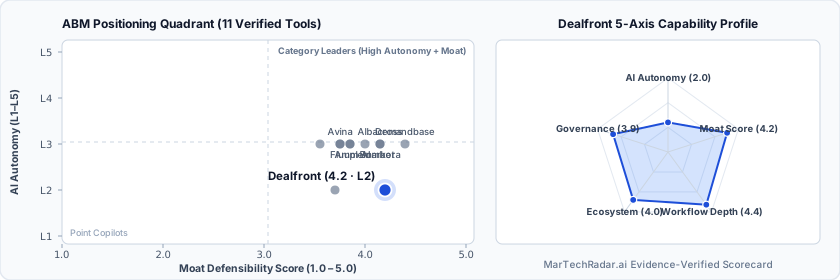
Dealfront is a Web SaaS tool for ABM (Buyer Intent Data & Account-Based Marketing) in AI SDR & Outbound. Pricing: Free plan · From €79/mo. Best suited to B2B SaaS, DTC / eCommerce and Enterprise Brands. Editor ratings: AI autonomy L2 (workflow copilot); moat score 4.2/5.0 (Proprietary moat). Fact-checked by Vasilia Xia on Oct 12, 2026.
GDPR-compliant European sales intelligence and web visitor deanonymization platform delivering B2B intent data and company discovery.
Dealfront buyer fit verdict: when to choose vs. when to walk away
Choose Dealfront if (Best Fit)
- Target ICP & Stack Fit: You operate as B2B SaaS, DTC / eCommerce and Enterprise Brands requiring a Web SaaS deployment for ABM, with verified ecosystem connectivity for Salesforce, HubSpot.
- L2 Architecture & Defensibility: Deep European business registry indexing combined with proprietary IP-to-company resolution algorithms, anchored by native compliance with European data privacy regulations.
- Commercial Model Fit: Your procurement budget aligns with Free plan · From €79/mo and want a self-serve free tier for zero-cost initial validation.
Walk away from Dealfront if (Deal-Breakers)
- Walk away if your workflow requires uncapped enterprise volume on the Free plan · From €79/mo entry plan without upgrading tiers.
- Walk away if your workflow cannot tolerate dynamic IP and remote work resolution: Deanonymization fidelity declines sharply when prospective buyers browse from residential networks or commercial VPN tunnels, yielding dropped visitor signals or false negative identity matches.
- Walk away if geographic data asymmetry is a deal-breaker for your team: While registry intelligence is granular across DACH and Nordic regions, company and contact coverage weakens significantly across North American and APAC territories compared to global aggregators.
Dealfront key facts & scorecard
| Pricing | Free plan · From €79/moVendor pricing page |
|---|---|
| Free plan | Yes |
| Delivery | Web SaaS |
| Audience | B2B SaaS, DTC / eCommerce, Enterprise Brands |
| AI autonomy level | L2 · Workflow copilotEditor-verified |
| Moat tier & score | 4.2 / 5.0 · Proprietary moatEditor-verified |
| Funding | Undisclosed |
| Total funding | €180MBacked by Great Hill Partners |
| Founders | Bastian Karweg |
| Company size | 101-250 employees |
| Ecosystem integrations | Salesforce, HubSpot |
| Governance & docs | Trust & Security ↗ · Changelog ↗ · Terms ↗ · Privacy ↗ |
| Headquarters | Karlsruhe, Germany |
| Founded | 2022 |
| Last verified |
Dealfront pros & cons: strengths vs. operational limitations
Pros: core strengths & capabilities
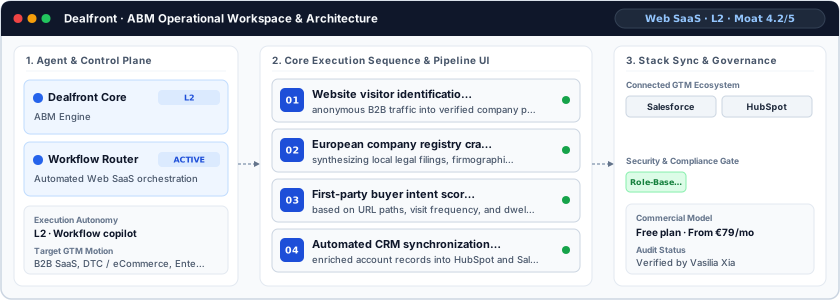
- Website visitor identification converting: anonymous B2B traffic into verified company profiles
- European company registry crawler: synthesizing local legal filings, firmographics, and financial metrics
- First-party buyer intent scoring: based on URL paths, visit frequency, and dwell times
- Automated CRM synchronization pushing: enriched account records into HubSpot and Salesforce
Cons: operational limitations & risks
- Dynamic IP and Remote Work Resolution: Deanonymization fidelity declines sharply when prospective buyers browse from residential networks or commercial VPN tunnels, yielding dropped visitor signals or false negative identity matches.
- Geographic Data Asymmetry: While registry intelligence is granular across DACH and Nordic regions, company and contact coverage weakens significantly across North American and APAC territories compared to global aggregators.
- Sync Latency and Ingestion Overhead: Bi-directional webhook synchronization with enterprise CRM instances introduces attribution latency, demanding custom field hygiene to prevent duplicate account creation during high-velocity outbound sweeps.
Dealfront TCO & deal-breaker stress test
Simulate 12-month stepped TCO, hidden cost multipliers, contract lock-in exposure, and stack failure modes using only facts verified by Vasilia Xia on · Capture SHA a93c5f8c.
Dealfront is viable for 5 seats, but requires commercial or technical verification on the flagged items below.
| Plan / Tier | Verified Rate | Scale Fit | Scope & Quota Notes |
|---|---|---|---|
| Free / Sandbox | €0 | Unlimited seats (capped credits) | Entry free tier with capped usage or feature quotas for initial workflow testing. |
| Entry / Starter | €79/mo | Unlimited seats (Entry credits) | Verified €79/mo published rate on vendor pricing schedule. |
| Growth / Professional | €369/mo | Unlimited seats (Growth credits) | Verified €369/mo published rate on vendor pricing schedule. |
| Scale / Advanced | €599/mo | Unlimited seats (Scale credits) | Verified €599/mo published rate on vendor pricing schedule. |
- Moat Score
- 4.2 / 5.0
- AI Autonomy
- L2
- Free Tier / Trial
- Free plan
Triggered audit signals & failure modes
- Opaque Enterprise Quoting vs. SMB/Mid-Market BudgetVerified Pricing Ledger
Dealfront does not disclose a public self-serve floor (Free plan · From €79/mo). Buyers with a $800/mo cap face high sales-qualification friction.
- Published Self-Serve Entry FloorVerified Pricing Ledger
Dealfront publishes a transparent entry point (Free plan · From €79/mo) with a free tier for initial validation before committing.
- Tier Fit for 5-Seat Scale: Entry / Starter (€79/mo)Verified Tier Schedule
Verified €79/mo published rate on vendor pricing schedule.
- Primary Operational Bottleneck: Dynamic IP and Remote Work ResolutionAudit by Vasilia Xia
Deanonymization fidelity declines sharply when prospective buyers browse from residential networks or commercial VPN tunnels, yielding dropped visitor signals or false negative identity matches.
Hidden TCO Multipliers & Quota Gates
- Annual Billing Headline vs. Monthly Premium: Headline entry rates reflect annual billing commitments (SAVE 30%); month-to-month flexibility carries a higher effective monthly rate or requires annual prepayment.
- Credit & Usage Burn Multiplier: Automated workflows consume metered credits/usage quotas; multi-step enrichment, voice minutes, or high-frequency agent runs can trigger mid-cycle top-up packs.
- Enterprise Governance & Add-On Gating: Advanced capabilities such as Single Sign-On (SSO), custom role permissions, or specialized analytics modules are gated behind upper tiers or paid add-ons.
When to Walk Away & Negotiation Levers
- Walk away if your workflow requires uncapped enterprise volume on the Free plan · From €79/mo entry plan without upgrading tiers.
- Walk away if your workflow cannot tolerate dynamic IP and remote work resolution: Deanonymization fidelity declines sharply when prospective buyers browse from residential networks or commercial VPN tunnels, yielding dropped visitor signals or false negative identity matches.
- Walk away if geographic data asymmetry is a deal-breaker for your team: While registry intelligence is granular across DACH and Nordic regions, company and contact coverage weakens significantly across North American and APAC territories compared to global aggregators.
- Validate exact quota thresholds (seats, credits, or API calls) included in Dealfront's Free plan · From €79/mo tier before converting from monthly to annual billing.
- Require a sandbox proof-of-concept testing dynamic IP and remote work resolution against your live CRM/data schema before annual sign-off.
Ask a custom procurement or TCO stress-test question about Dealfront
Lower 5-seat floor (~$29/mo vs. Custom Quote)
Lower 5-seat floor (~$259/mo vs. Custom Quote)
Dealfront key entities, modules & ecosystem stack
Dealfront moat & subtrack positioning
Deep European business registry indexing combined with proprietary IP-to-company resolution algorithms, anchored by native compliance with European data privacy regulations.
Editorial review
Fact-checked by Vasilia Xia (E-Commerce, Lifecycle & Retention Marketing Analyst) on .
Background
Formed in Karlsruhe, Germany, and established in 2022 via the €180M merger of Leadfeeder and Echobot backed by Great Hill Partners, Dealfront operates as an inbound web tracking and sales intelligence platform. Directed at European B2B commercial leaders, marketing operations managers, and demand generation teams, the solution addresses regional go-to-market data coverage gaps while strictly adhering to European privacy frameworks.
How Dealfront works
Operating at an L2 autonomy rating, Dealfront deploys a dual-pipeline engine. Inbound telemetry relies on a client-side JavaScript tracker that resolves raw visitor IP addresses against proprietary European business network mapping tables, stripping consumer internet service providers to reveal institutional visitors. Simultaneously, outbound enrichment pipelines crawl regional commercial registers, public trade databases, and corporate disclosures. These data streams feed directly into CRM endpoints, enriching account profiles with domain history, visit depth, and local compliance verification.
Limitations
Operational considerations and platform boundaries include:
- Dynamic IP and Remote Work Resolution: Deanonymization fidelity declines sharply when prospective buyers browse from residential networks or commercial VPN tunnels, yielding dropped visitor signals or false negative identity matches.
- Geographic Data Asymmetry: While registry intelligence is granular across DACH and Nordic regions, company and contact coverage weakens significantly across North American and APAC territories compared to global aggregators.
- Sync Latency and Ingestion Overhead: Bi-directional webhook synchronization with enterprise CRM instances introduces attribution latency, demanding custom field hygiene to prevent duplicate account creation during high-velocity outbound sweeps.
Dealfront pricing
Commercial access utilizes a tiered subscription framework initiated through a 14-day evaluation environment. An ongoing zero-cost tier captures basic telemetry, supporting up to 100 identified accounts per month across a rolling 7-day retention window. Paid production tiers start from €79/month billed on an annual cadence, scaling dynamically upward based on tracked volume quotas, enrichment credits, and extended data history access.
How Dealfront compares
Against comprehensive ABM platforms like 6sense, Dealfront lacks multi-channel ad orchestration and predictive AI pipeline modeling, but provides superior native DACH registry verification. Compared to Albacross, Dealfront delivers wider native data enrichment alongside basic IP lookup. While Amplemarket focuses on outbound cadence automation, Dealfront remains dedicated to inbound deanonymization and European compliance, making it best suited for mid-market revenue teams focused strictly on European territory penetration.
Direct competitors & market radar
Top algorithmic competitors based on category positioning, capability overlap, and ICP alignment.
Frequently asked questions about Dealfront
How much does Dealfront cost and what pricing tiers are available?
Published pricing summary for Dealfront: Free plan · From €79/mo. Dealfront includes a free tier or sandbox entry point. Verified tier schedule: Free / Sandbox (€0 for Unlimited seats (capped credits)); Entry / Starter (€79/mo for Unlimited seats (Entry credits)); Growth / Professional (€369/mo for Unlimited seats (Growth credits)); Scale / Advanced (€599/mo for Unlimited seats (Scale credits)). Commercial access utilizes a tiered subscription framework initiated through a 14-day evaluation environment. An ongoing zero-cost tier captures basic telemetry, supporting up to 100 identified accounts per month across a rolling 7-day retention window.
How does Dealfront work and how autonomous is its AI architecture?
GDPR-compliant European sales intelligence and web visitor deanonymization platform delivering B2B intent data and company discovery. Within ABM (Buyer Intent Data & Account-Based Marketing), MarTechRadar rates its execution architecture at L2 · Workflow copilot with a verified Moat Score of 4.2 / 5.0 (Proprietary moat). Deep European business registry indexing combined with proprietary IP-to-company resolution algorithms, anchored by native compliance with European data privacy regulations. Corporate profile: Founded by Bastian Karweg, operating at 101-250 employees scale.
What are the main limitations of Dealfront and when should buyers walk away?
Based on our editorial technical audit, key operational considerations and boundaries for Dealfront include: (1) Dynamic IP and Remote Work Resolution: Deanonymization fidelity declines sharply when prospective buyers browse from residential networks or commercial VPN tunnels, yielding dropped visitor signals or false negative identity matches. (2) Geographic Data Asymmetry: While registry intelligence is granular across DACH and Nordic regions, company and contact coverage weakens significantly across North American and APAC territories compared to global aggregators. (3) Sync Latency and Ingestion Overhead: Bi-directional webhook synchronization with enterprise CRM instances introduces attribution latency, demanding custom field hygiene to prevent duplicate account creation during high-velocity outbound sweeps. Primary procurement walk-away rule: Walk away if your workflow requires uncapped enterprise volume on the Free plan · From €79/mo entry plan without upgrading tiers.
What integrations, compliance certifications, and contract terms apply to Dealfront?
Verified ecosystem and stack integrations include Salesforce, HubSpot. First-party governance and developer endpoints verified on domain include: Trust/Security (https://www.leadfeeder.com/security). Key TCO multiplier to watch: Annual Billing Headline vs. Monthly Premium (Headline entry rates reflect annual billing commitments (SAVE 30%); month-to-month flexibility carries a higher effective monthly rate or requires annual prepayment.) Before signing a contract, procurement teams should validate exact quota thresholds (seats, credits, or API calls) included in Dealfront's Free plan · From €79/mo tier before converting from monthly to annual billing.
What are the best Dealfront alternatives and head-to-head competitors in 2026?
Top fact-checked alternatives to Dealfront in ABM (Buyer Intent Data & Account-Based Marketing) include Optimly AI (Free plan · $0/mo · Enterprise plan), Happenstance (Free plan · $0/mo), Trigify.io (Custom / enterprise pricing), Vector (Free plan · From $36,000/yr). Against comprehensive ABM platforms like 6sense, Dealfront lacks multi-channel ad orchestration and predictive AI pipeline modeling, but provides superior native DACH registry verification. Compared to Albacross, Dealfront delivers wider native data enrichment alongside basic IP lookup.
Verified sources & evidence trail
- Official product domain: https://dealfront.com
- Commercial pricing verification: https://www.dealfront.com/pricing/
- Verified corporate entity profiles (
sameAs): LinkedIn Company Profile · Crunchbase Entity Record - First-party governance & documentation links: Trust & Security · Changelog · Terms · Privacy
- Editorial audit sign-off: Fact-checked by Vasilia Xia on under the MarTechRadar Evidence-Ledger Protocol.