Greeter Review (2026): AI Marketing Agent Pricing, Limits & Alternatives
Bottom line
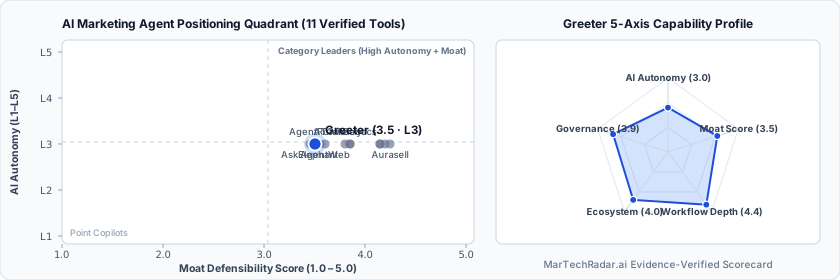
Greeter is a Web SaaS tool for AI Marketing Agent (Autonomous Marketing Agents & Digital Coworkers) in Agent & Marketing Ops. Pricing: Custom / enterprise pricing. Best suited to Growth Marketing Teams and Digital Marketing Leaders. Editor ratings: AI autonomy L3 (conditional automation); moat score 3.5/5.0 (Proprietary moat). Fact-checked by Sarah Per on Oct 10, 2026.
Autonomous customer engagement platform orchestrating automated digital storefront interactions and multi-step marketing agent workflows.
Greeter buyer fit verdict: when to choose vs. when to walk away
Choose Greeter if (Best Fit)
- Target ICP & Stack Fit: You operate as Growth Marketing Teams and Digital Marketing Leaders requiring a Web SaaS deployment for AI Marketing Agent, with verified ecosystem connectivity for Outreach, Twilio Segment.
- L3 Architecture & Defensibility: Proprietary physical-to-digital storefront conversion architecture and agent-directed workflow planning supported by institutional seed backing.
- Commercial Model Fit: Your procurement budget aligns with Custom / enterprise pricing.
Walk away from Greeter if (Deal-Breakers)
- Walk away if you require transparent self-serve monthly billing or your budget ceiling is under $1,000/mo (Greeter requires sales-gated custom quoting).
- Walk away if your workflow cannot tolerate hardware-software integration latency: Deployment timelines depend heavily on physical storefront technology provisioning, creating variable onboarding delays compared to pure cloud-hosted SaaS tools.
- Walk away if contextual drift in agent branching is a deal-breaker for your team: During non-linear customer journeys, the autonomous agent engine requires tightly bounded workflow schemas to prevent unintended message triggers across multi-location franchises.
Greeter key facts & scorecard
| Pricing | Custom / enterprise pricing |
|---|---|
| Free plan | No / not disclosed |
| Delivery | Web SaaS |
| Audience | Growth Marketing Teams, Digital Marketing Leaders |
| AI autonomy level | L3 · Conditional automationEditor-verified |
| Moat tier & score | 3.5 / 5.0 · Proprietary moatEditor-verified |
| Funding | Seed |
| Total funding | $7.8MBacked by Quiet Capital, Human Ventures, LightShed Ventures |
| Company size | 11-50 employees |
| Ecosystem integrations | Outreach, Twilio Segment |
| Governance & docs | Terms ↗ · Privacy ↗ |
| Headquarters | New York |
| Founded | 2024 |
| Last verified |
Greeter pros & cons: strengths vs. operational limitations
Pros: core strengths & capabilities
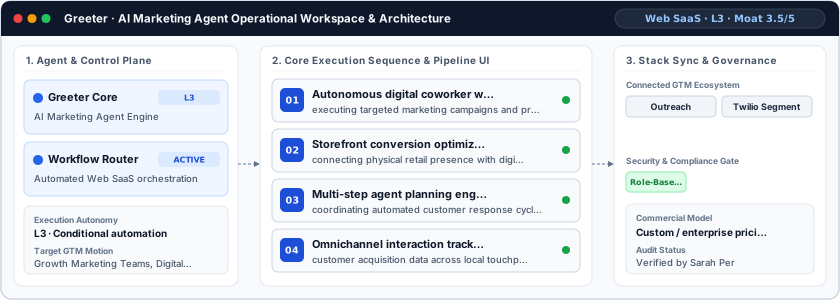
- Autonomous digital coworker workflows: executing targeted marketing campaigns and prospect touchpoints
- Storefront conversion optimization pipeline: connecting physical retail presence with digital outreach
- Multi-step agent planning engine: coordinating automated customer response cycles
- Omnichannel interaction tracking unifying: customer acquisition data across local touchpoints
Cons: operational limitations & risks
- Hardware-Software Integration Latency: Deployment timelines depend heavily on physical storefront technology provisioning, creating variable onboarding delays compared to pure cloud-hosted SaaS tools.
- Contextual Drift in Agent Branching: During non-linear customer journeys, the autonomous agent engine requires tightly bounded workflow schemas to prevent unintended message triggers across multi-location franchises.
- CRM Schema Mapping Dependencies: Downstream synchronization demands rigorous custom webhook alignment and manual entity mapping to prevent fragmented prospect profiles within legacy data warehouses.
Greeter TCO & deal-breaker stress test
Simulate 12-month stepped TCO, hidden cost multipliers, contract lock-in exposure, and stack failure modes using only facts verified by Sarah Per on · Capture SHA bcd7a586.
Greeter triggers high-severity friction under your 5-seat / $800/mo constraints. Benchmark the verified subtrack alternatives below before committing.
| Plan / Tier | Verified Rate | Scale Fit | Scope & Quota Notes |
|---|---|---|---|
| Enterprise / Custom | Custom quote | 15–50+ seats (Enterprise SLA) | Sales-negotiated annual contract for custom volume, SSO/RBAC governance, and dedicated SLA. |
- Moat Score
- 3.5 / 5.0
- AI Autonomy
- L3
- Free Tier / Trial
- None disclosed
Triggered audit signals & failure modes
- Opaque Enterprise Quoting vs. SMB/Mid-Market BudgetVerified Pricing Ledger
Greeter does not disclose a public self-serve floor (Custom / enterprise pricing). Buyers with a $800/mo cap face high sales-qualification friction.
- Sales-Gated Contract TermsFact-checked by Sarah Per
Greeter operates under a custom contract structure without public standard tiers. Commercial pricing is available on request through tailored enterprise sales quotes based on organizational scale and seats.
- Primary Operational Bottleneck: Hardware-Software Integration LatencyAudit by Sarah Per
Deployment timelines depend heavily on physical storefront technology provisioning, creating variable onboarding delays compared to pure cloud-hosted SaaS tools.
Hidden TCO Multipliers & Quota Gates
- Hardware-Software Integration Latency: Deployment timelines depend heavily on physical storefront technology provisioning, creating variable onboarding delays compared to pure cloud-hosted SaaS tools.
- Contextual Drift in Agent Branching: During non-linear customer journeys, the autonomous agent engine requires tightly bounded workflow schemas to prevent unintended message triggers across multi-location franchises.
When to Walk Away & Negotiation Levers
- Walk away if you require transparent self-serve monthly billing or your budget ceiling is under $1,000/mo (Greeter requires sales-gated custom quoting).
- Walk away if your workflow cannot tolerate hardware-software integration latency: Deployment timelines depend heavily on physical storefront technology provisioning, creating variable onboarding delays compared to pure cloud-hosted SaaS tools.
- Walk away if contextual drift in agent branching is a deal-breaker for your team: During non-linear customer journeys, the autonomous agent engine requires tightly bounded workflow schemas to prevent unintended message triggers across multi-location franchises.
- Demand a 30- to 60-day paid pilot opt-out clause in the Greeter order form before signing a 12-month enterprise commitment.
- Require a sandbox proof-of-concept testing hardware-software integration latency against your live CRM/data schema before annual sign-off.
Ask a custom procurement or TCO stress-test question about Greeter
Lower 5-seat floor (~$20/mo vs. Custom Quote) · Transparent self-serve entry without mandatory annual lock-in
Lower 5-seat floor (~$495/mo vs. Custom Quote) · Transparent self-serve entry without mandatory annual lock-in
Greeter key entities, modules & ecosystem stack
Greeter moat & subtrack positioning
Proprietary physical-to-digital storefront conversion architecture and agent-directed workflow planning supported by institutional seed backing.
Editorial review
Fact-checked by Sarah Per (Principal Content Systems & Generative Media Editor) on .
Background
Architected as a specialized digital coworker platform, Greeter was founded in 2024 in New York to automate customer acquisition across modern commercial footprints. Supported by $7.8M in seed funding, the company targets growth directors, marketing operations leaders, and retail franchise operators seeking to bridge physical presence with digital outreach. Rather than relying on static CRM automations, the platform deploys autonomous marketing agents to handle multi-step customer engagement sequences and inbound interest without requiring continuous manual oversight.
How Greeter works
Under the hood, Greeter functions as an L3 autonomous agent system that links prospect detection signals with programmatic campaign execution. The architecture couples front-end storefront interaction points with a multi-step task planning engine that parses incoming customer interest, evaluates intent thresholds, and executes branching engagement workflows. Real-time event streams flow into a decision loop that coordinates follow-ups, promotional delivery, and CRM record updates across distributed touchpoints, minimizing latency between customer contact and pipeline progression.
Limitations
Operational considerations and platform boundaries include:
- Hardware-Software Integration Latency: Deployment timelines depend heavily on physical storefront technology provisioning, creating variable onboarding delays compared to pure cloud-hosted SaaS tools.
- Contextual Drift in Agent Branching: During non-linear customer journeys, the autonomous agent engine requires tightly bounded workflow schemas to prevent unintended message triggers across multi-location franchises.
- CRM Schema Mapping Dependencies: Downstream synchronization demands rigorous custom webhook alignment and manual entity mapping to prevent fragmented prospect profiles within legacy data warehouses.
Greeter pricing
Greeter operates under a custom contract structure without public standard tiers. Commercial pricing is available on request through tailored enterprise sales quotes based on organizational scale and seats. The model typically bundles installation technology, continuous software access, and operational support into structured enterprise agreements adjusted for local operational scope.
How Greeter compares
Within the autonomous marketing coworker segment, Greeter contrasts sharply with tools like ai-marketing-claude, allGood, and AskElephant. While ai-marketing-claude specializes in analytical content prompting, allGood optimizes digital growth loops, and AskElephant focuses on conversational knowledge retrieval, Greeter differentiates by anchoring agent execution directly to storefront conversion channels. The system suits multi-location retail brands, franchise networks, and commercial operators requiring autonomous agents to bridge real-world foot traffic with automated digital pipelines.
Frequently asked questions about Greeter
How much does Greeter cost and does it require a custom enterprise quote?
Published pricing summary for Greeter: Custom / enterprise pricing. A permanent free plan is not disclosed for Greeter. Greeter operates under a custom contract structure without public standard tiers. Commercial pricing is available on request through tailored enterprise sales quotes based on organizational scale and seats.
How does Greeter work and how autonomous is its AI architecture?
Autonomous customer engagement platform orchestrating automated digital storefront interactions and multi-step marketing agent workflows. Within AI Marketing Agent (Autonomous Marketing Agents & Digital Coworkers), MarTechRadar rates its execution architecture at L3 · Conditional automation with a verified Moat Score of 3.5 / 5.0 (Proprietary moat). Proprietary physical-to-digital storefront conversion architecture and agent-directed workflow planning supported by institutional seed backing. Corporate profile: operating at 11-50 employees scale.
What are the main limitations of Greeter and when should buyers walk away?
Based on our editorial technical audit, key operational considerations and boundaries for Greeter include: (1) Hardware-Software Integration Latency: Deployment timelines depend heavily on physical storefront technology provisioning, creating variable onboarding delays compared to pure cloud-hosted SaaS tools. (2) Contextual Drift in Agent Branching: During non-linear customer journeys, the autonomous agent engine requires tightly bounded workflow schemas to prevent unintended message triggers across multi-location franchises. (3) CRM Schema Mapping Dependencies: Downstream synchronization demands rigorous custom webhook alignment and manual entity mapping to prevent fragmented prospect profiles within legacy data warehouses. Primary procurement walk-away rule: Walk away if you require transparent self-serve monthly billing or your budget ceiling is under $1,000/mo (Greeter requires sales-gated custom quoting).
What integrations, compliance certifications, and contract terms apply to Greeter?
Verified ecosystem and stack integrations include Outreach, Twilio Segment. Key TCO multiplier to watch: Hardware-Software Integration Latency (Deployment timelines depend heavily on physical storefront technology provisioning, creating variable onboarding delays compared to pure cloud-hosted SaaS tools.) Before signing a contract, procurement teams should demand a 30- to 60-day paid pilot opt-out clause in the Greeter order form before signing a 12-month enterprise commitment.
What are the best Greeter alternatives and head-to-head competitors in 2026?
Top fact-checked alternatives to Greeter in AI Marketing Agent (Autonomous Marketing Agents & Digital Coworkers) include AskElephant ($99–$119/seat/mo), Zapier (Free plan · $19.99–$69/mo), Honestly (Custom / enterprise pricing), Kris@Work (Custom / enterprise pricing). Within the autonomous marketing coworker segment, Greeter contrasts sharply with tools like ai-marketing-claude, allGood, and AskElephant.
Verified sources & evidence trail
- Official product domain: https://hellogreeter.com/
- Commercial pricing verification: Verified against official vendor pricing policy (Custom / enterprise pricing)
- Verified corporate entity profiles (
sameAs): LinkedIn Company Profile · Crunchbase Entity Record - First-party governance & documentation links: Terms · Privacy
- Editorial audit sign-off: Fact-checked by Sarah Per on under the MarTechRadar Evidence-Ledger Protocol.