Hunter.io Review (2026): Sales Intelligence Pricing, Limits & Alternatives
Bottom line
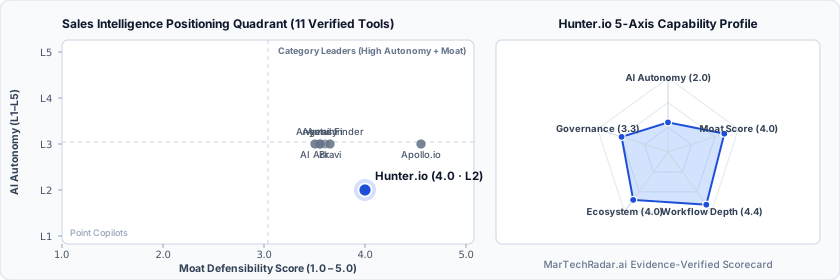
Hunter.io is a Web SaaS tool for Sales Intelligence (Lead Enrichment & Waterfall Orchestration) in AI SDR & Outbound. Pricing: Free plan · $49–$299/mo · Enterprise plan. Best suited to B2B SaaS and Creators / Solo. Editor ratings: AI autonomy L2 (workflow copilot); moat score 4.0/5.0 (Proprietary moat). Fact-checked by Anna Xia on Oct 6, 2026.
Domain-level email discovery and address verification engine combining public web indexing with direct SMTP handshake validation for outbound sales teams.
Hunter.io buyer fit verdict: when to choose vs. when to walk away
Choose Hunter.io if (Best Fit)
- Target ICP & Stack Fit: You operate as B2B SaaS and Creators / Solo requiring a Web SaaS deployment for Sales Intelligence, with verified ecosystem connectivity for Outreach, Apollo.io.
- L2 Architecture & Defensibility: Decade-long web crawl repository indexing corporate domain syntaxes, coupled with a distributed SMTP verification infrastructure minimizing deliverability drop-offs.
- Commercial Model Fit: Your procurement budget aligns with Free plan · $49–$299/mo · Enterprise plan and want a self-serve free tier for zero-cost initial validation.
Walk away from Hunter.io if (Deal-Breakers)
- Walk away if your workflow requires uncapped enterprise volume on the Free plan · $49–$299/mo · Enterprise plan entry plan without upgrading tiers.
- Walk away if your workflow cannot tolerate catch-all domain resolution: Mail servers configured as catch-all accept all incoming SMTP inquiries, which prevents the verification engine from deterministically validating mailbox existence and lowers verification certainty.
- Walk away if enrichment depth constraints is a deal-breaker for your team: The system specializes narrowly in business email identification, lacking native multi-channel signals such as direct mobile dials, technographic installations, or buyer intent indicators.
Hunter.io key facts & scorecard
| Pricing | Free plan · $49–$299/mo · Enterprise planVendor pricing page |
|---|---|
| Free plan | Yes |
| Delivery | Web SaaS |
| Audience | B2B SaaS, Creators / Solo |
| AI autonomy level | L2 · Workflow copilotEditor-verified |
| Moat tier & score | 4.0 / 5.0 · Proprietary moatEditor-verified |
| Funding | Bootstrapped |
| Total funding | BootstrappedBacked by Founders Owned |
| Founders | Antoine Fink, François Grante |
| Company size | 11-50 employees |
| Ecosystem integrations | Outreach, Apollo.io |
| Governance & docs | System Status ↗ · Changelog ↗ · Terms ↗ · Privacy ↗ |
| Headquarters | Paris, France |
| Founded | 2015 |
| Last verified |
Hunter.io pros & cons: strengths vs. operational limitations
Pros: core strengths & capabilities
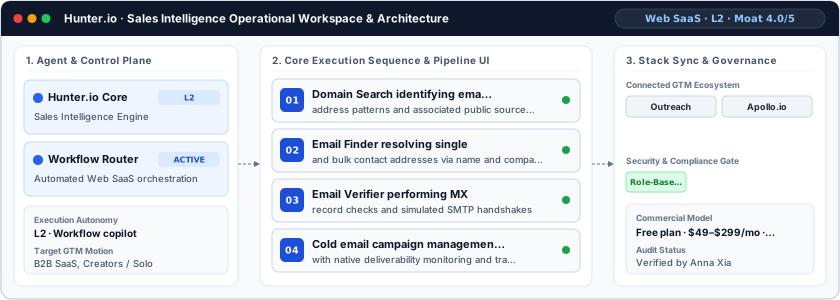
- Domain Search identifying email: address patterns and associated public source URLs
- Email Finder resolving single: and bulk contact addresses via name and company inputs
- Email Verifier performing MX: record checks and simulated SMTP handshakes
- Cold email campaign management interface: with native deliverability monitoring and tracking
Cons: operational limitations & risks
- Catch-All Domain Resolution: Mail servers configured as catch-all accept all incoming SMTP inquiries, which prevents the verification engine from deterministically validating mailbox existence and lowers verification certainty.
- Enrichment Depth Constraints: The system specializes narrowly in business email identification, lacking native multi-channel signals such as direct mobile dials, technographic installations, or buyer intent indicators.
- API Rate Throttling: High-volume data pipelines encounter rate throttling during synchronous bulk enrichments, requiring asynchronous queuing and batch orchestration inside downstream CRM pipelines.
Hunter.io TCO & deal-breaker stress test
Simulate 12-month stepped TCO, hidden cost multipliers, contract lock-in exposure, and stack failure modes using only facts verified by Anna Xia on · Capture SHA d2cb9088.
Hunter.io aligns with your 5-seat / $800/mo profile. Review the walk-away triggers and contract levers below before deployment.
| Plan / Tier | Verified Rate | Scale Fit | Scope & Quota Notes |
|---|---|---|---|
| Free / Sandbox | $0 | Unlimited seats (capped credits) | Entry free tier with capped usage or feature quotas for initial workflow testing. |
| Growth | $104/mo | Unlimited seats (Entry credits) | Grow momentum in your outreach |
| Scale | $209/mo | Unlimited seats (Growth credits) | Scale growth across leads and outreach |
| Essential | $408/mo | Unlimited seats (Scale credits) | 24,000 credits per year |
- Moat Score
- 4.0 / 5.0
- AI Autonomy
- L2
- Free Tier / Trial
- Free plan
Triggered audit signals & failure modes
- Published Self-Serve Entry FloorVerified Pricing Ledger
Hunter.io publishes a transparent entry point (Free plan · $49–$299/mo · Enterprise plan) with a free tier for initial validation before committing.
- Tier Fit for 5-Seat Scale: Scale ($209/mo)Verified Tier Schedule
Scale growth across leads and outreach
- Primary Operational Bottleneck: Catch-All Domain ResolutionAudit by Anna Xia
Mail servers configured as catch-all accept all incoming SMTP inquiries, which prevents the verification engine from deterministically validating mailbox existence and lowers verification certainty.
Hidden TCO Multipliers & Quota Gates
- Credit & Usage Burn Multiplier: Automated workflows consume metered credits/usage quotas; multi-step enrichment, voice minutes, or high-frequency agent runs can trigger mid-cycle top-up packs.
- Enterprise Governance & Add-On Gating: Advanced capabilities such as Single Sign-On (SSO), custom role permissions, or specialized analytics modules are gated behind upper tiers or paid add-ons.
When to Walk Away & Negotiation Levers
- Walk away if your workflow requires uncapped enterprise volume on the Free plan · $49–$299/mo · Enterprise plan entry plan without upgrading tiers.
- Walk away if your workflow cannot tolerate catch-all domain resolution: Mail servers configured as catch-all accept all incoming SMTP inquiries, which prevents the verification engine from deterministically validating mailbox existence and lowers verification certainty.
- Walk away if enrichment depth constraints is a deal-breaker for your team: The system specializes narrowly in business email identification, lacking native multi-channel signals such as direct mobile dials, technographic installations, or buyer intent indicators.
- Validate exact quota thresholds (seats, credits, or API calls) included in Hunter.io's Free plan · $49–$299/mo · Enterprise plan tier before converting from monthly to annual billing.
- Require a sandbox proof-of-concept testing catch-all domain resolution against your live CRM/data schema before annual sign-off.
Ask a custom procurement or TCO stress-test question about Hunter.io
Lower 5-seat floor (~$49/mo vs. $209 / mo)
Lower 5-seat floor (~$50/mo vs. $209 / mo)
Hunter.io key entities, modules & ecosystem stack
Hunter.io moat & subtrack positioning
Decade-long web crawl repository indexing corporate domain syntaxes, coupled with a distributed SMTP verification infrastructure minimizing deliverability drop-offs.
Editorial review
Fact-checked by Anna Xia (Senior B2B GTM & Revenue Systems Analyst) on .
Background
Hunter.io addresses the foundational sales development problem of establishing verified direct contact points from domain records. Founded in 2015 and headquartered in Paris, France, the platform serves outbound sales professionals, digital outreach specialists, and recruiting teams seeking structured contact discovery without configuring complex multi-vendor stacks. By cataloging publicly indexed corporate domains, the system translates company web footprints into validated professional contact points.
How Hunter.io works
The platform operates through an automated indexing architecture coupled with direct verification pipelines. When querying a domain, Hunter.io determines corporate syntax patterns by evaluating public web references and scoring confidence levels across historical findings. Its verification engine validates deliverability via multi-step validation: parsing MX records, validating mailbox format compliance, identifying catch-all configurations, and executing direct SMTP handshakes without delivering actual messages. This process outputs a score reflecting the deliverability probability for targeted corporate accounts.
Limitations
Operational considerations and platform boundaries include:
- Catch-All Domain Resolution: Mail servers configured as catch-all accept all incoming SMTP inquiries, which prevents the verification engine from deterministically validating mailbox existence and lowers verification certainty.
- Enrichment Depth Constraints: The system specializes narrowly in business email identification, lacking native multi-channel signals such as direct mobile dials, technographic installations, or buyer intent indicators.
- API Rate Throttling: High-volume data pipelines encounter rate throttling during synchronous bulk enrichments, requiring asynchronous queuing and batch orchestration inside downstream CRM pipelines.
Hunter.io pricing
Commercial access operates across modular monthly subscriptions based on search and verification credits. The entry tier starts at $49 per month for scaling teams requiring basic capacity, scaling to $299 per month for larger enrichment volumes, alongside a no-cost entry option and custom enterprise licensing. Each search or verification consumption deducts credits from a shared organizational pool across API queries and manual app runs.
How Hunter.io compares
Hunter.io positions itself as a specialized domain discovery engine against multi-source orchestration platforms like Clay and all-in-one engagement platforms like Apollo.io. While Apollo.io and AI Ark combine integrated dialers and vast proprietary B2B databases, Hunter.io emphasizes transparent source attribution and API simplicity. The product fits mid-market and SMB outreach teams needing predictable domain-level email extraction without the maintenance overhead of complex waterfall enrichment layers.
Direct competitors & market radar
Top algorithmic competitors based on category positioning, capability overlap, and ICP alignment.
Frequently asked questions about Hunter.io
How much does Hunter.io cost and what pricing tiers are available?
Published pricing summary for Hunter.io: Free plan · $49–$299/mo · Enterprise plan. Hunter.io includes a free tier or sandbox entry point. Verified tier schedule: Free / Sandbox ($0 for Unlimited seats (capped credits)); Growth ($104/mo for Unlimited seats (Entry credits)); Scale ($209/mo for Unlimited seats (Growth credits)); Essential ($408/mo for Unlimited seats (Scale credits)). Commercial access operates across modular monthly subscriptions based on search and verification credits. The entry tier starts at $49 per month for scaling teams requiring basic capacity, scaling to $299 per month for larger enrichment volumes, alongside a no-cost entry option and custom enterprise licensing.
How does Hunter.io work and how autonomous is its AI architecture?
Domain-level email discovery and address verification engine combining public web indexing with direct SMTP handshake validation for outbound sales teams. Within Sales Intelligence (Lead Enrichment & Waterfall Orchestration), MarTechRadar rates its execution architecture at L2 · Workflow copilot with a verified Moat Score of 4.0 / 5.0 (Proprietary moat). Decade-long web crawl repository indexing corporate domain syntaxes, coupled with a distributed SMTP verification infrastructure minimizing deliverability drop-offs. Corporate profile: Founded by Antoine Fink, François Grante, operating at 11-50 employees scale.
What are the main limitations of Hunter.io and when should buyers walk away?
Based on our editorial technical audit, key operational considerations and boundaries for Hunter.io include: (1) Catch-All Domain Resolution: Mail servers configured as catch-all accept all incoming SMTP inquiries, which prevents the verification engine from deterministically validating mailbox existence and lowers verification certainty. (2) Enrichment Depth Constraints: The system specializes narrowly in business email identification, lacking native multi-channel signals such as direct mobile dials, technographic installations, or buyer intent indicators. (3) API Rate Throttling: High-volume data pipelines encounter rate throttling during synchronous bulk enrichments, requiring asynchronous queuing and batch orchestration inside downstream CRM pipelines. Primary procurement walk-away rule: Walk away if your workflow requires uncapped enterprise volume on the Free plan · $49–$299/mo · Enterprise plan entry plan without upgrading tiers.
What integrations, compliance certifications, and contract terms apply to Hunter.io?
Verified ecosystem and stack integrations include Outreach, Apollo.io. First-party governance and developer endpoints verified on domain include: Status (https://status.hunter.io). Key TCO multiplier to watch: Credit & Usage Burn Multiplier (Automated workflows consume metered credits/usage quotas; multi-step enrichment, voice minutes, or high-frequency agent runs can trigger mid-cycle top-up packs.) Before signing a contract, procurement teams should validate exact quota thresholds (seats, credits, or API calls) included in Hunter.io's Free plan · $49–$299/mo · Enterprise plan tier before converting from monthly to annual billing.
What are the best Hunter.io alternatives and head-to-head competitors in 2026?
Top fact-checked alternatives to Hunter.io in Sales Intelligence (Lead Enrichment & Waterfall Orchestration) include AI Ark ($49/mo), Lusha (Free plan · $0/mo · Enterprise plan), Floqer (Free plan · $0/mo · Enterprise plan), Demand AI (Custom / enterprise pricing). Hunter.io positions itself as a specialized domain discovery engine against multi-source orchestration platforms like Clay and all-in-one engagement platforms like Apollo.io.
Verified sources & evidence trail
- Official product domain: https://hunter.io
- Commercial pricing verification: https://hunter.io/pricing
- Verified corporate entity profiles (
sameAs): LinkedIn Company Profile · Crunchbase Entity Record - First-party governance & documentation links: System Status · Changelog · Terms · Privacy
- Editorial audit sign-off: Fact-checked by Anna Xia on under the MarTechRadar Evidence-Ledger Protocol.