ion design Review (2026): AI Landing Page Pricing, Limits & Alternatives
Bottom line
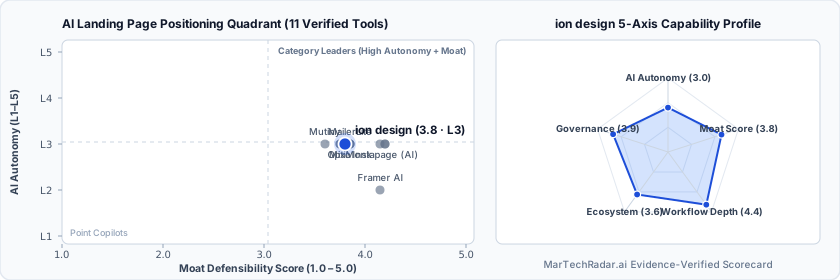
ion design is a Web SaaS tool for AI Landing Page (Landing Page Builders & Autonomous CRO) in Lifecycle & CDP. Pricing: Pricing not disclosed. Best suited to B2B SaaS and Marketing & Growth Teams. Editor ratings: AI autonomy L3 (conditional automation); moat score 3.8/5.0 (Proprietary moat). Fact-checked by Jagmeet Sine on Oct 16, 2026.
Autonomous AI storefront personalization and CRO platform that designs, launches, and optimizes ad landers, quizzes, and advertorials for ecommerce brands.
ion design buyer fit verdict: when to choose vs. when to walk away
Choose ion design if (Best Fit)
- Target ICP & Stack Fit: You operate as B2B SaaS and Marketing & Growth Teams requiring a Web SaaS deployment for AI Landing Page, with verified ecosystem connectivity for Shopify.
- L3 Architecture & Defensibility: Pairing autonomous on-brand landing page generation (ad landers, quizzes, advertorials) with the Dynamite real-time personalization engine drives measurable revenue per visitor.
- Commercial Model Fit: Your procurement budget aligns with Pricing not disclosed.
Walk away from ion design if (Deal-Breakers)
- Walk away if you require transparent self-serve monthly billing or your budget ceiling is under $1,000/mo (ion design requires sales-gated custom quoting).
- Walk away if your workflow cannot tolerate paid traffic volume bottleneck: Autonomous multivariate testing across ad landers, quizzes, and advertorials requires steady paid media click volume to separate winning layouts from statistical noise; low-traffic stores face an experimentation cold start bottleneck.
- Walk away if subdomain & checkout attribution friction is a deal-breaker for your team: Routing paid social traffic through managed subdomain landers requires careful UTM, pixel, and first-party cookie synchronization with Shopify or custom checkouts to avoid attribution latency.
ion design key facts & scorecard
| Pricing | Pricing not disclosed |
|---|---|
| Free plan | No / not disclosed |
| Delivery | Web SaaS |
| Audience | B2B SaaS, Marketing & Growth Teams |
| AI autonomy level | L3 · Conditional automationEditor-verified |
| Moat tier & score | 3.8 / 5.0 · Proprietary moatEditor-verified |
| Funding | Seed |
| Total funding | $2.3M |
| Founders | Samraaj Singh Bath, Samuel Barnholdt |
| Company size | 2-10 employees |
| Ecosystem integrations | Shopify |
| Governance & docs | Terms ↗ · Privacy ↗ |
| Headquarters | San Francisco, California |
| Founded | 2023 |
| Last verified |
ion design pros & cons: strengths vs. operational limitations
Pros: core strengths & capabilities
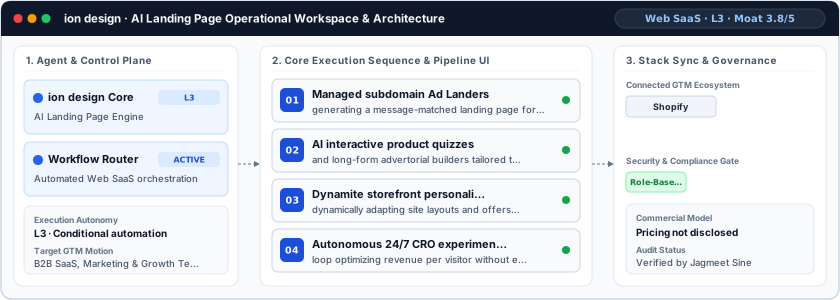
- Managed subdomain Ad Landers: generating a message-matched landing page for every paid social or search ad
- AI interactive product quizzes: and long-form advertorial builders tailored to buyer intent
- Dynamite storefront personalization engine: dynamically adapting site layouts and offers per visitor
- Autonomous 24/7 CRO experimentation: loop optimizing revenue per visitor without external agencies
Cons: operational limitations & risks
- Paid Traffic Volume Bottleneck: Autonomous multivariate testing across ad landers, quizzes, and advertorials requires steady paid media click volume to separate winning layouts from statistical noise; low-traffic stores face an experimentation cold start bottleneck.
- Subdomain & Checkout Attribution Friction: Routing paid social traffic through managed subdomain landers requires careful UTM, pixel, and first-party cookie synchronization with Shopify or custom checkouts to avoid attribution latency.
- Brand Design Approval Governance Barrier: Luxury and design-sensitive retail brands often require manual creative director sign-off before autonomous UI variations go live, introducing a workflow governance barrier and onboarding learning curve.
ion design TCO & deal-breaker stress test
Simulate 12-month stepped TCO, hidden cost multipliers, contract lock-in exposure, and stack failure modes using only facts verified by Jagmeet Sine on · Capture SHA a6523d67.
ion design triggers high-severity friction under your 5-seat / $800/mo constraints. Benchmark the verified subtrack alternatives below before committing.
| Plan / Tier | Verified Rate | Scale Fit | Scope & Quota Notes |
|---|---|---|---|
| Enterprise / Custom | Custom quote | 15–50+ seats (Enterprise SLA) | Sales-negotiated annual contract for custom volume, SSO/RBAC governance, and dedicated SLA. |
- Moat Score
- 3.8 / 5.0
- AI Autonomy
- L3
- Free Tier / Trial
- None disclosed
Triggered audit signals & failure modes
- Opaque Enterprise Quoting vs. SMB/Mid-Market BudgetVerified Pricing Ledger
ion design does not disclose a public self-serve floor (Pricing not disclosed). Buyers with a $800/mo cap face high sales-qualification friction.
- Sales-Gated Contract TermsFact-checked by Jagmeet Sine
Pricing is available on request through enterprise sales quotes, with customized tiers based on seat counts or usage volume.
- Primary Operational Bottleneck: Paid Traffic Volume BottleneckAudit by Jagmeet Sine
Autonomous multivariate testing across ad landers, quizzes, and advertorials requires steady paid media click volume to separate winning layouts from statistical noise; low-traffic stores face an experimentation cold start bottleneck.
Hidden TCO Multipliers & Quota Gates
- Credit & Usage Burn Multiplier: Automated workflows consume metered credits/usage quotas; multi-step enrichment, voice minutes, or high-frequency agent runs can trigger mid-cycle top-up packs.
- Enterprise Governance & Add-On Gating: Advanced capabilities such as Single Sign-On (SSO), custom role permissions, or specialized analytics modules are gated behind upper tiers or paid add-ons.
When to Walk Away & Negotiation Levers
- Walk away if you require transparent self-serve monthly billing or your budget ceiling is under $1,000/mo (ion design requires sales-gated custom quoting).
- Walk away if your workflow cannot tolerate paid traffic volume bottleneck: Autonomous multivariate testing across ad landers, quizzes, and advertorials requires steady paid media click volume to separate winning layouts from statistical noise; low-traffic stores face an experimentation cold start bottleneck.
- Walk away if subdomain & checkout attribution friction is a deal-breaker for your team: Routing paid social traffic through managed subdomain landers requires careful UTM, pixel, and first-party cookie synchronization with Shopify or custom checkouts to avoid attribution latency.
- Demand a 30- to 60-day paid pilot opt-out clause in the ion design order form before signing a 12-month enterprise commitment.
- Require a sandbox proof-of-concept testing paid traffic volume bottleneck against your live CRM/data schema before annual sign-off.
Ask a custom procurement or TCO stress-test question about ion design
Lower 5-seat floor (~$22/mo vs. Custom Quote) · Transparent self-serve entry without mandatory annual lock-in
Lower 5-seat floor (~$10/mo vs. Custom Quote) · Transparent self-serve entry without mandatory annual lock-in
ion design key entities, modules & ecosystem stack
ion design moat & subtrack positioning
Pairing autonomous on-brand landing page generation (ad landers, quizzes, advertorials) with the Dynamite real-time personalization engine drives measurable revenue per visitor.
Editorial review
Fact-checked by Jagmeet Sine (Senior MarTech Infrastructure & Agentic Workflow Architect) on .
Background
Founded in 2023 by Samraaj Singh Bath and Samuel Barnholdt and headquartered in San Francisco, California, ion design (ion.design, operating as ION) is an autonomous AI storefront conversion and landing page platform built for mid-market and enterprise ecommerce brands. Operating with a team of 2 to 10 employees and backed by $2.3M in Seed funding from Y Combinator (W24), Founders, Inc., and Lobster Capital, the company pairs online storefronts with 24/7 AI growth agents that design, launch, and iterate on conversion experiments to increase revenue per visitor.
How ion design works
ION operates at Level 3 autonomy through a brand-conditioned UI generation engine, managed subdomain edge router, and real-time behavioral personalization pipeline (Dynamite). Rather than sending all paid media traffic to a generic homepage or static product page, ION inspects the creative messaging of every active paid ad and deploys a message-matched Ad Lander on a managed subdomain. Alongside dedicated ad landers, the platform autonomously generates interactive AI product quizzes that guide shoppers to the right SKU and narrative AI advertorials that warm up cold social traffic, continuously testing layout and copy permutations against live checkout conversion telemetry.
Limitations
Operational limitations and technical trade-offs include:
- Paid Traffic Volume Bottleneck: Autonomous multivariate testing across ad landers, quizzes, and advertorials requires steady paid media click volume to separate winning layouts from statistical noise; low-traffic stores face an experimentation cold start bottleneck.
- Subdomain & Checkout Attribution Friction: Routing paid social traffic through managed subdomain landers requires careful UTM, pixel, and first-party cookie synchronization with Shopify or custom checkouts to avoid attribution latency.
- Brand Design Approval Governance Barrier: Luxury and design-sensitive retail brands often require manual creative director sign-off before autonomous UI variations go live, introducing a workflow governance barrier and onboarding learning curve.
ion design pricing
Pricing is available on request through enterprise sales quotes, with customized tiers based on seat counts or usage volume. Ecommerce growth and CRO teams can request a live platform walkthrough directly on the ION website to scope storefront traffic tiers and custom subdomain deployment.
How ion design compares
Within the Landing Page Builders & Autonomous CRO category, ion design competes against ecommerce landing page and personalization alternatives such as Replo, Unbounce, and Mutiny. Versus manual drag-and-drop page builders like Replo or B2B account personalization tools like Mutiny, ION differentiates itself by autonomously generating message-matched ad landers, quizzes, and advertorials paired with its Dynamite ecommerce personalization engine. High-spend D2C and enterprise retail brands choose ION to replace manual CRO agency retainers.
Frequently asked questions about ion design
How much does ion design cost and does it require a custom enterprise quote?
Published pricing summary for ion design: Pricing not disclosed. A permanent free plan is not disclosed for ion design. Pricing is available on request through enterprise sales quotes, with customized tiers based on seat counts or usage volume. Ecommerce growth and CRO teams can request a live platform walkthrough directly on the ION website to scope storefront traffic tiers and custom subdomain deployment.
How does ion design work and how autonomous is its AI architecture?
Autonomous AI storefront personalization and CRO platform that designs, launches, and optimizes ad landers, quizzes, and advertorials for ecommerce brands. Within AI Landing Page (Landing Page Builders & Autonomous CRO), MarTechRadar rates its execution architecture at L3 · Conditional automation with a verified Moat Score of 3.8 / 5.0 (Proprietary moat). Pairing autonomous on-brand landing page generation (ad landers, quizzes, advertorials) with the Dynamite real-time personalization engine drives measurable revenue per visitor. Corporate profile: Founded by Samraaj Singh Bath, Samuel Barnholdt, operating at 2-10 employees scale.
What are the main limitations of ion design and when should buyers walk away?
Based on our editorial technical audit, key operational considerations and boundaries for ion design include: (1) Paid Traffic Volume Bottleneck: Autonomous multivariate testing across ad landers, quizzes, and advertorials requires steady paid media click volume to separate winning layouts from statistical noise; low-traffic stores face an experimentation cold start bottleneck. (2) Subdomain & Checkout Attribution Friction: Routing paid social traffic through managed subdomain landers requires careful UTM, pixel, and first-party cookie synchronization with Shopify or custom checkouts to avoid attribution latency. (3) Brand Design Approval Governance Barrier: Luxury and design-sensitive retail brands often require manual creative director sign-off before autonomous UI variations go live, introducing a workflow governance barrier and onboarding learning curve. Primary procurement walk-away rule: Walk away if you require transparent self-serve monthly billing or your budget ceiling is under $1,000/mo (ion design requires sales-gated custom quoting).
What integrations, compliance certifications, and contract terms apply to ion design?
Verified ecosystem and stack integrations include Shopify. Key TCO multiplier to watch: Credit & Usage Burn Multiplier (Automated workflows consume metered credits/usage quotas; multi-step enrichment, voice minutes, or high-frequency agent runs can trigger mid-cycle top-up packs.) Before signing a contract, procurement teams should demand a 30- to 60-day paid pilot opt-out clause in the ion design order form before signing a 12-month enterprise commitment.
What are the best ion design alternatives and head-to-head competitors in 2026?
Top fact-checked alternatives to ion design in AI Landing Page (Landing Page Builders & Autonomous CRO) include Mutiny (Custom / enterprise pricing), Unbounce (From $22/mo), Replo (Custom / enterprise pricing), Sitekick (Custom / enterprise pricing). Within the Landing Page Builders & Autonomous CRO category, ion design competes against ecommerce landing page and personalization alternatives such as Replo, Unbounce, and Mutiny.
Verified sources & evidence trail
- Official product domain: https://www.ion.design/
- Commercial pricing verification: Verified against official vendor pricing policy (Pricing not disclosed)
- Verified corporate entity profiles (
sameAs): LinkedIn Company Profile · Crunchbase Entity Record - First-party governance & documentation links: Terms · Privacy
- Editorial audit sign-off: Fact-checked by Jagmeet Sine on under the MarTechRadar Evidence-Ledger Protocol.