Kit (ConvertKit) Review (2026): Email Marketing Pricing, Limits & Alternatives
Bottom line
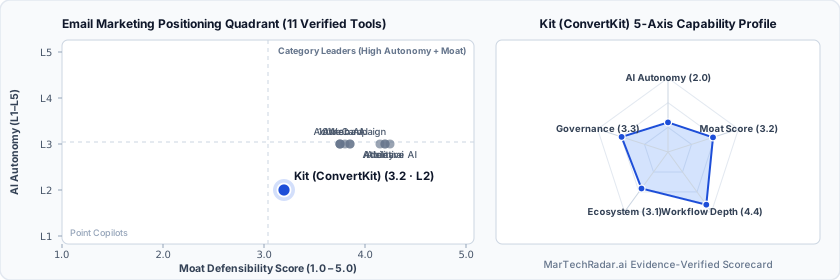
Kit (ConvertKit) is a Web SaaS tool for Email Marketing (AI Email Marketing & Lifecycle Journeys) in Lifecycle & CDP. Pricing: Custom / enterprise pricing. Best suited to B2B SaaS and Creators / Solo. Editor ratings: AI autonomy L2 (workflow copilot); moat score 3.2/5.0 (Workflow-embedded (strong)). Fact-checked by Sarah Per on Oct 7, 2026.
Audience growth and email marketing platform offering subscriber tagging, visual sequence automation, and digital commerce tools for creator-led businesses.
Kit (ConvertKit) buyer fit verdict: when to choose vs. when to walk away
Choose Kit (ConvertKit) if (Best Fit)
- Target ICP & Stack Fit: You operate as B2B SaaS and Creators / Solo requiring a Web SaaS deployment for Email Marketing, with verified ecosystem connectivity for Twilio Segment.
- L2 Architecture & Defensibility: Defensibility stems from a creator-centric ecosystem, high sender domain reputation networks, direct creator recommendation loops, and streamlined tag-based subscriber data architectures.
- Commercial Model Fit: Your procurement budget aligns with Custom / enterprise pricing.
Walk away from Kit (ConvertKit) if (Deal-Breakers)
- Walk away if you require transparent self-serve monthly billing or your budget ceiling is under $1,000/mo (Kit (ConvertKit) requires sales-gated custom quoting).
- Walk away if your workflow cannot tolerate relational data modeling: The flat tag-and-custom-field architecture struggles with complex multi-table entities such as multi-brand catalogs or nested B2B account hierarchies.
- Walk away if complex lifecycle logic is a deal-breaker for your team: Branching rules lack multi-arm split tests based on complex predictive scoring or real-time warehouse sync triggers common in enterprise CDPs.
Kit (ConvertKit) key facts & scorecard
| Pricing | Custom / enterprise pricingVendor pricing page |
|---|---|
| Free plan | No / not disclosed |
| Delivery | Web SaaS |
| Audience | B2B SaaS, Creators / Solo |
| AI autonomy level | L2 · Workflow copilotEditor-verified |
| Moat tier & score | 3.2 / 5.0 · Workflow-embedded (strong)Editor-verified |
| Funding | Bootstrapped |
| Ecosystem integrations | Twilio Segment |
| Governance & docs | API & Docs ↗ · Terms ↗ · Privacy ↗ |
| Headquarters | United States |
| Founded | 2013 |
| Last verified |
Kit (ConvertKit) pros & cons: strengths vs. operational limitations
Pros: core strengths & capabilities
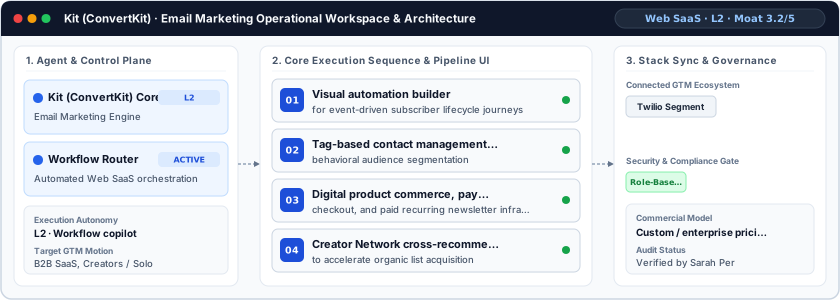
- Visual automation builder: for event-driven subscriber lifecycle journeys
- Tag-based contact management and: behavioral audience segmentation
- Digital product commerce, payment: checkout, and paid recurring newsletter infrastructure
- Creator Network cross-recommendation engine: to accelerate organic list acquisition
Cons: operational limitations & risks
- Relational Data Modeling: The flat tag-and-custom-field architecture struggles with complex multi-table entities such as multi-brand catalogs or nested B2B account hierarchies.
- Complex Lifecycle Logic: Branching rules lack multi-arm split tests based on complex predictive scoring or real-time warehouse sync triggers common in enterprise CDPs.
- Native Analytics Depth: Reporting modules emphasize broadcast-level open and click metrics, requiring external data pipeline exports for detailed attribution modeling.
Kit (ConvertKit) TCO & deal-breaker stress test
Simulate 12-month stepped TCO, hidden cost multipliers, contract lock-in exposure, and stack failure modes using only facts verified by Sarah Per on · Capture SHA 09e240f3.
Kit (ConvertKit) triggers high-severity friction under your 5-seat / $800/mo constraints. Benchmark the verified subtrack alternatives below before committing.
| Plan / Tier | Verified Rate | Scale Fit | Scope & Quota Notes |
|---|---|---|---|
| Creator | $33/mo | Unlimited seats (Entry credits) | For growing creators |
| Pro | $66/mo | Unlimited seats (Growth credits) | For scaling creators |
| Creator | $78/mo | Unlimited seats (Scale credits) | For growing creators |
| Enterprise / Custom | Custom quote | Unlimited seats (Enterprise SLA) | Sales-negotiated annual contract for custom volume, SSO/RBAC governance, and dedicated SLA. |
- Moat Score
- 3.2 / 5.0
- AI Autonomy
- L2
- Free Tier / Trial
- None disclosed
Triggered audit signals & failure modes
- Opaque Enterprise Quoting vs. SMB/Mid-Market BudgetVerified Pricing Ledger
Kit (ConvertKit) does not disclose a public self-serve floor (Custom / enterprise pricing). Buyers with a $800/mo cap face high sales-qualification friction.
- Sales-Gated Contract TermsFact-checked by Sarah Per
Commercial access operates across tiered subscriptions aligned with contact list volume and advanced functionality requirements.
- Tier Fit for 5-Seat Scale: Creator ($33/mo)Verified Tier Schedule
For growing creators
- Primary Operational Bottleneck: Relational Data ModelingAudit by Sarah Per
The flat tag-and-custom-field architecture struggles with complex multi-table entities such as multi-brand catalogs or nested B2B account hierarchies.
Hidden TCO Multipliers & Quota Gates
- Annual Billing Headline vs. Monthly Premium: Headline entry rates reflect annual billing commitments (Save $78); month-to-month flexibility carries a higher effective monthly rate or requires annual prepayment.
- Credit & Usage Burn Multiplier: Automated workflows consume metered credits/usage quotas; multi-step enrichment, voice minutes, or high-frequency agent runs can trigger mid-cycle top-up packs.
When to Walk Away & Negotiation Levers
- Walk away if you require transparent self-serve monthly billing or your budget ceiling is under $1,000/mo (Kit (ConvertKit) requires sales-gated custom quoting).
- Walk away if your workflow cannot tolerate relational data modeling: The flat tag-and-custom-field architecture struggles with complex multi-table entities such as multi-brand catalogs or nested B2B account hierarchies.
- Walk away if complex lifecycle logic is a deal-breaker for your team: Branching rules lack multi-arm split tests based on complex predictive scoring or real-time warehouse sync triggers common in enterprise CDPs.
- Demand a 30- to 60-day paid pilot opt-out clause in the Kit (ConvertKit) order form before signing a 12-month enterprise commitment.
- Require a sandbox proof-of-concept testing relational data modeling against your live CRM/data schema before annual sign-off.
Ask a custom procurement or TCO stress-test question about Kit (ConvertKit)
Lower 5-seat floor (~$9/mo vs. Custom Quote) · Transparent self-serve entry without mandatory annual lock-in
Lower 5-seat floor (~$13/mo vs. Custom Quote) · Transparent self-serve entry without mandatory annual lock-in
Kit (ConvertKit) key entities, modules & ecosystem stack
Kit (ConvertKit) moat & subtrack positioning
Defensibility stems from a creator-centric ecosystem, high sender domain reputation networks, direct creator recommendation loops, and streamlined tag-based subscriber data architectures.
Editorial review
Fact-checked by Sarah Per (Principal Content Systems & Generative Media Editor) on .
Background
Kit (formerly ConvertKit), based in the United States, is an audience engagement and email marketing platform designed to streamline digital relationship building and direct-to-consumer monetization. Engineered for professional creators, publishers, and boutique digital media brands, the software eliminates the overhead of rigid list-based architectures. By prioritizing lightweight tagging over segregated relational databases, Kit serves growth teams and independent operators who require adaptable lifecycle orchestration without enterprise software friction.
How Kit (ConvertKit) works
At an L2 autonomy level, Kit functions through a centralized tag-and-segment data model coupled with an event-driven automation engine. Ingestion pipelines process subscriber signups, link clicks, custom behavioral events, and purchase webhooks from native checkout or external e-commerce integrations. Rule sets trigger conditional branching paths within visual journey builders, dynamically injecting subscriber attributes via templating logic while offloading outbound delivery through managed MTAs with domain-level reputation pacing.
Limitations
Operational considerations and platform boundaries include:
- Relational Data Modeling: The flat tag-and-custom-field architecture struggles with complex multi-table entities such as multi-brand catalogs or nested B2B account hierarchies.
- Complex Lifecycle Logic: Branching rules lack multi-arm split tests based on complex predictive scoring or real-time warehouse sync triggers common in enterprise CDPs.
- Native Analytics Depth: Reporting modules emphasize broadcast-level open and click metrics, requiring external data pipeline exports for detailed attribution modeling.
Kit (ConvertKit) pricing
Commercial access operates across tiered subscriptions aligned with contact list volume and advanced functionality requirements. A baseline tier supports early-stage acquisition with core broadcast tools, while scaled production tiers unlock visual journey builders, third-party integrations, and team seats. Commercial enterprise pricing is available on request through tailored enterprise sales quotes based on organizational scale and seats, including custom migration services and dedicated IP management.
How Kit (ConvertKit) compares
Within the marketing technology landscape, Kit contrasts with multi-channel testing suites like AB Tasty, digital deployment engines like 10Web AI, and programmatic optimization agents like Ability.ai. While enterprise alternatives emphasize broad personalization experiments or algorithmic ad management, Kit focuses squarely on linear email sequencing and subscriber retention. It is optimal for creator-led enterprises and content-first operations requiring robust inbox delivery without maintaining complex customer data platform schemas.
Frequently asked questions about Kit (ConvertKit)
How much does Kit (ConvertKit) cost and does it require a custom enterprise quote?
Published pricing summary for Kit (ConvertKit): Custom / enterprise pricing. A permanent free plan is not disclosed for Kit (ConvertKit). Verified tier schedule: Creator ($33/mo for Unlimited seats (Entry credits)); Pro ($66/mo for Unlimited seats (Growth credits)); Creator ($78/mo for Unlimited seats (Scale credits)); Enterprise / Custom (Custom quote for Unlimited seats (Enterprise SLA)). Commercial access operates across tiered subscriptions aligned with contact list volume and advanced functionality requirements. A baseline tier supports early-stage acquisition with core broadcast tools, while scaled production tiers unlock visual journey builders, third-party integrations, and team seats.
How does Kit (ConvertKit) work and how autonomous is its AI architecture?
Audience growth and email marketing platform offering subscriber tagging, visual sequence automation, and digital commerce tools for creator-led businesses. Within Email Marketing (AI Email Marketing & Lifecycle Journeys), MarTechRadar rates its execution architecture at L2 · Workflow copilot with a verified Moat Score of 3.2 / 5.0 (Workflow-embedded (strong)). Defensibility stems from a creator-centric ecosystem, high sender domain reputation networks, direct creator recommendation loops, and streamlined tag-based subscriber data architectures.
What are the main limitations of Kit (ConvertKit) and when should buyers walk away?
Based on our editorial technical audit, key operational considerations and boundaries for Kit (ConvertKit) include: (1) Relational Data Modeling: The flat tag-and-custom-field architecture struggles with complex multi-table entities such as multi-brand catalogs or nested B2B account hierarchies. (2) Complex Lifecycle Logic: Branching rules lack multi-arm split tests based on complex predictive scoring or real-time warehouse sync triggers common in enterprise CDPs. (3) Native Analytics Depth: Reporting modules emphasize broadcast-level open and click metrics, requiring external data pipeline exports for detailed attribution modeling. Primary procurement walk-away rule: Walk away if you require transparent self-serve monthly billing or your budget ceiling is under $1,000/mo (Kit (ConvertKit) requires sales-gated custom quoting).
What integrations, compliance certifications, and contract terms apply to Kit (ConvertKit)?
Verified ecosystem and stack integrations include Twilio Segment. First-party governance and developer endpoints verified on domain include: API Docs (https://developers.kit.com/api-reference/overview). Key TCO multiplier to watch: Annual Billing Headline vs. Monthly Premium (Headline entry rates reflect annual billing commitments (Save $78); month-to-month flexibility carries a higher effective monthly rate or requires annual prepayment.) Before signing a contract, procurement teams should demand a 30- to 60-day paid pilot opt-out clause in the Kit (ConvertKit) order form before signing a 12-month enterprise commitment.
What are the best Kit (ConvertKit) alternatives and head-to-head competitors in 2026?
Top fact-checked alternatives to Kit (ConvertKit) in Email Marketing (AI Email Marketing & Lifecycle Journeys) include Klaviyo (AI) (Custom / enterprise pricing), Brevo AI (Free plan · $9–$499/mo), Mailchimp Intuit Assist ($13–$350/mo), Optimizely Opal (Custom / enterprise pricing). Within the marketing technology landscape, Kit contrasts with multi-channel testing suites like AB Tasty, digital deployment engines like 10Web AI, and programmatic optimization agents like Ability.ai.
Verified sources & evidence trail
- Official product domain: https://kit.com
- Commercial pricing verification: https://kit.com/pricing
- First-party governance & documentation links: API & Docs · Terms · Privacy
- Editorial audit sign-off: Fact-checked by Sarah Per on under the MarTechRadar Evidence-Ledger Protocol.