Kustomer Review (2026): Email Marketing Pricing, Limits & Alternatives
Bottom line
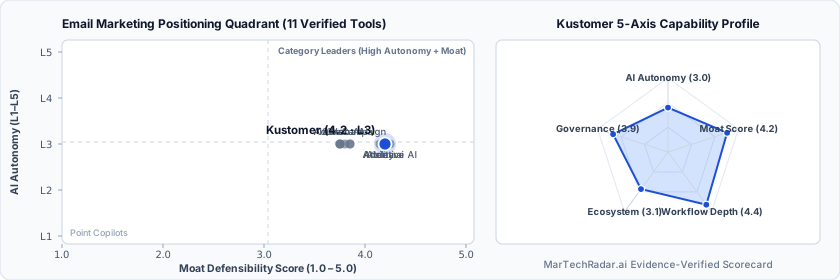
Kustomer is a Web SaaS tool for Email Marketing (AI Email Marketing & Lifecycle Journeys) in Lifecycle & CDP. Pricing: Custom / enterprise pricing. Best suited to DTC / eCommerce and Enterprise Brands. Editor ratings: AI autonomy L3 (conditional automation); moat score 4.2/5.0 (Proprietary moat). Fact-checked by Jagmeet Sine on Oct 12, 2026.
Omnichannel customer operations platform unifying cross-channel interactions, transactional context, and event pipelines into a chronological customer.
Kustomer buyer fit verdict: when to choose vs. when to walk away
Choose Kustomer if (Best Fit)
- Target ICP & Stack Fit: You operate as DTC / eCommerce and Enterprise Brands requiring a Web SaaS deployment for Email Marketing.
- L3 Architecture & Defensibility: Persistent single-thread customer timeline architecture coupled with high-throughput event ingestion pipes that consolidate transactional and conversational state across disparate messaging channels.
- Commercial Model Fit: Your procurement budget aligns with Custom / enterprise pricing.
Walk away from Kustomer if (Deal-Breakers)
- Walk away if you require transparent self-serve monthly billing or your budget ceiling is under $1,000/mo (Kustomer requires sales-gated custom quoting).
- Walk away if your workflow cannot tolerate data schema maintenance: High-volume operational teams encounter schema drift when integrating evolving custom objects, requiring ongoing governance to prevent timeline rendering latency.
- Walk away if webhook ingestion throttling is a deal-breaker for your team: Bursty event traffic from downstream transactional systems can trigger rate-limiting controls, delaying downstream workflow triggers during flash volume spikes.
Kustomer key facts & scorecard
| Pricing | Custom / enterprise pricing |
|---|---|
| Free plan | No / not disclosed |
| Delivery | Web SaaS |
| Audience | DTC / eCommerce, Enterprise Brands |
| AI autonomy level | L3 · Conditional automationEditor-verified |
| Moat tier & score | 4.2 / 5.0 · Proprietary moatEditor-verified |
| Funding | AcquiredAcquired by Meta |
| Total funding | $233.5MBacked by BoxGroup, Coatue |
| Founders | Brad Birnbaum, Jeremy Suriel |
| Company size | 251-500 employees |
| Governance & docs | Trust & Security ↗ · System Status ↗ · API & Docs ↗ · Changelog ↗ · Terms ↗ · Privacy ↗ |
| Headquarters | New York, United States |
| Founded | 2015 |
| Last verified |
Kustomer pros & cons: strengths vs. operational limitations
Pros: core strengths & capabilities
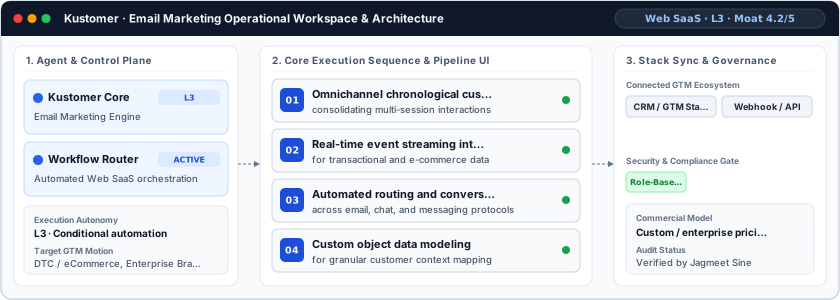
- Omnichannel chronological customer timeline: consolidating multi-session interactions
- Real-time event streaming integrations: for transactional and e-commerce data
- Automated routing and conversational triage: across email, chat, and messaging protocols
- Custom object data modeling: for granular customer context mapping
Cons: operational limitations & risks
- Data Schema Maintenance: High-volume operational teams encounter schema drift when integrating evolving custom objects, requiring ongoing governance to prevent timeline rendering latency.
- Webhook Ingestion Throttling: Bursty event traffic from downstream transactional systems can trigger rate-limiting controls, delaying downstream workflow triggers during flash volume spikes.
- Complex Customization Overhead: Deploying conditional routing trees across heterogeneous external systems introduces implementation overhead, necessitating dedicated technical resources for API integration maintenance.
Kustomer TCO & deal-breaker stress test
Simulate 12-month stepped TCO, hidden cost multipliers, contract lock-in exposure, and stack failure modes using only facts verified by Jagmeet Sine on · Capture SHA e07cb808.
Kustomer triggers high-severity friction under your 5-seat / $800/mo constraints. Benchmark the verified subtrack alternatives below before committing.
| Plan / Tier | Verified Rate | Scale Fit | Scope & Quota Notes |
|---|---|---|---|
| Enterprise / Custom | Custom quote | 15–50+ seats (Enterprise SLA) | Sales-negotiated annual contract for custom volume, SSO/RBAC governance, and dedicated SLA. |
- Moat Score
- 4.2 / 5.0
- AI Autonomy
- L3
- Free Tier / Trial
- None disclosed
Triggered audit signals & failure modes
- Opaque Enterprise Quoting vs. SMB/Mid-Market BudgetVerified Pricing Ledger
Kustomer does not disclose a public self-serve floor (Custom / enterprise pricing). Buyers with a $800/mo cap face high sales-qualification friction.
- Sales-Gated Contract TermsFact-checked by Jagmeet Sine
Commercial access is structured around customized enterprise agreements. Licensing requires engaging direct sales for custom enterprise quotes calibrated to seat counts, interaction volume, and platform tiering.
- Primary Operational Bottleneck: Data Schema MaintenanceAudit by Jagmeet Sine
High-volume operational teams encounter schema drift when integrating evolving custom objects, requiring ongoing governance to prevent timeline rendering latency.
Hidden TCO Multipliers & Quota Gates
- Credit & Usage Burn Multiplier: Automated workflows consume metered credits/usage quotas; multi-step enrichment, voice minutes, or high-frequency agent runs can trigger mid-cycle top-up packs.
- Enterprise Governance & Add-On Gating: Advanced capabilities such as Single Sign-On (SSO), custom role permissions, or specialized analytics modules are gated behind upper tiers or paid add-ons.
When to Walk Away & Negotiation Levers
- Walk away if you require transparent self-serve monthly billing or your budget ceiling is under $1,000/mo (Kustomer requires sales-gated custom quoting).
- Walk away if your workflow cannot tolerate data schema maintenance: High-volume operational teams encounter schema drift when integrating evolving custom objects, requiring ongoing governance to prevent timeline rendering latency.
- Walk away if webhook ingestion throttling is a deal-breaker for your team: Bursty event traffic from downstream transactional systems can trigger rate-limiting controls, delaying downstream workflow triggers during flash volume spikes.
- Demand a 30- to 60-day paid pilot opt-out clause in the Kustomer order form before signing a 12-month enterprise commitment.
- Require a sandbox proof-of-concept testing data schema maintenance against your live CRM/data schema before annual sign-off.
Ask a custom procurement or TCO stress-test question about Kustomer
Lower 5-seat floor (~$21/mo vs. Custom Quote) · Transparent self-serve entry without mandatory annual lock-in
Lower 5-seat floor (~$15/mo vs. Custom Quote) · Transparent self-serve entry without mandatory annual lock-in
Kustomer moat & subtrack positioning
Persistent single-thread customer timeline architecture coupled with high-throughput event ingestion pipes that consolidate transactional and conversational state across disparate messaging channels.
Editorial review
Fact-checked by Jagmeet Sine (Senior MarTech Infrastructure & Agentic Workflow Architect) on .
Background
Architected around a persistent event-driven data model, Kustomer was founded in 2015 in New York, United States, securing $233.5M in total institutional funding. Designed primarily for enterprise customer experience directors and lifecycle operations leads, the platform unifies fragmented service channels into an unbroken operational surface. Rather than isolating interactions across siloed ticket identifiers, Kustomer organizes cross-channel engagements into a consolidated chronological record, positioning the engine as a foundational data hub for high-volume customer interaction management.
How Kustomer works
At its architectural core, Kustomer operates via a unified timeline schema that streams asynchronous webhooks, third-party transactional telemetry, and inbound communication channels into persistent profile objects. Inbound events across email, messaging apps, and custom webhooks trigger deterministic classification pipelines that evaluate customer metadata against configurable routing policies. The system functions at Level 3 autonomy by executing conditional response sequences, updating external relational databases via bi-directional connectors, and surfacing prioritized agent interventions without requiring manual context handoffs.
Limitations
Operational considerations and platform boundaries include:
- Data Schema Maintenance: High-volume operational teams encounter schema drift when integrating evolving custom objects, requiring ongoing governance to prevent timeline rendering latency.
- Webhook Ingestion Throttling: Bursty event traffic from downstream transactional systems can trigger rate-limiting controls, delaying downstream workflow triggers during flash volume spikes.
- Complex Customization Overhead: Deploying conditional routing trees across heterogeneous external systems introduces implementation overhead, necessitating dedicated technical resources for API integration maintenance.
Kustomer pricing
Commercial access is structured around customized enterprise agreements. Licensing requires engaging direct sales for custom enterprise quotes calibrated to seat counts, interaction volume, and platform tiering. The commercial framework excludes entry-level tiers, directing prospective deployments through contract evaluations governed by organizational scale.
How Kustomer compares
Within customer interaction orchestration, Kustomer contrasts sharply against specialized digital tooling like 10Web AI, AB Tasty, and Ability.ai. Where 10Web AI targets synthetic web generation, AB Tasty focuses on client-side experimentation, and Ability.ai optimizes autonomous campaign performance, Kustomer maintains deep operational focus on multi-channel customer records and transactional support orchestration. The platform delivers optimal utility for mid-market and enterprise organizations operating complex, cross-channel customer relationship workflows.
Direct competitors & market radar
Top algorithmic competitors based on category positioning, capability overlap, and ICP alignment.
Frequently asked questions about Kustomer
How much does Kustomer cost and does it require a custom enterprise quote?
Published pricing summary for Kustomer: Custom / enterprise pricing. A permanent free plan is not disclosed for Kustomer. Commercial access is structured around customized enterprise agreements. Licensing requires engaging direct sales for custom enterprise quotes calibrated to seat counts, interaction volume, and platform tiering.
How does Kustomer work and how autonomous is its AI architecture?
Omnichannel customer operations platform unifying cross-channel interactions, transactional context, and event pipelines into a chronological customer. Within Email Marketing (AI Email Marketing & Lifecycle Journeys), MarTechRadar rates its execution architecture at L3 · Conditional automation with a verified Moat Score of 4.2 / 5.0 (Proprietary moat). Persistent single-thread customer timeline architecture coupled with high-throughput event ingestion pipes that consolidate transactional and conversational state across disparate messaging channels. Corporate profile: Founded by Brad Birnbaum, Jeremy Suriel, operating at 251-500 employees scale, acquired by Meta.
What are the main limitations of Kustomer and when should buyers walk away?
Based on our editorial technical audit, key operational considerations and boundaries for Kustomer include: (1) Data Schema Maintenance: High-volume operational teams encounter schema drift when integrating evolving custom objects, requiring ongoing governance to prevent timeline rendering latency. (2) Webhook Ingestion Throttling: Bursty event traffic from downstream transactional systems can trigger rate-limiting controls, delaying downstream workflow triggers during flash volume spikes. (3) Complex Customization Overhead: Deploying conditional routing trees across heterogeneous external systems introduces implementation overhead, necessitating dedicated technical resources for API integration maintenance. Primary procurement walk-away rule: Walk away if you require transparent self-serve monthly billing or your budget ceiling is under $1,000/mo (Kustomer requires sales-gated custom quoting).
What integrations, compliance certifications, and contract terms apply to Kustomer?
First-party governance and developer endpoints verified on domain include: Trust/Security (https://www.kustomer.com/security), Status (https://status.kustomer.com), API Docs (https://developer.kustomer.com). Key TCO multiplier to watch: Credit & Usage Burn Multiplier (Automated workflows consume metered credits/usage quotas; multi-step enrichment, voice minutes, or high-frequency agent runs can trigger mid-cycle top-up packs.) Before signing a contract, procurement teams should demand a 30- to 60-day paid pilot opt-out clause in the Kustomer order form before signing a 12-month enterprise commitment.
What are the best Kustomer alternatives and head-to-head competitors in 2026?
Top fact-checked alternatives to Kustomer in Email Marketing (AI Email Marketing & Lifecycle Journeys) include Haast (Custom / enterprise pricing), Monocle (Custom / enterprise pricing), Nas.com (From $20.75/mo), Wunderkind (Custom / enterprise pricing). Within customer interaction orchestration, Kustomer contrasts sharply against specialized digital tooling like 10Web AI, AB Tasty, and Ability.ai.
Verified sources & evidence trail
- Official product domain: https://kustomer.com
- Commercial pricing verification: Verified against official vendor pricing policy (Custom / enterprise pricing)
- Verified corporate entity profiles (
sameAs): LinkedIn Company Profile · Crunchbase Entity Record - First-party governance & documentation links: Trust & Security · System Status · API & Docs · Changelog · Terms · Privacy
- Editorial audit sign-off: Fact-checked by Jagmeet Sine on under the MarTechRadar Evidence-Ledger Protocol.