Litmus (AI Assist) Review (2026): Email Marketing Pricing, Limits & Alternatives
Bottom line
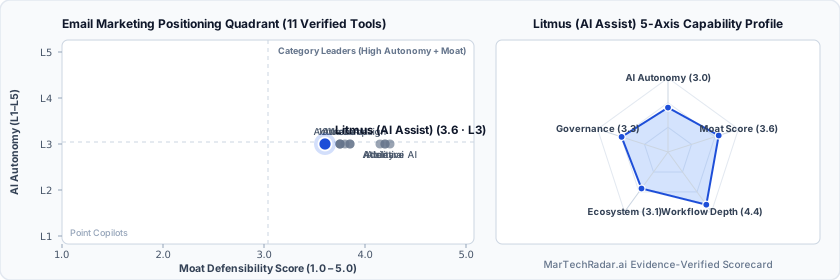
Litmus (AI Assist) is a Web SaaS tool for Email Marketing (AI Email Marketing & Lifecycle Journeys) in Lifecycle & CDP. Pricing: Custom / enterprise pricing. Best suited to DTC / eCommerce and Enterprise Brands. Editor ratings: AI autonomy L3 (conditional automation); moat score 3.6/5.0 (Proprietary moat). Fact-checked by Sarah Per on Oct 14, 2026.
Pre-send email testing, rendering diagnostics, and generative AI drafting engine optimizing cross-client template delivery and engagement.
Litmus (AI Assist) buyer fit verdict: when to choose vs. when to walk away
Choose Litmus (AI Assist) if (Best Fit)
- Target ICP & Stack Fit: You operate as DTC / eCommerce and Enterprise Brands requiring a Web SaaS deployment for Email Marketing, with verified ecosystem connectivity for Microsoft Outlook.
- L3 Architecture & Defensibility: Deep proprietary email rendering engine spanning hundreds of inbox clients combined with pre-send analytics and generative content assistance under Validity.
- Commercial Model Fit: Your procurement budget aligns with Custom / enterprise pricing.
Walk away from Litmus (AI Assist) if (Deal-Breakers)
- Walk away if you require transparent self-serve monthly billing or your budget ceiling is under $1,000/mo (Litmus (AI Assist) requires sales-gated custom quoting).
- Walk away if your workflow cannot tolerate client rendering disconnect: AI copy generations often exceed layout constraints in dynamic responsive templates, requiring manual CSS adjustments for complex outlook engines.
- Walk away if ESP orchestration boundary is a deal-breaker for your team: The system lacks native outbound mail transmission capabilities, forcing continuous bidirectional API syncing across disparate third-party sending infrastructures.
Litmus (AI Assist) key facts & scorecard
| Pricing | Custom / enterprise pricing |
|---|---|
| Free plan | No / not disclosed |
| Delivery | Web SaaS |
| Audience | DTC / eCommerce, Enterprise Brands |
| AI autonomy level | L3 · Conditional automationEditor-verified |
| Moat tier & score | 3.6 / 5.0 · Proprietary moatEditor-verified |
| Funding | Undisclosed |
| Ecosystem integrations | Microsoft Outlook |
| Governance & docs | System Status ↗ · Changelog ↗ · Terms ↗ · Privacy ↗ |
| Headquarters | United States |
| Founded | 2005 |
| Last verified |
Litmus (AI Assist) pros & cons: strengths vs. operational limitations
Pros: core strengths & capabilities
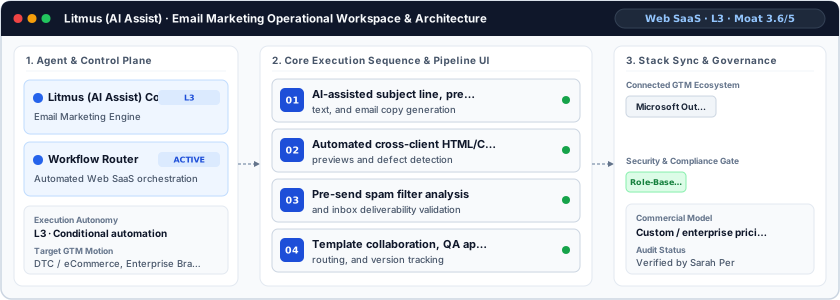
- AI-assisted subject line, preview: text, and email copy generation
- Automated cross-client HTML/CSS rendering: previews and defect detection
- Pre-send spam filter analysis: and inbox deliverability validation
- Template collaboration, QA approval: routing, and version tracking
Cons: operational limitations & risks
- Client Rendering Disconnect: AI copy generations often exceed layout constraints in dynamic responsive templates, requiring manual CSS adjustments for complex outlook engines.
- ESP Orchestration Boundary: The system lacks native outbound mail transmission capabilities, forcing continuous bidirectional API syncing across disparate third-party sending infrastructures.
- Downstream Attribution Lag: Pre-send optimization metrics do not dynamically retrain on post-click conversion events without secondary attribution pipeline integrations.
Litmus (AI Assist) TCO & deal-breaker stress test
Simulate 12-month stepped TCO, hidden cost multipliers, contract lock-in exposure, and stack failure modes using only facts verified by Sarah Per on · Capture SHA 7fdddd2b.
Litmus (AI Assist) triggers high-severity friction under your 5-seat / $800/mo constraints. Benchmark the verified subtrack alternatives below before committing.
| Plan / Tier | Verified Rate | Scale Fit | Scope & Quota Notes |
|---|---|---|---|
| Enterprise / Custom | Custom quote | 15–50+ seats (Enterprise SLA) | Sales-negotiated annual contract for custom volume, SSO/RBAC governance, and dedicated SLA. |
- Moat Score
- 3.6 / 5.0
- AI Autonomy
- L3
- Free Tier / Trial
- None disclosed
Triggered audit signals & failure modes
- Opaque Enterprise Quoting vs. SMB/Mid-Market BudgetVerified Pricing Ledger
Litmus (AI Assist) does not disclose a public self-serve floor (Custom / enterprise pricing). Buyers with a $800/mo cap face high sales-qualification friction.
- Sales-Gated Contract TermsFact-checked by Sarah Per
Commercial procurement operates entirely through tailored enterprise sales quotes based on organizational scale, testing volume, and user seat requirements.
- Primary Operational Bottleneck: Client Rendering DisconnectAudit by Sarah Per
AI copy generations often exceed layout constraints in dynamic responsive templates, requiring manual CSS adjustments for complex outlook engines.
Hidden TCO Multipliers & Quota Gates
- Client Rendering Disconnect: AI copy generations often exceed layout constraints in dynamic responsive templates, requiring manual CSS adjustments for complex outlook engines.
- ESP Orchestration Boundary: The system lacks native outbound mail transmission capabilities, forcing continuous bidirectional API syncing across disparate third-party sending infrastructures.
When to Walk Away & Negotiation Levers
- Walk away if you require transparent self-serve monthly billing or your budget ceiling is under $1,000/mo (Litmus (AI Assist) requires sales-gated custom quoting).
- Walk away if your workflow cannot tolerate client rendering disconnect: AI copy generations often exceed layout constraints in dynamic responsive templates, requiring manual CSS adjustments for complex outlook engines.
- Walk away if ESP orchestration boundary is a deal-breaker for your team: The system lacks native outbound mail transmission capabilities, forcing continuous bidirectional API syncing across disparate third-party sending infrastructures.
- Demand a 30- to 60-day paid pilot opt-out clause in the Litmus (AI Assist) order form before signing a 12-month enterprise commitment.
- Require a sandbox proof-of-concept testing client rendering disconnect against your live CRM/data schema before annual sign-off.
Ask a custom procurement or TCO stress-test question about Litmus (AI Assist)
Lower 5-seat floor (~$300/mo vs. Custom Quote) · Transparent self-serve entry without mandatory annual lock-in
Lower 5-seat floor (~$15/mo vs. Custom Quote) · Transparent self-serve entry without mandatory annual lock-in
Litmus (AI Assist) key entities, modules & ecosystem stack
Litmus (AI Assist) moat & subtrack positioning
Deep proprietary email rendering engine spanning hundreds of inbox clients combined with pre-send analytics and generative content assistance under Validity.
Editorial review
Fact-checked by Sarah Per (Principal Content Systems & Generative Media Editor) on .
Background
Architected as a specialized pre-send testing and content optimization layer, Litmus (AI Assist) serves corporate marketing operations and lifecycle development teams. Headquartered in the United States, the platform integrates generative text assistance directly into high-fidelity email verification pipelines. Now operating within Validity Engage, the system targets email developers and lifecycle marketing managers who require automated content generation paired with rigid rendering safeguards prior to broadcast.
How Litmus (AI Assist) works
Under the hood, the engine combines natural language generation APIs with Litmus's pre-existing HTML and CSS parsing infrastructure. When an operator inputs campaign objectives, target audience tags, or tone specifications, the natural language module produces variations of subject lines, preview headers, and body copy. These textual payloads are concurrently processed through a virtual rendering matrix simulating over one hundred desktop, mobile, and webmail clients. The system functions at an L3 conditional autonomy tier: while the LLM generates structural copy and flags rendering defects, deployment requires human verification and explicit dispatch approval.
Limitations
Operational considerations and platform boundaries include:
- Client Rendering Disconnect: AI copy generations often exceed layout constraints in dynamic responsive templates, requiring manual CSS adjustments for complex outlook engines.
- ESP Orchestration Boundary: The system lacks native outbound mail transmission capabilities, forcing continuous bidirectional API syncing across disparate third-party sending infrastructures.
- Downstream Attribution Lag: Pre-send optimization metrics do not dynamically retrain on post-click conversion events without secondary attribution pipeline integrations.
Litmus (AI Assist) pricing
Commercial procurement operates entirely through tailored enterprise sales quotes based on organizational scale, testing volume, and user seat requirements. Prospective buyers must contact the Validity Engage commercial team to establish contract tiers, with licensing fees scaling according to monthly client preview consumption, integrated workspace seats, and advanced security configurations.
How Litmus (AI Assist) compares
Within email lifecycle operations, Litmus (AI Assist) focuses on pre-send QA and inbox-render fidelity, differing fundamentally from 10Web AI, which automates web development pipelines, and AB Tasty, which targets client-side digital experience experimentation. Unlike Ability.ai, which centers on autonomous campaign orchestration, Litmus provides granular client-level rendering certainty combined with copilot text generation. It represents a suitable solution for regulated enterprises requiring multi-client template testing alongside governed generative drafting.
Frequently asked questions about Litmus (AI Assist)
How much does Litmus (AI Assist) cost and does it require a custom enterprise quote?
Published pricing summary for Litmus (AI Assist): Custom / enterprise pricing. A permanent free plan is not disclosed for Litmus (AI Assist). Commercial procurement operates entirely through tailored enterprise sales quotes based on organizational scale, testing volume, and user seat requirements.
How does Litmus (AI Assist) work and how autonomous is its AI architecture?
Pre-send email testing, rendering diagnostics, and generative AI drafting engine optimizing cross-client template delivery and engagement. Within Email Marketing (AI Email Marketing & Lifecycle Journeys), MarTechRadar rates its execution architecture at L3 · Conditional automation with a verified Moat Score of 3.6 / 5.0 (Proprietary moat). Deep proprietary email rendering engine spanning hundreds of inbox clients combined with pre-send analytics and generative content assistance under Validity.
What are the main limitations of Litmus (AI Assist) and when should buyers walk away?
Based on our editorial technical audit, key operational considerations and boundaries for Litmus (AI Assist) include: (1) Client Rendering Disconnect: AI copy generations often exceed layout constraints in dynamic responsive templates, requiring manual CSS adjustments for complex outlook engines. (2) ESP Orchestration Boundary: The system lacks native outbound mail transmission capabilities, forcing continuous bidirectional API syncing across disparate third-party sending infrastructures. (3) Downstream Attribution Lag: Pre-send optimization metrics do not dynamically retrain on post-click conversion events without secondary attribution pipeline integrations. Primary procurement walk-away rule: Walk away if you require transparent self-serve monthly billing or your budget ceiling is under $1,000/mo (Litmus (AI Assist) requires sales-gated custom quoting).
What integrations, compliance certifications, and contract terms apply to Litmus (AI Assist)?
Verified ecosystem and stack integrations include Microsoft Outlook. First-party governance and developer endpoints verified on domain include: Status (https://status.litmus.com). Key TCO multiplier to watch: Client Rendering Disconnect (AI copy generations often exceed layout constraints in dynamic responsive templates, requiring manual CSS adjustments for complex outlook engines.) Before signing a contract, procurement teams should demand a 30- to 60-day paid pilot opt-out clause in the Litmus (AI Assist) order form before signing a 12-month enterprise commitment.
What are the best Litmus (AI Assist) alternatives and head-to-head competitors in 2026?
Top fact-checked alternatives to Litmus (AI Assist) in Email Marketing (AI Email Marketing & Lifecycle Journeys) include MAI Agents (Free plan · $0/mo · Enterprise plan), AIgency (From $300/mo), AxleAuto.ai (Free plan · $0/mo · Enterprise plan), moxio (Custom / enterprise pricing). Within email lifecycle operations, Litmus (AI Assist) focuses on pre-send QA and inbox-render fidelity, differing fundamentally from 10Web AI, which automates web development pipelines, and AB Tasty, which targets client-side digital experience experimentation.
Verified sources & evidence trail
- Official product domain: https://litmus.com
- Commercial pricing verification: Verified against official vendor pricing policy (Custom / enterprise pricing)
- First-party governance & documentation links: System Status · Changelog · Terms · Privacy
- Editorial audit sign-off: Fact-checked by Sarah Per on under the MarTechRadar Evidence-Ledger Protocol.