LoveAi Review (2026): Sales Intelligence Pricing, Limits & Alternatives
Bottom line
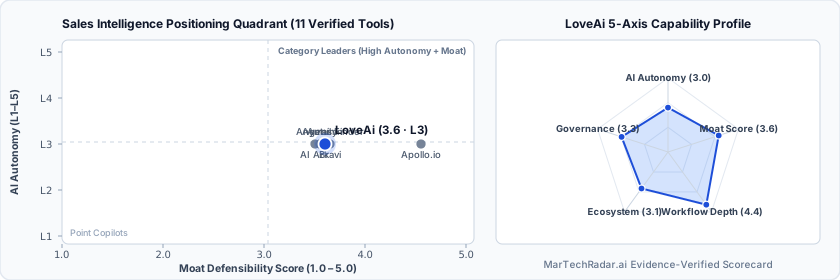
LoveAi is a Web SaaS tool for Sales Intelligence (Lead Enrichment & Waterfall Orchestration) in AI SDR & Outbound. Pricing: Custom / enterprise pricing. Best suited to B2B Sales Leaders, SDR/BDR Teams and Revenue Operations (RevOps). Editor ratings: AI autonomy L3 (conditional automation); moat score 3.6/5.0 (Proprietary moat). Fact-checked by Jagmeet Sine on Oct 15, 2026.
B2B lead enrichment and waterfall contact intelligence platform orchestrating automated multi-provider data validation and outbound qualification workflows.
LoveAi buyer fit verdict: when to choose vs. when to walk away
Choose LoveAi if (Best Fit)
- Target ICP & Stack Fit: You operate as B2B Sales Leaders, SDR/BDR Teams and Revenue Operations (RevOps) requiring a Web SaaS deployment for Sales Intelligence, with verified ecosystem connectivity for Apollo.io.
- L3 Architecture & Defensibility: Proprietary waterfall sequencing engine combining multi-source data aggregation, synthetic email verification, and automated CRM field mapping across global outbound pipelines.
- Commercial Model Fit: Your procurement budget aligns with Custom / enterprise pricing.
Walk away from LoveAi if (Deal-Breakers)
- Walk away if you require transparent self-serve monthly billing or your budget ceiling is under $1,000/mo (LoveAi requires sales-gated custom quoting).
- Walk away if your workflow cannot tolerate cascading API latency: Multi-vendor sequential waterfall logic introduces cumulative round-trip latency during batch processing, slowing bulk enrichment jobs compared to single-vendor lookups.
- Walk away if credit burn ambiguity is a deal-breaker for your team: Downstream query failovers risk depleting enrichment allowances across intermediary databases before hitting a structured data match.
LoveAi key facts & scorecard
| Pricing | Custom / enterprise pricing |
|---|---|
| Free plan | No / not disclosed |
| Delivery | Web SaaS |
| Audience | B2B Sales Leaders, SDR/BDR Teams, Revenue Operations (RevOps) |
| AI autonomy level | L3 · Conditional automationEditor-verified |
| Moat tier & score | 3.6 / 5.0 · Proprietary moatEditor-verified |
| Funding | Undisclosed |
| Ecosystem integrations | Apollo.io |
| Headquarters | Moldova |
| Founded | 2024 |
| Last verified |
LoveAi pros & cons: strengths vs. operational limitations
Pros: core strengths & capabilities
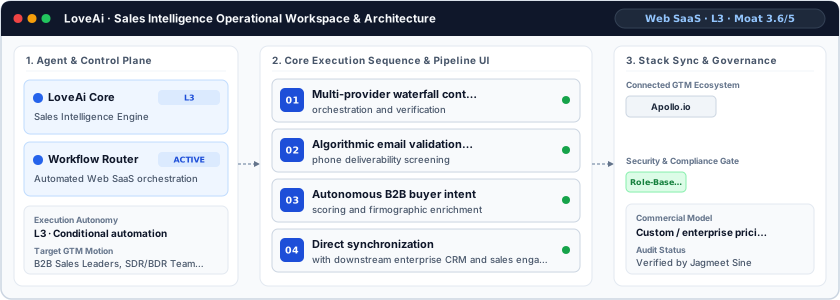
- Multi-provider waterfall contact data: orchestration and verification
- Algorithmic email validation and: phone deliverability screening
- Autonomous B2B buyer intent: scoring and firmographic enrichment
- Direct synchronization: with downstream enterprise CRM and sales engagement tools
Cons: operational limitations & risks
- Cascading API Latency: Multi-vendor sequential waterfall logic introduces cumulative round-trip latency during batch processing, slowing bulk enrichment jobs compared to single-vendor lookups.
- Credit Burn Ambiguity: Downstream query failovers risk depleting enrichment allowances across intermediary databases before hitting a structured data match.
- Schema Drift Maintenance: Dynamic CRM integrations require continuous field-mapping recalibration when third-party data providers modify nested JSON property structures.
LoveAi TCO & deal-breaker stress test
Simulate 12-month stepped TCO, hidden cost multipliers, contract lock-in exposure, and stack failure modes using only facts verified by Jagmeet Sine on .
LoveAi triggers high-severity friction under your 5-seat / $800/mo constraints. Benchmark the verified subtrack alternatives below before committing.
| Plan / Tier | Verified Rate | Scale Fit | Scope & Quota Notes |
|---|---|---|---|
| Enterprise / Custom | Custom quote | 15–50+ seats (Enterprise SLA) | Sales-negotiated annual contract for custom volume, SSO/RBAC governance, and dedicated SLA. |
- Moat Score
- 3.6 / 5.0
- AI Autonomy
- L3
- Free Tier / Trial
- None disclosed
Triggered audit signals & failure modes
- Opaque Enterprise Quoting vs. SMB/Mid-Market BudgetVerified Pricing Ledger
LoveAi does not disclose a public self-serve floor (Custom / enterprise pricing). Buyers with a $800/mo cap face high sales-qualification friction.
- Sales-Gated Contract TermsFact-checked by Jagmeet Sine
LoveAi distributes its platform under custom enterprise pricing, with commercial contracts negotiated on request through tailored enterprise sales quotes based on organizational scale and seats.
- Usage / Credit Burn VolatilityCommercial Model Audit
LoveAi uses credit or usage-metered billing (Custom / enterprise pricing). High-volume automated workflows across 5 seats can trigger mid-cycle overage charges.
- Primary Operational Bottleneck: Credit Burn AmbiguityAudit by Jagmeet Sine
Downstream query failovers risk depleting enrichment allowances across intermediary databases before hitting a structured data match.
Hidden TCO Multipliers & Quota Gates
- Credit & Usage Burn Multiplier: Automated workflows consume metered credits/usage quotas; multi-step enrichment, voice minutes, or high-frequency agent runs can trigger mid-cycle top-up packs.
- Cascading API Latency: Multi-vendor sequential waterfall logic introduces cumulative round-trip latency during batch processing, slowing bulk enrichment jobs compared to single-vendor lookups.
- Credit Burn Ambiguity: Downstream query failovers risk depleting enrichment allowances across intermediary databases before hitting a structured data match.
When to Walk Away & Negotiation Levers
- Walk away if you require transparent self-serve monthly billing or your budget ceiling is under $1,000/mo (LoveAi requires sales-gated custom quoting).
- Walk away if your workflow cannot tolerate cascading API latency: Multi-vendor sequential waterfall logic introduces cumulative round-trip latency during batch processing, slowing bulk enrichment jobs compared to single-vendor lookups.
- Walk away if credit burn ambiguity is a deal-breaker for your team: Downstream query failovers risk depleting enrichment allowances across intermediary databases before hitting a structured data match.
- Demand a 30- to 60-day paid pilot opt-out clause in the LoveAi order form before signing a 12-month enterprise commitment.
- Require a sandbox proof-of-concept testing cascading API latency against your live CRM/data schema before annual sign-off.
Ask a custom procurement or TCO stress-test question about LoveAi
Lower 5-seat floor (~$245/mo vs. Custom Quote) · Transparent self-serve entry without mandatory annual lock-in
Lower 5-seat floor (~$20/mo vs. Custom Quote) · Transparent self-serve entry without mandatory annual lock-in
LoveAi key entities, modules & ecosystem stack
LoveAi moat & subtrack positioning
Proprietary waterfall sequencing engine combining multi-source data aggregation, synthetic email verification, and automated CRM field mapping across global outbound pipelines.
Editorial review
Fact-checked by Jagmeet Sine (Senior MarTech Infrastructure & Agentic Workflow Architect) on .
Background
Within modern revenue ecosystems, data degradation and fragmented sourcing remain structural impediments to outbound pipeline generation. Headquartered in Moldova, LoveAi provides a B2B lead enrichment and waterfall orchestration system targeted at revenue operations architects and demand generation leaders. The platform sits between raw contact registries and downstream CRM environments, systematizing contact discovery, identity resolution, and firmographic append workflows across distributed enterprise sales pipelines.
How LoveAi works
Architecturally, LoveAi operates as a sequential waterfall engine that routes incoming domain or account identifiers across discrete third-party data vendor endpoints. The ingestion layer applies identity resolution logic to de-duplicate corporate domains before triggering cascading queries across specialized vendor indexes. Deliverability heuristics run synthetic MX record pings and SMTP handshakes to discard catch-all and invalid addresses. Enrichments are subsequently mapped to standardized schema models and pushed via asynchronous webhooks directly into outbound sequencing queues.
Limitations
Operational considerations and platform boundaries include:
- Cascading API Latency: Multi-vendor sequential waterfall logic introduces cumulative round-trip latency during batch processing, slowing bulk enrichment jobs compared to single-vendor lookups.
- Credit Burn Ambiguity: Downstream query failovers risk depleting enrichment allowances across intermediary databases before hitting a structured data match.
- Schema Drift Maintenance: Dynamic CRM integrations require continuous field-mapping recalibration when third-party data providers modify nested JSON property structures.
LoveAi pricing
LoveAi distributes its platform under custom enterprise pricing, with commercial contracts negotiated on request through tailored enterprise sales quotes based on organizational scale and seats. Procurement terms reflect enrichment volume requirements, monthly record consumption limits, and direct programmatic API access rights without standardized self-service public tiers.
How LoveAi compares
In contrast to all-in-one execution platforms like Apollo.io, which prioritize native outbound dialers and cadence tools over composable data piping, LoveAi focuses on upstream waterfall ingestion. Compared to Clay, which emphasizes flexible spreadsheet-style automation and generative web scraping, LoveAi provides a more rigid, dedicated verification pipeline. Furthermore, when measured against AI Ark's predictive intent routing, LoveAi prioritizes transactional identity resolution and verification deliverability. It remains best aligned for enterprise outbound teams seeking automated data validation layers within established CRM stacks. It is best suited for enterprise marketing teams and growth practitioners seeking disciplined workflow orchestration.
Frequently asked questions about LoveAi
How much does LoveAi cost and does it require a custom enterprise quote?
Published pricing summary for LoveAi: Custom / enterprise pricing. A permanent free plan is not disclosed for LoveAi. LoveAi distributes its platform under custom enterprise pricing, with commercial contracts negotiated on request through tailored enterprise sales quotes based on organizational scale and seats.
How does LoveAi work and how autonomous is its AI architecture?
B2B lead enrichment and waterfall contact intelligence platform orchestrating automated multi-provider data validation and outbound qualification workflows. Within Sales Intelligence (Lead Enrichment & Waterfall Orchestration), MarTechRadar rates its execution architecture at L3 · Conditional automation with a verified Moat Score of 3.6 / 5.0 (Proprietary moat). Proprietary waterfall sequencing engine combining multi-source data aggregation, synthetic email verification, and automated CRM field mapping across global outbound pipelines.
What are the main limitations of LoveAi and when should buyers walk away?
Based on our editorial technical audit, key operational considerations and boundaries for LoveAi include: (1) Cascading API Latency: Multi-vendor sequential waterfall logic introduces cumulative round-trip latency during batch processing, slowing bulk enrichment jobs compared to single-vendor lookups. (2) Credit Burn Ambiguity: Downstream query failovers risk depleting enrichment allowances across intermediary databases before hitting a structured data match. (3) Schema Drift Maintenance: Dynamic CRM integrations require continuous field-mapping recalibration when third-party data providers modify nested JSON property structures. Primary procurement walk-away rule: Walk away if you require transparent self-serve monthly billing or your budget ceiling is under $1,000/mo (LoveAi requires sales-gated custom quoting).
What integrations, compliance certifications, and contract terms apply to LoveAi?
Verified ecosystem and stack integrations include Apollo.io. Key TCO multiplier to watch: Credit & Usage Burn Multiplier (Automated workflows consume metered credits/usage quotas; multi-step enrichment, voice minutes, or high-frequency agent runs can trigger mid-cycle top-up packs.) Before signing a contract, procurement teams should demand a 30- to 60-day paid pilot opt-out clause in the LoveAi order form before signing a 12-month enterprise commitment.
What are the best LoveAi alternatives and head-to-head competitors in 2026?
Top fact-checked alternatives to LoveAi in Sales Intelligence (Lead Enrichment & Waterfall Orchestration) include CLODO (Pricing not disclosed), Outscraper (Pricing not disclosed), Northlight (Free plan · $0/mo · Enterprise plan), Typecharm (Custom / enterprise pricing). In contrast to all-in-one execution platforms like Apollo.io, which prioritize native outbound dialers and cadence tools over composable data piping, LoveAi focuses on upstream waterfall ingestion.
Verified sources & evidence trail
- Official product domain: https://loveai.pro/
- Commercial pricing verification: Verified against official vendor pricing policy (Custom / enterprise pricing)
- Editorial audit sign-off: Fact-checked by Jagmeet Sine on under the MarTechRadar Evidence-Ledger Protocol.