Lumar (DeepCrawl) Review (2026): Technical SEO Pricing, Limits & Alternatives
Bottom line
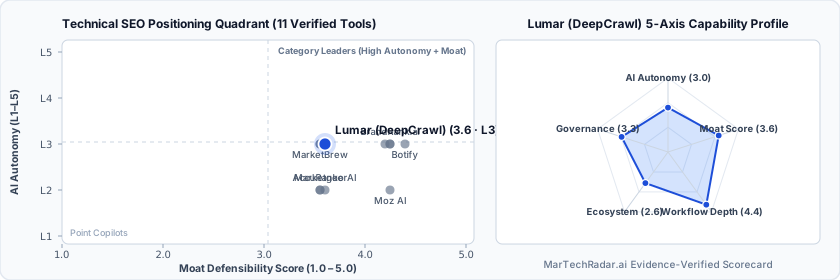
Lumar (DeepCrawl) is a Web SaaS tool for Technical SEO (Technical SEO Auditing & Indexing) in GEO & AI SEO. Pricing: Custom / enterprise pricing. Best suited to DTC / eCommerce and Enterprise Brands. Editor ratings: AI autonomy L3 (conditional automation); moat score 3.6/5.0 (Proprietary moat). Fact-checked by Jiacky Lee on Oct 15, 2026.
Enterprise cloud-native website intelligence platform that automates technical SEO auditing, web accessibility compliance, and generative engine.
Lumar (DeepCrawl) buyer fit verdict: when to choose vs. when to walk away
Choose Lumar (DeepCrawl) if (Best Fit)
- Target ICP & Stack Fit: You operate as DTC / eCommerce and Enterprise Brands requiring a Web SaaS deployment for Technical SEO.
- L3 Architecture & Defensibility: High-throughput cloud crawling pipeline capable of handling tens of millions of JavaScript-rendered pages without infrastructure degradation, coupled with automated CI/CD SEO regression testing gateways.
- Commercial Model Fit: Your procurement budget aligns with Custom / enterprise pricing.
Walk away from Lumar (DeepCrawl) if (Deal-Breakers)
- Walk away if you require transparent self-serve monthly billing or your budget ceiling is under $1,000/mo (Lumar (DeepCrawl) requires sales-gated custom quoting).
- Walk away if your workflow cannot tolerate rendering compute overhead: Large-scale JavaScript rendering across millions of URLs introduces significant compute queue delays and credit depletion compared to raw HTML parsing.
- Walk away if staging firewall authentication is a deal-breaker for your team: Executing automated CI/CD audits across pre-production environments frequently requires bespoke IP whitelisting or tunnel maintenance through corporate enterprise firewalls.
Lumar (DeepCrawl) key facts & scorecard
| Pricing | Custom / enterprise pricing |
|---|---|
| Free plan | No / not disclosed |
| Delivery | Web SaaS |
| Audience | DTC / eCommerce, Enterprise Brands |
| AI autonomy level | L3 · Conditional automationEditor-verified |
| Moat tier & score | 3.6 / 5.0 · Proprietary moatEditor-verified |
| Funding | Venture-backed |
| Governance & docs | System Status ↗ · Terms ↗ · Privacy ↗ |
| Headquarters | United States |
| Last verified |
Lumar (DeepCrawl) pros & cons: strengths vs. operational limitations
Pros: core strengths & capabilities
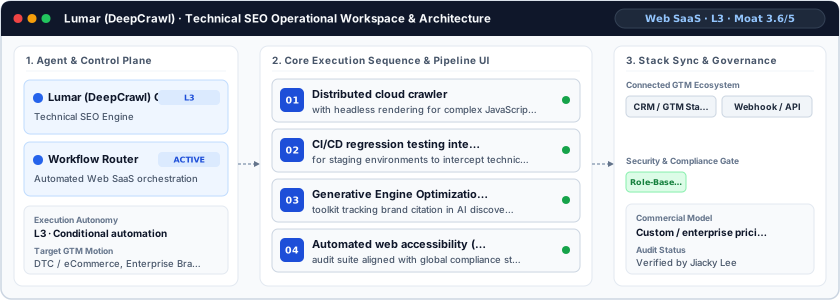
- Distributed cloud crawler: with headless rendering for complex JavaScript frameworks
- CI/CD regression testing integration: for staging environments to intercept technical debt
- Generative Engine Optimization (GEO): toolkit tracking brand citation in AI discovery models
- Automated web accessibility (a11y): audit suite aligned with global compliance standards
Cons: operational limitations & risks
- Rendering Compute Overhead: Large-scale JavaScript rendering across millions of URLs introduces significant compute queue delays and credit depletion compared to raw HTML parsing.
- Staging Firewall Authentication: Executing automated CI/CD audits across pre-production environments frequently requires bespoke IP whitelisting or tunnel maintenance through corporate enterprise firewalls.
- GEO Metric Nascent Standardization: Synthetic generative engine optimization scoring relies on fluctuating third-party LLM response patterns, resulting in higher metric variance than deterministic search ranking indicators.
Lumar (DeepCrawl) TCO & deal-breaker stress test
Simulate 12-month stepped TCO, hidden cost multipliers, contract lock-in exposure, and stack failure modes using only facts verified by Jiacky Lee on · Capture SHA 8dd85228.
Lumar (DeepCrawl) triggers high-severity friction under your 5-seat / $800/mo constraints. Benchmark the verified subtrack alternatives below before committing.
| Plan / Tier | Verified Rate | Scale Fit | Scope & Quota Notes |
|---|---|---|---|
| Enterprise / Custom | Custom quote | 15–50+ seats (Enterprise SLA) | Sales-negotiated annual contract for custom volume, SSO/RBAC governance, and dedicated SLA. |
- Moat Score
- 3.6 / 5.0
- AI Autonomy
- L3
- Free Tier / Trial
- None disclosed
Triggered audit signals & failure modes
- Opaque Enterprise Quoting vs. SMB/Mid-Market BudgetVerified Pricing Ledger
Lumar (DeepCrawl) does not disclose a public self-serve floor (Custom / enterprise pricing). Buyers with a $800/mo cap face high sales-qualification friction.
- Sales-Gated Contract TermsFact-checked by Jiacky Lee
Pricing is available on request through tailored enterprise sales quotes, with custom enterprise tiers structured around organizational scale, user seats, and workflow volume.
- Primary Operational Bottleneck: Rendering Compute OverheadAudit by Jiacky Lee
Large-scale JavaScript rendering across millions of URLs introduces significant compute queue delays and credit depletion compared to raw HTML parsing.
Hidden TCO Multipliers & Quota Gates
- Credit & Usage Burn Multiplier: Automated workflows consume metered credits/usage quotas; multi-step enrichment, voice minutes, or high-frequency agent runs can trigger mid-cycle top-up packs.
- Rendering Compute Overhead: Large-scale JavaScript rendering across millions of URLs introduces significant compute queue delays and credit depletion compared to raw HTML parsing.
- Staging Firewall Authentication: Executing automated CI/CD audits across pre-production environments frequently requires bespoke IP whitelisting or tunnel maintenance through corporate enterprise firewalls.
When to Walk Away & Negotiation Levers
- Walk away if you require transparent self-serve monthly billing or your budget ceiling is under $1,000/mo (Lumar (DeepCrawl) requires sales-gated custom quoting).
- Walk away if your workflow cannot tolerate rendering compute overhead: Large-scale JavaScript rendering across millions of URLs introduces significant compute queue delays and credit depletion compared to raw HTML parsing.
- Walk away if staging firewall authentication is a deal-breaker for your team: Executing automated CI/CD audits across pre-production environments frequently requires bespoke IP whitelisting or tunnel maintenance through corporate enterprise firewalls.
- Demand a 30- to 60-day paid pilot opt-out clause in the Lumar (DeepCrawl) order form before signing a 12-month enterprise commitment.
- Require a sandbox proof-of-concept testing rendering compute overhead against your live CRM/data schema before annual sign-off.
Ask a custom procurement or TCO stress-test question about Lumar (DeepCrawl)
Lower 5-seat floor (~$11/mo vs. Custom Quote) · Transparent self-serve entry without mandatory annual lock-in
Lower 5-seat floor (~$224/mo vs. Custom Quote) · Transparent self-serve entry without mandatory annual lock-in
Lumar (DeepCrawl) moat & subtrack positioning
High-throughput cloud crawling pipeline capable of handling tens of millions of JavaScript-rendered pages without infrastructure degradation, coupled with automated CI/CD SEO regression testing gateways.
Editorial review
Fact-checked by Jiacky Lee (Managing Editor, AI Autonomy & Moat Methodology) on .
Background
Headquartered in the United States, Lumar (DeepCrawl) functions as an enterprise website intelligence and technical audit platform designed to protect organic discovery across complex digital estates. Engineered primarily for enterprise technical SEO directors, web engineering leads, and digital operations teams, the platform translates raw site architecture into actionable diagnostic telemetry. As modern organic acquisition shifts from standard search indices to generative discovery engines, Lumar addresses the operational requirement of keeping millions of dynamic, JavaScript-rendered URLs indexable, compliant, and architecturally sound.
How Lumar (DeepCrawl) works
At its technical foundation, Lumar operates a distributed cloud crawling infrastructure paired with a headless browser rendering pipeline capable of processing large-scale single-page applications. The system parses document object models, extracts render-blocking scripts, and maps internal linking topologies at scale. Operating at an L3 autonomy profile, Lumar automates crawl scheduling, anomaly detection, and regression testing via continuous integration plugins that intercept code releases when SEO regressions occur. Scraped telemetry feeds into structured dashboards covering technical SEO parameters, generative engine optimization signals, web accessibility standards, and custom analytics extracts.
Limitations
Operational considerations and platform boundaries include:
- Rendering Compute Overhead: Large-scale JavaScript rendering across millions of URLs introduces significant compute queue delays and credit depletion compared to raw HTML parsing.
- Staging Firewall Authentication: Executing automated CI/CD audits across pre-production environments frequently requires bespoke IP whitelisting or tunnel maintenance through corporate enterprise firewalls.
- GEO Metric Nascent Standardization: Synthetic generative engine optimization scoring relies on fluctuating third-party LLM response patterns, resulting in higher metric variance than deterministic search ranking indicators.
Lumar (DeepCrawl) pricing
Pricing is available on request through tailored enterprise sales quotes, with custom enterprise tiers structured around organizational scale, user seats, and workflow volume.
How Lumar (DeepCrawl) compares
Within technical website intelligence, Lumar competes directly with Botify, Screaming Frog SEO, and Sitebulb. Unlike desktop-bound utilities such as Screaming Frog SEO and Sitebulb—which rely on local CPU and memory constraints—Lumar offloads execution to elastic cloud infrastructure, enabling simultaneous enterprise-scale audits. While Botify focuses heavily on log file analysis and automated server-side edge rendering, Lumar emphasizes pre-production continuous integration safeguards and broader cross-discipline auditing, including web accessibility and generative engine optimization. The platform remains optimal for global e-commerce and media enterprises requiring automated deployment gates. It is best suited for enterprise marketing teams and growth practitioners seeking disciplined workflow orchestration.
Frequently asked questions about Lumar (DeepCrawl)
How much does Lumar (DeepCrawl) cost and does it require a custom enterprise quote?
Published pricing summary for Lumar (DeepCrawl): Custom / enterprise pricing. A permanent free plan is not disclosed for Lumar (DeepCrawl). Pricing is available on request through tailored enterprise sales quotes, with custom enterprise tiers structured around organizational scale, user seats, and workflow volume.
How does Lumar (DeepCrawl) work and how autonomous is its AI architecture?
Enterprise cloud-native website intelligence platform that automates technical SEO auditing, web accessibility compliance, and generative engine. Within Technical SEO (Technical SEO Auditing & Indexing), MarTechRadar rates its execution architecture at L3 · Conditional automation with a verified Moat Score of 3.6 / 5.0 (Proprietary moat). High-throughput cloud crawling pipeline capable of handling tens of millions of JavaScript-rendered pages without infrastructure degradation, coupled with automated CI/CD SEO regression testing gateways.
What are the main limitations of Lumar (DeepCrawl) and when should buyers walk away?
Based on our editorial technical audit, key operational considerations and boundaries for Lumar (DeepCrawl) include: (1) Rendering Compute Overhead: Large-scale JavaScript rendering across millions of URLs introduces significant compute queue delays and credit depletion compared to raw HTML parsing. (2) Staging Firewall Authentication: Executing automated CI/CD audits across pre-production environments frequently requires bespoke IP whitelisting or tunnel maintenance through corporate enterprise firewalls. (3) GEO Metric Nascent Standardization: Synthetic generative engine optimization scoring relies on fluctuating third-party LLM response patterns, resulting in higher metric variance than deterministic search ranking indicators. Primary procurement walk-away rule: Walk away if you require transparent self-serve monthly billing or your budget ceiling is under $1,000/mo (Lumar (DeepCrawl) requires sales-gated custom quoting).
What integrations, compliance certifications, and contract terms apply to Lumar (DeepCrawl)?
First-party governance and developer endpoints verified on domain include: Status (https://status.lumar.io). Key TCO multiplier to watch: Credit & Usage Burn Multiplier (Automated workflows consume metered credits/usage quotas; multi-step enrichment, voice minutes, or high-frequency agent runs can trigger mid-cycle top-up packs.) Before signing a contract, procurement teams should demand a 30- to 60-day paid pilot opt-out clause in the Lumar (DeepCrawl) order form before signing a 12-month enterprise commitment.
What are the best Lumar (DeepCrawl) alternatives and head-to-head competitors in 2026?
Top fact-checked alternatives to Lumar (DeepCrawl) in Technical SEO (Technical SEO Auditing & Indexing) include Screaming Frog SEO (Free plan · £169–£199/yr), Sitebulb ($11–$125/mo), MarketBrew (Custom / enterprise pricing), IndexNow Automation (Custom / enterprise pricing). Within technical website intelligence, Lumar competes directly with Botify, Screaming Frog SEO, and Sitebulb.
Verified sources & evidence trail
- Official product domain: https://lumar.io
- Commercial pricing verification: Verified against official vendor pricing policy (Custom / enterprise pricing)
- First-party governance & documentation links: System Status · Terms · Privacy
- Editorial audit sign-off: Fact-checked by Jiacky Lee on under the MarTechRadar Evidence-Ledger Protocol.