Marketmuseai Review (2026): Content Optimization Pricing, Limits & Alternatives
Bottom line
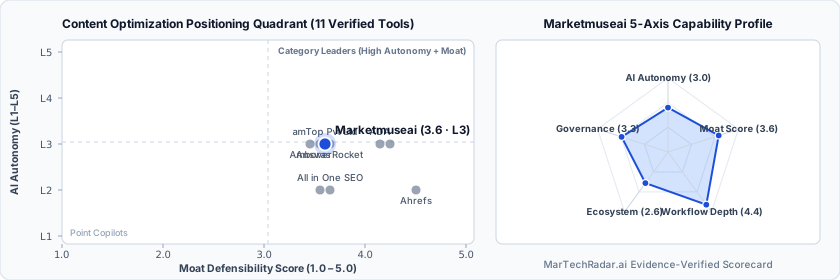
Marketmuseai is a Web SaaS tool for Content Optimization (Content Optimization & SERP Intelligence) in GEO & AI SEO. Pricing: Custom / enterprise pricing. Best suited to B2B SaaS. Editor ratings: AI autonomy L3 (conditional automation); moat score 3.6/5.0 (Proprietary moat). Fact-checked by Jiacky Lee on Oct 15, 2026.
Autonomous content intelligence and SERP optimization platform that applies semantic vector modeling to audit website architectures and identify topical.
Marketmuseai buyer fit verdict: when to choose vs. when to walk away
Choose Marketmuseai if (Best Fit)
- Target ICP & Stack Fit: You operate as B2B SaaS requiring a Web SaaS deployment for Content Optimization.
- L3 Architecture & Defensibility: Defensible topical authority scoring algorithms and personalized difficulty metrics derived from deep semantic vector graphs rather than third-party search volume databases.
- Commercial Model Fit: Your procurement budget aligns with Custom / enterprise pricing.
Walk away from Marketmuseai if (Deal-Breakers)
- Walk away if you require transparent self-serve monthly billing or your budget ceiling is under $1,000/mo (Marketmuseai requires sales-gated custom quoting).
- Walk away if your workflow cannot tolerate crawl processing latency: Ingesting and indexing substantial enterprise catalogs exceeding hundreds of thousands of URLs induces significant vector computation queues, delaying initial domain-wide gap visualizations.
- Walk away if dynamic javascript rendering overhead is a deal-breaker for your team: Single-page web applications and client-side rendered scripts can obscure critical contextual text blocks, requiring manual crawler configuration to ensure accurate semantic parsing.
Marketmuseai key facts & scorecard
| Pricing | Custom / enterprise pricing |
|---|---|
| Free plan | No / not disclosed |
| Delivery | Web SaaS |
| Audience | B2B SaaS |
| AI autonomy level | L3 · Conditional automationEditor-verified |
| Moat tier & score | 3.6 / 5.0 · Proprietary moatEditor-verified |
| Funding | Open source |
| Headquarters | United States |
| Last verified |
Marketmuseai pros & cons: strengths vs. operational limitations
Pros: core strengths & capabilities
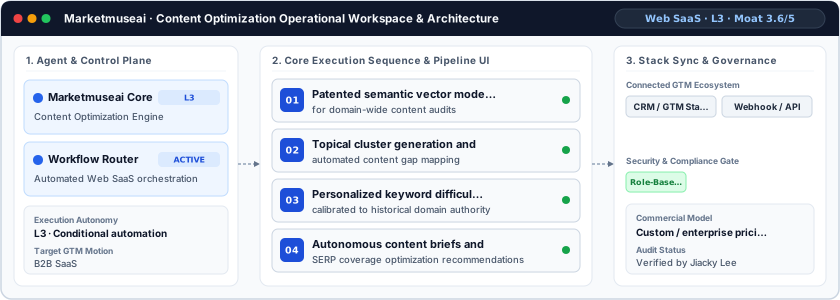
- Patented semantic vector modeling: for domain-wide content audits
- Topical cluster generation and: automated content gap mapping
- Personalized keyword difficulty scoring: calibrated to historical domain authority
- Autonomous content briefs and: SERP coverage optimization recommendations
Cons: operational limitations & risks
- Crawl processing latency: Ingesting and indexing substantial enterprise catalogs exceeding hundreds of thousands of URLs induces significant vector computation queues, delaying initial domain-wide gap visualizations.
- Dynamic JavaScript rendering overhead: Single-page web applications and client-side rendered scripts can obscure critical contextual text blocks, requiring manual crawler configuration to ensure accurate semantic parsing.
- Real-time search volatility calibration: Sudden search engine algorithm revisions cause short-term variance between historical topical authority scores and real-time live SERP ranking positions.
Marketmuseai TCO & deal-breaker stress test
Simulate 12-month stepped TCO, hidden cost multipliers, contract lock-in exposure, and stack failure modes using only facts verified by Jiacky Lee on · Capture SHA e3b0c442.
Marketmuseai triggers high-severity friction under your 5-seat / $800/mo constraints. Benchmark the verified subtrack alternatives below before committing.
| Plan / Tier | Verified Rate | Scale Fit | Scope & Quota Notes |
|---|---|---|---|
| Enterprise / Custom | Custom quote | 15–50+ seats (Enterprise SLA) | Sales-negotiated annual contract for custom volume, SSO/RBAC governance, and dedicated SLA. |
- Moat Score
- 3.6 / 5.0
- AI Autonomy
- L3
- Free Tier / Trial
- None disclosed
Triggered audit signals & failure modes
- Opaque Enterprise Quoting vs. SMB/Mid-Market BudgetVerified Pricing Ledger
Marketmuseai does not disclose a public self-serve floor (Custom / enterprise pricing). Buyers with a $800/mo cap face high sales-qualification friction.
- Sales-Gated Contract TermsFact-checked by Jiacky Lee
Marketmuseai provides its software through custom enterprise pricing, requiring prospective customers to contact sales directly.
- Primary Operational Bottleneck: Crawl processing latencyAudit by Jiacky Lee
Ingesting and indexing substantial enterprise catalogs exceeding hundreds of thousands of URLs induces significant vector computation queues, delaying initial domain-wide gap visualizations.
Hidden TCO Multipliers & Quota Gates
- Crawl processing latency: Ingesting and indexing substantial enterprise catalogs exceeding hundreds of thousands of URLs induces significant vector computation queues, delaying initial domain-wide gap visualizations.
- Dynamic JavaScript rendering overhead: Single-page web applications and client-side rendered scripts can obscure critical contextual text blocks, requiring manual crawler configuration to ensure accurate semantic parsing.
When to Walk Away & Negotiation Levers
- Walk away if you require transparent self-serve monthly billing or your budget ceiling is under $1,000/mo (Marketmuseai requires sales-gated custom quoting).
- Walk away if your workflow cannot tolerate crawl processing latency: Ingesting and indexing substantial enterprise catalogs exceeding hundreds of thousands of URLs induces significant vector computation queues, delaying initial domain-wide gap visualizations.
- Walk away if dynamic javascript rendering overhead is a deal-breaker for your team: Single-page web applications and client-side rendered scripts can obscure critical contextual text blocks, requiring manual crawler configuration to ensure accurate semantic parsing.
- Demand a 30- to 60-day paid pilot opt-out clause in the Marketmuseai order form before signing a 12-month enterprise commitment.
- Require a sandbox proof-of-concept testing crawl processing latency against your live CRM/data schema before annual sign-off.
Ask a custom procurement or TCO stress-test question about Marketmuseai
Lower 5-seat floor (~$29/mo vs. Custom Quote) · Transparent self-serve entry without mandatory annual lock-in
Lower 5-seat floor (~$50/mo vs. Custom Quote) · Transparent self-serve entry without mandatory annual lock-in
Marketmuseai moat & subtrack positioning
Defensible topical authority scoring algorithms and personalized difficulty metrics derived from deep semantic vector graphs rather than third-party search volume databases.
Editorial review
Fact-checked by Jiacky Lee (Managing Editor, AI Autonomy & Moat Methodology) on .
Background
Content strategy leaders face severe capital waste when scaling editorial output without topical authority. Headquartered in the United States, Marketmuseai addresses this operational bottleneck by shifting organic search strategy from uncalibrated keyword volume chasing to algorithmic domain coverage. Designed specifically for enterprise search directors and corporate content strategists, the platform operates within the content optimization and SERP intelligence landscape. It automates inventory auditing to ensure corporate domains construct the technical relevance required to compete across competitive search engine result pages.
How Marketmuseai works
At its technical core, the platform operates via conditional execution pipelines that ingest full domain site maps, parsing HTML assets into semantic vector embeddings. The engine maps existing URLs across relational topical graphs, isolating structural coverage voids against real-time SERP extractions. Rather than relying on generic third-party difficulty indices, Marketmuseai computes a proprietary personalized difficulty score by correlating a domain's published depth against external entity models. This enables the system to recommend precise subtopic additions, content structure blueprints, and internal linking paths autonomously.
Limitations
Operational considerations and platform boundaries include:
- Crawl processing latency: Ingesting and indexing substantial enterprise catalogs exceeding hundreds of thousands of URLs induces significant vector computation queues, delaying initial domain-wide gap visualizations.
- Dynamic JavaScript rendering overhead: Single-page web applications and client-side rendered scripts can obscure critical contextual text blocks, requiring manual crawler configuration to ensure accurate semantic parsing.
- Real-time search volatility calibration: Sudden search engine algorithm revisions cause short-term variance between historical topical authority scores and real-time live SERP ranking positions.
Marketmuseai pricing
Marketmuseai provides its software through custom enterprise pricing, requiring prospective customers to contact sales directly. Licensing packages are structured around organizational footprint, domain size, crawling volume, and internal seat requirements rather than standardized public tiers. The commercial model is delivered on an annual software-as-a-service basis, granting access to the semantic engine alongside tailored customer success implementations and dedicated computational ingestion capacity.
How Marketmuseai compares
Compared to direct category competitors like Typeface and Writer, Marketmuseai functions as an alternative focused on reliable workflow execution and transparent unit economics. Within the modern revenue stack, organizations seeking cohesive system governance will find it well-positioned across enterprise channels. It is best suited for enterprise marketing teams and growth practitioners seeking disciplined workflow orchestration.
Frequently asked questions about Marketmuseai
How much does Marketmuseai cost and does it require a custom enterprise quote?
Published pricing summary for Marketmuseai: Custom / enterprise pricing. A permanent free plan is not disclosed for Marketmuseai. Marketmuseai provides its software through custom enterprise pricing, requiring prospective customers to contact sales directly. Licensing packages are structured around organizational footprint, domain size, crawling volume, and internal seat requirements rather than standardized public tiers.
How does Marketmuseai work and how autonomous is its AI architecture?
Autonomous content intelligence and SERP optimization platform that applies semantic vector modeling to audit website architectures and identify topical. Within Content Optimization (Content Optimization & SERP Intelligence), MarTechRadar rates its execution architecture at L3 · Conditional automation with a verified Moat Score of 3.6 / 5.0 (Proprietary moat). Defensible topical authority scoring algorithms and personalized difficulty metrics derived from deep semantic vector graphs rather than third-party search volume databases.
What are the main limitations of Marketmuseai and when should buyers walk away?
Based on our editorial technical audit, key operational considerations and boundaries for Marketmuseai include: (1) Crawl processing latency: Ingesting and indexing substantial enterprise catalogs exceeding hundreds of thousands of URLs induces significant vector computation queues, delaying initial domain-wide gap visualizations. (2) Dynamic JavaScript rendering overhead: Single-page web applications and client-side rendered scripts can obscure critical contextual text blocks, requiring manual crawler configuration to ensure accurate semantic parsing. (3) Real-time search volatility calibration: Sudden search engine algorithm revisions cause short-term variance between historical topical authority scores and real-time live SERP ranking positions. Primary procurement walk-away rule: Walk away if you require transparent self-serve monthly billing or your budget ceiling is under $1,000/mo (Marketmuseai requires sales-gated custom quoting).
What integrations, compliance certifications, and contract terms apply to Marketmuseai?
Key TCO multiplier to watch: Crawl processing latency (Ingesting and indexing substantial enterprise catalogs exceeding hundreds of thousands of URLs induces significant vector computation queues, delaying initial domain-wide gap visualizations.) Before signing a contract, procurement teams should demand a 30- to 60-day paid pilot opt-out clause in the Marketmuseai order form before signing a 12-month enterprise commitment.
What are the best Marketmuseai alternatives and head-to-head competitors in 2026?
Top fact-checked alternatives to Marketmuseai in Content Optimization (Content Optimization & SERP Intelligence) include AI Engine Ranker (Custom / enterprise pricing), MindSEO (Custom / enterprise pricing), Service Stories (Custom / enterprise pricing), xCore (Custom / enterprise pricing). Compared to direct category competitors like Typeface and Writer, Marketmuseai functions as an alternative focused on reliable workflow execution and transparent unit economics. Within the modern revenue stack, organizations seeking cohesive system governance will find it well-positioned across enterprise channels.
Verified sources & evidence trail
- Official product domain: https://capstone-ai-marketplace.vercel.app/
- Commercial pricing verification: Verified against official vendor pricing policy (Custom / enterprise pricing)
- Editorial audit sign-off: Fact-checked by Jiacky Lee on under the MarTechRadar Evidence-Ledger Protocol.