Monaco Review (2026): AI Marketing Agent Pricing, Limits & Alternatives
Bottom line
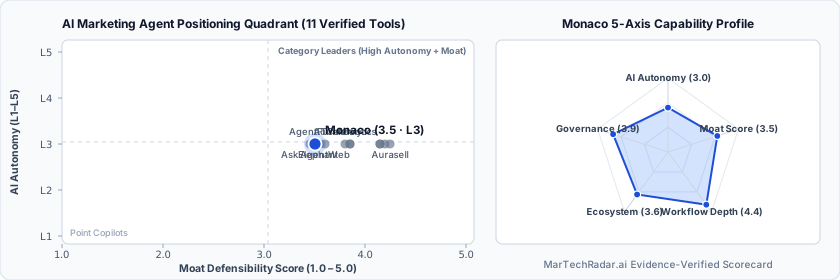
Monaco is a Web SaaS tool for AI Marketing Agent (Autonomous Marketing Agents & Digital Coworkers) in Agent & Marketing Ops. Pricing: $10,000 usage-based. Best suited to GTM Operations Teams, Enterprise Marketing Executives and Automated Ops Teams. Editor ratings: AI autonomy L3 (conditional automation); moat score 3.5/5.0 (Proprietary moat). Fact-checked by Sarah Per on Oct 10, 2026.
Autonomous revenue engine executing multi-agent outbound pipeline generation and prospect discovery for early-stage commercial teams.
Monaco buyer fit verdict: when to choose vs. when to walk away
Choose Monaco if (Best Fit)
- Target ICP & Stack Fit: You operate as GTM Operations Teams, Enterprise Marketing Executives and Automated Ops Teams requiring a Web SaaS deployment for AI Marketing Agent, with verified ecosystem connectivity for Outreach.
- L3 Architecture & Defensibility: Defensibility rests on proprietary task decomposition state machines and agent execution loops that link market research, prospect verification, and dynamic message generation directly into usage-based billing telemetry.
- Commercial Model Fit: Your procurement budget aligns with $10,000 usage-based.
Walk away from Monaco if (Deal-Breakers)
- Walk away if your team is at early validation stage with a <$250/mo tool budget (Monaco starts at $10,000 usage-based before seat or usage expansion).
- Walk away if your workflow cannot tolerate mailbox deliverability thresholds: Automated outbound cadence requires external mailbox warming and strict IP monitoring; rapid volume scaling triggers domain reputation penalties from corporate spam filters.
- Walk away if complex buyer attribution is a deal-breaker for your team: Autonomous research agents struggle to resolve enterprise committee hierarchies, often misidentifying economic buyers in complex multi-stakeholder organizational structures.
Monaco key facts & scorecard
| Pricing | $10,000 usage-basedVendor pricing page |
|---|---|
| Free plan | No / not disclosed |
| Delivery | Web SaaS |
| Audience | GTM Operations Teams, Enterprise Marketing Executives, Automated Ops Teams |
| AI autonomy level | L3 · Conditional automationEditor-verified |
| Moat tier & score | 3.5 / 5.0 · Proprietary moatEditor-verified |
| Funding | Series B |
| Total funding | $85MBacked by Founders Fund, Human Capital, Benchmark |
| Founders | Abishek Viswanathan, Brian Blond, Malay Desai, Sam Blond |
| Company size | 11-50 employees |
| Ecosystem integrations | Outreach |
| Governance & docs | Trust & Security ↗ · System Status ↗ · Terms ↗ · Privacy ↗ |
| Headquarters | San Francisco, California |
| Founded | 2024 |
| Last verified |
Monaco pros & cons: strengths vs. operational limitations
Pros: core strengths & capabilities
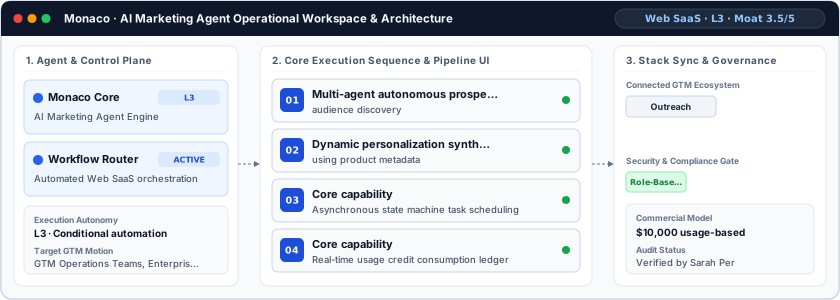
- Multi-agent autonomous prospecting and: audience discovery
- Dynamic personalization synthesis: using product metadata
- Core capability: Asynchronous state machine task scheduling
- Core capability: Real-time usage credit consumption ledger
Cons: operational limitations & risks
- Mailbox Deliverability Thresholds: Automated outbound cadence requires external mailbox warming and strict IP monitoring; rapid volume scaling triggers domain reputation penalties from corporate spam filters.
- Complex Buyer Attribution: Autonomous research agents struggle to resolve enterprise committee hierarchies, often misidentifying economic buyers in complex multi-stakeholder organizational structures.
- High Initial Capital Barrier: The essential commit structure requires upfront financial allocation before organizations validate model match or response performance within their niche markets.
Monaco TCO & deal-breaker stress test
Simulate 12-month stepped TCO, hidden cost multipliers, contract lock-in exposure, and stack failure modes using only facts verified by Sarah Per on · Capture SHA cdf3819b.
Monaco triggers high-severity friction under your 5-seat / $800/mo constraints. Benchmark the verified subtrack alternatives below before committing.
| Plan / Tier | Verified Rate | Scale Fit | Scope & Quota Notes |
|---|---|---|---|
| Entry / Starter | $10000/mo | Unlimited seats (Entry credits) | Verified $10000/mo published rate on vendor pricing schedule. |
- Moat Score
- 3.5 / 5.0
- AI Autonomy
- L3
- Free Tier / Trial
- None disclosed
Triggered audit signals & failure modes
- Budget Ceiling Breached ($10,000/mo vs. $800/mo cap)Verified Pricing Ledger
At 5 seats, Monaco's verified entry floor ($10,000 usage-based) exceeds your $800/mo budget before add-ons or overages.
- Published Self-Serve Entry FloorVerified Pricing Ledger
Monaco publishes a transparent entry point ($10,000 usage-based) for initial validation before committing.
- Usage / Credit Burn VolatilityCommercial Model Audit
Monaco uses credit or usage-metered billing ($10,000 usage-based). High-volume automated workflows across 5 seats can trigger mid-cycle overage charges.
- Primary Operational Bottleneck: Mailbox Deliverability ThresholdsAudit by Sarah Per
Automated outbound cadence requires external mailbox warming and strict IP monitoring; rapid volume scaling triggers domain reputation penalties from corporate spam filters.
Hidden TCO Multipliers & Quota Gates
- Credit & Usage Burn Multiplier: Automated workflows consume metered credits/usage quotas; multi-step enrichment, voice minutes, or high-frequency agent runs can trigger mid-cycle top-up packs.
- Mailbox Deliverability Thresholds: Automated outbound cadence requires external mailbox warming and strict IP monitoring; rapid volume scaling triggers domain reputation penalties from corporate spam filters.
- Complex Buyer Attribution: Autonomous research agents struggle to resolve enterprise committee hierarchies, often misidentifying economic buyers in complex multi-stakeholder organizational structures.
When to Walk Away & Negotiation Levers
- Walk away if your team is at early validation stage with a <$250/mo tool budget (Monaco starts at $10,000 usage-based before seat or usage expansion).
- Walk away if your workflow cannot tolerate mailbox deliverability thresholds: Automated outbound cadence requires external mailbox warming and strict IP monitoring; rapid volume scaling triggers domain reputation penalties from corporate spam filters.
- Walk away if complex buyer attribution is a deal-breaker for your team: Autonomous research agents struggle to resolve enterprise committee hierarchies, often misidentifying economic buyers in complex multi-stakeholder organizational structures.
- Negotiate price-lock protection on additional seats and overage credits above the $10,000 usage-based entry tier.
- Require a sandbox proof-of-concept testing mailbox deliverability thresholds against your live CRM/data schema before annual sign-off.
Ask a custom procurement or TCO stress-test question about Monaco
Lower 5-seat floor (~$10/mo vs. From $10,000 / mo)
Lower 5-seat floor (~$100/mo vs. From $10,000 / mo)
Monaco key entities, modules & ecosystem stack
Monaco moat & subtrack positioning
Defensibility rests on proprietary task decomposition state machines and agent execution loops that link market research, prospect verification, and dynamic message generation directly into usage-based billing telemetry.
Editorial review
Fact-checked by Sarah Per (Principal Content Systems & Generative Media Editor) on .
Background
Backed by $85M in venture funding and established in 2024 in San Francisco, California, Monaco targets technical founders and early commercial operators seeking automated pipeline generation. The platform functions as an autonomous revenue engine, replacing conventional outbound sales representatives with software agents configured to plan, draft, and dispatch target outreach campaigns without requiring internal sales operations staff.
How Monaco works
Monaco operates an L3 autonomous agent architecture driven by asynchronous state machines. The ingestion pipeline absorbs product documentation, customer profiles, and domain telemetry, decomposing high-level commercial objectives into discrete micro-tasks. Worker nodes perform web research, verify prospect parameters, and dynamically generate messaging through LLM inference chains. The engine continuously evaluates pipeline signals, adjusting cadence and audience parameters based on engagement metrics.
Limitations
Operational considerations and platform boundaries include:
- Mailbox Deliverability Thresholds: Automated outbound cadence requires external mailbox warming and strict IP monitoring; rapid volume scaling triggers domain reputation penalties from corporate spam filters.
- Complex Buyer Attribution: Autonomous research agents struggle to resolve enterprise committee hierarchies, often misidentifying economic buyers in complex multi-stakeholder organizational structures.
- High Initial Capital Barrier: The essential commit structure requires upfront financial allocation before organizations validate model match or response performance within their niche markets.
Monaco pricing
Monaco rejects per-seat licensing in favor of a consumption framework requiring a $10,000 upfront commit. This deposit converts directly into usage credits that deduct as agents execute research and messaging jobs. The tier includes unlimited user accounts and unlimited concurrent agents, transitioning to month-to-month replenishment without recurring platform fees.
How Monaco compares
Monaco contrasts sharply with deterministic outreach setups and conversational orchestrators like ai-marketing-claude, allGood, and AskElephant. While AskElephant focuses on conversational intelligence extraction and ai-marketing-claude functions as an ad-hoc copywriting co-pilot, Monaco provides unassisted autonomous outreach execution. It is suited for early-stage engineering-centric startups lacking sales development representatives. Enterprise procurement teams evaluating deployment readiness should assess API webhook throughput, role-based access governance, and bilateral data synchronization latency against existing marketing technology infrastructure before committing to multi-year production rollouts.
Direct competitors & market radar
Top algorithmic competitors based on category positioning, capability overlap, and ICP alignment.
Frequently asked questions about Monaco
How does Monaco usage and credit pricing work in 2026?
Published pricing summary for Monaco: $10,000 usage-based. A permanent free plan is not disclosed for Monaco. Monaco rejects per-seat licensing in favor of a consumption framework requiring a $10,000 upfront commit. This deposit converts directly into usage credits that deduct as agents execute research and messaging jobs.
How does Monaco work and how autonomous is its AI architecture?
Autonomous revenue engine executing multi-agent outbound pipeline generation and prospect discovery for early-stage commercial teams. Within AI Marketing Agent (Autonomous Marketing Agents & Digital Coworkers), MarTechRadar rates its execution architecture at L3 · Conditional automation with a verified Moat Score of 3.5 / 5.0 (Proprietary moat). Defensibility rests on proprietary task decomposition state machines and agent execution loops that link market research, prospect verification, and dynamic message generation directly into usage-based billing telemetry. Corporate profile: Founded by Abishek Viswanathan, Brian Blond, Malay Desai, Sam Blond, operating at 11-50 employees scale.
What are the main limitations of Monaco and when should buyers walk away?
Based on our editorial technical audit, key operational considerations and boundaries for Monaco include: (1) Mailbox Deliverability Thresholds: Automated outbound cadence requires external mailbox warming and strict IP monitoring; rapid volume scaling triggers domain reputation penalties from corporate spam filters. (2) Complex Buyer Attribution: Autonomous research agents struggle to resolve enterprise committee hierarchies, often misidentifying economic buyers in complex multi-stakeholder organizational structures. (3) High Initial Capital Barrier: The essential commit structure requires upfront financial allocation before organizations validate model match or response performance within their niche markets. Primary procurement walk-away rule: Walk away if your team is at early validation stage with a <$250/mo tool budget (Monaco starts at $10,000 usage-based before seat or usage expansion).
What integrations, compliance certifications, and contract terms apply to Monaco?
Verified ecosystem and stack integrations include Outreach. First-party governance and developer endpoints verified on domain include: Trust/Security (https://trust.monaco.com), Status (https://status.monaco.com). Key TCO multiplier to watch: Credit & Usage Burn Multiplier (Automated workflows consume metered credits/usage quotas; multi-step enrichment, voice minutes, or high-frequency agent runs can trigger mid-cycle top-up packs.) Before signing a contract, procurement teams should negotiate price-lock protection on additional seats and overage credits above the $10,000 usage-based entry tier.
What are the best Monaco alternatives and head-to-head competitors in 2026?
Top fact-checked alternatives to Monaco in AI Marketing Agent (Autonomous Marketing Agents & Digital Coworkers) include HubSpot Breeze (Free plan · $0/mo · Enterprise plan), Workato (Free plan · $100/mo · Enterprise plan), Lindy ($29.99–$199.99/seat/mo), Hightouch (Custom / enterprise pricing). Monaco contrasts sharply with deterministic outreach setups and conversational orchestrators like ai-marketing-claude, allGood, and AskElephant.
Verified sources & evidence trail
- Official product domain: https://www.monaco.com
- Commercial pricing verification: https://www.monaco.com/pricing
- Verified corporate entity profiles (
sameAs): LinkedIn Company Profile · Crunchbase Entity Record - First-party governance & documentation links: Trust & Security · System Status · Terms · Privacy
- Editorial audit sign-off: Fact-checked by Sarah Per on under the MarTechRadar Evidence-Ledger Protocol.