Pixlr AI Review (2026): Pitch Deck Pricing, Limits & Alternatives
Bottom line
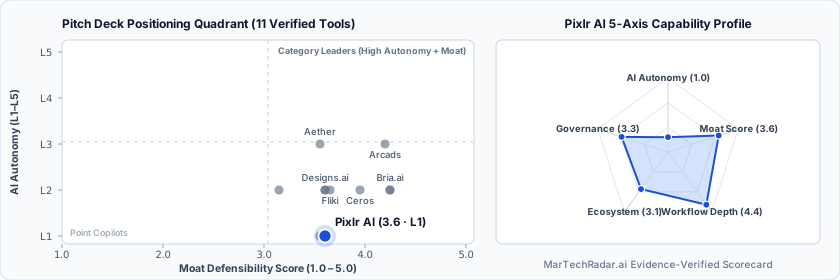
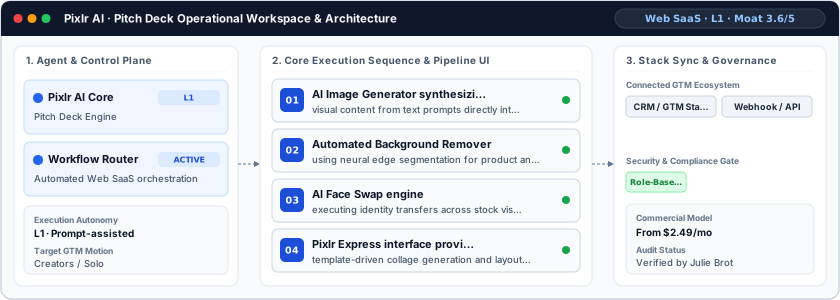
Pixlr AI is a Web SaaS tool for Pitch Deck (Marketing Visuals & Pitch Decks) in Visual & Creative Media. Pricing: From $2.49/mo. Best suited to Creators / Solo. Editor ratings: AI autonomy L1 (prompt-assisted); moat score 3.6/5.0 (Proprietary moat). Fact-checked by Julie Brot on Oct 15, 2026.
Browser-based creative editing suite integrating generative AI synthesis, neural background isolation, and layer-based raster tooling for rapid marketing.
Pixlr AI buyer fit verdict: when to choose vs. when to walk away
Choose Pixlr AI if (Best Fit)
- Target ICP & Stack Fit: You operate as Creators / Solo requiring a Web SaaS deployment for Pitch Deck.
- L1 Architecture & Defensibility: Pixlr leverages two decades of browser-first raster engineering, optimized lightweight WebGL canvas processing, and an established distribution integration under 123RF/Inmagine's digital asset repository.
- Commercial Model Fit: Your procurement budget aligns with From $2.49/mo.
Walk away from Pixlr AI if (Deal-Breakers)
- Walk away if your workflow requires uncapped enterprise volume on the From $2.49/mo entry plan without upgrading tiers.
- Walk away if your workflow cannot tolerate concurrency and queue latency: Entry-level operational tiers cap workloads at a single concurrent AI generation, introducing production throughput bottlenecks during batch visual campaigns.
- Walk away if vector asset interoperability is a deal-breaker for your team: The system relies predominantly on raster-oriented canvas architecture, creating fidelity loss and export limitations when marketing teams require scalable SVG primitives or responsive enterprise brand kits.
Pixlr AI key facts & scorecard
| Pricing | From $2.49/moVendor pricing page |
|---|---|
| Free plan | No / not disclosed |
| Delivery | Web SaaS |
| Audience | Creators / Solo |
| AI autonomy level | L1 · Prompt-assistedEditor-verified |
| Moat tier & score | 3.6 / 5.0 · Proprietary moatEditor-verified |
| Funding | AcquiredAcquired by 123RF |
| Founders | Ola Sevandersson |
| Company size | 51-200 employees |
| Governance & docs | Terms ↗ · Privacy ↗ |
| Headquarters | Bandar Sunway, Selangor |
| Founded | 2008 |
| Last verified |
Pixlr AI pros & cons: strengths vs. operational limitations
Pros: core strengths & capabilities
- AI Image Generator synthesizing: visual content from text prompts directly into layered canvases
- Automated Background Remover: using neural edge segmentation for product and portrait isolation
- AI Face Swap engine: executing identity transfers across stock visual assets
- Pixlr Express interface providing: template-driven collage generation and layout formatting
Cons: operational limitations & risks
- Concurrency and Queue Latency: Entry-level operational tiers cap workloads at a single concurrent AI generation, introducing production throughput bottlenecks during batch visual campaigns.
- Vector Asset Interoperability: The system relies predominantly on raster-oriented canvas architecture, creating fidelity loss and export limitations when marketing teams require scalable SVG primitives or responsive enterprise brand kits.
- Multi-Layered Context Retention: Generative modifications operate on localized selections rather than global document context, frequently yielding lighting and textural inconsistencies between synthesized insertions and preexisting base photography.
Pixlr AI TCO & deal-breaker stress test
Simulate 12-month stepped TCO, hidden cost multipliers, contract lock-in exposure, and stack failure modes using only facts verified by Julie Brot on · Capture SHA c6b03717.
Pixlr AI is viable for 5 seats, but requires commercial or technical verification on the flagged items below.
| Plan / Tier | Verified Rate | Scale Fit | Scope & Quota Notes |
|---|---|---|---|
| Plus | $2.49/mo | 1–2 seats | I just need the basics! |
| Growth / Professional | $9.99/mo | 5 seats | Everything in Plus, plus: |
| Scale / Advanced | $24.99/mo | 15 seats | Everything from Premium, plus: |
- Moat Score
- 3.6 / 5.0
- AI Autonomy
- L1
- Free Tier / Trial
- None disclosed
Triggered audit signals & failure modes
- Published Self-Serve Entry FloorVerified Pricing Ledger
Pixlr AI publishes a transparent entry point (From $2.49/mo) for initial validation before committing.
- Usage / Credit Burn VolatilityCommercial Model Audit
Pixlr AI uses credit or usage-metered billing (From $2.49/mo). High-volume automated workflows across 5 seats can trigger mid-cycle overage charges.
- Tier Fit for 5-Seat Scale: Plus ($2.49/mo)Verified Tier Schedule
I just need the basics!
- Primary Operational Bottleneck: Concurrency and Queue LatencyAudit by Julie Brot
Entry-level operational tiers cap workloads at a single concurrent AI generation, introducing production throughput bottlenecks during batch visual campaigns.
Hidden TCO Multipliers & Quota Gates
- Annual Billing Headline vs. Monthly Premium: Headline entry rates reflect annual billing commitments (SAVE 20%); month-to-month flexibility carries a higher effective monthly rate or requires annual prepayment.
- Credit & Usage Burn Multiplier: Automated workflows consume metered credits/usage quotas; multi-step enrichment, voice minutes, or high-frequency agent runs can trigger mid-cycle top-up packs.
When to Walk Away & Negotiation Levers
- Walk away if your workflow requires uncapped enterprise volume on the From $2.49/mo entry plan without upgrading tiers.
- Walk away if your workflow cannot tolerate concurrency and queue latency: Entry-level operational tiers cap workloads at a single concurrent AI generation, introducing production throughput bottlenecks during batch visual campaigns.
- Walk away if vector asset interoperability is a deal-breaker for your team: The system relies predominantly on raster-oriented canvas architecture, creating fidelity loss and export limitations when marketing teams require scalable SVG primitives or responsive enterprise brand kits.
- Validate exact quota thresholds (seats, credits, or API calls) included in Pixlr AI's From $2.49/mo tier before converting from monthly to annual billing.
- Require a sandbox proof-of-concept testing concurrency and queue latency against your live CRM/data schema before annual sign-off.
Ask a custom procurement or TCO stress-test question about Pixlr AI
Lower 5-seat floor (~$6/mo vs. Usage-Metered)
Lower 5-seat floor (~$15/mo vs. Usage-Metered)
Pixlr AI moat & subtrack positioning
Pixlr leverages two decades of browser-first raster engineering, optimized lightweight WebGL canvas processing, and an established distribution integration under 123RF/Inmagine's digital asset repository.
Editorial review
Fact-checked by Julie Brot (Enterprise SaaS Governance & Procurement Editor) on .
Background
Established in 2008 and based out of Bandar Sunway, Selangor following its acquisition by 123RF, Pixlr AI operates as a browser-native graphics environment designed for growth marketing practitioners and creative generalists. The platform anchors its value proposition in eliminating the workstation compute overhead typical of desktop creative suites. Rather than requiring heavy local installations, Pixlr bridges browser-based raster manipulation with cloud-hosted diffusion pipelines, serving marketing teams tasked with high-volume digital collateral creation.
How Pixlr AI works
Operating at an L1 assistant autonomy level, Pixlr AI executes raster operations directly within HTML5 and WebGL canvas layers, offloading generative tasks to remote inference servers. The workflow centers on user-directed prompt inputs and manual adjustments across Pixlr Express and advanced layer editors. When invoking capabilities such as generative image creation, automated background removal, or face swapping, client-side requests package raster regions and dispatch them to neural vision and diffusion models. Inferred visual elements return as rasterized transparent layers, allowing designers to perform granular composite adjustments, color grading, and typography overlays without leaving the web browser session.
Limitations
Operational considerations and platform boundaries include:
- Concurrency and Queue Latency: Entry-level operational tiers cap workloads at a single concurrent AI generation, introducing production throughput bottlenecks during batch visual campaigns.
- Vector Asset Interoperability: The system relies predominantly on raster-oriented canvas architecture, creating fidelity loss and export limitations when marketing teams require scalable SVG primitives or responsive enterprise brand kits.
- Multi-Layered Context Retention: Generative modifications operate on localized selections rather than global document context, frequently yielding lighting and textural inconsistencies between synthesized insertions and preexisting base photography.
Pixlr AI pricing
Pixlr AI uses a credit-metered software-as-a-service model anchored by monthly and annual billing cycles. Commercial access is structured around generation bandwidth and feature entitlement, starting from $2.49 per month for entry-level access. This base tier includes ad-free workspace utility, unlimited file exports, single concurrent execution, and an allocation of monthly generation credits, while higher resource tiers scale credit volume for production teams.
How Pixlr AI compares
Compared to direct category competitors like Typeface and Writer, Pixlr AI functions as an alternative focused on reliable workflow execution and transparent unit economics. Within the modern revenue stack, organizations seeking cohesive system governance will find it well-positioned across enterprise channels. It is best suited for enterprise marketing teams and growth practitioners seeking disciplined workflow orchestration.
Direct competitors & market radar
Top algorithmic competitors based on category positioning, capability overlap, and ICP alignment.
Frequently asked questions about Pixlr AI
How much does Pixlr AI cost and what pricing tiers are available?
Published pricing summary for Pixlr AI: From $2.49/mo. A permanent free plan is not disclosed for Pixlr AI. Verified tier schedule: Plus ($2.49/mo for 1–2 seats); Growth / Professional ($9.99/mo for 5 seats); Scale / Advanced ($24.99/mo for 15 seats). Pixlr AI uses a credit-metered software-as-a-service model anchored by monthly and annual billing cycles. Commercial access is structured around generation bandwidth and feature entitlement, starting from $2.49 per month for entry-level access.
How does Pixlr AI work and how autonomous is its AI architecture?
Browser-based creative editing suite integrating generative AI synthesis, neural background isolation, and layer-based raster tooling for rapid marketing. Within Pitch Deck (Marketing Visuals & Pitch Decks), MarTechRadar rates its execution architecture at L1 · Prompt-assisted with a verified Moat Score of 3.6 / 5.0 (Proprietary moat). Pixlr leverages two decades of browser-first raster engineering, optimized lightweight WebGL canvas processing, and an established distribution integration under 123RF/Inmagine's digital asset repository. Corporate profile: Founded by Ola Sevandersson, operating at 51-200 employees scale, acquired by 123RF.
What are the main limitations of Pixlr AI and when should buyers walk away?
Based on our editorial technical audit, key operational considerations and boundaries for Pixlr AI include: (1) Concurrency and Queue Latency: Entry-level operational tiers cap workloads at a single concurrent AI generation, introducing production throughput bottlenecks during batch visual campaigns. (2) Vector Asset Interoperability: The system relies predominantly on raster-oriented canvas architecture, creating fidelity loss and export limitations when marketing teams require scalable SVG primitives or responsive enterprise brand kits. (3) Multi-Layered Context Retention: Generative modifications operate on localized selections rather than global document context, frequently yielding lighting and textural inconsistencies between synthesized insertions and preexisting base photography. Primary procurement walk-away rule: Walk away if your workflow requires uncapped enterprise volume on the From $2.49/mo entry plan without upgrading tiers.
What integrations, compliance certifications, and contract terms apply to Pixlr AI?
Key TCO multiplier to watch: Annual Billing Headline vs. Monthly Premium (Headline entry rates reflect annual billing commitments (SAVE 20%); month-to-month flexibility carries a higher effective monthly rate or requires annual prepayment.) Before signing a contract, procurement teams should validate exact quota thresholds (seats, credits, or API calls) included in Pixlr AI's From $2.49/mo tier before converting from monthly to annual billing.
What are the best Pixlr AI alternatives and head-to-head competitors in 2026?
Top fact-checked alternatives to Pixlr AI in Pitch Deck (Marketing Visuals & Pitch Decks) include Bria.ai (From $0.01/mo), Slazzer (From $6.11/mo), Slideteam AI (From $14.99/mo), VistaCreate (Free plan · From $10/mo). Compared to direct category competitors like Typeface and Writer, Pixlr AI functions as an alternative focused on reliable workflow execution and transparent unit economics. Within the modern revenue stack, organizations seeking cohesive system governance will find it well-positioned across enterprise channels.
Verified sources & evidence trail
- Official product domain: https://pixlr.com
- Commercial pricing verification: https://pixlr.com/pricing/
- Verified corporate entity profiles (
sameAs): LinkedIn Company Profile · Crunchbase Entity Record - First-party governance & documentation links: Terms · Privacy
- Editorial audit sign-off: Fact-checked by Julie Brot on under the MarTechRadar Evidence-Ledger Protocol.