RichRelevance Review (2026): Email Marketing Pricing, Limits & Alternatives
Bottom line
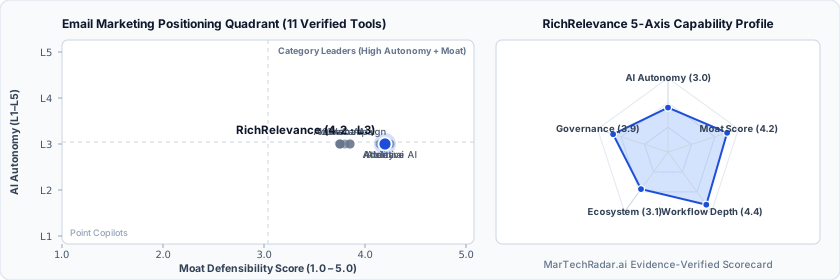
RichRelevance is a Web SaaS tool for Email Marketing (AI Email Marketing & Lifecycle Journeys) in Lifecycle & CDP. Pricing: Custom / enterprise pricing. Best suited to DTC / eCommerce and Enterprise Brands. Editor ratings: AI autonomy L3 (conditional automation); moat score 4.2/5.0 (Proprietary moat). Fact-checked by Vasilia Xia on Oct 15, 2026.
Enterprise personalization and behavioral recommendation engine orchestrating real-time dynamic content, search merchandising, and multi-channel lifecycle.
RichRelevance buyer fit verdict: when to choose vs. when to walk away
Choose RichRelevance if (Best Fit)
- Target ICP & Stack Fit: You operate as DTC / eCommerce and Enterprise Brands requiring a Web SaaS deployment for Email Marketing.
- L3 Architecture & Defensibility: Deep algorithmic heritage in predictive product recommendations and behavioral analytics, bolstered by extensive patent portfolios and broad retail enterprise integration footprints.
- Commercial Model Fit: Your procurement budget aligns with Custom / enterprise pricing.
Walk away from RichRelevance if (Deal-Breakers)
- Walk away if you require transparent self-serve monthly billing or your budget ceiling is under $1,000/mo (RichRelevance requires sales-gated custom quoting).
- Walk away if your workflow cannot tolerate catalog schema synchronization: Large retail catalogs with high inventory turnover require continuous batch or streaming delta updates; synchronization delays frequently lead to out-of-stock item recommendations.
- Walk away if cold-start behavioral latency is a deal-breaker for your team: Algorithmic decisioning degrades significantly on anonymous sessions lacking persistent identifiers, forcing fallback to global popularity metrics until sufficient event volume is captured.
RichRelevance key facts & scorecard
| Pricing | Custom / enterprise pricing |
|---|---|
| Free plan | No / not disclosed |
| Delivery | Web SaaS |
| Audience | DTC / eCommerce, Enterprise Brands |
| AI autonomy level | L3 · Conditional automationEditor-verified |
| Moat tier & score | 4.2 / 5.0 · Proprietary moatEditor-verified |
| Funding | Acquired |
| Total funding | $95.8M |
| Founders | David Selinger, Mike DeCourcey, Sundeep Ahuja, Tyler Kohn |
| Company size | 101-250 employees |
| Governance & docs | Privacy ↗ |
| Headquarters | San Francisco, California, United States |
| Founded | 2006 |
| Last verified |
RichRelevance pros & cons: strengths vs. operational limitations
Pros: core strengths & capabilities
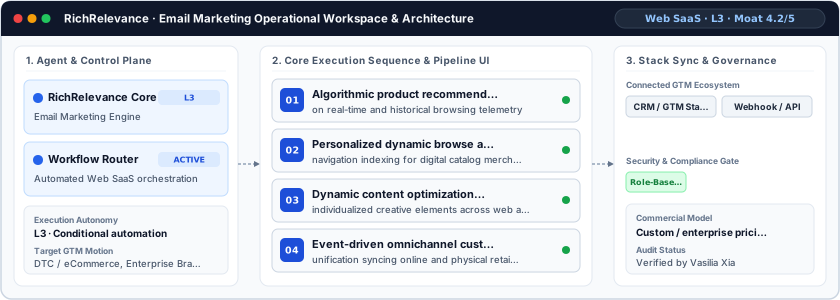
- Algorithmic product recommendations based: on real-time and historical browsing telemetry
- Personalized dynamic browse and: navigation indexing for digital catalog merchandising
- Dynamic content optimization serving: individualized creative elements across web and email channels
- Event-driven omnichannel customer profile: unification syncing online and physical retail signals
Cons: operational limitations & risks
- Catalog Schema Synchronization: Large retail catalogs with high inventory turnover require continuous batch or streaming delta updates; synchronization delays frequently lead to out-of-stock item recommendations.
- Cold-Start Behavioral Latency: Algorithmic decisioning degrades significantly on anonymous sessions lacking persistent identifiers, forcing fallback to global popularity metrics until sufficient event volume is captured.
- Edge API Payload Overhead: Embedding multiple dynamic personalization calls across high-volume digital storefronts introduces millisecond-level latency overhead that demands strict edge-caching configurations.
RichRelevance TCO & deal-breaker stress test
Simulate 12-month stepped TCO, hidden cost multipliers, contract lock-in exposure, and stack failure modes using only facts verified by Vasilia Xia on · Capture SHA d8bb4194.
RichRelevance triggers high-severity friction under your 5-seat / $800/mo constraints. Benchmark the verified subtrack alternatives below before committing.
| Plan / Tier | Verified Rate | Scale Fit | Scope & Quota Notes |
|---|---|---|---|
| Enterprise / Custom | Custom quote | 15–50+ seats (Enterprise SLA) | Sales-negotiated annual contract for custom volume, SSO/RBAC governance, and dedicated SLA. |
- Moat Score
- 4.2 / 5.0
- AI Autonomy
- L3
- Free Tier / Trial
- None disclosed
Triggered audit signals & failure modes
- Opaque Enterprise Quoting vs. SMB/Mid-Market BudgetVerified Pricing Ledger
RichRelevance does not disclose a public self-serve floor (Custom / enterprise pricing). Buyers with a $800/mo cap face high sales-qualification friction.
- Sales-Gated Contract TermsFact-checked by Vasilia Xia
RichRelevance maintains a direct enterprise sales engagement model. Commercial pricing is available on request through tailored enterprise sales quotes based on organizational scale and seats, catalog size, monthly API interaction volume, and server deployment scope.
- Primary Operational Bottleneck: Catalog Schema SynchronizationAudit by Vasilia Xia
Large retail catalogs with high inventory turnover require continuous batch or streaming delta updates; synchronization delays frequently lead to out-of-stock item recommendations.
Hidden TCO Multipliers & Quota Gates
- Catalog Schema Synchronization: Large retail catalogs with high inventory turnover require continuous batch or streaming delta updates; synchronization delays frequently lead to out-of-stock item recommendations.
- Cold-Start Behavioral Latency: Algorithmic decisioning degrades significantly on anonymous sessions lacking persistent identifiers, forcing fallback to global popularity metrics until sufficient event volume is captured.
When to Walk Away & Negotiation Levers
- Walk away if you require transparent self-serve monthly billing or your budget ceiling is under $1,000/mo (RichRelevance requires sales-gated custom quoting).
- Walk away if your workflow cannot tolerate catalog schema synchronization: Large retail catalogs with high inventory turnover require continuous batch or streaming delta updates; synchronization delays frequently lead to out-of-stock item recommendations.
- Walk away if cold-start behavioral latency is a deal-breaker for your team: Algorithmic decisioning degrades significantly on anonymous sessions lacking persistent identifiers, forcing fallback to global popularity metrics until sufficient event volume is captured.
- Demand a 30- to 60-day paid pilot opt-out clause in the RichRelevance order form before signing a 12-month enterprise commitment.
- Require a sandbox proof-of-concept testing catalog schema synchronization against your live CRM/data schema before annual sign-off.
Ask a custom procurement or TCO stress-test question about RichRelevance
Lower 5-seat floor (~$300/mo vs. Custom Quote) · Transparent self-serve entry without mandatory annual lock-in
Lower 5-seat floor (~$15/mo vs. Custom Quote) · Transparent self-serve entry without mandatory annual lock-in
RichRelevance moat & subtrack positioning
Deep algorithmic heritage in predictive product recommendations and behavioral analytics, bolstered by extensive patent portfolios and broad retail enterprise integration footprints.
Editorial review
Fact-checked by Vasilia Xia (E-Commerce, Lifecycle & Retention Marketing Analyst) on .
Background
Architectured as a centralized decisioning layer for high-throughput digital commerce, RichRelevance addresses the computational challenge of delivering sub-second individualization across distributed digital touchpoints. Established in 2006 in San Francisco, California, United States, the company accumulated $95.8M in venture funding before aligning under ADA Global. Tailored for enterprise digital merchandisers, digital marketing architects, and e-commerce technology leaders, the platform operates as a specialized personalization system that binds user behavioral intent directly to catalog discovery and cross-channel messaging operations.
How RichRelevance works
Operating at an L3 conditional autonomy tier, RichRelevance computes recommendations through a continuous behavioral ingestion pipeline that captures clickstream events, search queries, and purchase telemetry. These inputs feed into collaborative filtering and predictive affinity models, which recalculate user affinity scores in near real time. The decision engine arbitrates between business merchandising rules and algorithmic outputs to dynamically assemble individualized payloads. These payloads are delivered programmatically via API endpoints to populate personalized browse structures, site banners, and event-triggered outbound email blocks.
Limitations
Operational considerations and platform boundaries include:
- Catalog Schema Synchronization: Large retail catalogs with high inventory turnover require continuous batch or streaming delta updates; synchronization delays frequently lead to out-of-stock item recommendations.
- Cold-Start Behavioral Latency: Algorithmic decisioning degrades significantly on anonymous sessions lacking persistent identifiers, forcing fallback to global popularity metrics until sufficient event volume is captured.
- Edge API Payload Overhead: Embedding multiple dynamic personalization calls across high-volume digital storefronts introduces millisecond-level latency overhead that demands strict edge-caching configurations.
RichRelevance pricing
RichRelevance maintains a direct enterprise sales engagement model. Commercial pricing is available on request through tailored enterprise sales quotes based on organizational scale and seats, catalog size, monthly API interaction volume, and server deployment scope. Contracts typically entail annual multi-year commitments incorporating dedicated service-level agreements and enterprise implementation engineering.
How RichRelevance compares
While AB Tasty focuses primarily on client-side experimentation and feature flagging, RichRelevance emphasizes deep algorithmic catalog ranking and omnichannel behavioral data modeling. In contrast to 10Web AI, which concentrates on synthetic web page generation, RichRelevance targets multi-million SKU inventory orchestration. Compared to autonomous ad platforms such as Ability.ai, RichRelevance operates primarily within owned digital estate channels, making it optimal for mature multinational retailers requiring programmatic personalization across heavy e-commerce architectures. It is best suited for enterprise marketing teams and growth practitioners seeking disciplined workflow orchestration.
Direct competitors & market radar
Top algorithmic competitors based on category positioning, capability overlap, and ICP alignment.
Frequently asked questions about RichRelevance
How much does RichRelevance cost and does it require a custom enterprise quote?
Published pricing summary for RichRelevance: Custom / enterprise pricing. A permanent free plan is not disclosed for RichRelevance. RichRelevance maintains a direct enterprise sales engagement model. Commercial pricing is available on request through tailored enterprise sales quotes based on organizational scale and seats, catalog size, monthly API interaction volume, and server deployment scope.
How does RichRelevance work and how autonomous is its AI architecture?
Enterprise personalization and behavioral recommendation engine orchestrating real-time dynamic content, search merchandising, and multi-channel lifecycle. Within Email Marketing (AI Email Marketing & Lifecycle Journeys), MarTechRadar rates its execution architecture at L3 · Conditional automation with a verified Moat Score of 4.2 / 5.0 (Proprietary moat). Deep algorithmic heritage in predictive product recommendations and behavioral analytics, bolstered by extensive patent portfolios and broad retail enterprise integration footprints. Corporate profile: Founded by David Selinger, Mike DeCourcey, Sundeep Ahuja, Tyler Kohn, operating at 101-250 employees scale.
What are the main limitations of RichRelevance and when should buyers walk away?
Based on our editorial technical audit, key operational considerations and boundaries for RichRelevance include: (1) Catalog Schema Synchronization: Large retail catalogs with high inventory turnover require continuous batch or streaming delta updates; synchronization delays frequently lead to out-of-stock item recommendations. (2) Cold-Start Behavioral Latency: Algorithmic decisioning degrades significantly on anonymous sessions lacking persistent identifiers, forcing fallback to global popularity metrics until sufficient event volume is captured. (3) Edge API Payload Overhead: Embedding multiple dynamic personalization calls across high-volume digital storefronts introduces millisecond-level latency overhead that demands strict edge-caching configurations. Primary procurement walk-away rule: Walk away if you require transparent self-serve monthly billing or your budget ceiling is under $1,000/mo (RichRelevance requires sales-gated custom quoting).
What integrations, compliance certifications, and contract terms apply to RichRelevance?
Key TCO multiplier to watch: Catalog Schema Synchronization (Large retail catalogs with high inventory turnover require continuous batch or streaming delta updates; synchronization delays frequently lead to out-of-stock item recommendations.) Before signing a contract, procurement teams should demand a 30- to 60-day paid pilot opt-out clause in the RichRelevance order form before signing a 12-month enterprise commitment.
What are the best RichRelevance alternatives and head-to-head competitors in 2026?
Top fact-checked alternatives to RichRelevance in Email Marketing (AI Email Marketing & Lifecycle Journeys) include Pupila Brand Studio (Custom / enterprise pricing), Pletor (Custom / enterprise pricing), AIgency (From $300/mo), AxleAuto.ai (Free plan · $0/mo · Enterprise plan). While AB Tasty focuses primarily on client-side experimentation and feature flagging, RichRelevance emphasizes deep algorithmic catalog ranking and omnichannel behavioral data modeling.
Verified sources & evidence trail
- Official product domain: https://richrelevance.com
- Commercial pricing verification: Verified against official vendor pricing policy (Custom / enterprise pricing)
- Verified corporate entity profiles (
sameAs): Crunchbase Entity Record - First-party governance & documentation links: Privacy
- Editorial audit sign-off: Fact-checked by Vasilia Xia on under the MarTechRadar Evidence-Ledger Protocol.