SearchLens Review (2026): Content Optimization Pricing, Limits & Alternatives
Bottom line
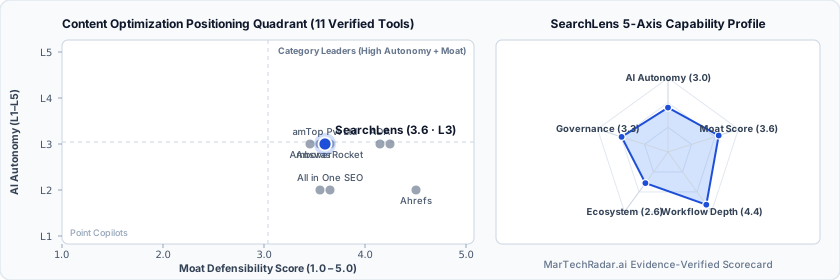
SearchLens is a Web SaaS tool for Content Optimization (Content Optimization & SERP Intelligence) in GEO & AI SEO. Pricing: Custom / enterprise pricing. Best suited to B2B SaaS. Editor ratings: AI autonomy L3 (conditional automation); moat score 3.6/5.0 (Proprietary moat). Fact-checked by Anna Xia on Oct 15, 2026.
SERP intelligence platform tracking generative AI Overviews, citation source distribution, and pixel-level organic link displacement across search engine.
SearchLens buyer fit verdict: when to choose vs. when to walk away
Choose SearchLens if (Best Fit)
- Target ICP & Stack Fit: You operate as B2B SaaS requiring a Web SaaS deployment for Content Optimization.
- L3 Architecture & Defensibility: Defensibility stems from a specialized headless browser rendering infrastructure engineered specifically to capture dynamic AI Overview generation, calculating pixel displacement and citation surface share where conventional HTML parsers fail.
- Commercial Model Fit: Your procurement budget aligns with Custom / enterprise pricing.
Walk away from SearchLens if (Deal-Breakers)
- Walk away if you require transparent self-serve monthly billing or your budget ceiling is under $1,000/mo (SearchLens requires sales-gated custom quoting).
- Walk away if your workflow cannot tolerate anti-scraping defenses: Aggressive bot mitigation and CAPTCHA interventions from search engines require continuous residential proxy rotation, resulting in intermittent query latency or localized data dropouts.
- Walk away if geographic SERP inconsistency is a deal-breaker for your team: Generative summary rollouts vary significantly across account personalization layers and micro-regions, making synthetic desktop viewport tests difficult to generalize across broad user bases.
SearchLens key facts & scorecard
| Pricing | Custom / enterprise pricing |
|---|---|
| Free plan | No / not disclosed |
| Delivery | Web SaaS |
| Audience | B2B SaaS |
| AI autonomy level | L3 · Conditional automationEditor-verified |
| Moat tier & score | 3.6 / 5.0 · Proprietary moatEditor-verified |
| Funding | Bootstrapped |
| Governance & docs | Terms ↗ · Privacy ↗ |
| Headquarters | United States |
| Last verified |
SearchLens pros & cons: strengths vs. operational limitations
Pros: core strengths & capabilities
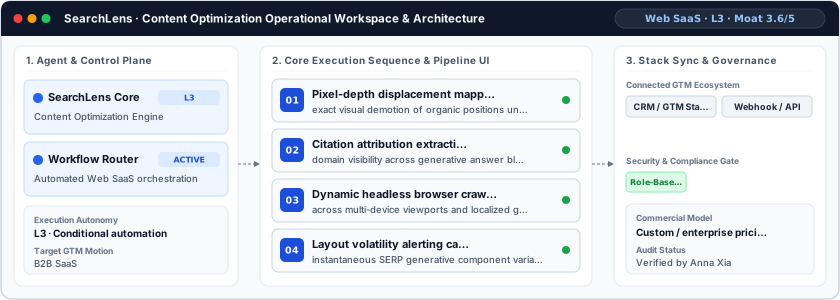
- Pixel-depth displacement mapping measuring: exact visual demotion of organic positions under AI Overviews
- Citation attribution extraction tracking: domain visibility across generative answer blocks
- Dynamic headless browser crawling: across multi-device viewports and localized geo-coordinates
- Layout volatility alerting capturing: instantaneous SERP generative component variations
Cons: operational limitations & risks
- Anti-Scraping Defenses: Aggressive bot mitigation and CAPTCHA interventions from search engines require continuous residential proxy rotation, resulting in intermittent query latency or localized data dropouts.
- Geographic SERP Inconsistency: Generative summary rollouts vary significantly across account personalization layers and micro-regions, making synthetic desktop viewport tests difficult to generalize across broad user bases.
- Schema Maintenance Overhead: Rapid experimentation with generative UI modules by major search engines frequently breaks underlying DOM selectors, requiring recurring parser adjustments to preserve historical tracking accuracy.
SearchLens TCO & deal-breaker stress test
Simulate 12-month stepped TCO, hidden cost multipliers, contract lock-in exposure, and stack failure modes using only facts verified by Anna Xia on · Capture SHA 9b617505.
SearchLens triggers high-severity friction under your 5-seat / $800/mo constraints. Benchmark the verified subtrack alternatives below before committing.
| Plan / Tier | Verified Rate | Scale Fit | Scope & Quota Notes |
|---|---|---|---|
| Enterprise / Custom | Custom quote | 15–50+ seats (Enterprise SLA) | Sales-negotiated annual contract for custom volume, SSO/RBAC governance, and dedicated SLA. |
- Moat Score
- 3.6 / 5.0
- AI Autonomy
- L3
- Free Tier / Trial
- None disclosed
Triggered audit signals & failure modes
- Opaque Enterprise Quoting vs. SMB/Mid-Market BudgetVerified Pricing Ledger
SearchLens does not disclose a public self-serve floor (Custom / enterprise pricing). Buyers with a $800/mo cap face high sales-qualification friction.
- Sales-Gated Contract TermsFact-checked by Anna Xia
Commercial procurement for SearchLens operates under custom enterprise pricing, requiring prospective organizations to contact sales for tailored enterprise quotes.
- Primary Operational Bottleneck: Anti-Scraping DefensesAudit by Anna Xia
Aggressive bot mitigation and CAPTCHA interventions from search engines require continuous residential proxy rotation, resulting in intermittent query latency or localized data dropouts.
Hidden TCO Multipliers & Quota Gates
- Anti-Scraping Defenses: Aggressive bot mitigation and CAPTCHA interventions from search engines require continuous residential proxy rotation, resulting in intermittent query latency or localized data dropouts.
- Geographic SERP Inconsistency: Generative summary rollouts vary significantly across account personalization layers and micro-regions, making synthetic desktop viewport tests difficult to generalize across broad user bases.
When to Walk Away & Negotiation Levers
- Walk away if you require transparent self-serve monthly billing or your budget ceiling is under $1,000/mo (SearchLens requires sales-gated custom quoting).
- Walk away if your workflow cannot tolerate anti-scraping defenses: Aggressive bot mitigation and CAPTCHA interventions from search engines require continuous residential proxy rotation, resulting in intermittent query latency or localized data dropouts.
- Walk away if geographic SERP inconsistency is a deal-breaker for your team: Generative summary rollouts vary significantly across account personalization layers and micro-regions, making synthetic desktop viewport tests difficult to generalize across broad user bases.
- Demand a 30- to 60-day paid pilot opt-out clause in the SearchLens order form before signing a 12-month enterprise commitment.
- Require a sandbox proof-of-concept testing anti-scraping defenses against your live CRM/data schema before annual sign-off.
Ask a custom procurement or TCO stress-test question about SearchLens
Lower 5-seat floor (~$29/mo vs. Custom Quote) · Transparent self-serve entry without mandatory annual lock-in
Lower 5-seat floor (~$50/mo vs. Custom Quote) · Transparent self-serve entry without mandatory annual lock-in
SearchLens moat & subtrack positioning
Defensibility stems from a specialized headless browser rendering infrastructure engineered specifically to capture dynamic AI Overview generation, calculating pixel displacement and citation surface share where conventional HTML parsers fail.
Editorial review
Fact-checked by Anna Xia (Senior B2B GTM & Revenue Systems Analyst) on .
Background
Headquartered in the United States, SearchLens provides search marketing directors and technical SEO engineers with visibility into visual layout shifts driven by generative search engine interfaces. As modern search providers deploy dynamic AI summary blocks that compress traditional organic real estate below the screen fold, legacy rank checkers that merely parse static HTML rankings fail to reflect actual consumer impression shares. SearchLens addresses this specific challenge by treating the search results layout as a visual coordinate plane rather than a flat numerical index.
How SearchLens works
SearchLens executes continuous headless browser rendering sessions across distributed geographic points of presence and variable viewports. Operating at an L3 autonomy profile, the platform ingests dynamic Document Object Model structures and applies visual layout parsing to calculate the exact vertical pixel displacement caused by generative answer panels. The pipeline isolates citation card carousels, extracts referenced source URLs, maps contextual entity associations, and programmatically correlates visual screen share against brand domain footprints without requiring manual query orchestration.
Limitations
Operational considerations and platform boundaries include:
- Anti-Scraping Defenses: Aggressive bot mitigation and CAPTCHA interventions from search engines require continuous residential proxy rotation, resulting in intermittent query latency or localized data dropouts.
- Geographic SERP Inconsistency: Generative summary rollouts vary significantly across account personalization layers and micro-regions, making synthetic desktop viewport tests difficult to generalize across broad user bases.
- Schema Maintenance Overhead: Rapid experimentation with generative UI modules by major search engines frequently breaks underlying DOM selectors, requiring recurring parser adjustments to preserve historical tracking accuracy.
SearchLens pricing
Commercial procurement for SearchLens operates under custom enterprise pricing, requiring prospective organizations to contact sales for tailored enterprise quotes. Subscription tiers are structured around tracked keyword volume, rendering query frequency, regional crawling points, and seat allocations. No standardized self-serve tiers are publicly listed, positioning enterprise onboarding around custom commercial licensing agreements that align with specific brand monitoring requirements.
How SearchLens compares
Compared to direct category competitors like Typeface and Writer, SearchLens functions as an alternative focused on reliable workflow execution and transparent unit economics. Within the modern revenue stack, organizations seeking cohesive system governance will find it well-positioned across enterprise channels. It is best suited for enterprise marketing teams and growth practitioners seeking disciplined workflow orchestration.
Frequently asked questions about SearchLens
How much does SearchLens cost and does it require a custom enterprise quote?
Published pricing summary for SearchLens: Custom / enterprise pricing. A permanent free plan is not disclosed for SearchLens. Commercial procurement for SearchLens operates under custom enterprise pricing, requiring prospective organizations to contact sales for tailored enterprise quotes. Subscription tiers are structured around tracked keyword volume, rendering query frequency, regional crawling points, and seat allocations.
How does SearchLens work and how autonomous is its AI architecture?
SERP intelligence platform tracking generative AI Overviews, citation source distribution, and pixel-level organic link displacement across search engine. Within Content Optimization (Content Optimization & SERP Intelligence), MarTechRadar rates its execution architecture at L3 · Conditional automation with a verified Moat Score of 3.6 / 5.0 (Proprietary moat). Defensibility stems from a specialized headless browser rendering infrastructure engineered specifically to capture dynamic AI Overview generation, calculating pixel displacement and citation surface share where conventional HTML parsers fail.
What are the main limitations of SearchLens and when should buyers walk away?
Based on our editorial technical audit, key operational considerations and boundaries for SearchLens include: (1) Anti-Scraping Defenses: Aggressive bot mitigation and CAPTCHA interventions from search engines require continuous residential proxy rotation, resulting in intermittent query latency or localized data dropouts. (2) Geographic SERP Inconsistency: Generative summary rollouts vary significantly across account personalization layers and micro-regions, making synthetic desktop viewport tests difficult to generalize across broad user bases. (3) Schema Maintenance Overhead: Rapid experimentation with generative UI modules by major search engines frequently breaks underlying DOM selectors, requiring recurring parser adjustments to preserve historical tracking accuracy. Primary procurement walk-away rule: Walk away if you require transparent self-serve monthly billing or your budget ceiling is under $1,000/mo (SearchLens requires sales-gated custom quoting).
What integrations, compliance certifications, and contract terms apply to SearchLens?
Key TCO multiplier to watch: Anti-Scraping Defenses (Aggressive bot mitigation and CAPTCHA interventions from search engines require continuous residential proxy rotation, resulting in intermittent query latency or localized data dropouts.) Before signing a contract, procurement teams should demand a 30- to 60-day paid pilot opt-out clause in the SearchLens order form before signing a 12-month enterprise commitment.
What are the best SearchLens alternatives and head-to-head competitors in 2026?
Top fact-checked alternatives to SearchLens in Content Optimization (Content Optimization & SERP Intelligence) include Can I Rank? (Custom / enterprise pricing), Positional.ai (Custom / enterprise pricing), Newwave Tech Foundry (Custom / enterprise pricing), RankerFox (Custom / enterprise pricing). Compared to direct category competitors like Typeface and Writer, SearchLens functions as an alternative focused on reliable workflow execution and transparent unit economics. Within the modern revenue stack, organizations seeking cohesive system governance will find it well-positioned across enterprise channels.
Verified sources & evidence trail
- Official product domain: https://searchlens.ai
- Commercial pricing verification: Verified against official vendor pricing policy (Custom / enterprise pricing)
- First-party governance & documentation links: Terms · Privacy
- Editorial audit sign-off: Fact-checked by Anna Xia on under the MarTechRadar Evidence-Ledger Protocol.