Sitechecker Review (2026): Content Optimization Pricing, Limits & Alternatives
Bottom line
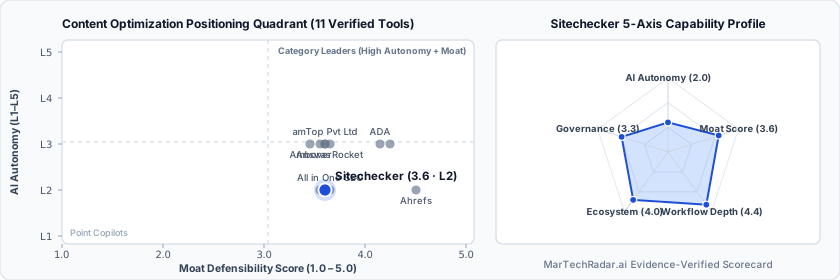
Sitechecker is a Web SaaS tool for Content Optimization (Content Optimization & SERP Intelligence) in GEO & AI SEO. Pricing: From $498/mo. Best suited to Creators / Solo. Editor ratings: AI autonomy L2 (workflow copilot); moat score 3.6/5.0 (Proprietary moat). Fact-checked by Anna Xia on Oct 15, 2026.
SEO command center and technical audit platform tracking site health, organic keyword rankings, and LLM visibility for agencies.
Sitechecker buyer fit verdict: when to choose vs. when to walk away
Choose Sitechecker if (Best Fit)
- Target ICP & Stack Fit: You operate as Creators / Solo requiring a Web SaaS deployment for Content Optimization, with verified ecosystem connectivity for Google Analytics 4 (GA4), Google Search Console.
- L2 Architecture & Defensibility: Defensibility centers on high-cadence site auditing coupled with multi-client agency project management, real-time Google Search Console integrations, and synthetic SERP tracking across traditional engines and generative AI surfaces.
- Commercial Model Fit: Your procurement budget aligns with From $498/mo.
Walk away from Sitechecker if (Deal-Breakers)
- Walk away if your team is at early validation stage with a <$250/mo tool budget (Sitechecker starts at From $498/mo before seat or usage expansion).
- Walk away if your workflow cannot tolerate crawl rate friction on dynamic javascript architectures: Large single-page applications with heavy client-side hydration can exhaust rendering resources, causing intermittent crawl timeouts and incomplete indexation audits during high-concurrency jobs.
- Walk away if API throughput and synchronization ceilings is a deal-breaker for your team: Accounts managing hundreds of domains experience synchronization delays when refreshing Google Search Console and GA4 historical data due to upstream third-party API rate quotas.
Sitechecker key facts & scorecard
| Pricing | From $498/moVendor pricing page |
|---|---|
| Free plan | No / not disclosed |
| Delivery | Web SaaS |
| Audience | Creators / Solo |
| AI autonomy level | L2 · Workflow copilotEditor-verified |
| Moat tier & score | 3.6 / 5.0 · Proprietary moatEditor-verified |
| Funding | Bootstrapped |
| Company size | 11-50 employees |
| Ecosystem integrations | Google Analytics 4 (GA4), Google Search Console |
| Governance & docs | API & Docs ↗ · Privacy ↗ |
| Headquarters | Tallinn, Harjumaa, Estonia |
| Founded | 2016 |
| Last verified |
Sitechecker pros & cons: strengths vs. operational limitations
Pros: core strengths & capabilities
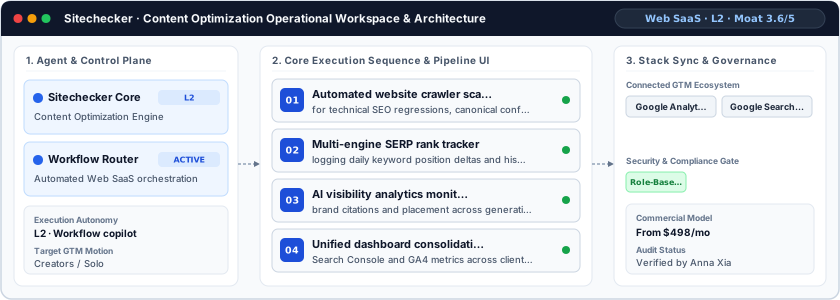
- Automated website crawler scanning: for technical SEO regressions, canonical conflicts, and metadata defects
- Multi-engine SERP rank tracker: logging daily keyword position deltas and historical movements
- AI visibility analytics monitoring: brand citations and placement across generative LLM answer engines
- Unified dashboard consolidating Google: Search Console and GA4 metrics across client portfolios
Cons: operational limitations & risks
- Crawl rate friction on dynamic JavaScript architectures: Large single-page applications with heavy client-side hydration can exhaust rendering resources, causing intermittent crawl timeouts and incomplete indexation audits during high-concurrency jobs.
- API throughput and synchronization ceilings: Accounts managing hundreds of domains experience synchronization delays when refreshing Google Search Console and GA4 historical data due to upstream third-party API rate quotas.
- LLM citation parsing volatility: The generative AI tracking engine relies on prompt sampling, which can produce non-deterministic visibility reports when commercial AI engines alter model weights or user interfaces.
Sitechecker TCO & deal-breaker stress test
Simulate 12-month stepped TCO, hidden cost multipliers, contract lock-in exposure, and stack failure modes using only facts verified by Anna Xia on · Capture SHA 05986372.
Sitechecker aligns with your 5-seat / $800/mo profile. Review the walk-away triggers and contract levers below before deployment.
| Plan / Tier | Verified Rate | Scale Fit | Scope & Quota Notes |
|---|---|---|---|
| Entry / Starter | $498/mo | Unlimited seats (Entry credits) | The number of projects in an account you can work at the same time. |
- Moat Score
- 3.6 / 5.0
- AI Autonomy
- L2
- Free Tier / Trial
- None disclosed
Triggered audit signals & failure modes
- Published Self-Serve Entry FloorVerified Pricing Ledger
Sitechecker publishes a transparent entry point (From $498/mo) for initial validation before committing.
- Primary Operational Bottleneck: Crawl rate friction on dynamic JavaScript architecturesAudit by Anna Xia
Large single-page applications with heavy client-side hydration can exhaust rendering resources, causing intermittent crawl timeouts and incomplete indexation audits during high-concurrency jobs.
Hidden TCO Multipliers & Quota Gates
- Annual Billing Headline vs. Monthly Premium: Headline entry rates reflect annual billing commitments (Save $498); month-to-month flexibility carries a higher effective monthly rate or requires annual prepayment.
- Crawl rate friction on dynamic JavaScript architectures: Large single-page applications with heavy client-side hydration can exhaust rendering resources, causing intermittent crawl timeouts and incomplete indexation audits during high-concurrency jobs.
- API throughput and synchronization ceilings: Accounts managing hundreds of domains experience synchronization delays when refreshing Google Search Console and GA4 historical data due to upstream third-party API rate quotas.
When to Walk Away & Negotiation Levers
- Walk away if your team is at early validation stage with a <$250/mo tool budget (Sitechecker starts at From $498/mo before seat or usage expansion).
- Walk away if your workflow cannot tolerate crawl rate friction on dynamic javascript architectures: Large single-page applications with heavy client-side hydration can exhaust rendering resources, causing intermittent crawl timeouts and incomplete indexation audits during high-concurrency jobs.
- Walk away if API throughput and synchronization ceilings is a deal-breaker for your team: Accounts managing hundreds of domains experience synchronization delays when refreshing Google Search Console and GA4 historical data due to upstream third-party API rate quotas.
- Negotiate price-lock protection on additional seats and overage credits above the From $498/mo entry tier.
- Require a sandbox proof-of-concept testing crawl rate friction on dynamic javascript architectures against your live CRM/data schema before annual sign-off.
Ask a custom procurement or TCO stress-test question about Sitechecker
Lower 5-seat floor (~$29/mo vs. From $498 / mo)
Lower 5-seat floor (~$8/mo vs. From $498 / mo)
Sitechecker key entities, modules & ecosystem stack
Sitechecker moat & subtrack positioning
Defensibility centers on high-cadence site auditing coupled with multi-client agency project management, real-time Google Search Console integrations, and synthetic SERP tracking across traditional engines and generative AI surfaces.
Editorial review
Fact-checked by Anna Xia (Senior B2B GTM & Revenue Systems Analyst) on .
Background
Established in 2016 and headquartered in Tallinn, Estonia, Sitechecker addresses a critical operational job-to-be-done: preventing silent technical code regressions and tracking multi-client search performance without administrative bloat. Engineered for agency SEO directors and performance marketers managing ten or more distinct domains, the platform acts as an automated diagnostic engine. Rather than forcing search teams into manual periodic audits, Sitechecker provides persistent surveillance across crawling, keyword position shifts, and generative AI search surfaces.
How Sitechecker works
Sitechecker operates as an L2 assistive platform utilizing a distributed headless browser crawler that maps client site topologies, canonical structures, and Core Web Vitals. The data ingestion pipeline syncs real-time performance indicators from Google Search Console and Google Analytics 4, normalizing indexation events alongside custom rank tracking queries. For AI visibility analytics, the system submits synthetic prompts to language model answer engines, parsing brand citations and placement metrics against baseline SERP positions to surface rank volatility without manual intervention.
Limitations
Operational considerations and platform boundaries include:
- Crawl rate friction on dynamic JavaScript architectures: Large single-page applications with heavy client-side hydration can exhaust rendering resources, causing intermittent crawl timeouts and incomplete indexation audits during high-concurrency jobs.
- API throughput and synchronization ceilings: Accounts managing hundreds of domains experience synchronization delays when refreshing Google Search Console and GA4 historical data due to upstream third-party API rate quotas.
- LLM citation parsing volatility: The generative AI tracking engine relies on prompt sampling, which can produce non-deterministic visibility reports when commercial AI engines alter model weights or user interfaces.
Sitechecker pricing
Commercial access operates on a software-as-a-service tier model starting from $498/month for multi-domain deployments. Licensing packages aggregate project capacities, tracked keywords, and recrawl frequencies under predictable operational budgets. Core plans provision unlimited user seats, scheduled PDF or Google Sheets data exports, and standard Google analytics integrations, reserving deeper LLM prompt quotas and multi-account agency governance modules for higher-volume configurations.
How Sitechecker compares
Within Content Optimization & SERP Intelligence, Sitechecker competes against all-in-one SEO suites like Ahrefs, Semrush, and SE Ranking AI, as well as technical crawlers and rank trackers like Screaming Frog SEO, Sitebulb, and AccuRanker. While Ahrefs and Semrush deliver larger historical backlink databases, Sitechecker prioritizes continuous technical regression alerts, real-time Google Search Console monitoring, and multi-site agency client workflows.
Direct competitors & market radar
Top algorithmic competitors based on category positioning, capability overlap, and ICP alignment.
Frequently asked questions about Sitechecker
How much does Sitechecker cost and what pricing tiers are available?
Published pricing summary for Sitechecker: From $498/mo. A permanent free plan is not disclosed for Sitechecker. Commercial access operates on a software-as-a-service tier model starting from $498/month for multi-domain deployments. Licensing packages aggregate project capacities, tracked keywords, and recrawl frequencies under predictable operational budgets.
How does Sitechecker work and how autonomous is its AI architecture?
SEO command center and technical audit platform tracking site health, organic keyword rankings, and LLM visibility for agencies. Within Content Optimization (Content Optimization & SERP Intelligence), MarTechRadar rates its execution architecture at L2 · Workflow copilot with a verified Moat Score of 3.6 / 5.0 (Proprietary moat). Defensibility centers on high-cadence site auditing coupled with multi-client agency project management, real-time Google Search Console integrations, and synthetic SERP tracking across traditional engines and generative AI surfaces. Corporate profile: operating at 11-50 employees scale.
What are the main limitations of Sitechecker and when should buyers walk away?
Based on our editorial technical audit, key operational considerations and boundaries for Sitechecker include: (1) Crawl rate friction on dynamic JavaScript architectures: Large single-page applications with heavy client-side hydration can exhaust rendering resources, causing intermittent crawl timeouts and incomplete indexation audits during high-concurrency jobs. (2) API throughput and synchronization ceilings: Accounts managing hundreds of domains experience synchronization delays when refreshing Google Search Console and GA4 historical data due to upstream third-party API rate quotas. (3) LLM citation parsing volatility: The generative AI tracking engine relies on prompt sampling, which can produce non-deterministic visibility reports when commercial AI engines alter model weights or user interfaces. Primary procurement walk-away rule: Walk away if your team is at early validation stage with a <$250/mo tool budget (Sitechecker starts at From $498/mo before seat or usage expansion).
What integrations, compliance certifications, and contract terms apply to Sitechecker?
Verified ecosystem and stack integrations include Google Analytics 4 (GA4), Google Search Console. First-party governance and developer endpoints verified on domain include: API Docs (https://docs.sitechecker.pro). Key TCO multiplier to watch: Annual Billing Headline vs. Monthly Premium (Headline entry rates reflect annual billing commitments (Save $498); month-to-month flexibility carries a higher effective monthly rate or requires annual prepayment.) Before signing a contract, procurement teams should negotiate price-lock protection on additional seats and overage credits above the From $498/mo entry tier.
What are the best Sitechecker alternatives and head-to-head competitors in 2026?
Top fact-checked alternatives to Sitechecker in Content Optimization (Content Optimization & SERP Intelligence) include ProRankTracker (Custom / enterprise pricing), Ahrefs ($29–$1,499/mo), SE Ranking AI (Custom / enterprise pricing), AccuRanker (From $224/mo). Within Content Optimization & SERP Intelligence, Sitechecker competes against all-in-one SEO suites like Ahrefs, Semrush, and SE Ranking AI, as well as technical crawlers and rank trackers like Screaming Frog SEO, Sitebulb, and AccuRanker.
Verified sources & evidence trail
- Official product domain: https://sitechecker.pro
- Commercial pricing verification: https://sitechecker.pro/account/plans/
- Verified corporate entity profiles (
sameAs): LinkedIn Company Profile · Crunchbase Entity Record - First-party governance & documentation links: API & Docs · Privacy
- Editorial audit sign-off: Fact-checked by Anna Xia on under the MarTechRadar Evidence-Ledger Protocol.