SmartrMail Review (2026): Email Marketing Pricing, Limits & Alternatives
Bottom line
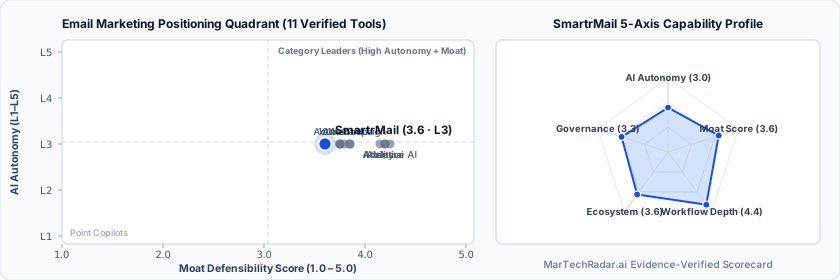
SmartrMail is a Web SaaS tool for Email Marketing (AI Email Marketing & Lifecycle Journeys) in Lifecycle & CDP. Pricing: Free plan · $0/mo · Enterprise plan. Best suited to DTC / eCommerce. Editor ratings: AI autonomy L3 (conditional automation); moat score 3.6/5.0 (Proprietary moat). Fact-checked by Jagmeet Sine on Oct 15, 2026.
E-commerce email and SMS marketing automation platform delivering personalized lifecycle journeys, cart recovery, and product recommendations.
SmartrMail buyer fit verdict: when to choose vs. when to walk away
Choose SmartrMail if (Best Fit)
- Target ICP & Stack Fit: You operate as DTC / eCommerce requiring a Web SaaS deployment for Email Marketing, with verified ecosystem connectivity for Shopify.
- L3 Architecture & Defensibility: Deep native synchronization with Shopify and e-commerce platforms, paired with an active-subscriber billing model and automated catalog-driven recommendation algorithms.
- Commercial Model Fit: Your procurement budget aligns with Free plan · $0/mo · Enterprise plan and want a self-serve free tier for zero-cost initial validation.
Walk away from SmartrMail if (Deal-Breakers)
- Walk away if your workflow requires uncapped enterprise volume on the Free plan · $0/mo · Enterprise plan entry plan without upgrading tiers.
- Walk away if your workflow cannot tolerate catalog schema dependency: The recommendation engine requires standardized product metadata tags, causing missing visual blocks or fallback rendering errors when inventories lack uniform SKUs or image URLs.
- Walk away if webhook latency under high concurrency is a deal-breaker for your team: During peak flash-sale spikes, incoming storefront order and cart webhooks can queue asynchronously, delaying time-critical cart recovery triggers beyond optimal behavioral windows.
SmartrMail key facts & scorecard
| Pricing | Free plan · $0/mo · Enterprise planVendor pricing page |
|---|---|
| Free plan | Yes |
| Delivery | Web SaaS |
| Audience | DTC / eCommerce |
| AI autonomy level | L3 · Conditional automationEditor-verified |
| Moat tier & score | 3.6 / 5.0 · Proprietary moatEditor-verified |
| Funding | Bootstrapped |
| Founders | George Hartley, Philip Slusarski |
| Company size | 11-50 employees |
| Ecosystem integrations | Shopify |
| Governance & docs | Terms ↗ |
| Headquarters | Melbourne, Victoria |
| Founded | 2016 |
| Last verified |
SmartrMail pros & cons: strengths vs. operational limitations
Pros: core strengths & capabilities
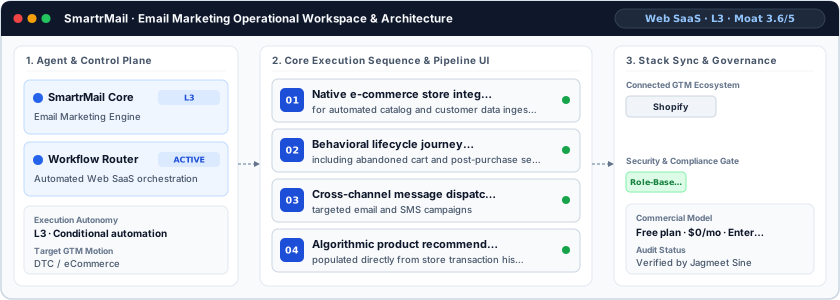
- Native e-commerce store integration: for automated catalog and customer data ingestion
- Behavioral lifecycle journey triggers: including abandoned cart and post-purchase sequences
- Cross-channel message dispatch supporting: targeted email and SMS campaigns
- Algorithmic product recommendation blocks: populated directly from store transaction history
Cons: operational limitations & risks
- Catalog Schema Dependency: The recommendation engine requires standardized product metadata tags, causing missing visual blocks or fallback rendering errors when inventories lack uniform SKUs or image URLs.
- Webhook Latency Under High Concurrency: During peak flash-sale spikes, incoming storefront order and cart webhooks can queue asynchronously, delaying time-critical cart recovery triggers beyond optimal behavioral windows.
- Complex Custom Journey Extensibility: Non-linear multi-branch logic across external CRM endpoints is constrained by fixed commerce trigger states, limiting advanced multi-touch personalization across non-standard data models.
SmartrMail TCO & deal-breaker stress test
Simulate 12-month stepped TCO, hidden cost multipliers, contract lock-in exposure, and stack failure modes using only facts verified by Jagmeet Sine on · Capture SHA 44ce146a.
SmartrMail is viable for 5 seats, but requires commercial or technical verification on the flagged items below.
| Plan / Tier | Verified Rate | Scale Fit | Scope & Quota Notes |
|---|---|---|---|
| Free / Sandbox | $0 | 1–2 seats (Evaluation) | Entry free tier with capped usage or feature quotas for initial workflow testing. |
| Entry / Starter | $0.01/mo | 1–2 seats | Everything in the Essential Plan |
| Growth / Professional | $10/mo | 5 seats | Everything in the Free Plan |
| Scale / Advanced | $49/mo | 15 seats | Everything in the Essential Plan |
- Moat Score
- 3.6 / 5.0
- AI Autonomy
- L3
- Free Tier / Trial
- Free plan
Triggered audit signals & failure modes
- Opaque Enterprise Quoting vs. SMB/Mid-Market BudgetVerified Pricing Ledger
SmartrMail does not disclose a public self-serve floor (Free plan · $0/mo · Enterprise plan). Buyers with a $800/mo cap face high sales-qualification friction.
- Published Self-Serve Entry FloorVerified Pricing Ledger
SmartrMail publishes a transparent entry point (Free plan · $0/mo · Enterprise plan) with a free tier for initial validation before committing.
- Tier Fit for 5-Seat Scale: Entry / Starter ($0.01/mo)Verified Tier Schedule
Everything in the Essential Plan
- Primary Operational Bottleneck: Catalog Schema DependencyAudit by Jagmeet Sine
The recommendation engine requires standardized product metadata tags, causing missing visual blocks or fallback rendering errors when inventories lack uniform SKUs or image URLs.
Hidden TCO Multipliers & Quota Gates
- Annual Billing Headline vs. Monthly Premium: Headline entry rates reflect annual billing commitments (Save 30%); month-to-month flexibility carries a higher effective monthly rate or requires annual prepayment.
- Credit & Usage Burn Multiplier: Automated workflows consume metered credits/usage quotas; multi-step enrichment, voice minutes, or high-frequency agent runs can trigger mid-cycle top-up packs.
- Enterprise Governance & Add-On Gating: Advanced capabilities such as Single Sign-On (SSO), custom role permissions, or specialized analytics modules are gated behind upper tiers or paid add-ons.
When to Walk Away & Negotiation Levers
- Walk away if your workflow requires uncapped enterprise volume on the Free plan · $0/mo · Enterprise plan entry plan without upgrading tiers.
- Walk away if your workflow cannot tolerate catalog schema dependency: The recommendation engine requires standardized product metadata tags, causing missing visual blocks or fallback rendering errors when inventories lack uniform SKUs or image URLs.
- Walk away if webhook latency under high concurrency is a deal-breaker for your team: During peak flash-sale spikes, incoming storefront order and cart webhooks can queue asynchronously, delaying time-critical cart recovery triggers beyond optimal behavioral windows.
- Validate exact quota thresholds (seats, credits, or API calls) included in SmartrMail's Free plan · $0/mo · Enterprise plan tier before converting from monthly to annual billing.
- Require a sandbox proof-of-concept testing catalog schema dependency against your live CRM/data schema before annual sign-off.
Ask a custom procurement or TCO stress-test question about SmartrMail
Lower 5-seat floor (~$49/mo vs. Custom Quote)
Lower 5-seat floor (~$15/mo vs. Custom Quote)
SmartrMail key entities, modules & ecosystem stack
SmartrMail moat & subtrack positioning
Deep native synchronization with Shopify and e-commerce platforms, paired with an active-subscriber billing model and automated catalog-driven recommendation algorithms.
Editorial review
Fact-checked by Jagmeet Sine (Senior MarTech Infrastructure & Agentic Workflow Architect) on .
Background
Within the e-commerce marketing ecosystem, software utility depends on how effectively transactional data translates into automated customer retention. Established in 2016 in Melbourne, Victoria, SmartrMail delivers an automated email and SMS orchestration engine built directly for digital commerce merchants. Targeted at e-commerce marketing managers and digital store operators, the platform replaces generic broadcast blast workflows with behavior-triggered customer communications connected to real-time storefront purchase patterns.
How SmartrMail works
SmartrMail operates an event-driven data ingestion layer that syncs catalog assets, order histories, and cart abandonment webhooks from commerce backends such as Shopify. Inbound events update customer activity states within an L3 autonomous execution pipeline. The platform computes subscriber engagement recency, queries product relational data, and generates dynamic recommendation modules within pre-configured visual templates. Outbound messages deploy through scheduled batch protocols or event-driven triggers based on deterministic cart and browse abandonment rules.
Limitations
Operational considerations and platform boundaries include:
- Catalog Schema Dependency: The recommendation engine requires standardized product metadata tags, causing missing visual blocks or fallback rendering errors when inventories lack uniform SKUs or image URLs.
- Webhook Latency Under High Concurrency: During peak flash-sale spikes, incoming storefront order and cart webhooks can queue asynchronously, delaying time-critical cart recovery triggers beyond optimal behavioral windows.
- Complex Custom Journey Extensibility: Non-linear multi-branch logic across external CRM endpoints is constrained by fixed commerce trigger states, limiting advanced multi-touch personalization across non-standard data models.
SmartrMail pricing
Commercial pricing operates on active subscriber volumes rather than total list counts. Access begins with an entry tier at $0 per month supporting up to 200 active contacts. Scaling past the initial tier transitions into volume-tiered monthly plans, with custom enterprise plans structured for high-volume senders needing dedicated account management, continuous deliverability monitoring, and custom sending concurrency.
How SmartrMail compares
SmartrMail competes against e-commerce marketing and optimization tooling such as 10Web AI, AB Tasty, and Ability.ai. While 10Web AI concentrates on site infrastructure automation and AB Tasty targets algorithmic split-testing, SmartrMail focuses strictly on lifecycle revenue extraction via transactional store triggers. For independent merchants seeking turnkey cart recovery and catalog-driven retention without complex CDP engineering, SmartrMail provides focused transactional orchestration. It is best suited for enterprise marketing teams and growth practitioners seeking disciplined workflow orchestration.
Direct competitors & market radar
Top algorithmic competitors based on category positioning, capability overlap, and ICP alignment.
Frequently asked questions about SmartrMail
How much does SmartrMail cost and what pricing tiers are available?
Published pricing summary for SmartrMail: Free plan · $0/mo · Enterprise plan. SmartrMail includes a free tier or sandbox entry point. Verified tier schedule: Free / Sandbox ($0 for 1–2 seats (Evaluation)); Entry / Starter ($0.01/mo for 1–2 seats); Growth / Professional ($10/mo for 5 seats); Scale / Advanced ($49/mo for 15 seats). Commercial pricing operates on active subscriber volumes rather than total list counts. Access begins with an entry tier at $0 per month supporting up to 200 active contacts.
How does SmartrMail work and how autonomous is its AI architecture?
E-commerce email and SMS marketing automation platform delivering personalized lifecycle journeys, cart recovery, and product recommendations. Within Email Marketing (AI Email Marketing & Lifecycle Journeys), MarTechRadar rates its execution architecture at L3 · Conditional automation with a verified Moat Score of 3.6 / 5.0 (Proprietary moat). Deep native synchronization with Shopify and e-commerce platforms, paired with an active-subscriber billing model and automated catalog-driven recommendation algorithms. Corporate profile: Founded by George Hartley, Philip Slusarski, operating at 11-50 employees scale.
What are the main limitations of SmartrMail and when should buyers walk away?
Based on our editorial technical audit, key operational considerations and boundaries for SmartrMail include: (1) Catalog Schema Dependency: The recommendation engine requires standardized product metadata tags, causing missing visual blocks or fallback rendering errors when inventories lack uniform SKUs or image URLs. (2) Webhook Latency Under High Concurrency: During peak flash-sale spikes, incoming storefront order and cart webhooks can queue asynchronously, delaying time-critical cart recovery triggers beyond optimal behavioral windows. (3) Complex Custom Journey Extensibility: Non-linear multi-branch logic across external CRM endpoints is constrained by fixed commerce trigger states, limiting advanced multi-touch personalization across non-standard data models. Primary procurement walk-away rule: Walk away if your workflow requires uncapped enterprise volume on the Free plan · $0/mo · Enterprise plan entry plan without upgrading tiers.
What integrations, compliance certifications, and contract terms apply to SmartrMail?
Verified ecosystem and stack integrations include Shopify. Key TCO multiplier to watch: Annual Billing Headline vs. Monthly Premium (Headline entry rates reflect annual billing commitments (Save 30%); month-to-month flexibility carries a higher effective monthly rate or requires annual prepayment.) Before signing a contract, procurement teams should validate exact quota thresholds (seats, credits, or API calls) included in SmartrMail's Free plan · $0/mo · Enterprise plan tier before converting from monthly to annual billing.
What are the best SmartrMail alternatives and head-to-head competitors in 2026?
Top fact-checked alternatives to SmartrMail in Email Marketing (AI Email Marketing & Lifecycle Journeys) include Constant Contact (From $0/mo), SendX (From $1.40/mo), Sleeknote (From $49/mo), Adclear (Custom / enterprise pricing). SmartrMail competes against e-commerce marketing and optimization tooling such as 10Web AI, AB Tasty, and Ability.ai.
Verified sources & evidence trail
- Official product domain: https://smartrmail.com
- Commercial pricing verification: https://www.smartrmail.com/pricing
- Verified corporate entity profiles (
sameAs): LinkedIn Company Profile · Crunchbase Entity Record - First-party governance & documentation links: Terms
- Editorial audit sign-off: Fact-checked by Jagmeet Sine on under the MarTechRadar Evidence-Ledger Protocol.