Socioh Review (2026): DCO Pricing, Limits & Alternatives
Bottom line
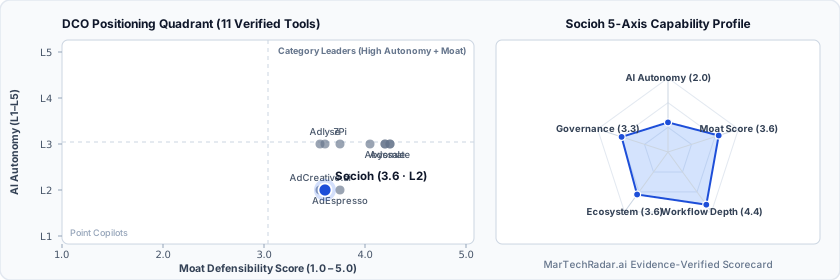
Socioh is a Web SaaS tool for DCO (Dynamic Creative Optimization / DCO) in AdTech & Paid Media. Pricing: From $3.20/mo. Best suited to DTC / eCommerce. Editor ratings: AI autonomy L2 (workflow copilot); moat score 3.6/5.0 (Proprietary moat). Fact-checked by Vasilia Xia on Oct 14, 2026.
Dynamic catalog ad platform combining programmatic product feed enrichment with managed design services for high-converting dynamic product ads.
Socioh buyer fit verdict: when to choose vs. when to walk away
Choose Socioh if (Best Fit)
- Target ICP & Stack Fit: You operate as DTC / eCommerce requiring a Web SaaS deployment for DCO, with verified ecosystem connectivity for Shopify.
- L2 Architecture & Defensibility: Tight integration with e-commerce platforms and third-party review engines paired with managed creative production services to prevent ad fatigue in dynamic catalog campaigns.
- Commercial Model Fit: Your procurement budget aligns with From $3.20/mo.
Walk away from Socioh if (Deal-Breakers)
- Walk away if your workflow requires uncapped enterprise volume on the From $3.20/mo entry plan without upgrading tiers.
- Walk away if your workflow cannot tolerate feed synchronization latency: Discrepancies can occur when inventory levels or product discounts fluctuate rapidly, as scheduled catalog refreshes may lag behind real-time storefront changes and temporarily serve outdated product badges.
- Walk away if platform dependency is a deal-breaker for your team: The delivery architecture relies heavily on Meta Catalog API specifications, leaving creative layouts vulnerable to upstream display policy adjustments or unexpected catalog ingestion formatting shifts.
Socioh key facts & scorecard
| Pricing | From $3.20/moVendor pricing page |
|---|---|
| Free plan | No / not disclosed |
| Delivery | Web SaaS |
| Audience | DTC / eCommerce |
| AI autonomy level | L2 · Workflow copilotEditor-verified |
| Moat tier & score | 3.6 / 5.0 · Proprietary moatEditor-verified |
| Funding | Venture-backed |
| Founders | Karan Jassar, Sahiba Sandhu, Sakhil Chawla |
| Company size | 11-50 employees |
| Ecosystem integrations | Shopify |
| Governance & docs | Terms ↗ · Privacy ↗ |
| Headquarters | Portland, Oregon |
| Founded | 2013 |
| Last verified |
Socioh pros & cons: strengths vs. operational limitations
Pros: core strengths & capabilities
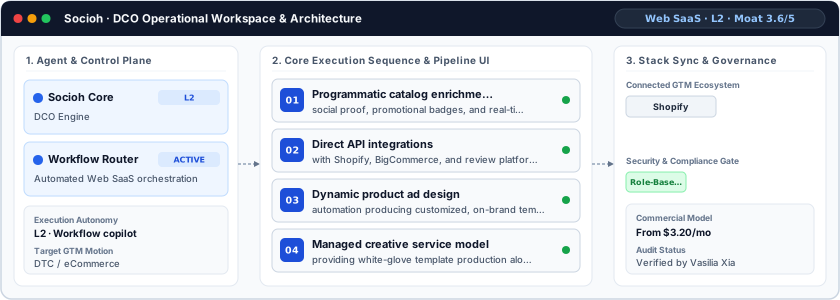
- Programmatic catalog enrichment injecting: social proof, promotional badges, and real-time inventory tags into product images
- Direct API integrations: with Shopify, BigCommerce, and review platforms such as Yotpo and Judge.me
- Dynamic product ad design: automation producing customized, on-brand templates for Meta catalog campaigns
- Managed creative service model: providing white-glove template production alongside automated feed distribution
Cons: operational limitations & risks
- Feed synchronization latency: Discrepancies can occur when inventory levels or product discounts fluctuate rapidly, as scheduled catalog refreshes may lag behind real-time storefront changes and temporarily serve outdated product badges.
- Platform dependency: The delivery architecture relies heavily on Meta Catalog API specifications, leaving creative layouts vulnerable to upstream display policy adjustments or unexpected catalog ingestion formatting shifts.
- Template customization constraints: Rule-based visual parameters require strict bounding box limits; highly irregular aspect ratios or lengthy review copy can trigger text clipping or suboptimal visual rendering within fixed dynamic layers.
Socioh TCO & deal-breaker stress test
Simulate 12-month stepped TCO, hidden cost multipliers, contract lock-in exposure, and stack failure modes using only facts verified by Vasilia Xia on · Capture SHA ce7c291e.
Socioh is viable for 5 seats, but requires commercial or technical verification on the flagged items below.
| Plan / Tier | Verified Rate | Scale Fit | Scope & Quota Notes |
|---|---|---|---|
| Entry / Starter | $3.2/mo | 1–2 seats | Verified $3.2/mo published rate on vendor pricing schedule. |
| Growth / Professional | $250/mo | 5 seats | Verified $250/mo published rate on vendor pricing schedule. |
- Moat Score
- 3.6 / 5.0
- AI Autonomy
- L2
- Free Tier / Trial
- None disclosed
Triggered audit signals & failure modes
- Published Self-Serve Entry FloorVerified Pricing Ledger
Socioh publishes a transparent entry point (From $3.20/mo) for initial validation before committing.
- Usage / Credit Burn VolatilityCommercial Model Audit
Socioh uses credit or usage-metered billing (From $3.20/mo). High-volume automated workflows across 5 seats can trigger mid-cycle overage charges.
- Tier Fit for 5-Seat Scale: Entry / Starter ($3.2/mo)Verified Tier Schedule
Verified $3.2/mo published rate on vendor pricing schedule.
- Primary Operational Bottleneck: Feed synchronization latencyAudit by Vasilia Xia
Discrepancies can occur when inventory levels or product discounts fluctuate rapidly, as scheduled catalog refreshes may lag behind real-time storefront changes and temporarily serve outdated product badges.
Hidden TCO Multipliers & Quota Gates
- Feed synchronization latency: Discrepancies can occur when inventory levels or product discounts fluctuate rapidly, as scheduled catalog refreshes may lag behind real-time storefront changes and temporarily serve outdated product badges.
- Platform dependency: The delivery architecture relies heavily on Meta Catalog API specifications, leaving creative layouts vulnerable to upstream display policy adjustments or unexpected catalog ingestion formatting shifts.
When to Walk Away & Negotiation Levers
- Walk away if your workflow requires uncapped enterprise volume on the From $3.20/mo entry plan without upgrading tiers.
- Walk away if your workflow cannot tolerate feed synchronization latency: Discrepancies can occur when inventory levels or product discounts fluctuate rapidly, as scheduled catalog refreshes may lag behind real-time storefront changes and temporarily serve outdated product badges.
- Walk away if platform dependency is a deal-breaker for your team: The delivery architecture relies heavily on Meta Catalog API specifications, leaving creative layouts vulnerable to upstream display policy adjustments or unexpected catalog ingestion formatting shifts.
- Validate exact quota thresholds (seats, credits, or API calls) included in Socioh's From $3.20/mo tier before converting from monthly to annual billing.
- Require a sandbox proof-of-concept testing feed synchronization latency against your live CRM/data schema before annual sign-off.
Ask a custom procurement or TCO stress-test question about Socioh
Lower 5-seat floor (~$15/mo vs. Usage-Metered)
Lower 5-seat floor (~$39/mo vs. Usage-Metered)
Socioh key entities, modules & ecosystem stack
Socioh moat & subtrack positioning
Tight integration with e-commerce platforms and third-party review engines paired with managed creative production services to prevent ad fatigue in dynamic catalog campaigns.
Editorial review
Fact-checked by Vasilia Xia (E-Commerce, Lifecycle & Retention Marketing Analyst) on .
Background
Established in 2013 and headquartered in Portland, Oregon, Socioh resolves the visual limitations of automated catalog advertising for direct-to-consumer e-commerce brands and performance marketing teams. Standard dynamic product ads on social platforms frequently rely on plain white-background product shots that fail to convey brand identity or drive high click-through rates. Socioh addresses this job-to-be-done by integrating dynamic catalog optimization software with dedicated creative production services, transforming standardized SKU feeds into branded creative assets.
How Socioh works
At its architectural core, Socioh operates as a Level 2 autonomous creative automation pipeline that ingests raw product feeds directly from e-commerce platforms like Shopify and BigCommerce. The engine synchronizes pricing changes, stock availability, and promotional variables, while extracting structured review metadata from third-party apps like Yotpo and Judge.me. These data points are programmatically mapped into rule-based graphic templates, dynamically layering customer testimonials, strike-through discounts, and urgency badges onto catalog images before pushing updated feeds directly to Meta ad accounts.
Limitations
Operational considerations and platform boundaries include:
- Feed synchronization latency: Discrepancies can occur when inventory levels or product discounts fluctuate rapidly, as scheduled catalog refreshes may lag behind real-time storefront changes and temporarily serve outdated product badges.
- Platform dependency: The delivery architecture relies heavily on Meta Catalog API specifications, leaving creative layouts vulnerable to upstream display policy adjustments or unexpected catalog ingestion formatting shifts.
- Template customization constraints: Rule-based visual parameters require strict bounding box limits; highly irregular aspect ratios or lengthy review copy can trigger text clipping or suboptimal visual rendering within fixed dynamic layers.
Socioh pricing
Socioh operates on a tiered monthly subscription model tied directly to an e-commerce merchant's gross monthly revenue tier. Commercial plans range from entry-level access starting from $3.20/month for testing micro-tiers up through structured tiers such as $1100 for merchants generating under $250k monthly revenue, $2100 for revenues between $250k and $800k, and $3500 for scaling brands generating between $800k and enterprise thresholds. Enterprise tiers for brands exceeding upper revenue levels start at $5000, with all primary packages incorporating white-glove design support alongside core software access.
How Socioh compares
Within the dynamic creative optimization category, Socioh occupies a hybrid niche compared to pure-play software engines like Abyssale, AdCreative.ai, and 7Pi. While Abyssale focuses on headless API image generation and AdCreative.ai relies on algorithmic asset generation, Socioh pairs software feed mapping with hands-on managed design services. This managed setup delivers refined visual consistency for high-growth direct-to-consumer retailers, though enterprise digital teams seeking standalone self-serve infrastructure may prefer developer-centric API alternatives.
Direct competitors & market radar
Top algorithmic competitors based on category positioning, capability overlap, and ICP alignment.
Frequently asked questions about Socioh
How much does Socioh cost and what pricing tiers are available?
Published pricing summary for Socioh: From $3.20/mo. A permanent free plan is not disclosed for Socioh. Verified tier schedule: Entry / Starter ($3.2/mo for 1–2 seats); Growth / Professional ($250/mo for 5 seats). Socioh operates on a tiered monthly subscription model tied directly to an e-commerce merchant's gross monthly revenue tier.
How does Socioh work and how autonomous is its AI architecture?
Dynamic catalog ad platform combining programmatic product feed enrichment with managed design services for high-converting dynamic product ads. Within DCO (Dynamic Creative Optimization / DCO), MarTechRadar rates its execution architecture at L2 · Workflow copilot with a verified Moat Score of 3.6 / 5.0 (Proprietary moat). Tight integration with e-commerce platforms and third-party review engines paired with managed creative production services to prevent ad fatigue in dynamic catalog campaigns. Corporate profile: Founded by Karan Jassar, Sahiba Sandhu, Sakhil Chawla, operating at 11-50 employees scale.
What are the main limitations of Socioh and when should buyers walk away?
Based on our editorial technical audit, key operational considerations and boundaries for Socioh include: (1) Feed synchronization latency: Discrepancies can occur when inventory levels or product discounts fluctuate rapidly, as scheduled catalog refreshes may lag behind real-time storefront changes and temporarily serve outdated product badges. (2) Platform dependency: The delivery architecture relies heavily on Meta Catalog API specifications, leaving creative layouts vulnerable to upstream display policy adjustments or unexpected catalog ingestion formatting shifts. (3) Template customization constraints: Rule-based visual parameters require strict bounding box limits; highly irregular aspect ratios or lengthy review copy can trigger text clipping or suboptimal visual rendering within fixed dynamic layers. Primary procurement walk-away rule: Walk away if your workflow requires uncapped enterprise volume on the From $3.20/mo entry plan without upgrading tiers.
What integrations, compliance certifications, and contract terms apply to Socioh?
Verified ecosystem and stack integrations include Shopify. Key TCO multiplier to watch: Feed synchronization latency (Discrepancies can occur when inventory levels or product discounts fluctuate rapidly, as scheduled catalog refreshes may lag behind real-time storefront changes and temporarily serve outdated product badges.) Before signing a contract, procurement teams should validate exact quota thresholds (seats, credits, or API calls) included in Socioh's From $3.20/mo tier before converting from monthly to annual billing.
What are the best Socioh alternatives and head-to-head competitors in 2026?
Top fact-checked alternatives to Socioh in DCO (Dynamic Creative Optimization / DCO) include Springboards (Custom / enterprise pricing), MatchCraft (Free plan · $0/mo · Enterprise plan), ModelRoom (From $39/mo), RelayThat (From $15/mo). Within the dynamic creative optimization category, Socioh occupies a hybrid niche compared to pure-play software engines like Abyssale, AdCreative.ai, and 7Pi.
Verified sources & evidence trail
- Official product domain: https://socioh.com
- Commercial pricing verification: https://socioh.com/pricing
- Verified corporate entity profiles (
sameAs): LinkedIn Company Profile · Crunchbase Entity Record - First-party governance & documentation links: Terms · Privacy
- Editorial audit sign-off: Fact-checked by Vasilia Xia on under the MarTechRadar Evidence-Ledger Protocol.