Sume Review (2026): AI Product Photography Pricing, Limits & Alternatives
Bottom line
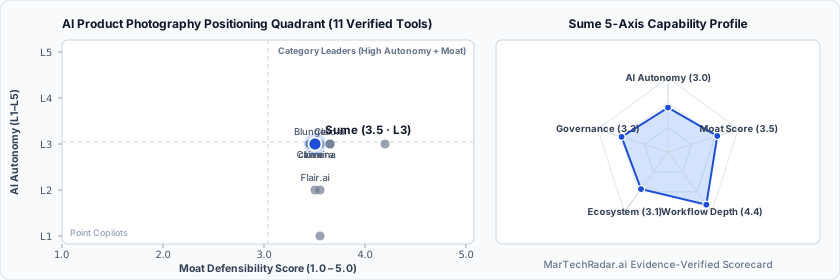
Sume is a Web SaaS tool for AI Product Photography (Product Photography & AI Retouching) in Visual & Creative Media. Pricing: $0.01–$0.95. Best suited to eCommerce Brands, Creative Agencies and Performance Video Marketers. Editor ratings: AI autonomy L3 (conditional automation); moat score 3.5/5.0 (Proprietary moat). Fact-checked by Jiacky Lee on Oct 10, 2026.
Programmatic video agent API generating automated synthetic avatars, product demonstration videos, and digital marketing assets on demand.
Sume buyer fit verdict: when to choose vs. when to walk away
Choose Sume if (Best Fit)
- Target ICP & Stack Fit: You operate as eCommerce Brands, Creative Agencies and Performance Video Marketers requiring a Web SaaS deployment for AI Product Photography.
- L3 Architecture & Defensibility: Proprietary generative neural pipelines bridging reference-photo avatar synthesis and physical product asset compositing via developer-first REST APIs.
- Commercial Model Fit: Your procurement budget aligns with $0.01–$0.95.
Walk away from Sume if (Deal-Breakers)
- Walk away if your workflow requires uncapped enterprise volume on the $0.01–$0.95 entry plan without upgrading tiers.
- Walk away if your workflow cannot tolerate concurrency and rate gating: Throughput remains bound by API concurrency caps and processing quotas, which can delay real-time video batch rendering during high-volume spikes.
- Walk away if input dependency on asset quality is a deal-breaker for your team: Generating avatars from low-resolution reference imagery introduces noticeable artifacting and temporal degradation in synthesized facial expressions.
Sume key facts & scorecard
| Pricing | $0.01–$0.95Vendor pricing page |
|---|---|
| Free plan | No / not disclosed |
| Delivery | Web SaaS |
| Audience | eCommerce Brands, Creative Agencies, Performance Video Marketers |
| AI autonomy level | L3 · Conditional automationEditor-verified |
| Moat tier & score | 3.5 / 5.0 · Proprietary moatEditor-verified |
| Funding | Pre-seed |
| Total funding | Pre-seedBacked by Kakao Ventures, Founders, Inc. |
| Founders | Chase Huh, David Im |
| Company size | 2-10 employees |
| Governance & docs | System Status ↗ · API & Docs ↗ · Terms ↗ · Privacy ↗ |
| Headquarters | San Francisco, California |
| Founded | 2026 |
| Last verified |
Sume pros & cons: strengths vs. operational limitations
Pros: core strengths & capabilities
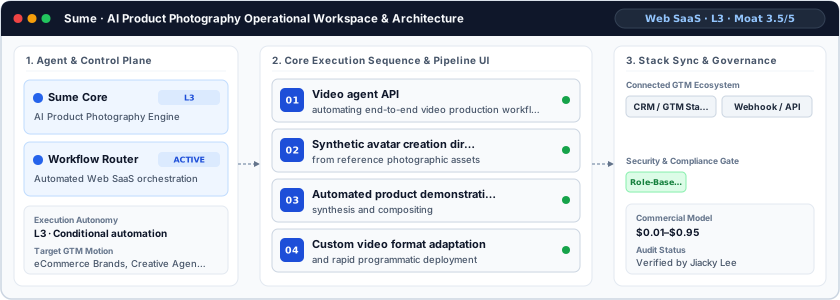
- Video agent API: automating end-to-end video production workflows
- Synthetic avatar creation directly: from reference photographic assets
- Automated product demonstration video: synthesis and compositing
- Custom video format adaptation: and rapid programmatic deployment
Cons: operational limitations & risks
- Concurrency and rate gating: Throughput remains bound by API concurrency caps and processing quotas, which can delay real-time video batch rendering during high-volume spikes.
- Input dependency on asset quality: Generating avatars from low-resolution reference imagery introduces noticeable artifacting and temporal degradation in synthesized facial expressions.
- Custom format ramp-up latency: Deploying bespoke automation pipelines requires tailored endpoint configuration from the engineering team, creating a multi-day onboarding delay for novel aspect ratios.
Sume TCO & deal-breaker stress test
Simulate 12-month stepped TCO, hidden cost multipliers, contract lock-in exposure, and stack failure modes using only facts verified by Jiacky Lee on · Capture SHA 2aa42036.
Sume is viable for 5 seats, but requires commercial or technical verification on the flagged items below.
| Plan / Tier | Verified Rate | Scale Fit | Scope & Quota Notes |
|---|---|---|---|
| Entry / Starter | $0.01/mo | 1–2 seats | Verified $0.01/mo published rate on vendor pricing schedule. |
| Growth / Professional | $0.95/mo | 5 seats | Verified $0.95/mo published rate on vendor pricing schedule. |
- Moat Score
- 3.5 / 5.0
- AI Autonomy
- L3
- Free Tier / Trial
- None disclosed
Triggered audit signals & failure modes
- Published Self-Serve Entry FloorVerified Pricing Ledger
Sume publishes a transparent entry point ($0.01–$0.95) for initial validation before committing.
- Usage / Credit Burn VolatilityCommercial Model Audit
Sume uses credit or usage-metered billing ($0.01–$0.95). High-volume automated workflows across 5 seats can trigger mid-cycle overage charges.
- Tier Fit for 5-Seat Scale: Entry / Starter ($0.01/mo)Verified Tier Schedule
Verified $0.01/mo published rate on vendor pricing schedule.
- Primary Operational Bottleneck: Concurrency and rate gatingAudit by Jiacky Lee
Throughput remains bound by API concurrency caps and processing quotas, which can delay real-time video batch rendering during high-volume spikes.
Hidden TCO Multipliers & Quota Gates
- Concurrency and rate gating: Throughput remains bound by API concurrency caps and processing quotas, which can delay real-time video batch rendering during high-volume spikes.
- Input dependency on asset quality: Generating avatars from low-resolution reference imagery introduces noticeable artifacting and temporal degradation in synthesized facial expressions.
When to Walk Away & Negotiation Levers
- Walk away if your workflow requires uncapped enterprise volume on the $0.01–$0.95 entry plan without upgrading tiers.
- Walk away if your workflow cannot tolerate concurrency and rate gating: Throughput remains bound by API concurrency caps and processing quotas, which can delay real-time video batch rendering during high-volume spikes.
- Walk away if input dependency on asset quality is a deal-breaker for your team: Generating avatars from low-resolution reference imagery introduces noticeable artifacting and temporal degradation in synthesized facial expressions.
- Validate exact quota thresholds (seats, credits, or API calls) included in Sume's $0.01–$0.95 tier before converting from monthly to annual billing.
- Require a sandbox proof-of-concept testing concurrency and rate gating against your live CRM/data schema before annual sign-off.
Ask a custom procurement or TCO stress-test question about Sume
Lower 5-seat floor (~$59/mo vs. Usage-Metered)
Lower 5-seat floor (~$120/mo vs. Usage-Metered)
Sume moat & subtrack positioning
Proprietary generative neural pipelines bridging reference-photo avatar synthesis and physical product asset compositing via developer-first REST APIs.
Editorial review
Fact-checked by Jiacky Lee (Managing Editor, AI Autonomy & Moat Methodology) on .
Background
Established in 2026 and based in San Francisco, California, Sume approaches commercial asset generation through an API-first video agent architecture rather than manual creative suites. Built specifically for technical growth marketers and software engineers orchestrating programmatic creative pipelines, the system eliminates traditional studio filming constraints. The platform abstracts neural rendering, avatar generation, and product compositing behind clean developer endpoints, allowing programmatic campaign scaling without human post-production intervention.
How Sume works
Sume operates as an L3 automated video engine powered by dedicated neural video generation models. The platform processes ingestion payloads containing reference photos, product catalogs, and scripting metadata via its public API. The ingestion pipeline extracts facial landmarks and brand asset coordinates to construct reusable avatars alongside branded product placements. Synthesized frames undergo automated lip-synchronization and temporal consistency filtering, outputting ready-to-post video spots directly to webhook destinations without manual keyframing.
Limitations
Operational considerations and platform boundaries include:
- Concurrency and rate gating: Throughput remains bound by API concurrency caps and processing quotas, which can delay real-time video batch rendering during high-volume spikes.
- Input dependency on asset quality: Generating avatars from low-resolution reference imagery introduces noticeable artifacting and temporal degradation in synthesized facial expressions.
- Custom format ramp-up latency: Deploying bespoke automation pipelines requires tailored endpoint configuration from the engineering team, creating a multi-day onboarding delay for novel aspect ratios.
Sume pricing
Commercial access to Sume relies on a consumption-based structure with metered API rates ranging from $0.01 to $0.95. Usage is tracked across granular unit tiers, where basic actions begin around $0.01 and one-time avatar profile creation scales up to $0.95 per identity. Ongoing frame and video synthesis operations bill via fractional per-second metering, while dedicated subscription tiers govern concurrent rendering pipelines and platform support allotments.
How Sume compares
Within programmatic product photography and asset retouching workflows, Sume differs significantly from asset-focused engines like Blunge, Caimera, and Clova. While Blunge and Clova focus heavily on static e-commerce visual enhancements and catalog backgrounds, Sume emphasizes dynamic video agents and script-driven dynamic avatars. Caimera delivers rapid photo-to-ad transformation, whereas Sume targets technical developer teams requiring programmatic API integration for automated video generation across global marketing operations.
Frequently asked questions about Sume
How much does Sume cost and what pricing tiers are available?
Published pricing summary for Sume: $0.01–$0.95. A permanent free plan is not disclosed for Sume. Verified tier schedule: Entry / Starter ($0.01/mo for 1–2 seats); Growth / Professional ($0.95/mo for 5 seats). Commercial access to Sume relies on a consumption-based structure with metered API rates ranging from $0.01 to $0.95. Usage is tracked across granular unit tiers, where basic actions begin around $0.01 and one-time avatar profile creation scales up to $0.95 per identity.
How does Sume work and how autonomous is its AI architecture?
Programmatic video agent API generating automated synthetic avatars, product demonstration videos, and digital marketing assets on demand. Within AI Product Photography (Product Photography & AI Retouching), MarTechRadar rates its execution architecture at L3 · Conditional automation with a verified Moat Score of 3.5 / 5.0 (Proprietary moat). Proprietary generative neural pipelines bridging reference-photo avatar synthesis and physical product asset compositing via developer-first REST APIs. Corporate profile: Founded by Chase Huh, David Im, operating at 2-10 employees scale.
What are the main limitations of Sume and when should buyers walk away?
Based on our editorial technical audit, key operational considerations and boundaries for Sume include: (1) Concurrency and rate gating: Throughput remains bound by API concurrency caps and processing quotas, which can delay real-time video batch rendering during high-volume spikes. (2) Input dependency on asset quality: Generating avatars from low-resolution reference imagery introduces noticeable artifacting and temporal degradation in synthesized facial expressions. (3) Custom format ramp-up latency: Deploying bespoke automation pipelines requires tailored endpoint configuration from the engineering team, creating a multi-day onboarding delay for novel aspect ratios. Primary procurement walk-away rule: Walk away if your workflow requires uncapped enterprise volume on the $0.01–$0.95 entry plan without upgrading tiers.
What integrations, compliance certifications, and contract terms apply to Sume?
First-party governance and developer endpoints verified on domain include: Status (https://status.sume.com), API Docs (https://docs.sume.com). Key TCO multiplier to watch: Concurrency and rate gating (Throughput remains bound by API concurrency caps and processing quotas, which can delay real-time video batch rendering during high-volume spikes.) Before signing a contract, procurement teams should validate exact quota thresholds (seats, credits, or API calls) included in Sume's $0.01–$0.95 tier before converting from monthly to annual billing.
What are the best Sume alternatives and head-to-head competitors in 2026?
Top fact-checked alternatives to Sume in AI Product Photography (Product Photography & AI Retouching) include Lamina ($59–$99/mo), Booth.ai (Custom / enterprise pricing), Smartmockups (Custom / enterprise pricing), Mogic AI (Custom / enterprise pricing). Within programmatic product photography and asset retouching workflows, Sume differs significantly from asset-focused engines like Blunge, Caimera, and Clova.
Verified sources & evidence trail
- Official product domain: https://sume.com
- Commercial pricing verification: https://www.sume.com/pricing/api
- Verified corporate entity profiles (
sameAs): LinkedIn Company Profile · Crunchbase Entity Record - First-party governance & documentation links: System Status · API & Docs · Terms · Privacy
- Editorial audit sign-off: Fact-checked by Jiacky Lee on under the MarTechRadar Evidence-Ledger Protocol.