Gravity Review (2026): AI Marketing Agent Pricing, Limits & Alternatives
Bottom line
Gravity is a Web SaaS tool for AI Marketing Agent (Autonomous Marketing Agents & Digital Coworkers) in Agent & Marketing Ops. Pricing: Custom / enterprise pricing. Best suited to GTM Operations Teams, Enterprise Marketing Executives and Automated Ops Teams. Editor ratings: AI autonomy L3 (conditional automation); moat score 3.8/5.0 (Proprietary moat). Fact-checked by Tim Fenolz on Oct 11, 2026.
Autonomous go-to-market agent platform acting as a directive revenue chief of staff to replace passive CRM data entry with proactive sales execution.
Gravity buyer fit verdict: when to choose vs. when to walk away
Choose Gravity if (Best Fit)
- Target ICP & Stack Fit: You operate as GTM Operations Teams, Enterprise Marketing Executives and Automated Ops Teams requiring a Web SaaS deployment for AI Marketing Agent, with verified ecosystem connectivity for Salesforce, HubSpot.
- L3 Architecture & Defensibility: Gravity differentiates through persistent, directive revenue agents that transition systems of record into autonomous systems of execution, though its defensibility remains nascent given its early pre-seed stage.
- Commercial Model Fit: Your procurement budget aligns with Custom / enterprise pricing.
Walk away from Gravity if (Deal-Breakers)
- Walk away if you require transparent self-serve monthly billing or your budget ceiling is under $1,000/mo (Gravity requires sales-gated custom quoting).
- Walk away if your workflow cannot tolerate schema mapping brittleness: Complex, heavily customized Salesforce or HubSpot object schemas require extensive field-level mapping, creating operational fragility during upstream property changes.
- Walk away if cold-start context latency is a deal-breaker for your team: Because the platform depends on historical deal activity to formulate high-conviction interventions, early deployments suffer from delayed recommendation accuracy in low-volume pipelines.
Gravity key facts & scorecard
| Pricing | Custom / enterprise pricing |
|---|---|
| Free plan | No / not disclosed |
| Delivery | Web SaaS |
| Audience | GTM Operations Teams, Enterprise Marketing Executives, Automated Ops Teams |
| AI autonomy level | L3 · Conditional automationEditor-verified |
| Moat tier & score | 3.8 / 5.0 · Proprietary moatEditor-verified |
| Funding | Pre-seed |
| Total funding | $550KBacked by Antler |
| Founders | Andrew Sawyer, Ashmer Aslam |
| Company size | 2-10 employees |
| Ecosystem integrations | Salesforce, HubSpot |
| Headquarters | Boulder, Colorado |
| Founded | 2025 |
| Last verified |
Gravity pros & cons: strengths vs. operational limitations
Pros: core strengths & capabilities
- Horizon predictive pipeline and: deal trajectory orchestration
- Helium proactive task automation: and rep intervention engine
- Ask Gravity conversational revenue: intelligence interface
- Bi-directional CRM synchronization and: record hygiene automation
Cons: operational limitations & risks
- Schema Mapping Brittleness: Complex, heavily customized Salesforce or HubSpot object schemas require extensive field-level mapping, creating operational fragility during upstream property changes.
- Cold-Start Context Latency: Because the platform depends on historical deal activity to formulate high-conviction interventions, early deployments suffer from delayed recommendation accuracy in low-volume pipelines.
- Write-Back Concurrency: Simultaneous automated agent record updates and manual seller modifications can generate sync race conditions, necessitating periodic conflict resolution within the host CRM.
Gravity TCO & deal-breaker stress test
Simulate 12-month stepped TCO, hidden cost multipliers, contract lock-in exposure, and stack failure modes using only facts verified by Tim Fenolz on · Capture SHA bdb91d7f.
Gravity triggers high-severity friction under your 5-seat / $800/mo constraints. Benchmark the verified subtrack alternatives below before committing.
| Plan / Tier | Verified Rate | Scale Fit | Scope & Quota Notes |
|---|---|---|---|
| Enterprise / Custom | Custom quote | 15–50+ seats (Enterprise SLA) | Sales-negotiated annual contract for custom volume, SSO/RBAC governance, and dedicated SLA. |
- Moat Score
- 3.8 / 5.0
- AI Autonomy
- L3
- Free Tier / Trial
- None disclosed
Triggered audit signals & failure modes
- Opaque Enterprise Quoting vs. SMB/Mid-Market BudgetVerified Pricing Ledger
Gravity does not disclose a public self-serve floor (Custom / enterprise pricing). Buyers with a $800/mo cap face high sales-qualification friction.
- Sales-Gated Contract TermsFact-checked by Tim Fenolz
Gravity provides custom enterprise licensing structured around organizational scale and user seats.
- Primary Operational Bottleneck: Schema Mapping BrittlenessAudit by Tim Fenolz
Complex, heavily customized Salesforce or HubSpot object schemas require extensive field-level mapping, creating operational fragility during upstream property changes.
Hidden TCO Multipliers & Quota Gates
- Schema Mapping Brittleness: Complex, heavily customized Salesforce or HubSpot object schemas require extensive field-level mapping, creating operational fragility during upstream property changes.
- Cold-Start Context Latency: Because the platform depends on historical deal activity to formulate high-conviction interventions, early deployments suffer from delayed recommendation accuracy in low-volume pipelines.
When to Walk Away & Negotiation Levers
- Walk away if you require transparent self-serve monthly billing or your budget ceiling is under $1,000/mo (Gravity requires sales-gated custom quoting).
- Walk away if your workflow cannot tolerate schema mapping brittleness: Complex, heavily customized Salesforce or HubSpot object schemas require extensive field-level mapping, creating operational fragility during upstream property changes.
- Walk away if cold-start context latency is a deal-breaker for your team: Because the platform depends on historical deal activity to formulate high-conviction interventions, early deployments suffer from delayed recommendation accuracy in low-volume pipelines.
- Demand a 30- to 60-day paid pilot opt-out clause in the Gravity order form before signing a 12-month enterprise commitment.
- Require a sandbox proof-of-concept testing schema mapping brittleness against your live CRM/data schema before annual sign-off.
Ask a custom procurement or TCO stress-test question about Gravity
Lower 5-seat floor (~$25/mo vs. Custom Quote) · Transparent self-serve entry without mandatory annual lock-in
Lower 5-seat floor (~$495/mo vs. Custom Quote) · Transparent self-serve entry without mandatory annual lock-in
Gravity key entities, modules & ecosystem stack
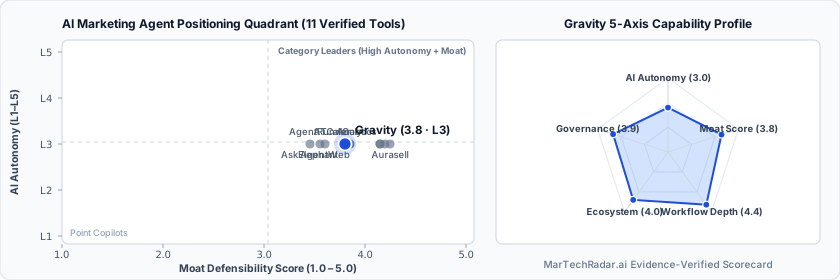
Gravity moat & subtrack positioning
Gravity differentiates through persistent, directive revenue agents that transition systems of record into autonomous systems of execution, though its defensibility remains nascent given its early pre-seed stage.
Editorial review
Fact-checked by Tim Fenolz (Lead AdTech, Programmatic & Attribution Analyst) on .
Background
Architectured to shift go-to-market operations from passive systems of record toward directive execution systems, Gravity was founded in 2025 in Boulder, Colorado. Backed by $550K in pre-seed financing, the platform functions as an autonomous revenue chief of staff targeting chief revenue officers, sales executives, and revenue operations teams burdened by manual CRM maintenance. Instead of treating customer databases as historical data repositories, Gravity proactively orchestrates seller workflows around revenue generation.
How Gravity works
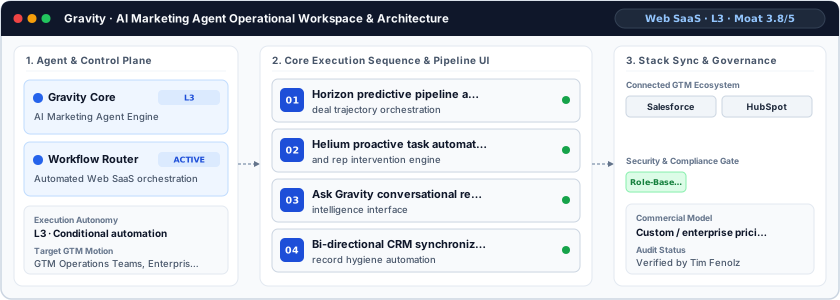
At the architectural layer, the system autonomy, Gravity ingests pipeline data, customer communications, and deal milestones through bi-directional CRM integration layers. Its modular architecture—comprising the Horizon trajectory engine, the Helium execution framework, and the conversational Ask Gravity interface—synthesizes raw sales activity into continuous next-best-action directives. Specialized agent loops monitor pipeline movement, compute deal velocity risks, and automatically push prescriptive deal progression tasks directly to sellers, minimizing manual record logging.
Limitations
Operational considerations and platform boundaries include:
- Schema Mapping Brittleness: Complex, heavily customized Salesforce or HubSpot object schemas require extensive field-level mapping, creating operational fragility during upstream property changes.
- Cold-Start Context Latency: Because the platform depends on historical deal activity to formulate high-conviction interventions, early deployments suffer from delayed recommendation accuracy in low-volume pipelines.
- Write-Back Concurrency: Simultaneous automated agent record updates and manual seller modifications can generate sync race conditions, necessitating periodic conflict resolution within the host CRM.
Gravity pricing
Gravity provides custom enterprise licensing structured around organizational scale and user seats. Rather than publishing standard self-serve tiers, the platform provisions deployments through direct enterprise proposals based on CRM instance complexity, agent integration requirements, and pipeline volume, with commercial quotes available on request from sales.
How Gravity compares
Within the autonomous coworker space, Gravity directly contrasts with solutions like allGood and AskElephant, as well as domain-tuned options like ai-marketing-claude. AskElephant targets conversational capture and call transcription summaries, whereas allGood focuses on broader operations workflow automation. Gravity specializes strictly in directive revenue orchestration, making it suitable for mid-market B2B software companies seeking to automate seller prioritization and eliminate CRM compliance bottlenecks.
Direct competitors & market radar
Top algorithmic competitors based on category positioning, capability overlap, and ICP alignment.
Frequently asked questions about Gravity
How much does Gravity cost and does it require a custom enterprise quote?
Published pricing summary for Gravity: Custom / enterprise pricing. A permanent free plan is not disclosed for Gravity. Gravity provides custom enterprise licensing structured around organizational scale and user seats.
How does Gravity work and how autonomous is its AI architecture?
Autonomous go-to-market agent platform acting as a directive revenue chief of staff to replace passive CRM data entry with proactive sales execution. Within AI Marketing Agent (Autonomous Marketing Agents & Digital Coworkers), MarTechRadar rates its execution architecture at L3 · Conditional automation with a verified Moat Score of 3.8 / 5.0 (Proprietary moat). Gravity differentiates through persistent, directive revenue agents that transition systems of record into autonomous systems of execution, though its defensibility remains nascent given its early pre-seed stage. Corporate profile: Founded by Andrew Sawyer, Ashmer Aslam, operating at 2-10 employees scale.
What are the main limitations of Gravity and when should buyers walk away?
Based on our editorial technical audit, key operational considerations and boundaries for Gravity include: (1) Schema Mapping Brittleness: Complex, heavily customized Salesforce or HubSpot object schemas require extensive field-level mapping, creating operational fragility during upstream property changes. (2) Cold-Start Context Latency: Because the platform depends on historical deal activity to formulate high-conviction interventions, early deployments suffer from delayed recommendation accuracy in low-volume pipelines. (3) Write-Back Concurrency: Simultaneous automated agent record updates and manual seller modifications can generate sync race conditions, necessitating periodic conflict resolution within the host CRM. Primary procurement walk-away rule: Walk away if you require transparent self-serve monthly billing or your budget ceiling is under $1,000/mo (Gravity requires sales-gated custom quoting).
What integrations, compliance certifications, and contract terms apply to Gravity?
Verified ecosystem and stack integrations include Salesforce, HubSpot. Key TCO multiplier to watch: Schema Mapping Brittleness (Complex, heavily customized Salesforce or HubSpot object schemas require extensive field-level mapping, creating operational fragility during upstream property changes.) Before signing a contract, procurement teams should demand a 30- to 60-day paid pilot opt-out clause in the Gravity order form before signing a 12-month enterprise commitment.
What are the best Gravity alternatives and head-to-head competitors in 2026?
Top fact-checked alternatives to Gravity in AI Marketing Agent (Autonomous Marketing Agents & Digital Coworkers) include Actively AI (Custom / enterprise pricing), Tray.io (Custom / enterprise pricing), GoMarble (From $25/mo), Dalil AI (From $3/mo). Within the autonomous coworker space, Gravity directly contrasts with solutions like allGood and AskElephant, as well as domain-tuned options like ai-marketing-claude. AskElephant targets conversational capture and call transcription summaries, whereas allGood focuses on broader operations workflow automation.
Verified sources & evidence trail
- Official product domain: https://www.gravitygtm.com
- Commercial pricing verification: Verified against official vendor pricing policy (Custom / enterprise pricing)
- Verified corporate entity profiles (
sameAs): LinkedIn Company Profile · Crunchbase Entity Record - Editorial audit sign-off: Fact-checked by Tim Fenolz on under the MarTechRadar Evidence-Ledger Protocol.