Help Scout Review (2026): Email Marketing Pricing, Limits & Alternatives
Bottom line
Help Scout is a Web SaaS tool for Email Marketing (AI Email Marketing & Lifecycle Journeys) in Lifecycle & CDP. Pricing: Free plan · $0/mo · Enterprise plan. Best suited to B2B SaaS and Creators / Solo. Editor ratings: AI autonomy L3 (conditional automation); moat score 4.2/5.0 (Proprietary moat). Fact-checked by Vasilia Xia on Oct 14, 2026.
AI-driven customer communications and support platform unifying shared mailboxes, conversational copilot tooling, and automated lifecycle messaging.
Help Scout buyer fit verdict: when to choose vs. when to walk away
Choose Help Scout if (Best Fit)
- Target ICP & Stack Fit: You operate as B2B SaaS and Creators / Solo requiring a Web SaaS deployment for Email Marketing.
- L3 Architecture & Defensibility: Sticky conversational intelligence layer combining a unified shared mailbox, proprietary Copilot agent workflows, and deep integrations across B2B SaaS and service stacks.
- Commercial Model Fit: Your procurement budget aligns with Free plan · $0/mo · Enterprise plan and want a self-serve free tier for zero-cost initial validation.
Walk away from Help Scout if (Deal-Breakers)
- Walk away if your workflow requires uncapped enterprise volume on the Free plan · $0/mo · Enterprise plan entry plan without upgrading tiers.
- Walk away if your workflow cannot tolerate high-volume mailbox warming and delivery constraints: The system relies on shared inbound and outbound mail channels that encounter deliverability throttling when scaling broad outbound lifecycle sequences beyond transactional thresholds.
- Walk away if custom object schema rigidity is a deal-breaker for your team: Data modeling remains constrained around conventional conversation and contact entities, requiring complex webhook workarounds when syncing relational enterprise data from external warehouses.
Help Scout key facts & scorecard
| Pricing | Free plan · $0/mo · Enterprise planVendor pricing page |
|---|---|
| Free plan | Yes |
| Delivery | Web SaaS |
| Audience | B2B SaaS, Creators / Solo |
| AI autonomy level | L3 · Conditional automationEditor-verified |
| Moat tier & score | 4.2 / 5.0 · Proprietary moatEditor-verified |
| Funding | Venture-backed |
| Total funding | $28M |
| Founders | Denny Swindle, Jared McDaniel, Nick Francis |
| Company size | 51-200 employees |
| Governance & docs | System Status ↗ · API & Docs ↗ · Terms ↗ · Privacy ↗ |
| Headquarters | Boston, MA |
| Founded | 2011 |
| Last verified |
Help Scout pros & cons: strengths vs. operational limitations
Pros: core strengths & capabilities
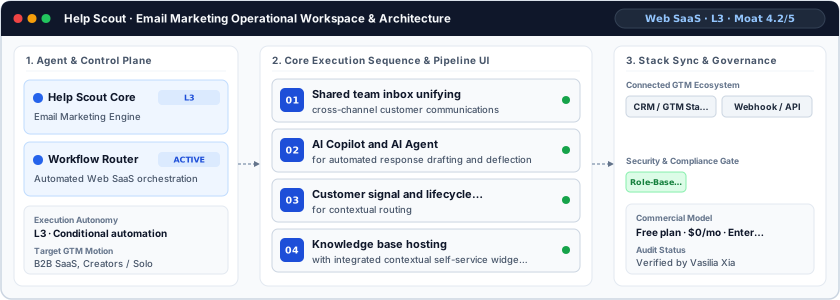
- Shared team inbox unifying: cross-channel customer communications
- AI Copilot and AI Agent: for automated response drafting and deflection
- Customer signal and lifecycle journey tracking: for contextual routing
- Knowledge base hosting: with integrated contextual self-service widgets
Cons: operational limitations & risks
- High-Volume Mailbox Warming and Delivery Constraints: The system relies on shared inbound and outbound mail channels that encounter deliverability throttling when scaling broad outbound lifecycle sequences beyond transactional thresholds.
- Custom Object Schema Rigidity: Data modeling remains constrained around conventional conversation and contact entities, requiring complex webhook workarounds when syncing relational enterprise data from external warehouses.
- Downstream Attribution Lag: Lifecycle tracking lacks granular multi-touch revenue attribution modeling, restricting visibility to direct resolution metrics rather than pipeline expansion across extended sales cycles.
Help Scout TCO & deal-breaker stress test
Simulate 12-month stepped TCO, hidden cost multipliers, contract lock-in exposure, and stack failure modes using only facts verified by Vasilia Xia on · Capture SHA cae42dd2.
Help Scout is viable for 5 seats, but requires commercial or technical verification on the flagged items below.
| Plan / Tier | Verified Rate | Scale Fit | Scope & Quota Notes |
|---|---|---|---|
| Free / Sandbox | $0 | 1–2 seats (Evaluation) | Entry free tier with capped usage or feature quotas for initial workflow testing. |
| Entry / Starter | $0.75/mo | 1–2 seats | Scale capacity with an AI assistant that instantly resolves customer requests. Pay per resoluti |
| Growth / Professional | $10/mo | 5 seats | What counts as an AI resolution? |
| Scale / Advanced | $12/mo | 15 seats | What counts as an AI resolution? |
- Moat Score
- 4.2 / 5.0
- AI Autonomy
- L3
- Free Tier / Trial
- Free plan
Triggered audit signals & failure modes
- Opaque Enterprise Quoting vs. SMB/Mid-Market BudgetVerified Pricing Ledger
Help Scout does not disclose a public self-serve floor (Free plan · $0/mo · Enterprise plan). Buyers with a $800/mo cap face high sales-qualification friction.
- Published Self-Serve Entry FloorVerified Pricing Ledger
Help Scout publishes a transparent entry point (Free plan · $0/mo · Enterprise plan) with a free tier for initial validation before committing.
- Tier Fit for 5-Seat Scale: Entry / Starter ($0.75/mo)Verified Tier Schedule
Scale capacity with an AI assistant that instantly resolves customer requests. Pay per resoluti
- Primary Operational Bottleneck: High-Volume Mailbox Warming and Delivery ConstraintsAudit by Vasilia Xia
The system relies on shared inbound and outbound mail channels that encounter deliverability throttling when scaling broad outbound lifecycle sequences beyond transactional thresholds.
Hidden TCO Multipliers & Quota Gates
- Per-Seat Linear Scaling: Help Scout prices licenses on a per-user/seat basis (Free plan · $0/mo · Enterprise plan); expanding from 2 to 15+ operators multiplies base recurring spend linearly.
- Credit & Usage Burn Multiplier: Automated workflows consume metered credits/usage quotas; multi-step enrichment, voice minutes, or high-frequency agent runs can trigger mid-cycle top-up packs.
- Enterprise Governance & Add-On Gating: Advanced capabilities such as Single Sign-On (SSO), custom role permissions, or specialized analytics modules are gated behind upper tiers or paid add-ons.
When to Walk Away & Negotiation Levers
- Walk away if your workflow requires uncapped enterprise volume on the Free plan · $0/mo · Enterprise plan entry plan without upgrading tiers.
- Walk away if your workflow cannot tolerate high-volume mailbox warming and delivery constraints: The system relies on shared inbound and outbound mail channels that encounter deliverability throttling when scaling broad outbound lifecycle sequences beyond transactional thresholds.
- Walk away if custom object schema rigidity is a deal-breaker for your team: Data modeling remains constrained around conventional conversation and contact entities, requiring complex webhook workarounds when syncing relational enterprise data from external warehouses.
- Validate exact quota thresholds (seats, credits, or API calls) included in Help Scout's Free plan · $0/mo · Enterprise plan tier before converting from monthly to annual billing.
- Require a sandbox proof-of-concept testing high-volume mailbox warming and delivery constraints against your live CRM/data schema before annual sign-off.
Ask a custom procurement or TCO stress-test question about Help Scout
Lower 5-seat floor (~$27/mo vs. Custom Quote)
Lower 5-seat floor (~$105/mo vs. Custom Quote)
Help Scout moat & subtrack positioning
Sticky conversational intelligence layer combining a unified shared mailbox, proprietary Copilot agent workflows, and deep integrations across B2B SaaS and service stacks.
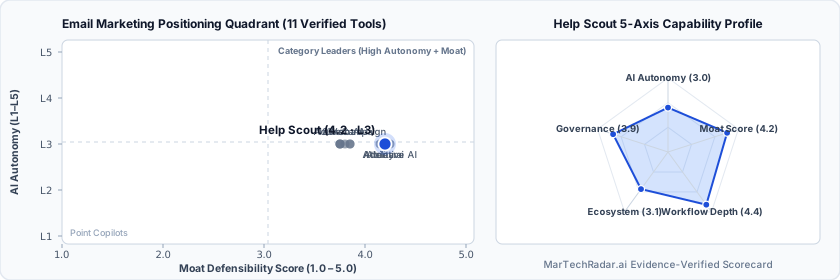
Editorial review
Fact-checked by Vasilia Xia (E-Commerce, Lifecycle & Retention Marketing Analyst) on .
Background
Architected as a centralized communications pipeline, Help Scout grounds customer lifecycle interactions within a shared team inbox and automated assistance fabric. Headquartered in Boston, MA, and founded in 2011, the company has secured $28M in total venture capital funding to modernize operational engagement. Built for customer operations leads and lifecycle marketing managers, the software transitions standard service operations into proactive cross-channel dialogue across email and web chat touchpoints.
How Help Scout works
At its architectural core, Help Scout ingests inbound message events via webhook relays and bidirectional email sync, mapping incoming payloads against unified contact profiles. The engine utilizes an L3 autonomous workflow framework comprising rule-driven sorting logic, automated deflection, and generative Copilot assistance. Text embeddings evaluate conversation history against indexed internal knowledge bases, drafting contextual replies and triggering transactional touchpoints without manual agent intervention.
Limitations
Operational considerations and platform boundaries include:
- High-Volume Mailbox Warming and Delivery Constraints: The system relies on shared inbound and outbound mail channels that encounter deliverability throttling when scaling broad outbound lifecycle sequences beyond transactional thresholds.
- Custom Object Schema Rigidity: Data modeling remains constrained around conventional conversation and contact entities, requiring complex webhook workarounds when syncing relational enterprise data from external warehouses.
- Downstream Attribution Lag: Lifecycle tracking lacks granular multi-touch revenue attribution modeling, restricting visibility to direct resolution metrics rather than pipeline expansion across extended sales cycles.
Help Scout pricing
Commercial procurement operates on a hybrid model that includes entry-level access starting with a free tier at $0 per user per month. As conversation volumes, shared mailbox limits, and AI Copilot capabilities scale, organizations move into paid user-seated tiers alongside customized annual enterprise agreements featuring dedicated account governance and advanced API rate limits.
How Help Scout compares
Help Scout occupies a functional middle ground between automated infrastructure builders and pure conversion suites. While 10Web AI targets autonomous site generation and AB Tasty prioritizes predictive multivariate web experimentation, Help Scout concentrates squarely on conversational continuity and transactional lifecycle interactions. For specialized autonomous conversion tasks, platforms like Ability.ai provide deeper real-time optimization, whereas Help Scout is designed specifically for mid-market teams seeking low-friction customer interaction routing.
Frequently asked questions about Help Scout
How much does Help Scout cost and what pricing tiers are available?
Published pricing summary for Help Scout: Free plan · $0/mo · Enterprise plan. Help Scout includes a free tier or sandbox entry point. Verified tier schedule: Free / Sandbox ($0 for 1–2 seats (Evaluation)); Entry / Starter ($0.75/mo for 1–2 seats); Growth / Professional ($10/mo for 5 seats); Scale / Advanced ($12/mo for 15 seats). Commercial procurement operates on a hybrid model that includes entry-level access starting with a free tier at $0 per user per month.
How does Help Scout work and how autonomous is its AI architecture?
AI-driven customer communications and support platform unifying shared mailboxes, conversational copilot tooling, and automated lifecycle messaging. Within Email Marketing (AI Email Marketing & Lifecycle Journeys), MarTechRadar rates its execution architecture at L3 · Conditional automation with a verified Moat Score of 4.2 / 5.0 (Proprietary moat). Sticky conversational intelligence layer combining a unified shared mailbox, proprietary Copilot agent workflows, and deep integrations across B2B SaaS and service stacks. Corporate profile: Founded by Denny Swindle, Jared McDaniel, Nick Francis, operating at 51-200 employees scale.
What are the main limitations of Help Scout and when should buyers walk away?
Based on our editorial technical audit, key operational considerations and boundaries for Help Scout include: (1) High-Volume Mailbox Warming and Delivery Constraints: The system relies on shared inbound and outbound mail channels that encounter deliverability throttling when scaling broad outbound lifecycle sequences beyond transactional thresholds. (2) Custom Object Schema Rigidity: Data modeling remains constrained around conventional conversation and contact entities, requiring complex webhook workarounds when syncing relational enterprise data from external warehouses. (3) Downstream Attribution Lag: Lifecycle tracking lacks granular multi-touch revenue attribution modeling, restricting visibility to direct resolution metrics rather than pipeline expansion across extended sales cycles. Primary procurement walk-away rule: Walk away if your workflow requires uncapped enterprise volume on the Free plan · $0/mo · Enterprise plan entry plan without upgrading tiers.
What integrations, compliance certifications, and contract terms apply to Help Scout?
First-party governance and developer endpoints verified on domain include: Status (https://status.helpscout.com), API Docs (https://docs.helpscout.com). Key TCO multiplier to watch: Per-Seat Linear Scaling (Help Scout prices licenses on a per-user/seat basis (Free plan · $0/mo · Enterprise plan); expanding from 2 to 15+ operators multiplies base recurring spend linearly.) Before signing a contract, procurement teams should validate exact quota thresholds (seats, credits, or API calls) included in Help Scout's Free plan · $0/mo · Enterprise plan tier before converting from monthly to annual billing.
What are the best Help Scout alternatives and head-to-head competitors in 2026?
Top fact-checked alternatives to Help Scout in Email Marketing (AI Email Marketing & Lifecycle Journeys) include Emma (From $105/mo), Front (From $0.05/mo), Mailmodo (From $27/mo), Netic (Custom / enterprise pricing). Help Scout occupies a functional middle ground between automated infrastructure builders and pure conversion suites.
Verified sources & evidence trail
- Official product domain: https://helpscout.com
- Commercial pricing verification: https://www.helpscout.com/pricing/
- Verified corporate entity profiles (
sameAs): LinkedIn Company Profile · Crunchbase Entity Record - First-party governance & documentation links: System Status · API & Docs · Terms · Privacy
- Editorial audit sign-off: Fact-checked by Vasilia Xia on under the MarTechRadar Evidence-Ledger Protocol.