Mailmodo Review (2026): Email Marketing Pricing, Limits & Alternatives
Bottom line
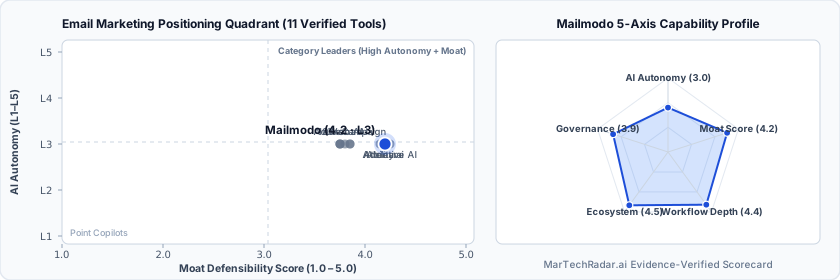
Mailmodo is a Web SaaS tool for Email Marketing (AI Email Marketing & Lifecycle Journeys) in Lifecycle & CDP. Pricing: From $27/mo. Best suited to B2B SaaS and DTC / eCommerce. Editor ratings: AI autonomy L3 (conditional automation); moat score 4.2/5.0 (Proprietary moat). Fact-checked by Sarah Per on Oct 14, 2026.
Interactive AMP and HTML email automation engine that streamlines campaign creation, dynamic customer journeys, and in-email conversion forms.
Mailmodo buyer fit verdict: when to choose vs. when to walk away
Choose Mailmodo if (Best Fit)
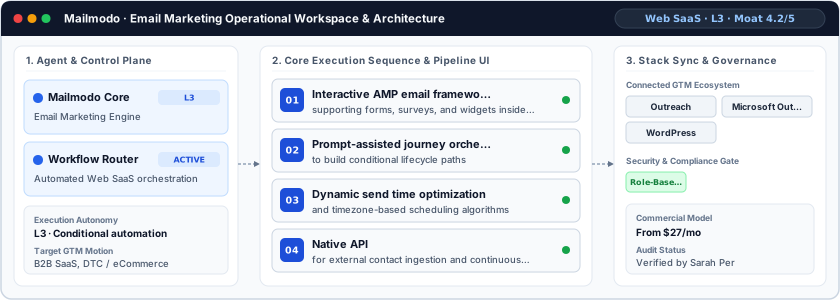
- Target ICP & Stack Fit: You operate as B2B SaaS and DTC / eCommerce requiring a Web SaaS deployment for Email Marketing, with verified ecosystem connectivity for Outreach, Microsoft Outlook, WordPress.
- L3 Architecture & Defensibility: Proprietary interactive AMP email components combined with an integrated visual journey builder and native prompt-driven workflow generation infrastructure.
- Commercial Model Fit: Your procurement budget aligns with From $27/mo.
Walk away from Mailmodo if (Deal-Breakers)
- Walk away if your workflow requires uncapped enterprise volume on the From $27/mo entry plan without upgrading tiers.
- Walk away if your workflow cannot tolerate email client protocol disparity: Interactive AMP components require dedicated fallback maintenance, as desktop Outlook and Apple Mail do not execute dynamic scripts or form submissions inside message bodies.
- Walk away if API rate caps is a deal-breaker for your team: Entry tiers impose strict throughput thresholds, limiting high-velocity webhook ingestion and dynamic recipient syncs to five requests per second.
Mailmodo key facts & scorecard
| Pricing | From $27/moVendor pricing page |
|---|---|
| Free plan | No / not disclosed |
| Delivery | Web SaaS |
| Audience | B2B SaaS, DTC / eCommerce |
| AI autonomy level | L3 · Conditional automationEditor-verified |
| Moat tier & score | 4.2 / 5.0 · Proprietary moatEditor-verified |
| Funding | Seed |
| Total funding | $2.3M |
| Founders | Apurv Gupta, Aquibur Rahman |
| Company size | 11-50 employees |
| Ecosystem integrations | Outreach, Microsoft Outlook, WordPress |
| Governance & docs | Trust & Security ↗ · API & Docs ↗ |
| Headquarters | San Francisco, California |
| Founded | 2020 |
| Last verified |
Mailmodo pros & cons: strengths vs. operational limitations
Pros: core strengths & capabilities
- Interactive AMP email framework: supporting forms, surveys, and widgets inside the recipient inbox
- Prompt-assisted journey orchestration engine: to build conditional lifecycle paths
- Dynamic send time optimization: and timezone-based scheduling algorithms
- Native API: for external contact ingestion and continuous campaign analytics extraction
Cons: operational limitations & risks
- Email Client Protocol Disparity: Interactive AMP components require dedicated fallback maintenance, as desktop Outlook and Apple Mail do not execute dynamic scripts or form submissions inside message bodies.
- API Rate Caps: Entry tiers impose strict throughput thresholds, limiting high-velocity webhook ingestion and dynamic recipient syncs to five requests per second.
- Data Pipeline Latency: Dynamic contact synchronization depends on scheduled batched polling rather than real-time continuous event streaming for non-native CRM integrations.
Mailmodo TCO & deal-breaker stress test
Simulate 12-month stepped TCO, hidden cost multipliers, contract lock-in exposure, and stack failure modes using only facts verified by Sarah Per on · Capture SHA 20529bd9.
Mailmodo aligns with your 5-seat / $800/mo profile. Review the walk-away triggers and contract levers below before deployment.
| Plan / Tier | Verified Rate | Scale Fit | Scope & Quota Notes |
|---|---|---|---|
| Lite | $27/mo | 1–2 seats | /month, billed annually |
| Custom | $79/mo | 5 seats | Chat & Email Support |
- Moat Score
- 4.2 / 5.0
- AI Autonomy
- L3
- Free Tier / Trial
- None disclosed
Triggered audit signals & failure modes
- Published Self-Serve Entry FloorVerified Pricing Ledger
Mailmodo publishes a transparent entry point (From $27/mo) for initial validation before committing.
- Tier Fit for 5-Seat Scale: Custom ($79/mo)Verified Tier Schedule
Chat & Email Support
- Primary Operational Bottleneck: Email Client Protocol DisparityAudit by Sarah Per
Interactive AMP components require dedicated fallback maintenance, as desktop Outlook and Apple Mail do not execute dynamic scripts or form submissions inside message bodies.
Hidden TCO Multipliers & Quota Gates
- Annual Billing Headline vs. Monthly Premium: Headline entry rates reflect annual billing commitments; month-to-month flexibility carries a higher effective monthly rate or requires annual prepayment.
- Credit & Usage Burn Multiplier: Automated workflows consume metered credits/usage quotas; multi-step enrichment, voice minutes, or high-frequency agent runs can trigger mid-cycle top-up packs.
When to Walk Away & Negotiation Levers
- Walk away if your workflow requires uncapped enterprise volume on the From $27/mo entry plan without upgrading tiers.
- Walk away if your workflow cannot tolerate email client protocol disparity: Interactive AMP components require dedicated fallback maintenance, as desktop Outlook and Apple Mail do not execute dynamic scripts or form submissions inside message bodies.
- Walk away if API rate caps is a deal-breaker for your team: Entry tiers impose strict throughput thresholds, limiting high-velocity webhook ingestion and dynamic recipient syncs to five requests per second.
- Validate exact quota thresholds (seats, credits, or API calls) included in Mailmodo's From $27/mo tier before converting from monthly to annual billing.
- Require a sandbox proof-of-concept testing email client protocol disparity against your live CRM/data schema before annual sign-off.
Ask a custom procurement or TCO stress-test question about Mailmodo
Lower 5-seat floor (~$15/mo vs. $79 / mo)
Offers a free tier (Free plan · $0/mo · Enterprise plan)
Mailmodo key entities, modules & ecosystem stack
Mailmodo moat & subtrack positioning
Proprietary interactive AMP email components combined with an integrated visual journey builder and native prompt-driven workflow generation infrastructure.
Editorial review
Fact-checked by Sarah Per (Principal Content Systems & Generative Media Editor) on .
Background
Within modern marketing stacks, Mailmodo addresses conversion friction caused by external redirection by delivering interactive AMP experiences directly inside email clients. Headquartered in San Francisco, California and founded in 2020, the company secured $2.3M in venture funding to streamline outbound communications. Designed primarily for lifecycle marketing managers and growth engineers, the system provides automated workflow infrastructure to turn static customer outreach into functional, application-like transactional touchpoints.
How Mailmodo works
Mailmodo combines an interactive AMP email compilation pipeline with an automated customer journey engine. The platform ingests behavioral events via REST APIs and webhooks, evaluating them against audience definitions to trigger conditional branching. An integrated prompt interface converts natural language directives into responsive email components, structural layouts, and branching paths. System dispatchers calculate send time optimization across recipient timezones, automatically serving static HTML fallbacks to clients lacking interactive MIME-type rendering support.
Limitations
Operational considerations and platform boundaries include:
- Email Client Protocol Disparity: Interactive AMP components require dedicated fallback maintenance, as desktop Outlook and Apple Mail do not execute dynamic scripts or form submissions inside message bodies.
- API Rate Caps: Entry tiers impose strict throughput thresholds, limiting high-velocity webhook ingestion and dynamic recipient syncs to five requests per second.
- Data Pipeline Latency: Dynamic contact synchronization depends on scheduled batched polling rather than real-time continuous event streaming for non-native CRM integrations.
Mailmodo pricing
Mailmodo uses a subscription model based on contact volume and outbound sending limits. The entry-level Lite tier starts at $27 per month billed annually, which provides 2,000 monthly sending credits, basic integrations, and execution of a single active journey for up to 500 contacts. Organizations scaling their infrastructure can move to the Pro tier at $79 per month, which unlocks expanded API limits, team collaboration seats, and advanced campaign scheduling tools.
How Mailmodo compares
While adjacent MarTech platforms like AB Tasty emphasize client-side web experimentation, 10Web AI automates WordPress infrastructure, and Ability.ai tackles autonomous marketing agents, Mailmodo focuses specifically on interactive email orchestration. It excels for mid-market product and retention teams seeking to lower churn through in-email actions. However, enterprises requiring deep omnichannel cross-messaging over mobile push and paid media will encounter functional boundaries compared to complex enterprise marketing hubs.
Direct competitors & market radar
Top algorithmic competitors based on category positioning, capability overlap, and ICP alignment.
Frequently asked questions about Mailmodo
How much does Mailmodo cost and what pricing tiers are available?
Published pricing summary for Mailmodo: From $27/mo. A permanent free plan is not disclosed for Mailmodo. Verified tier schedule: Lite ($27/mo for 1–2 seats); Custom ($79/mo for 5 seats). Mailmodo uses a subscription model based on contact volume and outbound sending limits. The entry-level Lite tier starts at $27 per month billed annually, which provides 2,000 monthly sending credits, basic integrations, and execution of a single active journey for up to 500 contacts.
How does Mailmodo work and how autonomous is its AI architecture?
Interactive AMP and HTML email automation engine that streamlines campaign creation, dynamic customer journeys, and in-email conversion forms. Within Email Marketing (AI Email Marketing & Lifecycle Journeys), MarTechRadar rates its execution architecture at L3 · Conditional automation with a verified Moat Score of 4.2 / 5.0 (Proprietary moat). Proprietary interactive AMP email components combined with an integrated visual journey builder and native prompt-driven workflow generation infrastructure. Corporate profile: Founded by Apurv Gupta, Aquibur Rahman, operating at 11-50 employees scale.
What are the main limitations of Mailmodo and when should buyers walk away?
Based on our editorial technical audit, key operational considerations and boundaries for Mailmodo include: (1) Email Client Protocol Disparity: Interactive AMP components require dedicated fallback maintenance, as desktop Outlook and Apple Mail do not execute dynamic scripts or form submissions inside message bodies. (2) API Rate Caps: Entry tiers impose strict throughput thresholds, limiting high-velocity webhook ingestion and dynamic recipient syncs to five requests per second. (3) Data Pipeline Latency: Dynamic contact synchronization depends on scheduled batched polling rather than real-time continuous event streaming for non-native CRM integrations. Primary procurement walk-away rule: Walk away if your workflow requires uncapped enterprise volume on the From $27/mo entry plan without upgrading tiers.
What integrations, compliance certifications, and contract terms apply to Mailmodo?
Verified ecosystem and stack integrations include Outreach, Microsoft Outlook, WordPress. First-party governance and developer endpoints verified on domain include: Trust/Security (https://www.mailmodo.com/security), API Docs (https://www.mailmodo.com/developers/8e957152b6128-getting-started-with-mailmodo-api). Key TCO multiplier to watch: Annual Billing Headline vs. Monthly Premium (Headline entry rates reflect annual billing commitments; month-to-month flexibility carries a higher effective monthly rate or requires annual prepayment.) Before signing a contract, procurement teams should validate exact quota thresholds (seats, credits, or API calls) included in Mailmodo's From $27/mo tier before converting from monthly to annual billing.
What are the best Mailmodo alternatives and head-to-head competitors in 2026?
Top fact-checked alternatives to Mailmodo in Email Marketing (AI Email Marketing & Lifecycle Journeys) include Front (From $0.05/mo), Help Scout (Free plan · $0/mo · Enterprise plan), Netic (Custom / enterprise pricing), Privy (Free plan · $0/mo · Enterprise plan). While adjacent MarTech platforms like AB Tasty emphasize client-side web experimentation, 10Web AI automates WordPress infrastructure, and Ability.ai tackles autonomous marketing agents, Mailmodo focuses specifically on interactive email orchestration.
Verified sources & evidence trail
- Official product domain: https://www.mailmodo.com
- Commercial pricing verification: https://www.mailmodo.com/pricing/
- Verified corporate entity profiles (
sameAs): LinkedIn Company Profile · Crunchbase Entity Record - First-party governance & documentation links: Trust & Security · API & Docs
- Editorial audit sign-off: Fact-checked by Sarah Per on under the MarTechRadar Evidence-Ledger Protocol.