rift Review (2026): Email Marketing Pricing, Limits & Alternatives
Bottom line
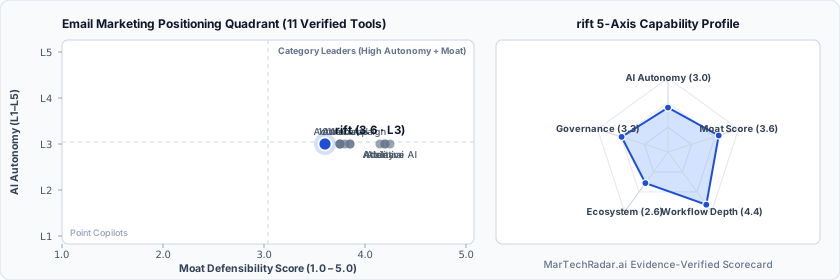
rift is a Web SaaS tool for Email Marketing (AI Email Marketing & Lifecycle Journeys) in Lifecycle & CDP. Pricing: Custom / enterprise pricing. Best suited to CRM & Lifecycle Marketers, eCommerce Growth Teams and Customer Experience Directors. Editor ratings: AI autonomy L3 (conditional automation); moat score 3.6/5.0 (Proprietary moat). Fact-checked by Sarah Per on Oct 15, 2026.
Autonomous lifecycle email marketing platform that orchestrates predictive send times, algorithmic copy variations, and dynamic customer journeys.
rift buyer fit verdict: when to choose vs. when to walk away
Choose rift if (Best Fit)
- Target ICP & Stack Fit: You operate as CRM & Lifecycle Marketers, eCommerce Growth Teams and Customer Experience Directors requiring a Web SaaS deployment for Email Marketing.
- L3 Architecture & Defensibility: Defensibility centers on real-time event ingestion linked to closed-loop attribution models that autonomously optimize multi-step retention sequences.
- Commercial Model Fit: Your procurement budget aligns with Custom / enterprise pricing.
Walk away from rift if (Deal-Breakers)
- Walk away if you require transparent self-serve monthly billing or your budget ceiling is under $1,000/mo (rift requires sales-gated custom quoting).
- Walk away if your workflow cannot tolerate attribution window latency: Multi-touch attribution models experience reporting lag when synchronizing offline or multi-channel conversion data back to specific email triggers, occasionally misallocating variant lift.
- Walk away if schema maintenance overhead is a deal-breaker for your team: Upstream data modifications within the host data warehouse or CRM require manual schema adjustments, risking pipeline breaks during autonomous journey branch calculations.
rift key facts & scorecard
| Pricing | Custom / enterprise pricing |
|---|---|
| Free plan | No / not disclosed |
| Delivery | Web SaaS |
| Audience | CRM & Lifecycle Marketers, eCommerce Growth Teams, Customer Experience Directors |
| AI autonomy level | L3 · Conditional automationEditor-verified |
| Moat tier & score | 3.6 / 5.0 · Proprietary moatEditor-verified |
| Funding | Seed |
| Headquarters | United States |
| Last verified |
rift pros & cons: strengths vs. operational limitations
Pros: core strengths & capabilities
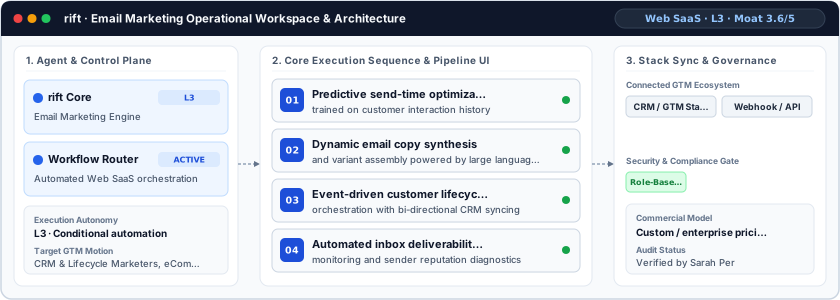
- Predictive send-time optimization engine: trained on customer interaction history
- Dynamic email copy synthesis: and variant assembly powered by large language models
- Event-driven customer lifecycle journey: orchestration with bi-directional CRM syncing
- Automated inbox deliverability health: monitoring and sender reputation diagnostics
Cons: operational limitations & risks
- Attribution Window Latency: Multi-touch attribution models experience reporting lag when synchronizing offline or multi-channel conversion data back to specific email triggers, occasionally misallocating variant lift.
- Schema Maintenance Overhead: Upstream data modifications within the host data warehouse or CRM require manual schema adjustments, risking pipeline breaks during autonomous journey branch calculations.
- Deliverability Ramp Delays: Aggressive autonomous sequence scaling can outpace dedicated IP warm-up protocols, demanding technical oversight to prevent reputation degradation across major mailbox providers.
rift TCO & deal-breaker stress test
Simulate 12-month stepped TCO, hidden cost multipliers, contract lock-in exposure, and stack failure modes using only facts verified by Sarah Per on .
rift triggers high-severity friction under your 5-seat / $800/mo constraints. Benchmark the verified subtrack alternatives below before committing.
| Plan / Tier | Verified Rate | Scale Fit | Scope & Quota Notes |
|---|---|---|---|
| Enterprise / Custom | Custom quote | 15–50+ seats (Enterprise SLA) | Sales-negotiated annual contract for custom volume, SSO/RBAC governance, and dedicated SLA. |
- Moat Score
- 3.6 / 5.0
- AI Autonomy
- L3
- Free Tier / Trial
- None disclosed
Triggered audit signals & failure modes
- Opaque Enterprise Quoting vs. SMB/Mid-Market BudgetVerified Pricing Ledger
rift does not disclose a public self-serve floor (Custom / enterprise pricing). Buyers with a $800/mo cap face high sales-qualification friction.
- Sales-Gated Contract TermsFact-checked by Sarah Per
Commercial access to rift follows an enterprise direct sales motion without publicly listed standard rates. Commercial pricing is available on request through tailored enterprise sales quotes based on organizational scale and seats.
- Primary Operational Bottleneck: Attribution Window LatencyAudit by Sarah Per
Multi-touch attribution models experience reporting lag when synchronizing offline or multi-channel conversion data back to specific email triggers, occasionally misallocating variant lift.
Hidden TCO Multipliers & Quota Gates
- Attribution Window Latency: Multi-touch attribution models experience reporting lag when synchronizing offline or multi-channel conversion data back to specific email triggers, occasionally misallocating variant lift.
- Schema Maintenance Overhead: Upstream data modifications within the host data warehouse or CRM require manual schema adjustments, risking pipeline breaks during autonomous journey branch calculations.
When to Walk Away & Negotiation Levers
- Walk away if you require transparent self-serve monthly billing or your budget ceiling is under $1,000/mo (rift requires sales-gated custom quoting).
- Walk away if your workflow cannot tolerate attribution window latency: Multi-touch attribution models experience reporting lag when synchronizing offline or multi-channel conversion data back to specific email triggers, occasionally misallocating variant lift.
- Walk away if schema maintenance overhead is a deal-breaker for your team: Upstream data modifications within the host data warehouse or CRM require manual schema adjustments, risking pipeline breaks during autonomous journey branch calculations.
- Demand a 30- to 60-day paid pilot opt-out clause in the rift order form before signing a 12-month enterprise commitment.
- Require a sandbox proof-of-concept testing attribution window latency against your live CRM/data schema before annual sign-off.
Ask a custom procurement or TCO stress-test question about rift
Lower 5-seat floor (~$38/mo vs. Custom Quote) · Transparent self-serve entry without mandatory annual lock-in
Lower 5-seat floor (~$39/mo vs. Custom Quote) · Transparent self-serve entry without mandatory annual lock-in
rift moat & subtrack positioning
Defensibility centers on real-time event ingestion linked to closed-loop attribution models that autonomously optimize multi-step retention sequences.
Editorial review
Fact-checked by Sarah Per (Principal Content Systems & Generative Media Editor) on .
Background
Headquartered in the United States, rift operates as an autonomous lifecycle email marketing engine built to eliminate manual campaign orchestration across digital retention funnels. Designed primarily for lifecycle marketing directors, CRM technical leads, and growth engineers, the system automates multi-stage subscriber journeys that previously required extensive manual workflow mapping. Within modern engagement stacks, rift functions as a specialized automation layer that converts raw behavioral events into adaptive message sequences.
How rift works
At its technical core, the platform operates as a Level 3 autonomous system driven by event-ingestion webhooks and bidirectional CRM synchronization. Inbound user telemetry passes into predictive timing models that calculate individual recipient engagement probabilities. Concurrently, natural language generation modules assemble context-aware email variants matched to subscriber cohort traits. Closed-loop telemetry continuously measures conversion signals, feeding back into algorithmic decision graphs that autonomously calibrate cadence, subject lines, and cohort transitions.
Limitations
Operational considerations and platform boundaries include:
- Attribution Window Latency: Multi-touch attribution models experience reporting lag when synchronizing offline or multi-channel conversion data back to specific email triggers, occasionally misallocating variant lift.
- Schema Maintenance Overhead: Upstream data modifications within the host data warehouse or CRM require manual schema adjustments, risking pipeline breaks during autonomous journey branch calculations.
- Deliverability Ramp Delays: Aggressive autonomous sequence scaling can outpace dedicated IP warm-up protocols, demanding technical oversight to prevent reputation degradation across major mailbox providers.
rift pricing
Commercial access to rift follows an enterprise direct sales motion without publicly listed standard rates. Commercial pricing is available on request through tailored enterprise sales quotes based on organizational scale and seats. Contracts typically incorporate variables such as active subscriber counts, monthly email volume throughput, dedicated infrastructure allocations, and professional services required for custom data pipeline integrations.
How rift compares
Compared to direct category competitors like Typeface and Writer, rift functions as an alternative focused on reliable workflow execution and transparent unit economics. Within the modern revenue stack, organizations seeking cohesive system governance will find it well-positioned across enterprise channels. It is best suited for enterprise marketing teams and growth practitioners seeking disciplined workflow orchestration.
Direct competitors & market radar
Top algorithmic competitors based on category positioning, capability overlap, and ICP alignment.
Frequently asked questions about rift
How much does rift cost and does it require a custom enterprise quote?
Published pricing summary for rift: Custom / enterprise pricing. A permanent free plan is not disclosed for rift. Commercial access to rift follows an enterprise direct sales motion without publicly listed standard rates. Commercial pricing is available on request through tailored enterprise sales quotes based on organizational scale and seats.
How does rift work and how autonomous is its AI architecture?
Autonomous lifecycle email marketing platform that orchestrates predictive send times, algorithmic copy variations, and dynamic customer journeys. Within Email Marketing (AI Email Marketing & Lifecycle Journeys), MarTechRadar rates its execution architecture at L3 · Conditional automation with a verified Moat Score of 3.6 / 5.0 (Proprietary moat). Defensibility centers on real-time event ingestion linked to closed-loop attribution models that autonomously optimize multi-step retention sequences.
What are the main limitations of rift and when should buyers walk away?
Based on our editorial technical audit, key operational considerations and boundaries for rift include: (1) Attribution Window Latency: Multi-touch attribution models experience reporting lag when synchronizing offline or multi-channel conversion data back to specific email triggers, occasionally misallocating variant lift. (2) Schema Maintenance Overhead: Upstream data modifications within the host data warehouse or CRM require manual schema adjustments, risking pipeline breaks during autonomous journey branch calculations. (3) Deliverability Ramp Delays: Aggressive autonomous sequence scaling can outpace dedicated IP warm-up protocols, demanding technical oversight to prevent reputation degradation across major mailbox providers. Primary procurement walk-away rule: Walk away if you require transparent self-serve monthly billing or your budget ceiling is under $1,000/mo (rift requires sales-gated custom quoting).
What integrations, compliance certifications, and contract terms apply to rift?
Key TCO multiplier to watch: Attribution Window Latency (Multi-touch attribution models experience reporting lag when synchronizing offline or multi-channel conversion data back to specific email triggers, occasionally misallocating variant lift.) Before signing a contract, procurement teams should demand a 30- to 60-day paid pilot opt-out clause in the rift order form before signing a 12-month enterprise commitment.
What are the best rift alternatives and head-to-head competitors in 2026?
Top fact-checked alternatives to rift in Email Marketing (AI Email Marketing & Lifecycle Journeys) include Instantly.ai ($37.60–$358/mo · Enterprise plan), Smartlead.ai ($39–$379/mo), Eikona (Custom / enterprise pricing), Laizy (Custom / enterprise pricing). Compared to direct category competitors like Typeface and Writer, rift functions as an alternative focused on reliable workflow execution and transparent unit economics. Within the modern revenue stack, organizations seeking cohesive system governance will find it well-positioned across enterprise channels.
Verified sources & evidence trail
- Official product domain: https://www.getrift.com
- Commercial pricing verification: Verified against official vendor pricing policy (Custom / enterprise pricing)
- Editorial audit sign-off: Fact-checked by Sarah Per on under the MarTechRadar Evidence-Ledger Protocol.